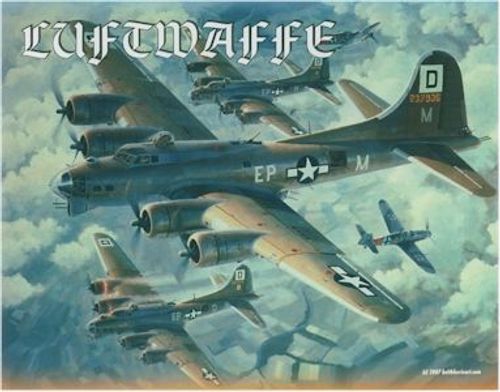
Luftwaffe: Aerial Combat – Germany 1943-45
Luftwaffe: Aerial Combat – Germany 1943-45 Rulebook
Table of Contents
Table of Contents
- 1.0 INTRODUCTION
- 2.0 COMPONENTS
- 3.0 PREPARE FOR PLAY (BASIC GAME)
- 4.0 HOW TO WIN (BASIC GAME)
- 5.0 SEQUENCE OF PLAY
- 6.0 AIRFIELDS & BASING
- 7.0 HOW TO MOVE
- 8.0 TIME RECORD & AIRCRAFT ENDURANCE
- 9.0 STACKING & MISSION GROUPS
- 10.0 BOMBING MISSIONS
- 11.0 SNEAK RAIDS
- 12.0 FIGHTER MISSIONS
- 13.0 AERIAL COMBAT
- 14.0 STRAFING AIRBASES
- 15.0 ANTI-AIRCRAFT (AA) FIRE
- 16.0 FORMATION MARKERS
- 17.0 BASIC GAME VICTORY CONDITION (VARIANT)
- 18.0 PREPARE FOR PLAY (TOURNAMENT GAME)
- 19.0 TOURNAMENT GAME VICTORY CONDITIONS
- 20.0 RECOVERY LINES (R LINES)
- 21.0 REINFORCEMENTS & WITHDRAWALS
- 22.0 REPLACEMENTS
- 23.0 SHUTTLE RAIDS
- 24.0 JET & ROCKET FIGHTERS
- 25.0 PREPARE FOR PLAY (ADVANCED GAME)
- 26.0 ADVANCED GAME VICTORY CONDITIONS
- 27.0 REINFORCEMENTS
- 28.0 REPLACEMENTS (ADVANCED GAME)
- 29.0 INTENSIVE OPERATIONS
- 30.0 GERMAN OIL & FUEL EXPENDITURES
- 31.0 GERMAN STACKING
- 32.0 PLOESTI
- 33.0 ROYAL AIR FORCE (RAF)
- 34.0 MOVEMENT
- 35.0 FIGHTER SHUTTLES
- 36.0 REPAIR OF BOMBED TARGETS
- 37.0 CRITICAL INDUSTRIES
- 38.0 POWER GENERATION & TRANSPORTATION
- 39.0 ALTERNATIVE AIRCRAFT REINFORCEMENTS
- OPTIONAL RULES
- 40.0 INDIVIDUAL UNIT ENDURANCE
- 41.0 COMBINED ATTACKS
- 42.0 ATTACKING BOMBERS
- 43.0 BOMBER STACKING
- 44.0 ENGAGING & FUEL EXPENDITURE
- 45.0 GOERING
- 46.0 ME-109 VARIANTS
- 47.0 ADVANCED BOMBERS
- 48.0 STAGING
- 49.0 GERMAN AA REINFORCEMENTS
- 50.0 PERIPHERAL OPERATIONS
- 51.0 KEY INDUSTRIAL COMPLEXES
- 52.0 EXTENDED WAR
- 53.0 PLAY BALANCE
- 54.0 SOLO GAMES
- 55.0 SHORT GAME: OPERATION GOTTERDAMMERUNG
1.0 INTRODUCTION
Luftwaffe is a wargame of the American strategic bombing campaign against the Third Reich in 1943-45. The game has two players: the American (who controls all United States Army Air Force and Allied air operations) and the German (who controls the Luftwaffe).
The game map shows targets in the Third Reich that were bombed historically, or could have been bombed had the US implemented alternative air strategies. The American objective is to destroy sufficient German targets to cause the economic collapse of the Third Reich. The German objective is to prevent this from happening.
Luftwaffe is played in a series of "quarters," each representing three months of real aerial warfare. Quarters are broken down into turns, each representing 20 minutes. Units represent Geschwader (wings) for the Luftwaffe, and groupings of three USAAF air groups for American forces or, in some cases, wings.
Both players have the historic forces involved in the air war over Europe in 1943-45. Additionally, they have the option to produce and deploy various "what if" aircraft, including jets.
Luftwaffe includes several different levels of 'games' within it, each in increasing levels of complexity. There is the "Basic Game," covering the situation at the time of D-Day in 1944. Then there is the "Tournament Game," which covers the entire 1943-45 air war. That's followed by the "Advanced Game," which adds options for targeting and aircraft reinforcement. Finally, there is "Operation Gotterdammerung," covering the final phase of the air war. Unless otherwise stated, all Basic Game rules apply to the Tournament and Advanced Games, and all Tournament Game rules apply to the Advanced Game.
This edition of Luftwaffe is based on the original game produced by the Avalon Hill Game Company decades ago. It contains additional optional rules, as well as modifications to some of the original game systems, to provide a more realistic and more challenging simulation of aerial warfare. It also employs a victory point system for determining who wins instead of the "all or nothing" victory conditions of the original design.
2.0 COMPONENTS
2.1 Rules
The rules are written using a case numbering system. Each major rules section is indicated by the number before the decimal point, and subsections of each rule are indicated by numbers or letters after the decimal. Rules will sometimes refer to other rules, in which case the specific rules section is indicated within brackets. For example, [2.2] would indicate section [2.2] Game Map.
2.11 Important Definition. Throughout the rules, the word "force" is used as follows: a single unit, or stack of units, which are conducting some action together, such as movement or combat.
2.2 Game Map
The map shows the Third Reich as it appeared in mid-World War II. The geographic boundaries represent those imposed on Europe by the Nazis.
2.21 A hexagonal grid has been overlaid on the map. The individual hexagons (or "hexes") are used to regulate the placement and movement of units, as well as to organize the different target types found in various hexes. A playing piece is always placed inside a hex, never along a hexside.
2.22 Targets. Numerous hexes on the map have targets or other information inside them. Those data may include the name of a city located in the hex, as well as symbols indicating targets in the hex. The following are the target types.
- Aircraft Factories represent centers for the manufacture of aircraft or aircraft components.
- Industrial Complexes represent centers of manufacturing and war industry.
- Oil represents petroleum production, crude or artificial.
- Power Generation represents primary electrical power centers.
- Transportation represents critical transportation nodes. They're represented by rail lines running between named cities. The rail lines between the cities aren't targets; only the connected cities are. They're sometimes referred to as "rail centers."
- V-Weapons represent launch sites for V-1 and V-2 missiles or their research facilities.
Airfields on the map are all German. Allied airbases aren't shown. Allied units base off-map in Britain, Italy and the USSR. Airfields may be targets.
2.23 Ploesti. The Romanian petroleum complex at Ploesti is depicted as an inset box. In the Tournament and Advanced Games, the Americans may attack Ploesti.
2.24 "R" Lines, or Recovery Lines, are the orange lines on the map. They mark the boundaries of Allied air cover in 1943, 1944 and 1945. They're the points from which American air missions enter play or return to their home bases. The year on each line indicates which game years that line is in effect. Britain is off the northwest R Line in 1943-45. In 1945 it is also off the west R Line, which comes into play only in 1945. Italy is off of the south R Line in 1944-45. The USSR is off the east map edge.
2.25 Numbered Squares in the Baltic Sea, off northern Germany, are used as starting locations for "Sneak Raiders." Numbered squares along the east edge of the map are used for "Shuttle Raids" to the USSR, which are used in the Tournament and Advanced Games.
2.26 National Borders. The national borders shown on the map have no effect on play except for Switzerland (unplayable).
2.3 Playing Pieces
There are two general types of playing pieces: 1) units, which represent the various air forces engaged in the campaign and have aircraft icons on them; and 2) markers, which are used to record various game functions.
2.31 Units. German counters are green. American counters are blue. Each unit has the following items of information on them.
- Aircraft Type: this is used to determine on which column the unit will fire when using the Combat Results Table, and for determining time in the air.
- "E" Rating (or Evaluation Rating): this is the large number in the upper left corner of each fighter unit. It indicates the relative efficiency of fighter aircraft in engaging enemy fighters. Bombers have a bomb rating (the asterisk is there to remind players).
- Speed (or "movement factor"): this is the large number in the lower left corner of fighter units. It indicates the maximum number of hexes the unit may move in a single game turn.
- Identification: this is the small number. For German units it identifies the Geschwader (wing). For American units it represents one of the three groups that composed the unit or, in some cases, it may also represent a wing.
- Bomb Points: this is the number with the asterisk in the upper left. It indicates how many targets within a single hex the bomber can attack at one time. Bomb ratings are not used in engaging fighters. Fighters have no bomb points.
- Rocket Fighter Symbol and Jet Fighter Symbol: the source prints these two icons here; the glyphs did not survive text extraction, so they are not reproduced.
Fighters & Bombers: there are two general types of aircraft in the game, fighters and bombers. Fighters have an E Rating (or a "G" in the case of Me-163s). Bombers have Bomb Points. Only the American player has bombers for purposes of the game. While several Luftwaffe unit types, such as the Ju-88, had a dual role as bombers, for purposes of the game all Luftwaffe aircraft types are fighters.
P-38D: The P-38 "Droop-Snoots" were P-38s converted into light bombers. For all game purposes they're treated as bombers. They may never fire, offensively or defensively.
2.32 Veteran/Fatigued. Each unit is back-printed. The front side is its "veteran" side; the reverse side is its "fatigued" side. Units can alternate between veteran and fatigued as a result of combat or other game actions. In general, veteran units are treated exactly as fatigued units, but with the following exception. In combat, a veteran unit counts as two combat factors, while a fatigued unit counts as one combat factor.
2.33 Abbreviation. Kdo Bonow: Kommando Bonow (ad hoc formation of Ar-234s).
2.34 Markers.
- Endurance. Each player has a set of endurance markers corresponding to each type of aircraft he possesses. They're used to record the number of turns that aircraft has remaining in the air. The number before the slash indicates the number of turns in the air without auxiliary fuel tanks. The number after the slash indicates the number of turns in the air after auxiliary fuel tanks have been dropped. "Aircraft Time" pieces indicate the length of time a given type of aircraft can stay in the air. For example, P-47s can stay in the air for 10 turns with auxiliary fuel tanks, and three without auxiliary fuel tanks. Not all types of aircraft have auxiliary fuel tanks. Also, some bombers don't have corresponding endurance markers, since they can remain in the air throughout an entire quarter (for example: B-17s).
- Formation Markers. Both players use them to conceal the strengths of their air formations.
- Intensive Operations. Each player uses them to indicate whether he will be conducting intensive operations that turn.
- Quarter Marker. This indicates which three-month period is in progress. For example: "Jan '44" means the quarter of January through March 1944 is in progress.
- RAF Bomber Commands 1 & 2. The American player uses these to make area attacks on enemy cities.
- Sneak Raiders. The American player uses these to indicate forces making sneak raids. Two kinds of pieces are used in conjunction with sneak raids. This piece indicates the number of bomber counters participating in a sneak raid. The number of such bomber counters may never exceed five. The other piece indicates the turn during which sneak raid counters are placed on the numbered Baltic Sea squares. Sneak raiders may appear from turn number three through turn number 10, inclusive.
- Time Now. Each player uses this to indicate the current turn in a quarter. Numbers from "1" to "20" are printed on the "Order of Battle" cards. There are 20 turns in a quarter.
2.4 Combat Results Table
The Combat Results Table (CRT) is used to resolve attacks by aircraft against other aircraft.
2.5 Reinforcement Chart
Each player has a reinforcement chart that shows which units will appear during which quarters. The reinforcement charts also indicate which turn is in progress.
2.6 Planning Pads
The sheets with the miniature version of the map are planning pads. Players use them to plot raids and other actions, as well as to record destroyed targets.
2.7 Dice
One six-sided die is included with the game. It's used to generate random results on the Combat Results Table and for other game actions.
3.0 PREPARE FOR PLAY (BASIC GAME)
3.1 The Basic Game represents the situation on D-Day, 6 June 1944. It consists of only one quarter with 20 turns.
3.11 Basic Game rules include sections 3.0 to 22.0. Use only those rules when playing the Basic Game.
3.2 Players determine who will command the Americans and who will command the Germans.
3.3 Each player punches out the units required for the scenario.
3.31 German Order of Battle
- 5 x FW-190; 2 x Me-410
- 8 x Me-109; 1 x Ju-88
- 6 x Me-110
3.32 American Order of Battle
- 9 x B-17; 3 x P-47; 3 x P-38
- 12 x B-24; 6 x P-51
3.33 Players can use any units of the indicated types; the historic unit identification number doesn't make a difference; those numbers are there only for historical interest.
3.4 The German player places his aircraft counters on any hexes on the map containing airbases. No more than one counter may be placed on each airbase at the start of play.
3.5 The American player determines his sneak raid strategy. He picks two sneak raid pieces—one indicates the number of raiding counters; the other indicates the turn of the raid—and places them face down in the designated place in the Baltic Sea. The actual counters that will participate in the sneak raid are temporarily kept off the map and out of sight. If no sneak raid is planned, invert blank counters.
3.6 The American player plans his bombing missions on a planning sheet. He doesn't show that plan to the German player until the end of the game. He will show the sheet to the German player at the end of the game to confirm the various bomber units sent out actually went to the targets they were to have bombed.
3.7 The American player selects which units, if any, he will move on turn one and places them in any hexes on his side of the R Lines, within the constraints of the Mission Group rule (see section 9.0). American units may begin in Britain or Italy or any combination of the two, but not in the USSR.
3.8 American units that won't cross the R Line during turn one are kept off map. They may not be examined by the German player. Up to 10 unused counters may be used in dummy stacks to keep the German player from anticipating how much force has actually been committed to each front. The American player can use the "Formation" markers for that purpose.
3.9 For the Basic Game, use the 1944 R Line.
4.0 HOW TO WIN (BASIC GAME)
4.1 The German player wins if the American player bombs eight or fewer cities that have aircraft factories by the end of play.
4.2 If the American player bombs nine, 10 or 11 cities that have aircraft factories, the game is a draw.
4.3 The American player wins if he bombs 12 or more cities that have aircraft factories by the time the game is over.
4.4 There is a penalty for losing planes due to fuel shortages. For each American unit that fails to re-cross the R Line due to fuel shortage, the German player "saves" one bombed city at the end of the game. For each German unit that fails to land before its fuel runs out, the American player "bombs" one target for free at the end of the game. For example, if the American player bombed 12 cities, but two US fighter units ran out of fuel before the turn 20 deadline, the American player could count only 10 cities as actually having been bombed.
5.0 SEQUENCE OF PLAY
5.1 Luftwaffe 2 is played in a series of "Quarters," each of which represent three months. Each quarter is further broken down into "phases." Players must follow the phased sequence of play for each quarter until the game comes to an end. The term "turn" refers to the operational phase of an individual player turn during which that player is moving his units and initiating combat.
5.11 Basic Game: in the Basic Game only one quarter is played.
5.2 All actions must take place within this strict sequence. For example, since the German player takes his aircraft replacements prior to his Repair Phase, he may not use repaired aircraft factories to generate replacements in the same turn, though they would do so in the following turns (assuming they weren't bombed again).
5.21 Those parts of the sequence of play that apply only to the Basic Game are indicated below. Others may be skipped when playing the Tournament and Advanced Games.
5.3 Sequence of Play Outline
-
Reinforcement Phase (Tournament & Advanced Games): Each player takes any reinforcements for the quarter and simultaneously places them as follows.
- 1a) American places reinforcements in Britain and/or Italy.
- 1b) German places reinforcements on any airbases on his side of the R Line.
-
Redeployment Phase (Tournament & Advanced Games)
- 2a) The German player must move his aircraft in such a way he has no more than one unit per base. He may also redeploy jet and rocket fighters that aren't on jet/rocket bases to jet/rocket bases.
- 2b) If it's 1944 or 1945, the American player may move any and all of his air units from Britain to Italy and vice versa.
-
Planning Phase
- 3a) American Target Planning (Basic, Tournament & Advanced Games): the American player uses his target pad to designate his mission groups, to indicate which bombers will be attacking which targets, and any sneak and shuttle raids if playing the Tournament or Advanced Games.
- 3b) Intensive Operations Determination Phase (Advanced Game): both players, simultaneously and without informing the other, determine whether this will be a turn of intensive operations for his forces.
-
Economic Phase (Advanced Game)
- 4a) Industrial Support: the German player determines which industries, if any, will support other industries. See section 36.0.
- 4b) Oil: the German player determines how many fuel (oil) points he will have available for the turn. He may then expend them to provide fuel to fly aircraft units. The German player also decides if he wants to expend oil in order to increase his unit-per-hex stacking limit.
6.0 AIRFIELDS & BASING
6.1 Aircraft are always in one of two states: either "flying" or "based." An air unit is flying if it's in the air and expending endurance. An air unit is based if it's on the ground.
6.2 German Basing
German air units are based if they're located on an airfield hex and not flying. That can be noted by placing a blank marker on top of based units.
6.21 The German player may base an unlimited number of air units on each base. But see rule 6.22 for restrictions on taking off and landing.
6.22 Restrictions. A maximum of one German air unit may take off or land from any single airbase during any single turn. For example, it is Turn 3 of the January 1944 quarter, the German player could land a maximum of one air unit on the Berlin airfield, or have one unit take off from it, in that turn. Remember, a turn is one of the 20 periods into which each quarter is divided; so you could have a grand total of 20 different units either take off or land on each single airfield in the course of a turn.
6.3 American Basing
American air units base in the Britain, Italy and—if using the shuttle rule—USSR off-map areas. That's indicated by placing based units in the appropriate areas. There's no limit to the number of American air units that may base in an off-map area. An unlimited number of American air units may take off or land in any off-map area on any turn.
6.31 An American unit may land during any American turn as follows.
- All games: it's on the friendly side of the R Line for Britain or Italy and the American player declares the unit has landed. In that case, the unit doesn't have to move off the map; it simply has to be on the American side of the R Line.
- Tournament & Advanced Games: it exits the east map edge into the USSR and has sufficient turns of fuel remaining to land (see rules 23.0 & 35.0). Note that to land in the USSR, a unit must exit the map and not simply cross the eastern R Line.
6.32 When an American air unit is based or lands, place it in the appropriate off-map box. It isn't kept on the hexagonal portion of the map. Once on the hexagonal portion of the map, American air units are always considered to be flying. American units may never base on German airfields.
6.4 Basing & Combat
Based German units may not attack or be attacked via air-to-air combat. They may be attacked if their airbase is bombed (see 10.5) or strafed (see 14.0). Based American aircraft may not be attacked by the Germans, since the Germans may not enter off-map areas.
7.0 HOW TO MOVE
7.1 During his turn, a player may move some, none, or all of his air units within the constraints of endurance (rule 8.0), airbase take-off limits (rule 6.2), and fuel (optional rule 28.0). You may move your side's units only during your own turns. You may never move in the enemy player's turn. The die has no effect on movement; it's used only to resolve combat.
7.2 Each unit may move a number of hexes up to its printed movement factor. Each hex always costs one movement factor to enter, regardless of any terrain in it.
7.3 Unused movement factors may not be transferred from one unit to another, nor may they be accumulated from one turn to the next.
7.4 Bombers must always move to their assigned targets by the most direct course. They must travel their full movement factor each turn until they arrive at their target. For example: a B-17 would generally always have to move three hexes per turn (exception: see 7.41). Remember, only the US player has bombers.
7.41 When a bomber unit reaches its target hex it may cease movement even if it has unexpended movement points. That is, the turn they bomb a target hex, bombers are exempted from the requirement they have to move a maximum number of hexes. For example: a B-17 assigned to bomb Berlin starts its turn adjacent to the Berlin city hex. The American player moves it one hex into Berlin and then stops. At the end of the turn it bombs Berlin. It could not move farther that turn, since bombing takes place after all movement has been completed.
7.42 After bombing their assigned targets, bombers must return to cross the R Line from which they started. They don't have to re-cross by the same hex from which they entered the map, just the same R Line. For example: bombers that started in Britain must return to Britain. (The Tournament Game Recovery Line and Shuttle Bombing rules may be used to change this requirement.)
7.43 Returning bombers must travel at their full movement factor each turn.
7.44 See also the Mission Groups and Bomber Missions rules, sections 9.0 & 10.0.
7.5 Fighters may move less than their full movement factor each turn. Fighters may move in any direction or combination of directions each turn. For example, the movement factor of the Fw-190 is 7. An Fw-190 unit could therefore move anywhere from zero to seven hexes in any one turn.
7.6 Combat is executed during movement. See section 13.0.
7.7 Restrictions
7.71 Neither player may ever move units into or through Switzerland.
7.72 German units may never cross the R Lines to the Allied side of the map, nor may German units ever exit the map.
8.0 TIME RECORD & AIRCRAFT ENDURANCE
8.1 Players keep track of turns using the track on the Order of Battle cards where turn numbers from "1" through "20" are printed.
8.11 The Basic Game lasts one quarter (20 turns). It may end sooner if all American bombers have re-crossed an R Line.
8.12 A player moves his "Time Now" piece to cover the number of the turn currently in play. Players should keep each other informed about which turn of the game is being played.
8.2 Endurance
8.21 Each player has a set of endurance markers that give the time remaining in the air for each of their aircraft types. When one aircraft of a type takes off, all of that type are considered launched, and all expend fuel simultaneously. A player may have different types of aircraft flying in a particular turn, and each type is recorded separately. Air units are considered to be launched and therefore expending fuel even if they're sitting on airbases (German) or have yet to deploy onto the map (American).
8.22 The aircraft-type endurance marker is placed on the turn number on the turn record track in the numbered box equal to the number of the current turn plus the number on the endurance marker. If there are two numbers on the marker, use the number to the left of the slash. For example: an American P-47 enters play on Turn 2. A P-47's maximum endurance is 10. The American player places the P-47 endurance marker in the Turn 12 box to indicate the maximum number of turns it may remain in the air. All P-47s that enter play, even on later turns, would have to re-cross the R Line by the end of Turn 12 or they're lost owing to running out of fuel. Note that also means no P-47 could enter play on Turns 13 or later, since by that time all P-47s must land. This rule is intended to maximize simplicity. See the optional rules for a more realistic way to record fuel.
8.23 When the "Time Now" piece moves into a turn number box covered by an aircraft time piece, all planes of that type must land. If they're German, they must land on an airbase that hasn't been bombed. If they're American, they must re-cross the R Line. Units that don't land or re-cross the R Line when required to do so are eliminated.
8.24 A player doesn't have to launch his aircraft on any particular turn. Regardless of all other considerations, though, all aircraft must land by the end of the 20th turn or they're considered lost due to lack of fuel. For example, P-47s could be launched on Turn 18, but if they didn't re-cross the R Line by the end of Turn 20 they'd be lost.
8.25 Players may keep their aircraft endurance markers hidden from each other, though players may also, through some elementary "intelligence" work, figure out enemy aircraft endurance times.
8.26 No unit may initiate combat on the turn it has to land. That includes fighters attacking enemy aircraft, and bombers bombing targets on the ground. A unit may be attacked, and defends normally, on any turn it's in the air.
8.27 Units may land prior to the end of their endurance. If one unit lands, others of the same type may continue fighting as long as they have fuel. For example: P-47s that can fly until Turn 11 could all land (cross the R Line) on Turn 3 if the American player decided to bring them home.
8.3 Auxiliary Fuel Tanks
8.31 Aircraft types that have numbers before and after the slashes on their endurance markers have auxiliary fuel tanks.
8.32 The number to the left of the slash indicates how many turns a type has if its tanks aren't dropped early. The number on the right indicates the number of turns once tanks have been dropped. For example, if P-47s hold their tanks, they have a maximum of 10 turns in the air; without tanks they have only three turns in the air.
8.33 Players have the option of dropping their tanks during any portion of any turn. If any planes of a certain type drop their tanks, all planes of that type are considered to have dropped their tanks. This doesn't cause other aircraft types to drop their tanks.
8.34 Dropping tanks forces an adjustment of that type's "Aircraft Time" counter on the time record. Subtract the number on the right of the "Aircraft Time" counters from the number on the left to find the number of turns external fuel tanks keep a plane in the air. Fuel is first taken from external tanks and, when they're empty, those tanks are automatically dropped. For example, auxiliary fuel tanks keep P-47s airborne for seven turns (10-3=7). After P-47s have been in the air seven turns, their tanks are dropped automatically. As a further example, P-47s that arrive on the R Line during Turn 2 must put their time counter on Turn 12. If they drop tanks during Turn 5, their time counter is moved to Turn 8 because they have only three turns in the air remaining once their external fuel tanks have been dropped. Therefore all P-47s must re-cross the R Line before Turn 8 ends. Tanks dropped on Turn 9 or later wouldn't alter recovery time.
8.35 All planes that have auxiliary fuel tanks carry them each time they take off even if they were dropped on earlier flights. This applies only to the Germans since only their fighters can land and take off again in the same quarter.
8.36 If air units drop their tanks during an enemy player turn, readjust the marker based on the current enemy player turn. For example: it's the German third turn and a German force attacks an American force. The American force drops tanks. Readjust the marker for the American units based on the third turn.
8.4 Americans
8.41 All American air units may fly only one mission per turn. Once they land, they may not return to play that quarter. They're available on future quarters.
8.42 All American units must spend their first turn in a quarter on the map behind an R Line. They must re-cross the R Line before the 20th turn ends.
8.43 Heavy Bombers. B-17s, B-24s, B-29s, B-32s and B-35s don't have endurance markers because they have sufficient fuel to fly 20 turns. Note that other American bomber types have endurance markers and are subject to all fuel restrictions.
8.44 Fighters. As all fighters of the same type start behind the R Line the same turn, their "Aircraft Time" counter is put on the time record on the proper turn number. American fighters may stay on their side of the R Line without necessarily having to land, though they may do so. They may simply patrol there, hoping to attack an unwary German air unit that ventures too close.
8.45 American fighters may re-cross an R-line and remain airborne, fuel permitting, behind the R-line to attack an unwary German air unit that ventures too close. For example, as P-47s arrive on the R Line in Turn 2, the P-47 time counter is put on Turn 12. The P-47s aren't required to cross the R Line on the next or later turns, but all must re-cross the R Line for good no later than Turn 12. If they don't, they're eliminated.
8.5 Germans
German fighters are subject to all fuel restrictions; however, they may fly more than one mission per quarter if they refuel at an airbase.
8.51 Only German planes may refuel. Refueling may occur only at airbases, and those airbases may not have been bombed. No more than one unit, veteran or fatigued, may be refueled at any one airbase during any one turn.
8.52 It takes one complete turn on the ground for a German unit to refuel. During that turn no units of its type may fly. For example: a German Me-109 lands at an airbase during Turn 5. It refuels on Turn 6. It may fly again during Turn 7, providing all other units of that same type are ready to go.
8.53 No more than one air unit may be refueled per turn per base. For example: two Me-109s are on a base. One refuels on Turn 8. The second refuels on Turn 9.
8.6 Regardless of all other considerations, air units may not drop tanks in a situation in which doing so would cause them to run out of fuel before reaching a friendly base or R Line.
8.7 German units that can't reach a base, and American units that can't re-cross an R Line, before their fuel is exhausted must be removed from the map as soon as that situation is discovered. Those units are eliminated and may not make suicide attacks. That situation may also cause other penalties as noted throughout the rules.
8.8 School Units
In the Advanced Game the Germans have several "school units." They count the same as other units of the same type for endurance. For example: the Me-109 endurance marker applies to both regular and school unit Me-109s.
9.0 STACKING & MISSION GROUPS
9.1 Stacking is the word used to describe having more than one unit in a hex at the same time. Stacking works differently for the Americans and Germans.
9.11 Stacking is always described in terms of units, not steps. A fatigued unit counts the same as a veteran unit for all stacking purposes. Air units on the ground never count against the stacking of units in the air and vice versa.
9.12 Units may move through each other in excess of stacking limits. Stacking applies only at the end of movement and combat.
9.13 Friendly and enemy units may stack in the same hex with no additional stacking limits.
9.14 Stacks must be moved one stack at a time.
9.15 Units in the same "mission group" must move as a stack; that is, move together all units in a single mission group. Each stack is moved separate and apart from all other stacks. All units in a mission group must move together, and at the speed of the slowest unit in the mission group. Additionally, each stack attacks separately for air-to-air combat. See the bombing rules for the impact of mission groups on bombing.
9.151 Units in a mission group will move with the speed of the slowest unit in that stack. A mission group may break up at any time, and its former units may move up to their full speeds, but are then no longer part of the same mission group.
9.16 A player may not combine two different stacks into a single attack. They would first have to spend a turn in which they combined and then could attack together (though only the Germans can combine stacks; see below).
9.17 Units on the ground (based) and units flying above them are never part of the same mission group. The units on the ground may join the units in the air by flying up to join them on a subsequent turn.
9.2 American Mission Groups
American mission groups are formed during the planning stage. Indicate on the pad which air units will be forming a mission group. That's done within the following limits.
- Only one type of bomber may be in any given mission group. For example: only B-17s or only B-26s, never a combination of the two types.
- Any and all types of fighters may be in a mission group as escorts.
- An American mission group may never exceed 12 units of any types, bombers and fighters.
- Targeting: each bomber mission group is assigned one "primary" and any number of "secondary" targets. The primary target must be the target among those in the mission group that's the farthest number of hexes from the R-line of the mission group starting hex. At least one unit within the mission group must be assigned to that primary target. Other units in the mission group may be assigned to other targets within one turn's move of their mission group's flight path. For example: the American player assigns six B-17s to a mission group in 1943 operating from England. The mission group's primary target is Mannheim. Its secondary targets include Aachen and Trier. The American player could assign two B-17s to attack Mannheim, one to attack Aachen and three to attack Trier.
- The terms "primary" and "secondary" refer only to the target positions relative to the R Line; they have nothing to do with the number of bombers assigned to each. That is, the primary target might have only one bomber assigned to it, while a secondary target might have five bombers assigned to it. A mission must have a primary target, but doesn't necessarily need to have any secondary target. Once assigned to a target, no bomber may switch targets even if all the primary mission bombers are shot down.
- More than one mission group may be assigned to attack the same target in the same quarter, traveling as separate stacks.
- Fighters assigned as escorts aren't assigned targets to be bombed; they travel along with the bombers they're escorting. Mission groups that contain only fighters don't need to have targets assigned; just write "Fighter Sweep" next to them.
- All secondary targets must be reachable in one Movement from the flight path toward the primary target (see 9.24).
9.21 When initially placed on the map, all units in an American mission group must be placed in the same hex, and no more than one mission group may be placed in a hex when initially placed. The American player may not stack more than one mission group in the same hex at the end of any Movement Phase.
9.22 American mission groups may move through each other, but at the end of a movement phase, the following limits must be met: 1) No more than one mission group per hex; and 2) no more than 12 units per hex.
9.221 Since bombers must move toward their targets in the shortest number of turns, sometimes there will be cases where more than one bomber mission group will have to be stacked in the same hex. For example, two mission groups of bombers are approaching Berlin, one from the north and one from the south. In that case the American player must end their moves in such a manner no more than one mission group will end up in the same hex. In that case only, the American player may have bombers move less than their full number of hexes; though they would have to move the maximum number of hexes they could move and still not be stacked together.
9.23 Releasing Escorts From Mission Groups. At the start of any American Movement Phase (step 6b3), the American player may "release" any or all escorts from a mission group. Such fighters must end their movement in such a way as not to exceed the stacking limit. Released fighters may not stack with other mission groups at the end of their movement.
9.24 Releasing Bombers From Mission Groups. At the start of any American movement phase (step 6b3), the American player may "release" any or all bombers from a mission group. They may then move to their designated targets.
- When bombers get within one move's range of their target, the American player may release them from the formation. They then attack their target. Once released, they may not rejoin the mission group.
- When bombers are released from a mission group to attack their targets, any fighters in the mission group may also go along with them, remaining as escorts, which might or might not be released later.
9.25 Units may be released individually or in groups. If in groups, the units may remain stacked together; however, they may not end their movement in such a way as to be stacked with other mission groups. That means once the American breaks up a stack, its component units may not re-stack.
9.26 Fighter Sweep Groups. An American force may begin as all fighters, in which case the units may be released as described above. For example: an American mission group consists of 6 x B-17s, 2 x P-51s and 4 x P-47s. Its target is Berlin. At the end of the first turn of movement the American player releases the P-47s so they can hunt German air units. The remaining B-17s and P-51s continue on to Berlin.
9.3 German Mission Groups
9.31 Stacking for German units is six units in the air. (In the Tournament Game that can be increased.)
9.32 The German player may initially stack only one unit on an airbase during initial set up. During his player turns, the German player may move additional air units to air bases, up to six units in each. Stacking is unlimited on airbases once the player turns begin. The German player may end a quarter with up to six air units on any single base. In the Tournament and Advanced Games, those units would be automatically redeployed during the following Redeployment Phase, such that no more than one unit is deployed per base.
10.0 BOMBING MISSIONS
10.1 Mission Planning
Only the American side (including the Royal Air Force) can bomb targets. Mission planning for bombing is done on the target sheets. The American player draws a line between the identification number of a bomber unit and the city it will bomb, or to "air base attack." A bomber unit may not be assigned to attack more than one hex in a single quarter. Any number of bombers may be assigned to bomb the same target. Players may also choose to use other methods for target planning if they find them more convenient, such as writing the name of the target next to the individual bomber group number.
10.11 Each bomber unit is assigned to attack one city. It may attack a number of targets within that city equal to its bomb points. If a city has more than one target within its hex, the American player must indicate which air units will attack which individual targets.
10.12 A "target" is defined as one airbase or aircraft factory or industrial complex or oil or power generation or transportation or V-weapon symbol in a given hex.
Old Hand's Note: Unlike original Luftwaffe, where a single bomber could destroy all targets within a hex, target destruction is now determined by bomb points (see 10.2).
10.13 Optionally, to make the game simpler, the American player need only indicate which city will be targeted by a mission group and, once the bombers arrive there, he can decide who will bomb what within the hex.
10.2 Bombing Points
Each bomber unit has a number of bombing points. Each bombing point can destroy one target within a hex. If a player has excess bombing points, he may not use that excess to destroy targets in other hexes.
- Veteran unit bombing points:
- A-20s, A-26s, B-25s, B-26s, P-38DS = 1 bombing point
- B-17s, B-24s = 2 bombing points
- B-29s, B-32s, B-35 = 4 bombing points
- Fatigued unit bombing points:
- A-20s, A-26s, B-25s, B-26s, P-38DS = ½ bombing point
- B-17s, B-24s = 1 bombing point
- B-29s, B-32s, B-35 = 2 bombing points
For example: there are four targets within a city. A single B-17 unit (two bombing points) could be assigned to bomb any two of the four targets. Another B-17 could attack the other two.
10.21 If a veteran unit is reduced to its fatigued state as a result of combat during a raid, and it was assigned multiple targets, the American player decides which targets it will bomb when it reaches the target hex. It may not bomb more targets than its reduced bomb points allow.
10.22 An air unit with a half (1/2) bombing point may not bomb a target by itself. It may be combined with another half bomb point unit to create one bomb point of target destruction. That presumes the combined units were originally assigned the same target and arrive at the hex in the same turn.
10.3 Organization
Only bombers of the same type may fly together in the same mission group.
10.31 Bombers must fly to their target by following the most direct route to the target of each unit within it. The "most direct route" is defined as the route that takes the least number of air turns from departure hex to the target and back from that hex to an R Line. Minor deviations that increase the distance by a number of hexes less than the bomber's movement factor are permissible if they don't increase the number of turns in the air needed to reach the target or, when returning, re-cross the R Line.
10.32 Units that have bombed their targets must return toward their R Line by the most direct route.
10.33 No Aborts. Bombers attacking cities may never abort (end) a mission prior to bombing it, regardless of casualties.
10.4 Target Destruction. A bombed industry is considered to have been destroyed, and thereby counts for victory points. Note that under certain conditions the German may rebuild bombed targets.
10.5 Bombing Airfields
All the rules given above in "Bombing Cities" also apply below, except as noted.
10.51 The American player assigns bombers to bomb bases simply by writing that next to the unit's identification number. Unlike bombing other targets, a bomber may attack any airbase within range. The American player may choose which one on a turn by turn basis.
10.52 Since the American player may decide to attack any particular base at any time, such bomber units don't have to travel by the most direct route to any such target. Such bombers must, however, still travel by the most direct route when returning to their R Line. Bombers assigned to airfield attack may also "loiter" behind their R Line, waiting for an opportunistic target to be created on the German side.
10.53 No single bomber unit may make more than one airbase attack per turn. Also, bombers assigned to attack airbases may not attack other targets within the hex of the airbase they end up attacking. So, for example, a B-17 with two bomb points could attack one airbase per turn at most.
10.54 When an airbase is bombed, all aircraft based in it are eliminated. That base may not be used for the rest of that quarter for anything.
10.55 Bombers don't have to endure any anti-aircraft (AA) fire from airbases they are bombing. If, however, a base being bombed is in the same hex as a city, the heavy city AA guns fire at those bombers before they attack the airbase.
10.6 Bombers assigned to attack airbases may abort at any time simply by re-crossing the R Line. Also note that strafing fighters are affected by base AA fire. The reason is bases were guarded by light AA weapons that would have had little effect on high-flying bombers.
11.0 SNEAK RAIDS
11.1 Sneak raids are conducted via the Baltic Sea. On the US side, only sneak raiders may fly in Baltic Sea hexes. During his planning phase the American player commits himself to the number of bomber units he wants to launch as sneak raiders and the turn during which they appear on the map. That's done by using the markers. Indicate the turn when, and hex number in the where, they will appear.
11.11 The American player picks two sneak raid markers—one indicates the number of raiding counters; the other indicates the turn of the raid—and places them face-down on the designated area in the Baltic Sea. The actual counters that will participate in the sneak raid are temporarily kept off the map and out of sight. If no sneak raid is planned, invert blank counters in the Baltic Sea to confuse the German player.
11.12 A maximum of five bomber units may participate in a sneak raid during any given quarter.
11.2 Entry
11.21 All sneak raiders for a given quarter must enter through the same hex at the same time.
11.22 Two turns before sneak raiders appear, the German player must be warned to expect a sneak raid.
11.23 One turn before they appear, the German player must be told the hex number area through which they will appear.
11.24 On the turn they appear, the American player places the sneak raid bomber counters on one of the hexes designated in the previous turn, and he also turns those pieces right-side-up to corroborate the number of sneak raiders and their turn of appearance.
11.25 Sneak raiders must spend their turn of entry sitting on the numbered Baltic Sea hex in which they've been placed. They may be attacked there by German units during the German player's next turn.
11.3 Sneak raiders must reach their targets and re-cross the R Line, or land in the USSR via shuttle (see section 21.0), prior to the end of the 20th turn.
11.4 Only one sneak raid per quarter is permitted. Only B-17, B-24, B-29, B-32 and B-35 bombers may participate.
11.5 No aircraft are permitted to leave the map via Baltic Sea hexes. That includes sneak raiders as well as other missions. Units entering through Baltic Sea hexes may exit from the map to Britain, or Italy or the USSR if using the Shuttle Raid rule, but they may never reverse course in order to exit through a Baltic Sea hex.
12.0 FIGHTER MISSIONS
12.1 Fighter Sorties
12.11 American fighters may fly only once in each quarter.
12.12 German fighters may fly as many times in each quarter as refueling permits.
12.13 Though all planes of the same type must take off at the same time (if German), or be placed behind the R Line at the same time (if American), they may operate independently and may land or re-cross the R Line (for the Americans) individually any time prior to fuel exhaustion. American fighters may patrol behind the R Line waiting for a chance to strafe or otherwise attack the enemy. They may cross and re-cross the R Line as often as their fuel situation permits.
12.14 American fighters that enter via one R Line can exit via another R Line. They may not exit via the Baltic Sea or into the USSR. In the Tournament and Advanced games, fighters may fly to the USSR via shuttle raids.
12.15 American fighters may not enter the map from Baltic Sea hexes.
12.2 Close Escort
American fighters may provide close escort to protect bombers.
12.21 Fighters providing close escort must start behind the R Line with the bombers in their mission group. They must stay with those bombers until:
- they reach the limits of their fuel; or 2) until attacked by Germans, whichever comes first.
12.22 If they reach the limits of their fuel, they must turn back to a friendly R Line. That happens on the turn on which their endurance marker indicates they have to turn back; they may not fly any deeper into the Reich's skies.
12.23 Once any force of escorts is attacked by German fighters, the American player can decide if they will remain with their bombers or will be "released." If they're released, they no longer provide protection to bombers (see below), but may initiate combat with German fighters (and/or strafe). Released fighters may not provide further close escort for their mission group bombers (or any others). If more than one fighter unit is providing close escort to a mission group, some may be released while others remain on close escort.
12.24 Close escorts that must discontinue their mission because of their fuel situation may not strafe or dogfight on their way back to the R Line.
12.25 If the close escort is not released, the units in the close escort leave the map (and land) when bombers in their mission group re-cross the R Line.
12.26 Close escorts may not fire on attacking Germans. They may attack them only once they've been released, and only during the American turn.
12.27 If all the bombers in a mission group are shot down (say by AA fire), then any escorts are automatically released.
12.3 Fighters don't have to use all their movement points in a turn. For example: an Me-109 with a movement factor of "6" could move from "0" to "6" hexes per turn.
13.0 AERIAL COMBAT
13.1 A player initiates aerial combat by moving a fighter unit or stack of fighters into a hex containing flying enemy units. Combat is executed during movement, and each moving force attacks before the next moving force does the same. The player moving his units is "the attacker"; his opponent is "the defender." Thus, during an American turn, American units will be the attackers, while during the German turn, German units will be the attackers.
13.11 American fighters may attack German fighters on airbases using strafing.
13.2 Attack Situations
13.21 Fighter vs. Fighter. The following procedure is used when fighters are attacking a defending force containing only fighters.
- The attacking fighter force moves into the defending fighter force's hex.
- Attacking fighters engage the defending fighters, using the "best against the best" provision.
- The attacking fighters fire using the appropriate column on the CRT.
- Extract any losses on the defender inflicted by the attacker.
- The attacking force may continue moving.
13.211 Note that defending fighters don't fire back. If the defending player wants to attack the enemy force that just attacked his force, he would have to wait until his own turn and then move into the former attacking force's hex.
13.22 Fighter vs. Bomber (but no escorting fighters). The following procedure is used when fighters attack a defending force containing only bombers.
- The attacking force moves into the defending force's hex.
- Attacking fighters fire on the defending bombers using the appropriate column on the CRT. They don't engage using the "best against the best" provision.
- Defending bombers conduct defensive fire against the attacking fighters.
- Extract losses from both the attacking fighters and the defending bombers. That is, defensive bomber fire is simultaneous with attacking fighter fire, and both results are applied only after both players have finished rolling the die.
- The attacking force may continue moving.
13.23 Fighter vs. Bomber & Escorts. The following procedure is used when fighters attack a defending force containing bombers with a fighter escort.
-
The attacking force moves into the defending force's hex.
-
Attacking fighters engage the defending fighters, using the "best against the best" provision.
-
Extract any losses inflicted by the attacking fighters on the defending escorts.
-
If all escort fighters have been eliminated, any excess losses are applied to the bombers (see 13.232).
-
If bombers have taken losses, surviving defending bombers conduct defensive fire on the attacking fighters. If only escort fighters were lost, there is no return fire (see 13.231).
-
The attacking force may continue moving.
13.231 Note that escorting fighters don't fire back. If they are to attack the force that attacked them, they have to wait until their side's turn, when the American player could release them and move them into the former attacking force's hex.
13.232 German fighters must eliminate all escort fighters before any bomber losses occur; however, any excess losses scored against escort fighters is automatically applied to the bombers. For example, if Me-109s attack bombers with a close escort of two P-47 factors, and that attack results in a loss of five factors, the two fighter factors are eliminated and the overkill of three factors is taken from the bombers. If both FW-190 and Me-109 fighters attacked, and if the FW-190s eliminated the P-47s, the Me-109s could then attack the bombers.
13.233 Germans attacking a close escort may be fired on by the bombers if any bomber factors are lost due to overkill against their close escort fighters. If any bomber losses occur, all bomber factors in that hex fire before any bomber losses are taken. For example: three FW-190s attack a stack of one veteran P-47s and four B-17s. The FW-190s inflict three losses. The American player must eliminate the P-47 and then must also reduce one B-17. At that time, all the B-17s may conduct defensive fire. Say they inflict one loss, then one FW-190 is reduced. If the German also had one Me-109, it could also fire on the B-17s after the FW-190s had done so, and the one loss owing to the bombers' defensive fire could be applied against the Me-109 instead of the FW-190. (German player's choice.)
13.24 Owing to the stacking and mission group rules, all bombers and fighters in the same square must be part of the same mission group. So there will be no situations in which more than one mission group could be attacked in a single square at the same time.
13.3 General Aerial Combat Strictures
13.31 Combat occurs during movement. As an attacking force enters an enemy occupied hex, it executes its attack. The attacking force may continue moving. Attacking does not cost any movement points. The attacker may even have begun his move in the defending force's hex.
13.32 Each attack is resolved as soon as the moving force enters the enemy hex. On completion of that combat, and any subsequent movement by the attacking force, the phasing player may move another of his forces and conduct another attack. More than one friendly fighter stack may attack the same enemy stack during the same player turn. Such multiple attacks are executed one at a time; they may not be combined and by definition are separate attacks. Note that means, unless units begin a turn stacked together, they will not be able to combine for a single attack.
13.33 Attacking is entirely at the moving player's option. Units may enter and pass through enemy occupied hexes without attacking.
13.34 Each type of attacking fighter combines its attack with all the units of its same type in its force. Different types of fighters may not combine their fire. If there are different types of fighters in the same stack, each type attacks as a group in the order of the "best against the best" (see 13.6). For example: a stack containing three FW-190s, two Me-109s and one Me-110 attack. The three FW-190s conduct one fire, then the two Me-109s, then the Me-110.
13.35 Each unit may attack only once per turn. That's true even if it moves through more than one enemy occupied hex in a single turn. If a stack of units is moving together, the moving player must decide if all or none will attack. You may not have just some of the units in a stack attack.
13.36 Defending bombers may fire defensively each time they're attacked by a mission group. That's one defensive fire per attack by an enemy mission group, not one defensive fire against each type of fighter within an attacking mission group. So, for example, if a stack of German fighters containing FW-190s and Me-109s attack an American bomber mission group, the FW-190s and Me-109s would fire separately, but the American bombers would fire only once defensively and that one result would be applied against all the interceptors.
[Source numbering: the source prints a second paragraph as "13.36"; it is transcribed here as printed.]
13.36 Only fighters may attack; bombers may not attack. Both fighters and bombers may defend in the sense that they can be fired on; however, only bombers may conduct defensive fire, which is a special sub-type of combat. Also, fighters flying close escort may not attack, though they could if they were released from their escort mission.
13.37 Combat takes place only within hexes. Units in adjacent hexes may not attack each other.
13.4 Restrictions
13.41 Units may not attack on a turn they're to land. They may attack on the turns they take off. For example: An He-162 has an endurance of "1." It takes off on Turn 2. It could attack an enemy unit on Turn 2, but since it must land on Turn 3, it couldn't attack enemy units on Turn 3. Effectively, the number of turns a unit may remain in the air is equal to the number on its endurance marker plus one. That's owing to the fact the endurance markers are placed on the Turn Record Track in the numbered box equal to the current turn plus the number on the endurance marker. For example, an air unit with an endurance of "2" could take off on Turn 1, continue flying on Turn 2, and land on Turn 3. Note, though, on the final turn of movement, when it must land, it may not attack.
13.42 Since German units may never cross the R Line, no combat will take place on the Allied side of any R Line. Combat may otherwise potentially take place anywhere on the map except Switzerland.
13.5 Aerial Combat Results Table (CRT)
All air to air combat is resolved on the Aerial Combat Results Table (CRT). That's done by attacking fighters or defending bombers "firing." Each type of aircraft has a designated column on the CRT that determines the results of the attacks it makes.
13.51 Procedure
- Each type of aircraft in a force fires as a single combined group. All units of the same type must fire together. If more than one type of aircraft is listed in the same column (for example, P-40s and P-51s), they still fire as separate groups. For example: P-40s and P-51s are listed on the same column. However, if P-40s and P-51s were in the same attacking force, the two types would fire separately.
- Add up the total number of factors of firing units. Each veteran unit is worth two fire factors. Every fatigued unit is worth one fire factor.
- Use the number of firing factors to determine which line will be used on the CRT.
- The firing player rolls a die. Cross index the die roll with the line being used to get a numeric result.
- The numeric result is applied immediately, prior to any other firing. See below for details on inflicting losses.
- Proceed to the next group of firing units. If no more units are to fire, that combat comes to an end. For example: the German player has an attacking force containing five veteran Me-109s and four fatigued Me-109s. It would be worth 14 combat factors, since each veteran unit is worth two fire factors and each fatigued unit is worth one. Say they attack an American force and roll a "6." That causes the loss of 11 enemy factors. Also note that if 23 B-24 factors fire, a roll of a "6" achieves the same result.
13.52 If the exact number of firing factors doesn't appear in the column, use the next lower number. For example, the number "12" doesn't appear in the B-17 column; therefore the number "11" is used for the fire of 12 B-17 factors.
13.53 Casualty Extraction. Each point of loss called for by the CRT causes the loss of one step of a unit. If a veteran unit loses a factor, it's flipped over so its fatigued side shows upward. If a fatigued unit loses a factor, it's eliminated and removed from the map. A veteran unit may also be completely eliminated if it loses two factors.
13.54 When there's a choice of units to be taken as losses, the targeted player chooses which of his units will be reduced and/or eliminated. Casualties may be taken only from units that participate in each particular battle.
[Source numbering: there is no 13.55 in the source; 13.56 follows 13.54.]
13.56 If the CRT calls for the loss of more factors than the enemy has in a particular battle, only those actually present in the hex may be lost. The overkill may not be taken from uninvolved units. That is, if you wipe out an entire enemy stack, losses may not be extracted from stacks in other hexes.
13.6 Best Against the Best & E Ratings
When fighters are attacking an enemy force of fighters, or bombers and escort fighters, the best of the attackers must first fight the best of the defenders. The best fighter is the type with the highest E Rating. If the best attackers don't succeed in fully eliminating the enemy, the second-best attackers must fight the best surviving enemy fighters. That process continues until all the attackers have fired once. For example, FW-190s (E Rating = 4) and Me-109s (E Rating = 3) attack a force of P-51s (E Rating = 4) and P-38s (E Rating = 2). The FW-190s will fight the P-51s first, because both those types have the highest E Ratings. If any P-51s survive that attack, the Me-109s must attack them and apply any overkill against the P-38s. The lower E Rating planes may not be attacked until the best in the stack are eliminated.
13.61 To resolve combat, compare the attacker's E Rating to the defender's E Rating. If the attacker's rating equals or exceeds that of the defender, the die roll result isn't modified. If the attacker's E Rating is lower than that of the defender, subtract that difference in ratings from the die roll. For example, Me-109s (E Rating = 3) attack P-51s (E Rating = 4). The difference in the E Ratings ("1") is subtracted from the die roll before losses are determined. If a "4" were rolled, losses would actually be taken by looking at the "3" column. If a "1" were rolled, there would be no losses. Another example, P-51s (E Rating = 4) attack Me-109s (E Rating = 3). Since the P-51 E rating is higher than that of the Me-109, there's no modification to the die roll. A die roll of "4" would remain a "4."
13.62 A die roll reduced to less than "1" causes no losses.
13.63 If more than one type of aircraft has the "best" E Rating, the owning player decides which type will be the best. Different types may not be combined to determine best versus best.
13.64 IMPORTANT: what is reduced is the die roll, not the actual losses. For example: four factors of P-38s fire on FW-190s and roll a "5." Because of the E Rating difference, they have a minus-two die roll modifier. That reduces the rolled "5" to a "3," which causes a loss of one enemy step.
13.65 Some aircraft types have a negative E Rating. Use standard math to determine the difference. For example: a Ju-88 school unit (E Rating = -1) attacks a P-38 (E Rating = 2). The difference in E ratings is "3" (remember the old school number line and count two spots from two to zero, and then one more to the left to get to negative-one).
13.66 Best against the best is determined both by E Rating and unit type. For example, two fighter units with the same E Rating (such as P-47s and Spitfires) could not be combined into one firing group.
13.67 School Units. In the Advanced Game the German player receives "school units." Several are of the same type as other German fighters, but have lower E Ratings. School units may not be combined with non-school units of the same type for purposes of E Rating determination. They may be combined for purposes of attacking bombers, since that process doesn't use E Ratings.
13.7 Auxiliary Fuel Tanks
13.71 A player may decide to drop auxiliary fuel tanks at any time in a turn. Once that's has been declared, all aircraft of that type drop their fuel tanks. In combat situations, players decide to drop tanks at the initiation of combat for each type of aircraft involved and, once that decision has been made it remains in effect for the remainder of that combat. For example: the German player is attacking with a force of FW-190s and Me-109s. He decides the FW-190s will drop their tanks while the Me-109s won't. After the FW-190s fire, he may not reconsider and have the Me-109s drop their tanks.
13.711 Players should decide, on a combat by combat basis, who will drop tanks first by rolling a die, and the low roller has to make the decision first.
13.72 Effects. The E Rating of an aircraft being attacked is reduced by two if it holds onto its auxiliary fuel tanks. The E Rating of an attacking aircraft with auxiliary fuel tanks is also reduced by two. For example, the E Rating of P-51s is "4." If they attack while carrying auxiliary fuel tanks, their E Rating is reduced to "2."
13.73 In some cases, holding onto auxiliary fuel tanks will cause an aircraft to have a negative E Rating. For example: an air unit with a "1" E Rating would have a "-1" E Rating if holding its drop tanks. If it were to attack an enemy air unit with an E Rating of "1," it would shift two columns to the left when firing on the CRT.
13.74 When auxiliary fuel tanks make otherwise unequal aircraft equals, the one with the best 'natural' E Rating is considered the best. For example: A P-51 (E Rating = 4) is attacking alongside a P-38 (E Rating = 2). The P-51 keeps its tanks, the P-38 drops them. The P-51 would still be considered "best."
14.0 STRAFING AIRBASES
14.1 Any qualified American fighter units may strafe German fighters on the ground on an airbase.
14.11 Strafing Qualifications
14.12 All American fighters are considered qualified to strafe, with the following exceptions: 1) fighters escorting bombers; 2) fighters that must land this turn; and 3) fighters discovered to be out of fuel.
14.13 If there are German fighters airborne over an airbase, they must be eliminated before the American fighters can strafe that airbase. American fighters engaging German fighters in the air may not strafe in the same turn. Excess losses inflicted on airborne German fighters may not be applied as strafing losses against planes on the ground.
14.2 Prior to the execution of a strafing attack, American fighters must endure any AA fire (see section 15.0).
14.3 Strafing attacks are executed exactly as regular air to air combat, except: 1) the E Ratings of the attacking and defending units are ignored; and 2) always add one to the die roll of the strafing fighters.
15.0 ANTI-AIRCRAFT (AA) FIRE
15.1 There are two types of anti-aircraft (AA) fire in the game: "heavy" city AA and "light" airbase AA.
15.2 City AA. Every city on the map (red triangles) has heavy AA guns defending it. The instant any American mission group enters a hex containing such a German city, that city's AA guns fire at it. In each case, that AA fire is resolved instantaneously, before any further movement. Heavy AA fire is resolved on the City AA fire column of the CRT. Both fighters and bombers may be subjected to it.
15.21 Each city can fire only once at each mission group as it enters its hex in a particular turn. If more than one mission group enters its hex, each is fired at separately.
15.22 Note that it doesn't make a difference if a passing mission group is planning to bomb the city; the AA fire still has the same effect.
15.23 Losses are extracted immediately, and the German player chooses which units will be affected (but he doesn't get to know target assignments when making that decision). Since AA fire occurs during movement, any bombers shot down don't count for bombing targets on the ground in that hex.
15.3 Airbase Light AA. Every airbase on the map has light AA guns. Light AA may fire only at strafing fighters. They may not assist friendly airborne fighters that dogfight in their hex, nor may they fire on bombers.
15.31 Light AA fire is resolved on the Airbase AA fire column of the CRT. It's resolved after the American player declares which fighters will strafe a base. Extract any losses to the strafing fighters, then resolve the strafing attack. If all strafing fighters are shot down, no strafing attack occurs. The German player chooses which strafing units will be affected in the case of losses.
15.32 If more than one American fighter mission group strafes a German airbase, each is fired on separately as it attacks.
15.4 American fighters that attempt to strafe an airbase in a city hex are first fired on by the heavy city AA, then by the light airbase AA.
15.5 AA guns are never destroyed, even if all targets in their hexes are destroyed.
16.0 FORMATION MARKERS
16.1 Players may use formation markers to reduce clutter on the map. At any time during planning, or during your own turn, you may replace any stack of units with a formation marker. Those units are placed in the box corresponding to the formation. Units in a formation box are treated as if they're on the map itself for all purposes.
16.2 Revealing Units
You must reveal the exact units in a formation box whenever an enemy unit enters that hex or when they bomb or strafe a hex.
16.3 Whenever an American formation marker is on the German side of the R Line, the American player must tell the Germans which air units are in it.
17.0 BASIC GAME VICTORY CONDITION (VARIANT)
17.1 Prior to start of play, the American player secretly writes down which target complex he will seek to destroy. He can choose aircraft factories, oil refineries or transportation centers. At the end of the game the American player reveals which target complex he chose, totals the number of those targets he bombed, and determines who won the game.
17.2 Aircraft Factories
If the American player chose this target complex, victory is determined as described in section 4.0.
17.3 Oil Refineries
If the American player chose this target complex: 1) he wins if he bombs eight or more cities containing oil refineries; 2) the German player wins if five or fewer such cities are bombed; and 3) a draw results when six or seven such cities are bombed.
17.4 Transportation Centers
If the American player chose this target complex: 1) he wins if he bombs 14 or more cities containing transportation centers; 2) the German player wins if 11 or fewer such cities are bombed; and 3) a draw results when 12 or 13 such cities are bombed.
18.0 PREPARE FOR PLAY (TOURNAMENT GAME)
18.1 The Tournament Game consists of 10 quarters, each with 20 turns. Prior to start of the game, the players determine who will play the Americans and who will play the Germans.
18.2 Time
18.21 The first quarter is "January '43," the second is "April '43," etc., until the 10th and last quarter, which is "April '45." Those dates are printed on the Tournament Game Order of Battle Card. Each quarter represents the results of three months of bombing.
18.22 Each quarter ends when 20 complete turns have been played or when all American units have left the map, whichever occurs first.
18.23 The game is over at the end of the 10th quarter (April 1945).
18.24 The American player isn't required to attack each quarter. Attacking quarterly provides the greatest number of opportunities to bomb targets, but it may also lead to heavy American losses. The American player may announce, at the start of any quarter, that he will skip operations that turn. In that case, skip step six of the turn sequence. Skipping one or more quarters cuts losses but also limits the number of raids that can be launched during a game.
18.3 Deployment
18.31 The German sets up first by taking all that side's units listed on the Tournament Game Reinforcement Chart for January 1943 and placing them on airbases on the map. No more than one counter may be placed on each airbase.
18.32 The American player takes all American units listed on the Tournament Game Reinforcement Chart for January 1943 and places them in Britain.
18.4 Begin play of the game using the sequence given in section 5.0.
19.0 TOURNAMENT GAME VICTORY CONDITIONS
19.1 Prior to start of play, the American player secretly writes down one of the following target complexes: 1) aircraft factories; 2) industrial complexes; 3) oil refineries; 4) power generation; or 5) transportation.
19.2 The American player wins by bombing all targets of the designated type before the end of the game.
19.3 The German player wins by avoiding the American victory condition.
19.4 The American player doesn't have to tell the German player which target complex he has chosen until the end of the game, or whenever he has destroyed all the targets in the chosen complex.
19.5 There's a penalty for losing planes due to fuel shortages. For each American unit that fails to re-cross the R Line because of fuel shortage, the German player saves one target at the end of the game. For each German unit that fails to land before its fuel runs out, the American player gets credit for one additional target at the end of the game.
20.0 RECOVERY LINES (R LINES)
20.1 There are three sets of R Lines. Each goes into effect with the start of the year listed.
- All raids flown in 1943 must start behind the 1943 R Line or Baltic Sea hexes.
- Raids flown in 1944 may begin behind the 1943 and/or 1944 R Lines as well as Baltic Sea hexes.
- Raids flown in 1945 may begin behind 1943 and/or 1944 and/or 1945 R Lines as well as Baltic Sea hexes.
- Also see the Shuttle Rule (21.0) for raids going into and out of the USSR.
[Source note: the Shuttle Rule is cross-referenced here as 21.0; the shuttle rules are printed in section 23.0.]
20.2 1943 Operations
In 1943, American air units may be based only in Britain.
20.3 1944 Operations
In 1944, American air units may be based in Britain or Italy.
20.31 Units may fly from Britain to Italy, and vice versa. They are not shuttle raids per se. Simply indicate that intention on the planning sheet. The only restriction, if the unit in question is a bomber, it must have sufficient fuel for the entire raid. Fighters have the option to land in either Britain or Italy; that doesn't have to be pre-planned. For example: a B-17 raid is based in Britain. It targets Schweinfurt and then flies on to Italy to land.
20.32 During the Planning Phase, the American player may shift any and all units from Britain to Italy, and vice versa. That's not considered movement, and the Germans may not intercept such transfers, since the units would be flown or shipped via the Atlantic.
20.4 1945 Operations
20.41 At the start of the January 1945 turn, any German air units on airbases on the Allied side of that year's R Line are eliminated. They may never be replaced. For example: the German player leaves an Me-109 on the Budapest airbase at the end of December 1944. At the start of January 1945, that Me-109 is eliminated.
20.42 The American player may not bomb targets on the Allied side of the R Line in 1945, and hence never receives victory points for such unbombed targets. Any points the American received previously for bombing them are retained and count toward fulfilling the American victory conditions. Similarly, such targets, if un-bombed, don't provide any benefits to the German player for oil, aircraft replacements, etc.
20.43 The German player may not use airbases on the Allied side of the R Line in 1945. Cities on the Allied side of the R line in 1945 may not fire AA at American units.
20.44 The American player may not land units on German bases on the Allied side of the 1945 R Line.
21.0 REINFORCEMENTS & WITHDRAWALS
21.1 Reinforcements are new units introduced into play each quarter. Reinforcements available for each quarter are listed on the Tournament Game Order of Battle Card. Reinforcements are added almost every quarter. A player takes reinforcements during his Reinforcement Phases.
21.11 The American places reinforcements in Britain or Italy. There's no limit to the number of units that may be placed in Britain or Italy.
21.12 The German places reinforcements on any airbase on his side of the R Line. No more than one reinforcement unit may be placed on any airbase during a Reinforcement Phase, and a reinforcement may not be placed in an airbase that already has an air unit in it.
21.2 Withdrawals. The order of battle cards also show units that must be removed from play. They're withdrawn during the Reinforcement Phase. Simply remove them from the map. Withdrawn units may not re-enter play, unless some specific rule states they may. Withdrawn units may not be taken as replacements (see section 22.0).
21.21 A player must withdraw the type of unit indicated. He may withdraw one veteran unit of that type. If no veteran unit of the type is available, he must do one of the following, in this order.
- For fighters, withdraw a veteran unit of the same or higher E Rating (veteran or fatigued). For the Americans, bombers must have equal or greater bomb points. If a German school unit is to be withdrawn, that player must withdraw a school unit in its place with an equal or higher E Rating.
- Withdraw a fatigued unit of the same type, or higher E Rating if none of the same type are available, and deduct a replacement point. (For the American, it must be of the appropriate type, fighter or bomber.) This is done during that turn's Replacement Phase.
- Deduct two replacement points. (For the American, it must be of the appropriate type, fighter or bomber.) This is done during that turn's Replacement Phase.
- Give the enemy two victory points.
22.0 REPLACEMENTS
22.1 Replacements is the term used to describe the reconstituting of reduced and/or eliminated units. Each player receives replacement points (RP). During the Replacement Phase, both players may expend those RP to either: 1) flip fatigued units to their veteran side; and/or 2) return completely eliminated units to play as fatigued units.
22.11 A player expends one replacement factor to do either one of the above, within the restrictions below.
22.2 German
22.21 In 1943, the German player receives one replacement factor per quarter for every six unbombed aircraft factories. Since there are 43 aircraft factories, he may earn a maximum of seven replacement factors per quarter in 1943.
22.22 In 1944 and 1945, the German receives one replacement factor per quarter for every four unbombed aircraft factories. Since there are 43 aircraft factories, he may earn a maximum of 10 replacement factors per quarter in 1944 and 1945. For example: it's January 1944 and the German player has nine unbombed aircraft factories. That would give him two RP. He could use them to, say, flip one fatigued Me-109 to its veteran side and bring back into play an eliminated Fw-190 as a fatigued unit. Suppose, however, the German player had no losses that turn. He could then accumulate two RP, which would be added to his total in the following Replacement Phase.
22.23 Replacement factors are awarded at the start of each Replacement Phase for surviving aircraft factories.
22.24 Unused replacements may be accumulated from quarter to quarter.
22.3 American
The American player has 104 bomber and 52 fighter replacement factors available for the entire game.
22.31 Replacements may be applied only to units in Britain and Italy. They may not be used for units operating out of the USSR (see section 23.0). Units that operate in the USSR and are fatigued may not receive replacements there. Units that operated from the USSR and are completely eliminated while doing so may be replaced using normal procedures, but they are replaced in Britain or Italy.
22.4 Both players are required to replace all units as long as their replacement factors hold out.
22.5 Completely eliminated units restored to play via replacements are placed on the map the same way as reinforcements. Fatigued units are flipped to their veteran side on whatever base (for the Germans) or Italian or British off-map area (for the Americans) they occupy.
22.6 Restrictions
22.61 An eliminated unit may only be brought back into play as a fatigued unit at the normal cost of one replacement point. If it survives that replacement turn, on the following turn the owning player may decide to expend another replacement point to flip it to its veteran side. That is, a fatigued unit may be increased to its veteran side only if: 1) It began that turn already in play on the map; and 2) the owning player expends a replacement point. Effectively, replacement of eliminated units is a two-turn process to bring back an eliminated unit to its veteran strength side. A unit that's replaced may conduct operations normally during the turn it's placed on the map or is flipped from fatigued to veteran status.
22.7 Out of Fuel
Air units eliminated due to running out of fuel before they could reach a friendly base or recross an R Line are permanently eliminated and may never be replaced. Units may otherwise be replaced any number of times regardless of how they were destroyed.
23.0 SHUTTLE RAIDS
23.1 Shuttle raids are bomber missions flown from Britain or Italy to the USSR, or from the USSR to Britain or Italy. They bomb a target on the map and then continue on to their landing area.
23.11 In the Tournament Game only bombers may shuttle.
23.12 Shuttling bombers must be assigned a target on the map. That can be to either bomb a target or attack airfields. Note: The American player may routinely and without declaring a shuttle raid have air units take off from Britain and land in Italy, and vice versa. Shuttle raids represent the extraordinary planning procedures required to gain the cooperation of the Soviets.
23.2 Planning Shuttle Raids
23.21 The American player plans shuttle raids during the Planning Phase by indicating those units' starting area (Britain or Italy) and destination (USSR). The American player circles those bomber units' identification numbers on his target pad. A maximum of one shuttle raid mission group per quarter may be planned and executed.
23.22 The inverted counter that has "Shuttle to Russia," and the target pad, are shown to the German player after the shuttle turn is completed. The American player may use a blank counter to deceive the German into thinking a shuttle is being planned, though that would also have to be revealed at the end of the turn.
23.23 Shuttle raiders may start from their start lines at any time, just like other bombers, but they must bomb and be off the map into the USSR by the end of the 20th turn.
23.24 Shuttle bombers may attack targets normally on the turn they shuttle.
23.25 Sneak Raiders may be designated as shuttle raiders and fly via the Baltic to the USSR. In that case, there can only be one combined sneak/shuttle raid per quarter.
23.26 Bombers on a shuttle mission don't all have to bomb the same target, just as long as the provisions of 8.24 are followed.
23.27 Shuttle bombers assigned to attack airbases may abort the airbase attack mission and then continue on to the USSR (if flying from Britain or Italy) or vice versa (see 9.6).
[Source note: the source cross-references "9.6" here; no section 9.6 exists in the source.]
23.3 Operating From The USSR
23.31 Shuttle raiders may be based in the USSR as long as the American player wants. The USSR becomes their home base and they may fly all normal missions from the USSR.
23.32 Such units may return to Britain or Italy during any quarter after they arrive in the USSR. Some, none, or all of such units may fly missions and/or return to Britain or Italy, or they may fly back to the USSR; however, the maximum of one shuttle raid per quarter still applies. If shuttling bombers return from the USSR to Britain or Italy, they can not fly to the USSR that Quarter.
23.321 This does not impede bomber operations based in the USSR but which also return to the USSR in the same quarter. For example: the American player could have one bomber mission group shuttle from Britain to the USSR while other bomber mission groups based in the USSR conduct raids against different targets.
23.33 Aircraft operating with the USSR as both their launch and landing area are not considered to be shuttle raiders.
23.4 Return Shuttles
23.41 Units based in the USSR may be flown back to Britain or Italy via shuttle missions. Follow the same procedure as above, but with the USSR as the starting base and either Britain or Italy as the destination. Write the turn they're to appear and the number of the hex on the target pad. For example: if "Turn 8, Hex 7" were written, the units must appear on Turn 8 any hex numbered 7.
23.42 Two turns before shuttle units are to appear on the map, the German player must be warned to expect them. On the turn prior to their appearance, the German player must be told the numbered area they will use. Shuttle planes must spend the turn of their appearance on a numbered hex. They may be attacked there by any German fighters within range.
23.43 Shuttle units based in the USSR don't have to return to their original base area. For example: a shuttle that originated in Italy could shuttle to the USSR and then later shuttle back to Britain.
23.44 Shuttle raiders may not return to Britain via the Baltic.
23.5 1943 Raids
23.51 In 1943, shuttle raids may be conducted only between Britain and the USSR. The raiders leave or re-enter the map via the numbered land hexes on the east map edge designated "3," "4" or "5." They may not use any others.
23.6 1944 Raids
23.61 In 1944, shuttles may be flown between Britain or Italy and the USSR.
23.7 1945 R Line
The 1945 R Line on the eastern part of the map goes into effect at the start of January 1945. Shuttling air units must still enter and exit the map from numbered squares on the east map edge, not via the 1945 R Line.
The 1945 R Line delineates an area into which no German units may move, in any way, in 1945.
23.8 Ending Shuttle Raids
23.81 If a shuttle mission between Britain and the USSR (or vice versa) is entirely shot down, starting with the next quarter the American player may plan no more shuttle missions from Britain to the USSR (or vice versa).
23.82 If a shuttle mission between Italy and the USSR (or vice versa) is entirely shot down, starting with the next quarter the American player may plan no more shuttle missions from Italy to the USSR (or vice versa).
23.83 Regardless of the rules above: 1) American units in the USSR may always shuttle back to Britain and/or Italy; and 2) units already in the USSR may continue conducting operations normally.
23.84 If all aircraft operating from the USSR are shot down or otherwise destroyed on missions that were planned to both start and end with them landing in the USSR, that doesn't stop future shuttle raids. Rules 22.81 and 22.82 apply only to situations in which units are shuttling from/to Britain/Italy and the USSR.
[Source note: this paragraph cross-references "22.81" and "22.82"; the rules it describes are 23.81 and 23.82, and it is transcribed as printed.]
23.85 While shuttle raids are stopped if an entire mission is shot down as described above, that doesn't affect sneak raids (see section 11.0). Sneak raids may always be conducted regardless of losses.
24.0 JET & ROCKET FIGHTERS
24.1 In the Tournament Game, the German player receives as reinforcements jet fighters and rocket fighters (Me-262s and Me-163s, respectively). They operate as fighters, with the following additional rules.
24.2 Jet and rocket fighters are immune to bomber defensive fire.
24.3 Combat. Jet and rocket fighters may attack prior to any non-jet/non-rocket fighters. They inflict losses prior to any non-jet/non-rocket fighters attacking. Bombers destroyed by jet and/or rocket fighters are removed before conventional fighters attack. Only bombers that survive the jet/rocket attack may fire defensively at the conventional fighters that may attack later during that combat.
24.4 E Ratings
Jet fighters (Me-262s in the Tournament Game) have E ratings, which are used as a normal E Rating for fighter vs. fighter combat.
24.41 Me-163s. The Me-163 must take off, attack, and land all in the same turn. The entire flight, from take-off to landing, may not exceed four hexes (as per its printed speed). This is an exception to the normal rule that doesn't allow a unit to attack in the same turn it lands.
24.42 When an Me-163 attacks American fighters, those American planes' E Ratings are ignored.
24.5 Basing
24.51 The German player designates as "jet" or "rocket" fighter bases the airbases on which jet or rocket fighters were placed during the turn's Reinforcement Phase. That's done on the mission planning pad. The German player will therefore have one jet base for every operational jet/rocket unit. Once a base is designated as a jet/rocket base, it remains so for the remainder of the game. A jet/rocket fighter isn't restricted to operating from the base at which it was originally deployed. It may use any other jet/rocket base.
24.52 Jet fighters may only refuel at jet bases. Rocket fighters may only refuel at rocket bases. If they land at an inappropriate airbase, they may not take off again that quarter. That doesn't prevent other jets/rockets from refueling and taking off from other jet/rocket airbases. Effectively, if a jet or rocket fighter lands at a non jet or rocket base, respectively, it's out of play for the quarter. It may still be strafed and bombed by the Americans.
24.53 A jet or rocket fighter that landed at an inappropriate base may be moved by the German player during his following Redeployment Phase to any functioning, appropriate base.
24.54 Conventional fighters may refuel at jet or rocket bases, but not vice versa.
25.0 PREPARE FOR PLAY (ADVANCED GAME)
25.1 Set up for the Advanced Game is generally the same as that of the Tournament Game, with the following changes.
25.3 Deployment
25.31 German. The German player sets up first. He takes all German units listed on the Advanced Game Reinforcement Chart for January 1943 and places them on airbases on the map. No more than one counter may be placed on each airbase.
25.311 Critical Industry Determination. The German player places all the "Critical Industry" markers in a large-mouth opaque container, such as a coffee mug or cereal bowl. He then picks at random one of them. That pick is the German critical industry. He notes which one it is on a piece of paper that's then set aside, out of sight. That information is kept secret from the American player until the end of the game.
25.32 American. The American player takes all American units listed on the Advanced Game Reinforcement Chart for January 1943 and places them in Britain.
25.4 Begin play of the game, using the sequence given in section 5.0.
26.0 ADVANCED GAME VICTORY CONDITIONS
26.1 The American player scores points for bombing targets. The number of points received will vary depending on the year in which they're scored. Those points are as follows.
- 1943: three points per target bombed.
- 1944: two points per target bombed.
- 1945: one point per target bombed.
26.11 Critical Industry. When playing the Advanced Game and a bombed target turns out to have been within the "critical industry," the American player receives twice the normal amount of points for each such target. The critical industry is revealed only at the end of the game by the German player (or at whatever time in the game it's otherwise revealed), and the true points are then scored. For example: oil is the critical industry. The American player would receive six points for bombing an Oil target in 1943, four in 1944 and two in 1945.
26.12 V-Weapons always generate twice the points listed in 26.1, but they may generally only be bombed in 1944 and 1945. The exception is Peenemunde, which may be bombed in any year. V-Weapons are never the critical industry.
26.13 Airfields don't count for points when bombed.
26.14 If a target city hasn't been bombed, and ends up—still unbombed—on the American side of the 1945 line, it yields zero points; however, cities bombed prior to 1945, and then end up on the Allied side of the 1945 line, still do count for their points.
26.15 RAF. Targets destroyed by RAF attacks count normally for victory points.
26.16 The German player doesn't receive victory points. Essentially, the German player wins by successfully defending the Reich's industrial infrastructure.
26.2 Levels of Victory
At the end of the game, the American player totals the true number of victory points he scored. That total determines which player, if any, has won the game. In the list below, "Strategic" is the best (highest-level) kind of victory, and "Tactical" is the least-best (lowest-level).
- 241+: American Strategic Victory
- 201-240+: American Tactical Victory
- 161-200+: American Marginal Victory
- 121-160+: Draw
- 81-120+: German Marginal Victory
- 41-80+: German Tactical Victory
- 0-40+: German Strategic Victory
26.3 Sudden Death Victory
The game instantly comes to an end if either of the following conditions are met at any time.
26.31 American Sudden Death Victory: the American player has bombed all aircraft factory, industrial complex, oil, power generation, transportation and V-weapons targets on the map, including all targets in Ploesti. The US Army Air Force has thereby won the war with a strategic victory. Note that means, for targets that will end up behind the 1945 line, the American player must have bombed them in 1943 or 1944.
26.32 German Sudden Death Victory: if all American aircraft have been shot down at the same time, and there are no more American replacement points available, the German player wins a strategic victory. The Luftwaffe has achieved air supremacy.
26.33 A sudden death victory may not occur during the last quarter of the game, April '45.
26.4 Out of Fuel Penalty
Each German air unit eliminated because it ran out of fuel before it could land at an airbase gives the American player one victory point. Each American air unit eliminated because it ran out of fuel before it could cross an R Line deducts one victory point from the American total (and that may go lower than zero).
27.0 REINFORCEMENTS
27.1 American Reinforcements
27.11 The Advanced Game Order of Battle is used, which adds more new units to the American side. The American units in the Tournament Game represent the Eighth and Fifteenth Air Forces. The extra units added in the Advanced Game represent the Ninth and Twelfth Tactical Air Forces.
27.2 American B-25, B-26, A-20 and A-26 bombers may not make sneak raids, nor may they shuttle to the USSR. They may fly between Britain and Italy.
27.21 B-25, B-26, A-20 and A-26 bombers have "Aircraft Time" pieces. They must cross the R Line prior to their running out of fuel or they're lost.
27.22 P-38DS bombers may not make sneak raids. They may shuttle to the USSR.
27.23 Bombers of different types may still not stack together.
27.3 German Reinforcements
27.31 Railroad Units. On the Advanced Game Order of Battle card, 10 German units are designated "Railroad Units." Two are listed in July '44, and the others in January '45. It takes three unbombed rail (transportation) centers to 'free' one such unit. Calculations are made during the Reinforcement Phase of the listed turn. The German player must state which transportation centers will be used to 'free' which units. Each rail center may be used only once per game, and rail centers used to free July '44 units may not be used to free January '45 units. For example: in July '44, owing to an extraordinary American bombing campaign, the German player has only four remaining un-bombed rail centers. He could, therefore, receive one railroad unit that turn. In January '45 he could not 'free' any more railroad units.
27.32 School Units. Ten of the units on the Order of Battle card are "School Units" (Schl). The E Ratings on those units are lower because their pilots aren't experienced. The German player uses school units to: 1) activate replacement points as described in 28.3; and 2) to trade for certain units in the Alternative Orders of Battle, as described in section 39.0.
27.33 School units may not be held off-map to preclude losses.
27.4 Alternative Orders of Battle
Both players have units on the Reinforcement Chart with double squares. Those are units that may be deployed only when using the Alternative Order of Battle optional rule section (39.0).
28.0 REPLACEMENTS (ADVANCED GAME)
28.1 American
The American player gets 124 bomber and 102 fighter replacement factors. They're used as described in the Tournament Game rules.
28.2 German
28.21 In 1943, the German player receives one replacement factor for every five unbombed aircraft factories.
28.21 In 1944 and 1945, the German player receives one replacement factor for every three unbombed aircraft factories.
[Source numbering: the source prints two paragraphs as "28.21"; both are transcribed as printed.]
28.3 German Pilot Training
In addition to 22.6, the German player must also have fueled school units in order to expend replacement points. Each fueled veteran school unit allows the expenditure of up to four replacement points, and each fatigued school unit allows for the expenditure of two replacement points. For a school unit to be used for this purpose, the German player must also have expended fuel to allow it to fly during that turn. The school unit doesn't have to actually fly a mission, but the fuel must still be expended for it. There are no similar restrictions on the American player.
28.4 German school units may be replaced, but they're subject to all replacement requirements.
29.0 INTENSIVE OPERATIONS
29.1 Both players may declare "intensive operations" during the Planning Phase. If both players are eligible to for intensive operations in the same quarter, each player selects a formation marker and places it face down, then reveal them simultaneously. If a player reveals a #10 marker, that player must conduct intensive operations for that quarter. Note that if the American player declares intensive operations, the Germans would not have to do so, and vice versa.
29.11 A player may declare intensive operations a maximum of one quarter per calendar year. So each player can conduct one intensive operation in 1943, one in 1944 and one in 1945.
29.2 A player who has declared intensive operations conducts his turn normally, except as follows.
-
The bomb points of all American bomber units are doubled.
-
Add one to the die roll of all fighter fire and bomber defensive fire for the side that declared intensive operations; however, a die roll of six always remains a six. If both sides declared intensive operations, both gain the fire modifier.
-
Add one to all German AA fire die rolls if the American player declared intensive operations.
-
At the completion of the 20th turn of the quarter, all veteran units on a side that declared intensive operations, and that flew at any time during that quarter, are flipped to their fatigued side. Fatigued units remain fatigued.
29.21 The die roll modifier described in point two above is cumulative with any other die roll modifiers. For example: say a fighter is attacking with a "-2" modifier owing to E Ratings. If it gained a "+1" shift owing to intensive operations, the final modifier would be "-1."
29.22 Point four above applies only to individual units that flew. Units that didn't fly aren't affected. For example, if the American player declares intensive operations and flies three out of four P-51s, the fourth P-51, which didn't fly, wouldn't be affected, but the three that did fly would be affected.
29.23 Units flipped to their fatigued side owing to intensive operations may be increased to veteran strength using normal replacement procedures.
29.3 Further Restrictions
29.31 Neither player may declare intensive operations during two immediately consecutive quarters, no matter what calendar years are involved.
29.32 Intensive operations may never be declared by either player during the April 1944 and January 1945 quarters, due to D-Day and the Battle of the Bulge.
30.0 GERMAN OIL & FUEL EXPENDITURES
30.1 The German player receives fuel points from unbombed oil targets. One unbombed oil target provides one fuel point. Fuel points are expended for the following functions,
- To allow German units to fly. Normally, expending one fuel point will allow 20 German air units to fly. If oil is the critical industry, expending one fuel point will allow only 10 German air units to fly.
- To allow the Germans to stack his units 12 high. See section 31.0 for more details.
30.11 Both veteran and fatigued units count as a full units for purposes of fuel point expenditure.
30.2 Fuel points may not be accumulated from quarter to quarter. Any unused points have gone to other uses outside the scope of air operations.
30.3 As oil targets are eliminated, lack of fuel may force the German player to "ground" aircraft. Units grounded for lack of fuel may not fly during that quarter, even if some or all of the fueled-and-flying units are destroyed in combat. Grounded units must still be placed on the map at the start of the quarter, and they may be strafed. The German player may change which units will be fueled from quarter to quarter.
30.31 Determining the number of fuel points is done only during the designated part of the Planning Phase. The destruction of oil targets during a turn has no impact until the following turn.
30.32 Jet and rocket fighters count for this rule; however, a jet or rocket fighter that lands at a non-jet/rocket base and is redeployed to a jet/rocket base doesn't expend fuel in doing that.
30.4 In the quarter after all oil targets are bombed, the entire Luftwaffe is grounded. The American player must still bomb targets to win but, except for AA fire, the German player has nothing to oppose the American effort (though rule section 36.0, Repair of Bombed Targets, may allow for the rebuilding of oil capacity).
30.5 The German player doesn't have to expend oil to redeploy aircraft units on bases during the Redeployment Phase.
30.6 Example: oil isn't the critical industry. If the German player starts a quarter with two oil targets unbombed, 40 units may fly during that quarter, because each oil facility can fuel 20 air units. If another oil target were bombed during that quarter, 20 units wouldn't have to land immediately; they could fly for the rest of that quarter. During the following quarter, however, only 20 units could fly.
31.0 GERMAN STACKING
31.1 Normally, the German player may stack a maximum of six units per hex in the air; however, German units may stack up to 12 units per hex in the air if he expends eight fuel points during the Planning Phase.
31.2 The German only expends eight fuel points once per quarter, in order to be allowed an unlimited number of 12-high stacks during all of that quarter.
31.3 The German player decides on a quarter by quarter basis whether he will expend the eight fuel points to enable the 12-high stacking limit. That remains true whether oil is or isn't the critical industry.
31.4 Fuel points expended for stacking are in addition to any expended to fly units.
31.5 The German player may not choose to expend fewer than eight fuel points in order to enable some increase in stacking below 12.
32.0 PLOESTI
32.1 The complex of petroleum refineries at Ploesti, Romania, provided the Germans with a substantial part of their petroleum. In the game, Ploesti is represented by an inset box the American player may attack using a special procedure. The oil symbols count in the same manner as other oil symbols for victory, aircraft fueling, and so forth. There are eight oil symbols in the Ploesti box.
32.2 The American player may attack Ploesti on any turn starting in July 1943 and ending in July 1944, inclusive. Starting in October 1944, Ploesti is considered to be behind Allied lines.
32.21 Allied bombers may be based in Britain, Italy or the USSR and attack Ploesti. They're combined into one mission group for Ploesti. Such bombers are not placed on the hexagonal portion of the map during the turn in they bomb Ploesti.
32.3 Procedure
- During the Planning Phase, the American player can decide he will attack Ploesti that turn. He may allocate any number and types of bombers to that mission. These may be combined into a single mission group, which is an exception to the normal rule about combining bombers and reflects the different scale of the Ploesti operation. No other aircraft types may be assigned. Any bombers assigned to attack Ploesti don't take part in operations on the hexagonal portion of the game map that quarter.
- Place any bombers assigned to attack Ploesti in the Ploesti Box. During the RAF/Ploesti Phase, resolve that attack as follows.
- 2a) The German player rolls a die. That result is the total number of bomber factors the American player must eliminate from the Ploesti raiders before they attack the target.
- 2b) All surviving bombers attack Ploesti. Each bomb point destroys one oil target.
- 2c) The German player rolls a second die. That result is the total number of bomber factors the American player must eliminate from among the Ploesti raiders before they return to base. That is, the American player can potentially lose from two to 12 factors of bombers in any air raid on Ploesti: one to six going in and one to six coming out.
[Source numbering: the Ploesti paragraphs below are printed as "30.4" through "30.7", repeating numbers already used above; they are transcribed under those printed numbers.]
30.4 If the American player declares "intensive operations" during the turn of a Ploesti mission: 1) the German rolls two dice and totals their results to inflict both the incoming and outgoing raider casualties; and 2) double the surviving bombers' bomb points against Ploesti.
30.5 Shuttle Raiders may attack Ploesti, and they may even be combined with non-shuttlers when doing so.
30.6 RAF
Up to one RAF attack per quarter may be made against Ploesti and, if successful, it destroys one Oil target. The RAF takes no losses when attacking Ploesti, at least not in game terms. This is resolved before any American bombers attack the target. See section 33.0.
30.7 The German player may not place or move any units in the Ploesti box. The effects of Axis fighter defenses in the Balkans, and AA, are accounted for by the rules above.
33.0 ROYAL AIR FORCE (RAF)
33.1 During the RAF Phase, the American player may utilize the Royal Air Force to attack a number of German cities.
33.11 The American player may make the following number of RAF strategic bombing attacks per quarter.
- January '43 through April '44, inclusive: one attack.
- July '44 through April '45, inclusive: two attacks.
33.12 If two RAF attacks may be made in a quarter, each must be made against a different city.
33.2 To execute an RAF attack, the American player designates a German city or airfield and rolls a die. That city (or airfield) is successfully bombed on a die roll of one, two or three; four, five or six has no effect. A successful attack destroys all the targets in the selected hex. That includes airbases as well as all other targets.
33.21 Destroyed targets remain destroyed for the remainder of the game, unless repaired.
33.22 If a successful RAF attack is made against an airbase, the base may not be used that quarter.
33.3 Battle of Berlin
The RAF successfully bombs Berlin on a die roll of one instead of one through three. That's owing to the greater air defenses of the Reich's capital.
33.4 The RAF may only attack targets in Greater Germany. The RAF may attack regardless of whether American units conduct any raids that quarter.
33.5 Use the Bomber Command markers to indicate which cities will be bombed by the RAF during a quarter.
33.6 If the RAF destroys an airfield with German aircraft on it, those aircraft may not fly during the quarter, but those units are otherwise not effected.
33.7 Other than the Berlin effect described above, AA fire has no effect on the RAF, nor may German fighters otherwise impede RAF attacks. The effects of German air defenses against the RAF are built into the die roll.
34.0 MOVEMENT
34.1 Fighters
In order to conduct an attack, a fighter must have at least one extra movement point beyond that which it took to reach the hex in which the combat is to take place. The unit doesn't lose any movement points to attack, it simply has to have one available. That applies to attacking enemy units as well as strafing. For example, an Me-109 (movement factor = 6) could attack a unit five hexes away, but it couldn't attack a unit six hexes away. If it attacked an American stack five hexes away, it could still move a sixth hex. That represents the time needed to engage enemy forces.
34.2 Bombers don't have to stop in their target hex, but may bomb during the Movement Phase and then start the homeward leg of their trip that same move. They may still also stop above their target city. They may bomb a target even if they don't have movement factors remaining to allow them to move farther that turn. Whether bombers stop on, or pass over, their target, that city's AA guns still always fire before the bombs are dropped.
35.0 FIGHTER SHUTTLES
35.1 Fighters may shuttle to Russia. Fighter shuttles are fighter missions in which American fighters begin a quarter in Britain or Italy and then fly to the USSR, or that begin in the USSR and fly to either Britain or Italy. Note the American player may have fighter units that base in Britain fly to Italy in the course of a turn, and vice versa. That isn't considered a fighter shuttle, and the following rules don't apply to normal missions.
35.11 American fighters may shuttle from Britain or Italy to the USSR, or vice versa, if they have sufficient fuel. Fighter shuttles are planned the same way as bomber shuttles. They exit or return via the numbered hexes on the east map edge in Greater Germany and the General Government.
35.12 Unlike bombers, no fighter may shuttle via the Baltic Sea.
35.13 Fighter shuttles apply against the one shuttle mission per quarter restriction. The American player could have only one bomber shuttle mission, or one fighter shuttle mission, or one combined bomber-escort shuttle mission per turn. Fighters escorting bombers may be released, but they must land in the USSR by the end of the quarter or are considered lost for lack of fuel. They may not turn back to Britain or Italy.
35.14 While shuttling fighters have to enter the map as a single mission group, they may break down into smaller mission groups.
35.15 Fighters may use the USSR as a home base in the same way as bombers.
35.2 When a fighter unit exits the map, it moves into a numbered hex and then expends one more movement point.
35.21 When a fighter unit exits the map, it must have the number of turns of fuel remaining equal to the number in the box. If not, it's lost due to lack of fuel. For example: when exiting through the hexes numbered "3," a fighter must have at least three turns remaining in the air.
35.3 Return shuttles are also planned in the same way as bomber return shuttles.
35.31 When a fighter unit appears on a numbered hex in order to return, it's considered to have been in the air that many turns. For example, a fighter entering in a hex numbered "5" is considered to have been in the air five turns in order to get there, and its "Aircraft Time" piece must be placed accordingly.
35.4 Entry or exit may occur any time after Turn 2, but the amount of fuel used to reach those hexes must still be accounted for when placing the "Aircraft Time" marker on the time record. For example: the hexes numbered "9," near Kiel and Rostock, cost nine air turns. A unit could enter one of those hexes from the USSR on Turn 2, though it's considered to have expended nine turns of fuel to get there. Similarly, an air unit can exit from a "9" hex on Turn 20 and still be considered to have landed safely.
35.5 Fighter Missions
35.51 Shuttling fighters may provide escort to bombers shuttling to or returning from the USSR; however, they must start in the same area—Britain, Italy or the USSR—and on the same turn, and must have sufficient fuel. They enter the map in the same mission group stack.
35.52 American fighters based in the USSR may provide escort to USSR-based bombers conducting raids onto the map and then returning to the USSR.
35.53 Shuttle fighters may conduct fighter sweeps.
35.54 Fighters conducting shuttles otherwise perform normally, except they land in the area the American player designated.
35.55 Fighter units assigned to shuttle may not drop tanks if in so doing they would be unable to reach their designated landing area.
35.6 Ending Fighter Shuttles
If all shuttling fighters are eliminated, no more fighters may be shuttled for the remainder of the game; however, bomber shuttles may continue, and vice versa.
35.7 Bombers with endurance markers may not conduct shuttle operations. The reason is they have to be retained in the west to conduct their normal tactical support of ground forces.
35.8 If the reinforcement chart calls for air units to be withdrawn, the US player may withdraw a unit based in the USSR only if there are no other units available in Britain or Italy.
36.0 REPAIR OF BOMBED TARGETS
36.1 During the Repair Phase of each turn in 1944 and 1945, the German player receives a designated number of repair points. He may expend those points to repair certain bombed targets. Targets may not be repaired in 1943.
36.11 Repair points may not be accumulated from turn to turn. If the German player doesn't use them they're lost.
36.2 The German player receives one repair point for every eight unbombed industrial hexes. For example: if the German player has 21 unbombed industrial hexes, he would get two repair points. If he has three unbombed targets, he would get no repair points.
36.3 Only the following bombed targets may be repaired: aircraft factories, industrial complexes, oil, power generation and transportation (railroads). Note: bombed airfield are automatically repaired at the end of each quarter.
36.4 To repair a bombed target, expend one repair point. A repaired target is restored to full functionality; however, the American player still keeps any victory points he got for it. If a repaired facility is bombed and destroyed again, no additional victory points are received for it, but it's again out of action for all other purposes.
36.5 A target may be bombed and repaired any number of times as long as a repair point is expended each time.
36.6 The German player must inform the American player of targets that have been repaired.
37.0 CRITICAL INDUSTRIES
37.1 The German player has five types of potential critical industry targets: aircraft factories, industrial complexes, oil, power generation and transportation (railroads). V-Weapons don't constitute a critical industry.
37.2 At the start of each game, the German player places the five Strategic Target markers in a large-mouth opaque container. He then picks one at random. The marker picked is the critical industry for that game.
37.3 The German player doesn't reveal the marker to the American player until the end of the game. The American player may try, of course, to infer what the marker may be as targets are bombed and the German player implements the effects of losing the critical industry. The German player may also attempt to deceive the Allied player by drawing less than the maximum support for any industry.
37.4 Effects
The effects of the critical industry are listed below.
[Source note: the source says the effects are "listed below," but no effects list follows in the eRules text (it is absent from the RTF as well), so none is reproduced here.]
37.5 Play Balance
If the German player is better than the American player, the German player picks two Strategic Target markers, and applies both. If the American player is better than the German player, the German player places one or two blank markers in the container. If a Blank marker is picked, there is no critical industry and this rule is ignored, though the American player is not informed of that until the end of the game.
37.51 If picking two critical industries, the effects of both apply. For example, if both power and transportation are picked, both would be required to run an aircraft factory. If a player had sufficient power to run aircraft factories, but all transportation targets were bombed, the aircraft factory could not run.
37.52 Historically, oil and power generation were critical industries.
38.0 POWER GENERATION & TRANSPORTATION
38.1 If either power generation or transportation are critical industries they must provide support to other industries. That means the German player needs the designated number of that type of supporting industry in order to make the supported industries function. Only unbombed targets provide support for other industries (and the supported industries must also be un-bombed). For example, if transportation is a critical industry, a single unbombed transportation target could provide support to three aircraft, one oil and one industrial complex for a turn, or to five aircraft factories, etc.
38.11 Industry support is checked during the Planning Phase.
38.2 If there are insufficient supporting industries to support a designated type of other industry, the supported industries don't generate their special bonuses.
- Aircraft factories don't produce replacements.
- Industrial complexes don't provide repair points.
- Oil doesn't provide fuel.
38.3 The German player chooses which industries will be supported. The German player can support some, none or all of any industry. For example: Power generation is the critical industry. The American player bombs all power generation targets except one. The German player could support up to six aircraft/oil/industrial centers and no more.
38.4 The German player may change which industries will be supported from quarter to quarter.
38.5 Industries that end up behind the Allied front line may no longer be used to provide support, oil, repair points or aircraft replacements.
38.6 In summary, the German player doesn't actually announce what industries he's supporting. He should write down the support instructions for later verification by the American player.
39.0 ALTERNATIVE AIRCRAFT REINFORCEMENTS
39.1 Both players may decide on reinforcement options. That's done prior to the start of play. Each player chooses his options in secret and in writing. They are revealed only when the units are actually deployed or some other action would cause them to be revealed. Players may agree prior to the start of play on the number of options each will take.
39.2 Once a player has chosen an option, he must implement it during the game to the best of his ability.
39.3 Chart Explanation
39.31 Reinforcements: they are the units received. They're received in addition to any other aircraft received that turn.
39.32 Substitutions
- Substitutions are units that must be removed from play in order to receive the optional reinforcements. The player may withdraw either units in play or scheduled to appear that turn. Fatigued units count as a full unit for this kind of withdrawal. School units may also be withdrawn.
- The US player may in some cases substitute replacement points for alternative units instead of withdrawing units. In those cases, reinforcements are brought in at full strength, unlike normal replacement point expenditure.
- Withdrawn units may never be returned to play; that is, you may not bring them back by expending replacement points.
- If an option calls for units to be withdrawn and none are available, any reinforcement otherwise received for that option is forfeit.
- In some cases a player must withdraw a unit on a turn prior to the substitute reinforcement being brought into play. In those cases, the player keeps track of the withdrawn units in order to trigger the alternative reinforcement.
- Requirements for withdrawals apply only to the units specifically called for by the options. They don't apply to reinforcements received normally. For example: jets received via the jet fighter option require school units to be withdrawn, but that doesn't apply to Me-262s and Me-163s that are normally received in the last two quarters of the game.
[Source note: the alternative reinforcement options themselves are presented in the source's chart, which is not part of the rules text and is not reproduced here.]
OPTIONAL RULES
40.0 INDIVIDUAL UNIT ENDURANCE
40.1 It's unrealistic to require all planes of a certain type to drop their auxiliary fuel tanks just because one plane of the same type did so. That requirement, as well as the one that says all planes of the same type must depart and recover at the same time, were written in order to minimize the detail players must confront when first learning the game. Using this rule, players may choose to record the departure time of each individual air unit by using the list printed on the target sheets or any convenient piece of paper.
40.2 Also account individually for each unit that drops its auxiliary fuel tanks, not by aircraft type. For example: if one Me-109 drops its fuel tanks, that doesn't require other Me-109s to do the same.
41.0 COMBINED ATTACKS
41.1 As an exception to rule that prohibits different types of fighters from firing together using the same die roll, use the following: when several different types of fighters have taken losses to the point they can't fire on the table, they may combine with other remnant units and fire by using the column of the least effective of the combined types. They use the E Rating of the lowest E Rated unit in the combined force. All other normal fighter rules apply. For example, one Me-109 factor and one Ju-88 factor in the same hex could fire as two Ju-88 factors.
42.0 ATTACKING BOMBERS
42.1 Normally, bomber defensive fire is simultaneous with interceptor offensive fire. If, however, any of the attacking fighters haven't dropped their auxiliary tanks (assuming they have drop tanks), the bombers fire first against them. Units that have no drop tanks are treated as if they had dropped tanks for purposes of this rule.
42.2 If there's an escort and the German player attacks that escort without dropping his tanks, and if all American fighters are destroyed, excess losses are applied against the bombers. The bombers fire defensively simultaneously at this group of fighters.
43.0 BOMBER STACKING
43.1 Bomber units that have completed their bombing attacks may combine in stacks with other bomber units that have also completed their bomb runs. They simply move into the same hex and form a single new stack. They may re-stack only if it will not cost the units extra turns on the map. Within that restriction, bombers don't have to expend all of their movement points on the turn they re-stack.
43.2 Bombers must be of the same type to re-stack in this way. They don't necessarily have to have been from the same starting mission group.
43.3 Any fighter escorts with bombers that re-stack may also re-stack. Fighters conducting independent operations, and escort fighters released from their mission groups, may never re-stack.
44.0 ENGAGING & FUEL EXPENDITURE
44.1 Any fighters that fire on enemy units automatically lose one turn of endurance. That represents the extra fuel expenditures required for dog fighting.
44.2 When using this rule, don't use the rule that requires fighters to have one remaining movement point in order to engage.
44.3 Fighters may now land in a turn in which they fire.
44.4 Jet and rocket fighters aren't affected by this rule. They engage without losing a turn of endurance.
45.0 GOERING
45.1 On orders from Luftwaffe chief Hermann Goering, German fighters may ignore American fighters escorting bombers and instead attack the bombers directly. In that case, the American escort fighters may fire at the German fighters and inflict casualties before the latter fire at the bombers. This is the only way fighters can "fire defensively."
45.2 The German player may choose to use this rule on an attack by attack basis; however, if he chooses to use this rule for an individual attack, all units in that mission group must use it.
46.0 ME-109 VARIANTS
46.1 At the start of each quarter the German player decides whether he wants to use "up-gunned" Me-109s. Once that decision is made, it remains in effect for the entire quarter.
46.2 If the German player chooses to use the up-gunned Me-109s: use the FW-109 CRT line for the Me-109s and reduce the "E" rating of all Me-109 units by one. For example: a "3" would become a "2."
46.3 If the German player decides not to up-gun his Me-109s, all Me-109 units retain their normal E Ratings, but they use the same CRT column as the Ta-152.
46.3 The German player picks the up-gunned Me-109s marker if he chooses to use up-gunned Me-109s. He must show the marker to the American player the first time Me-109s fire in a Quarter.
[Source numbering: the source prints two paragraphs as "46.3"; both are transcribed as printed.]
46.4 This rule also affects Me-109 school units.
47.0 ADVANCED BOMBERS
47.1 Whenever German fighters fire at B-29s, B-32s or B-35s, subtract one from the die roll. A roll of one remains a one.
47.2 If firing at escort fighters and there are excess losses that can be inflicted on bombers, in that case don't subtract one.
47.3 AA fire is not affected.
48.0 STAGING
48.1 Staging takes place when the German player moves aircraft from one airbase to another airbase without having to account for endurance.
48.2 All aircraft of a type take off and then land in the same turn. There is no need to place the endurance marker. Units that stage don't require an extra turn in which to refuel. For example: Me-109s stage on Turn 1, taking off and landing during Turn 1. They may fly missions on Turn 2.
48.3 Restriction
Staging aircraft may not engage in any combat during the turn in which they stage. Staging units count towards fuel normally.
48.4 There's no limit on the number of turns in which units may stage.
48.5 When using the Individual Unit Endurance rule (40.0), each unit may stage individually rather than by type.
Old Hands Note: Unlike the original, staging to create stacks on the ground doesn't work (see 6.22). Units now have to use their first turn in the air to form a stack.
49.0 GERMAN AA REINFORCEMENTS
49.1 The German player receives additional AA points as reinforcements.
49.11 On each turn of the game starting with April 1943, the German player receives one AA point of reinforcement. He assigns each AA reinforcement point to any city on the map. That's done by noting the location of the AA points on the Mission Planning pad or a piece of paper.
49.12 AA Points may be assigned only to hexes with cities.
49.13 The German player may never assign more than two AA points per city. That's in addition to the city's inherent AA points, so any given city could have up to a maximum of three AA.
49.14 AA points may not be assigned to Ploesti.
49.15 AA points in cities caught behind the 1945 R Line in January 1945 are lost permanently.
49.2 The German player may, during any Reinforcement Phase, change the location of AA points from any cities to any other cities. Inherent AA may not be so transferred.
49.3 Effects
Each AA point acts as one additional heavy city AA point for purposes of firing AA. The German player rolls once for each AA point against intruders in addition to any inherent city AA. AA points in all respects act as regular city AA. For example: Berlin has two AA points assigned to it. A stack of American bombers attacks Berlin. The German player would roll three times on the City AA Table against those bombers, once for Berlin's inherent AA and once each for each of the two AA points.
49.31 AA Points act in all other regards as regular city AA. They may not be destroyed.
50.0 PERIPHERAL OPERATIONS
50.1 D-Day
50.11 During the July 1944 quarter, after the Planning Phase but before any operational turns, the German player must roll a die. He immediately inflicts that number of losses on his units. That represents the Luftwaffe's abortive attempt to counterattack against the Normandy beachhead.
50.12 The Allied player may not declare intensive operations in the April 1944 turn.
50.2 Bulge & Bodenplatte
50.21 During the January 1945 quarter, after the Planning Phase but before any operational turns, the German player must roll a die. He immediately inflicts that number of losses on his units.
50.22 The American player then rolls a die and inflicts that number of losses on his units.
50.23 The Allied player may not declare intensive operations in the January 1945 quarter.
50.24 At his option, the German player may cancel the Bulge and Bodenplatte operations, but he must declare that in October 1945. Such a cancellation has the following effects.
- Don't roll for losses as described above.
- The American may now declare intensive operations in January 1945.
- The 1945 R Line in Belgium and France goes into effect at the start of the October 1944 turn.
[Source note: the cancellation deadline is printed as "October 1945", which is after the January 1945 quarter it cancels and conflicts with item 3; it is transcribed as printed.]
50.3 Bombing USAAF Bases in the USSR
50.31 During any one Planning Phase in 1943 or 1944, the German player may declare he will have the Luftwaffe bomb American bases in the USSR. That may be declared only if the Americans currently have one or more units in the USSR. It occurs after the Planning Phase but before any operational turns.
50.32 The German player rolls a die, divides the result by two and rounds up any remainder. That's the number of losses inflicted on American units currently based in the USSR, which will be a number from one to three.
50.33 The German may declare an attack on the USSR only once per game, and then only in 1943 or 1944. No German losses are taken, nor does this involve German units on the map.
50.34 If all American air units, fighters and bombers, are destroyed by the air raid, no more American shuttles to the USSR may be made for the remainder of the game.
51.0 KEY INDUSTRIAL COMPLEXES
51.1 Each industrial complex has a specific type of production listed on the mission pads (for example, "Ball Bearings," "Steel," etc.). At the start of play, the German player makes up a set of eight markers. Write the name of one type of industrial complex production on it. For example: "Armaments" on one counter, "Ball Bearings" on another, etc. The German player draws one (without first looking) at the beginning of the game and keeps it secret until all targets within that complex have been bombed.
51.2 In the quarters following the destruction of all the targets within the critical complex, the German player may not take aircraft replacement points. Accumulated replacement points may be retained and expended, but once they're used up, no more are received.
51.3 At the end of each quarter, the American player rolls a die and a result of one or two forces the German to reveal one of the complexes that isn't the key complex. The die is rolled after each quarter, even those in which there's no American activity, and the German player decides which of the remaining complexes to name as not being the key industry.
51.4 This rule is in addition to any effects of the Advanced Game Critical Industries Rule.
52.0 EXTENDED WAR
52.1 By mutual consent, players may extend the game into July 1945. The following rules apply during the July 1945 Quarter.
52.2 Neither side receives any reinforcements or replacements.
52.3 The American player gains 50 victory points if he has a B-29, B-32 or B-35 complete a bombing mission against Berlin. No individual target within the hex needs to be indicated, and this may be done even if Berlin was already bombed and all targets in that hex were destroyed. If the American player fails to have any B-29, B-32 or B-35 complete a mission to Berlin, subtract 50 victory points from the American total. (Yes, this represents the atomic bomb.)
53.0 PLAY BALANCE
53.1 When playing with opponents of unequal skill or experience, by mutual consent they may do any of the following in order to even things up.
53.2 RAF Attacks
Increase the number of RAF attacks per turn by one, or don't allow them at all.
53.3 Critical Industries & Key Industrial Complexes
Add extra blank counters to the pool of markers from which they're initially picked if the American player is better, or the German player has to pick an extra industry at random if the he's better.
53.4 Experimental Reinforcements
Players may vary the reinforcement schedules to represent various "what if" production schedules. Extra He-162 and Me-163 counters have been included so players can try games in which the Germans are considered to have developed the Me-163 first in place of the Me-262. You may also try using the He-162s in place of the Me-262s for another option. There is also an extra P-80 for the American player. Players may agree on various experimental reinforcements based on their own research or play balance issues.
54.0 SOLO GAMES
54.1 Mission Planning
Use colored pencils or pens to draw out the bomber movements for the first turn of the game and to show when fighters are flying escort or are to appear on the start line. Each succeeding move of the game is drawn on a separate sheet. When the entire mission has been plotted in that manner, put the sheets into an envelope and draw up a second, third and fourth raid. Then shuffle the envelopes and play the Germans 'live' against one of the plans, which you select at random. Once American fighters appear on the start line, move them to those areas where they can be most effective; make decisions for the American fighters so they will give the best account of themselves.
54.11 To increase the number of American operations against which you may play, record the movements made during live games and file them away for later study and reuse in solo games.
54.2 Critical Industries & Key Industries
The German player picks the Critical Industry and/or Key Industry marker but doesn't look at it. Instead, when American forces have bombed sufficient targets in any one of the potential critical or key industries to cause a potential effect on the game, the German player turns over one of the un-picked markers.
54.21 If that's the critical or key industry, then implement any effects for it. If not, there is no effect, but continue doing this for each target complex until there is only one unpicked marker remaining, at which time the player will know which industry is the critical industry, and this can be turned face up.
55.0 SHORT GAME: OPERATION GOTTERDAMMERUNG
55.1 Operation Gotterdammerung is a short scenario covering the "last stand" of the Luftwaffe. Basic Game rules are in effect for this game.
55.2 How to Win
55.21 The American player wins by bombing at least 14 oil targets and keeping his losses at less than double those of the German player (computed based on number of factors lost).
55.22 The German player wins if 13 or fewer oil targets are bombed and American losses are at least double the German losses.
55.23 The game is a draw on any other results.
55.3 Game length is one quarter (April '45, 20 turns).
55.4 Luftwaffe Order of Battle
- 5 x Ju-88; 7 x FW-190
- 11 x Me-109; 1 x He-219; 1 x Me-163
- 1 x Me-110; 2 x Me-262
55.4 The Germans have sufficient fuel for all aircraft.
[Source numbering: the source prints two paragraphs as "55.4"; both are transcribed as printed.]
55.5 American Order of Battle
The American player uses all the forces he would have available for the April '45 quarter, which includes all the units from previous quarters.
55.51 Sneak raids may be made.
55.6 Use the 1945 R Line.