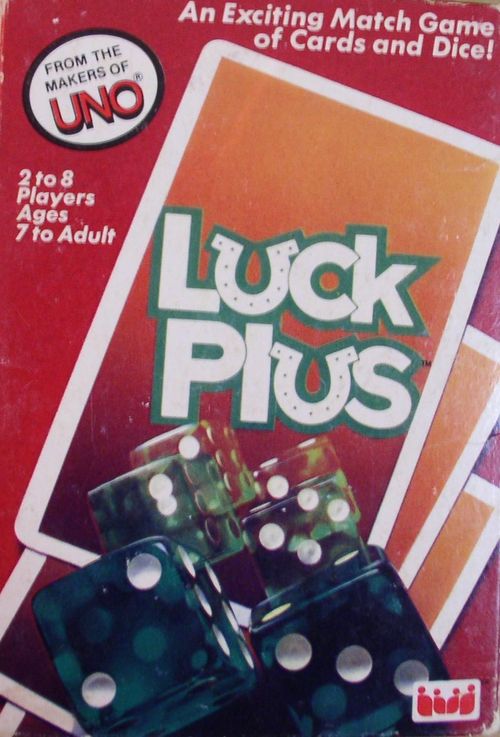
Luck Plus
Luck Plus Rulebook
Table of Contents
Table of Contents
Summary of Play
-
Determine the dealer by high roll of the dice. Deal 8 cards FACE UP on the table to each player. The remaining cards are stacked FACE DOWN in the center of the table to form the DRAW PILE. The top card of the DRAW PILE is turned FACE UP and placed next to the DRAW PILE to form the MATCH PILE. (If a LUCK PLUS card is the first card to be turned over, it is placed under the DRAW PILE and the next card is turned over.)
-
Play begins with the player to the left of the dealer rolling the dice. The player will then try to get rid of as many cards as possible by matching the numbers on the cards with the numbers on the dice. Matching can be done in several different ways either separately or at the same time:
- A. Match BOTH numbers on the dice (EXAMPLE: If #2 and #3 are rolled, then a #2 card and a #3 card will match) OR...
- B. Match the TOTAL of BOTH dice (EXAMPLE: If #2 and #3 are rolled, then a #5 card will match) OR...
- C. Match the TOP card showing on the MATCH PILE OR...
- D. ANY or ALL of these choices.
As matches are made, the cards are put FACE UP on the MATCH PILE (SEE EXAMPLES OF PLAY).
-
When a player makes a match, he continues his turn and MUST roll the dice again IF his last card played on the MATCH PILE says GO, TRANSFER, TRANSFER PLUS or DOUBLES. The last card played on the MATCH PILE says STOP or LUCK PLUS, then the turn is over, and the dice passes to the next player (SEE TYPES OF CARDS and EXAMPLES OF PLAY).
Types of Cards
The numbers on the cards are used to match the DICE or the MATCH PILE, but here's how to use the words on the cards to direct and limit play. Use the following as a quick reference during the game:
- GO CARD — As the last card of a match, roll again.
- TRANSFER CARD — Same as GO card, but may be given to opponent on left when picked from DRAW PILE.
- TRANSFER PLUS CARD — Same as TRANSFER card, but may be given to ANY opponent.
- DOUBLES CARD — Same as GO card, but can only be matched when DOUBLES are rolled.
- STOP CARD — As the last card of a match, turn ends.
- LUCK PLUS CARD — A wild card played on the MATCH PILE any time during a turn. Turn then ends.
The following explains these cards in detail:
GO CARD — When played as the last card of a match, the player KEEPS HIS TURN and MUST ROLL THE DICE AGAIN.
TRANSFER CARD — When played as the last card of a match, the player KEEPS HIS TURN and MUST ROLL AGAIN.
The special feature of TRANSFER cards is that they may also be used as a type of penalty card for the next player. If a player draws a TRANSFER card from the DRAW PILE, the player MAY give that card to the player on his left. (A player may choose to use the TRANSFER card to match the dice or the top card of the MATCH PILE.) TRANSFER cards can only be given to the next player when drawn from the DRAW PILE. If a TRANSFER card is dealt to you or given to you by another player, you may not transfer it. The card is then played the same way as a GO card.
IMPORTANT! When a TRANSFER card is given to another player, this is considered a match, and the player who gives the card KEEPS HIS TURN and MUST ALWAYS ROLL AGAIN.
TRANSFER PLUS CARD — These are the most dangerous cards in the deck! These cards are used exactly as regular TRANSFER cards EXCEPT that the player drawing the card may give that card to ANY player — PLUS, the player may also give ANY OTHER CARD of his choice from his hand to the SAME player. The player may additionally give as many of that same number card he has at the same time even though the words on the cards may be different.
As with TRANSFER cards, playing a TRANSFER PLUS card is a match, and the player who gives the card KEEPS HIS TURN and MUST ALWAYS ROLL AGAIN.
DOUBLES CARD — These cards are used to make a match when "Doubles" are rolled on the dice (the same number appears on each die). If a player rolls "Doubles" and has a DOUBLES card, he may place it on the MATCH PILE to make a match. He may also play the cards with numbers corresponding to the dice in the same play. The DOUBLES card can be played either before or after the numerical cards are played. When the match is made, the player KEEPS HIS TURN AND MUST ROLL AGAIN.
Remember that DOUBLES cards can match each other when on top of the MATCH PILE.
STOP CARD — When played as the last card of a match, the player's turn ENDS and STOPS IMMEDIATELY. The player cannot lay down any other cards on a STOP card since the turn has already been discontinued. Even if a player places a STOP card on the MATCH PILE by mistake in the middle of a match or play, then the turn still stops. All players should be alert to stop the play as soon as a player makes this mistake! Note that a card is considered in play as soon as a player removes his hand from the card on the MATCH PILE.
There is ONE exception to this rule:
COMBINED STOP: If the player is matching his cards with both dice, he always plays both cards at the same time. But if both cards are STOP cards, he can still play the cards at the same time, placing one card on top of the other. The player's turn ends when BOTH STOP cards are played.
If, however, one of the cards is a STOP card and the other card is a GO card, then the STOP card must always be the last card played on the MATCH PILE. The player's turn then ends as explained. Play then proceeds to the next player on the left.
LUCK PLUS CARD — These are WILD CARDS. A LUCK PLUS card may be played at any time during a player's turn. The LUCK PLUS card is played on ANY card on the MATCH PILE. The player may then play on the MATCH PILE any other card of his choice as a BONUS card. The player may play additional bonus cards if the player has more of the same number card. (Words on the cards can be different.) However, after playing the LUCK PLUS card alone or with bonus cards, the player's turn ENDS IMMEDIATELY even if the bonus cards are GO cards. Note: Bonus cards can be DOUBLES cards or LUCK PLUS cards as well as numerical cards. If a player chooses not to play bonus cards on the LUCK PLUS card, the turn still ENDS. However, the next player must utilize the bonus rule and MUST play ANY CARD on the MATCH PILE. That player's turn will then END after all bonus cards are played.
Hint: The LUCK PLUS card gives a player the best opportunity for getting rid of high number cards such as 11's and 12's.
Special Matching Rules
-
SPLIT MATCH — A player may match using the top card of the MATCH PILE as part of the number combination rolled on the dice. For example, if a 3 and a 4 are rolled on the dice and a 3 is FACE UP on the MATCH PILE, then the player may play a 4 card from his hand on the MATCH PILE.
-
At the start of any turn (except at the beginning of the game) the player may match the dice from the previous player's turn. This is done before the player rolls the dice for his turn. If the dice are accidentally rolled first then the player cannot use this option.
-
Remember that a player always has an option to match cards after rolling the dice. He can refuse to match even if matches are possible, but he must then DRAW a card before his turn can end.
-
Remember — a turn ends:
- If you cannot or do not want to play any cards, you then draw an unplayable card and add it to your hand.
- If you play a STOP card.
- If you play a LUCK PLUS card with BONUS CARD(s) or without BONUS CARDS.
- If the previous player played a LUCK PLUS CARD and forced you to use up your turn by playing BONUS CARD(s).
Going Out and Winning
The first player to get rid of all his cards is the WINNER.
-
It is possible for a player to "LUCK OUT", that is, rid his hand of all cards on the first turn. However, in most cases play will continue for several rounds. OPTION: If a "LUCK OUT" occurs, all other players are given one complete turn to reduce their cards regardless of whether they have had a turn. Also several players may "LUCK OUT" in the same turn. Additionally, once a player gets a "LUCK OUT," he cannot receive any more cards.
-
Once a player has only one card remaining and that card is a number 6 or less, then on his turn, that player needs only to match ONE of the dice to go out. However, the player must roll both dice in order to make that last match.
-
If, at the start of a turn, a player's last card is numbered 6 or less and it matches the TOTAL FULL combination of the dice from the previous turn OR the card on top of the MATCH PILE, then he can go out.
-
If no player goes out by the time the DRAW PILE is depleted, the MATCH PILE may be reshuffled except for the top card. The reshuffled deck is then used as the new DRAW PILE.
Scoring
By hands — The overall winner is the first to win a designated number of hands, such as 5 or 10. The first player to go out wins ONE hand.
By point system — The overall winner can be determined by scoring points. Each card is worth a certain amount of points as follows:
- ALL NUMBER CARDS — face value
- DOUBLES CARDS — 15 points
- TRANSFER PLUS CARDS — 20 points
- LUCK PLUS CARDS — 25 points
- LUCK OUT PLAY — 30 point bonus
Once a player goes out, all other players total the points in their hands. The points totaled are then awarded to the player who went out. The first player to reach a designated score such as 250 or 500 is the winner. The game may also be scored by having each player keep the point total he is caught with in his hand each time a player goes out. When a player reaches a designated score such as 250 or 500, the game is over and the player with the least amount of points is the winner.
Strategy Hints
- Players should try to make as many matches as possible during a turn in order to get rid of a maximum number of cards.
- When it's your turn, look ahead to the next player's hand. Remember he will try to use the last dice roll of your turn and the last card you play on the MATCH PILE.
Examples of Play
In order to understand various play situations, we have provided some examples.
Example #1: MATCH PILE: 7. DICE: 3 and 5. HAND: GO 7, GO 7, STOP 7, GO 5, GO 6, STOP 6, STOP 8, GO 3.
The player sees that he can make matches on both the MATCH PILE and the dice. He will first match both GO-7 cards on the MATCH PILE, and will not use the STOP-7 card since that card will automatically end the turn. Continuing the play he lays down the GO-3 card and the GO-5 card to match BOTH numbers on the dice. Finally the player lays down the STOP-8 card which is the TOTAL of the dice. His turn ends.
Example #2: MATCH PILE: GO 9. DICE: 2 and 4. HAND: TR 12, STOP 8, STOP 2, DB, GO 9, GO 6, GO 2, GO 4.
The player will first match the GO-9 card on the MATCH PILE. Next, the player will lay the GO-2 card, the GO-4 card (matching BOTH numbers on the dice) and the GO-6 card on the MATCH PILE (matching the TOTAL of the dice). Since the last card played was a GO card he MUST ROLL AGAIN.
After rolling the dice, the table now looks like this: MATCH PILE: GO 6. DICE: 6 and 6 (doubles). HAND: TR 12, STOP 8, STOP 2, DB.
The lucky player will lay down the DOUBLES card since he rolled doubles and then, on the same play, will lay down the TRANSFER-12 card since this card matches the TOTAL of the dice. The player MUST ROLL AGAIN.
After rolling the dice, the table now looks like this: MATCH PILE: TR 12. DICE: 6 and 4. HAND: STOP 8, STOP 2.
At this point, the player cannot make any matches although the TOTAL of the cards is the same as the TOTAL of the dice. THE CARDS MUST MATCH EXACTLY. The player must now draw a card. The card drawn is a TRANSFER-6 card. The player gives this card to the next player and then ROLLS AGAIN.
Example #3: MATCH PILE: STOP 9. DICE: as pictured. HAND: GO 9, GO 9, TR 9, GO 8, GO 12.
Before rolling, the player sees that he can match the match pile with all three #9 cards. Rather than using all the #9 cards at once, the player can "milk" his turn by playing them separately and rolling the dice after each #9 card is placed on the match pile (GO cards and TRANSFER cards allow the roll of the dice EACH TIME they are the last card played on the match pile). This strategy allows a player to get more chances to get rid of the remaining #8 and #12 cards.
Example #4: MATCH PILE: STOP 10. DICE: as pictured (total 5). HAND: TR 5, LUCK PLUS, GO 11, STOP 11.
BEFORE rolling for his turn, the player lays down on top of the MATCH PILE the TR-5 card to match the total of the dice. He sees that he does not have to roll the dice since his next move will be to use the LUCK PLUS card and STOP-11 card, followed by the GO-11 card for his bonus cards. The player eliminates all his cards and wins the hand.
Examples of Possible Combinations and When a Turn Can End: If a 3 and a 4 are rolled on the dice, the following can happen if different types of 3 and 4 cards are played:
- GO-3 and GO-4 — turn continues
- GO-3 and TRANSFER-4 — turn continues
- *GO-3 and STOP-4 — turn ends
- TRANSFER-3 and TRANSFER-4 — turn continues
- *TRANSFER-3 and STOP-4 — turn ends
- STOP-3 and STOP-4 — turn ends
The order of placing the cards on the match pile can be reversed except in examples marked by *. In these cases, the STOP card must always be played LAST.