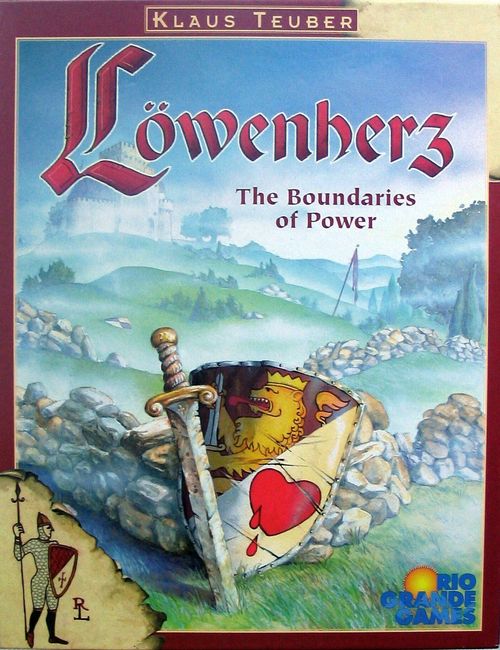
Löwenherz
Löwenherz Rulebook
Table of Contents
Table of Contents
- What's in the Box
- Introduction
- Basic Game
- Regions
- Playing the Game
- Action Descriptions
- Rules for Placing Knights
- Rules for Extending Regions
- Rules for Power Trials
- Rules for Duels
- Scoring
- Politics Cards
- End of the Game
- Variable Construction Rules
- Special Rules for 2 Players
- Short Rules (Summary of Round)
- Overview & Layout for the Basic Game
What's in the Box
- 1 board frame
- 6 map pieces
- 4 power markers (1 in each of rose, gold, purple, and gray)
- 16 castles (4 each in rose, gold, purple, and gray)
- 48 knights (12 each in rose, gold, purple, and gray)
- 100 boundary walls (black)
- 1 first player castle (black)
- 1 rulebook
- 112 cards:
- 52 money cards
- 4 summary cards (1 for each player)
- 12 decision cards (3 for each player)
- 31 action cards
- 13 politics cards
Introduction
Löwenherz may be played two ways. The basic game uses a standard layout for the board and the initial placements of castles and knights; the basic game is shorter and an excellent way for beginning players to learn the game. Experienced players may want to use the variable construction rules, which provide a greater challenge and a longer game.
Basic Game
At the start of the basic game, each player (prince) controls one region containing one castle and one knight. Before starting play lay out the map as shown in the picture on the card labeled "Overview and layout for the basic game":
- Lay out the board frame.
- Put the 6 map pieces within the frame so that they read in alphabetical order from top left as shown in the picture.
| A | B | C |
|---|---|---|
| D | E | F |
- Each player selects a color and takes 1 power marker, 3 castles and 12 knights in this color (The fourth castle is used in the special 2-player version described later).
- Each player places the 3 castles, 3 of the knights and boundary walls on the map board as shown in the picture (if playing with three players, the pieces of the fourth color are placed on the board as obstacles to the three players.)
- The 31 action cards are sorted by the letters on their backs; remove those featuring the letter A (these are used in the variable construction rules only); shuffle the remaining four sets separately; and place them face down, one on top of the other in the place shown in the picture (the B cards are on the top, C cards are next, then the D cards, and finally the E cards at the bottom). The space adjacent to the action cards on the board is used to place these cards as they are drawn.
- Each player places his power marker on top of the lion (the starting space of the power track).
- The unused boundary walls and the first player castle are placed near the board.
- The money cards are sorted by value (1, 2 and 3 ducats) and placed face up on the 3 spaces on the map board as shown in the picture. This is the bank.
- Each player takes money cards worth 12 ducats, (2 x 1, 2 x 2, and 2 x 3). A player's money is private.
- The 13 politics cards are shuffled and separated into 2 piles, one of 6 cards and one of 7. Both piles are placed face down on the map board as shown in the picture.
- The decision cards are sorted by the color shown in the coat of arms on their fronts. Each player takes the color matching his other pieces. Each player will have three decision cards numbered 1, 2, and 3.
- Each player takes a summary card.
Regions
Regions are groups of spaces which are completely enclosed by boundary walls and contain 1 castle. In the example, only the gold prince controls a region. Although the castles of the rose and purple princes are completely surrounded by boundary walls, neither controls the area because both have castles there. Notice that the edges of the map frame have printed boundary walls on them and, thus, form a boundary wall around the entire kingdom.
Tip: Place your boundary walls so that the area enclosed is as large as possible. When you create regions you score power points based on the size of the region: bigger is better. Also, including towns and hills will make the region more valuable.
Playing the Game
The youngest player starts, taking the first player castle (designating that player as the first player on this turn).
- The first player turns over the top action card and lays it face up on the adjacent space. The card will picture three actions or it will be a special silver mine action card.
- When a card with three actions pictured is turned over, the first player must decide which action he wants to perform. He does this by placing one of his three decision cards face up on the table. He selects card 1 if he wants the top action, card 2 if he wants the middle action, and card 3 if he wants the bottom action. The other players follow in clockwise order, each placing the card designating their choice face up on the table.
When playing with three players, the first player selects two decision cards, placing both face up on the table.
The actions are performed by the players selecting them with the top action being first, the middle second, and the bottom last. If two or more players choose the same action, there may be a power trial (see power trials), as most actions can only be performed by a single player. This may cause one or two players to have no actions to perform in a turn. When playing with three, it is possible that the first player performs both his chosen actions. When all actions have been performed, the decision cards are returned to the players.
- When a silver mine action card is turned over, each player moves his power marker one space forward on the power track for each hill space that he has enclosed in his regions. Then the first player turns over another action card. There is only one silver mine action card in each set of lettered action cards (B, C, & D).
- The first player gives the first player castle to the person on his left who becomes the first player for the next turn.
Action Descriptions
There are brief descriptions of the different actions on the summary cards. These cards also have scoring information on them, which show the number of power points gained for newly created regions; players should refer to these when planning or scoring.
Money Bag
Money bag - receive ducats. Whoever chooses this action receives as many ducats as stated. If 2 or more players choose this action, the ducats are divided between them, truncating fractions.
Boundary Walls
Boundary Walls - place boundary walls. Whoever chooses this action may place as many boundary walls as are shown on the card (1, 2, or 3). Boundary walls are neutral and, thus, can form a wall for neighboring princes as well as the prince placing the wall. The walls are taken from the common stock and are placed observing the following:
- Boundary walls must always be placed on the line between two spaces.
- Boundary walls may never be placed between a knight and a castle of the same prince (color) or between two knights of the same prince.
- Boundary walls cannot be placed in a region.
- If the placing of boundary walls creates one or more regions, scoring is done immediately (see scoring).
- When a prince has three regions, he can place no more boundary walls, but he may select that action using his decision cards.
Single Sword and Shield
Single sword and shield - place a knight (see below) or expand a region (see below). Whoever chooses this action may either place a knight from his stock (if he has no more knights, he may place no more) or extend one of his regions by two spaces.
Rules for Placing Knights
- Knights may only be placed on blank or wooded spaces. Placing a knight on wooded spaces costs 5 ducats which is paid immediately to the bank.
- A knight may never be placed on hill or town spaces, or on a space already containg a knight.
- A knight must always be placed on a space that is adjacent to (diagonal does not count) to one of your own knights or castles.
- A knight is not considered to be adjacent to another knight or a castle if a boundary wall separates them.
Example: - the gold prince wants to place a knights near the castle shown. He may only place it on one of the two spaces marked with arrows. The other spaces cannot be used: the space above the existing knight contains a hill and both spaces below would be separated from the new knight by the boundary wall.
Rules for Extending Regions
- A player may extend one of his regions by one or two spaces.
- The 1st space must be adjacent (not diagonal) to the region. The 2nd space must be adjacent to the region as it now exists due to the addition of the first space. It may be adjacent to the new space or any space that existed before the first addition.
Spaces which are occupied by another prince's pieces cannot be expanded into.
Spaces which belong to no prince's region or spaces in neutral zones (see below) can be taken over without restrictions.
A player may not extend into one of his own regions.
A player may only extend his region into another prince's region if the number of knights in his region exceeds that of the other prince's region.
If the number of knights in a neighboring region is as large or larger, a player cannot take any spaces from this region.
Examples: - the gold prince may expand into the region of purple.
- the rose prince may expand into the regions of purple and gold; gold may only expand into purple's region; and purple may not expand into either of the other two.
When a player expands a region, neutral zones can be created. Neutral zones consist of spaces which are enclosed by boundary walls, but contain no castle. Spaces in a neutral zone may be taken over by expansion from any neighboring region.
Regions may only be expanded by use of an expansion action card. It is not possible to enlarge a region by placing boundary walls.
Two Swords and Two Shields
Two swords and two shields - place two knights or place one knight and expand one region. Whoever chooses this action may either place two knights or, in either order, place one knight and expand one of his regions by two spaces. Using this action to expand twice is not allowed.
Crown and Scepter
Crown and scepter - take a politics card. Whoever chooses this action may look through one of the two piles of politics cards and select one card. The meanings of the these cards will be explained later.
Rules for Power Trials
With the exception of the receive ducats action where ducats are distributed between players, an action can only be performed by one player. If two players choose the same action, they first negotiate with each other as to who will carry out the action. Negotiations take the form of offers (possibly mutual) of ducats to gain the opportunity to perform the action. Politics cards may not be offered in a negotiation.
Example: Fred and Kevin have both chosen the same action (place 2 boundary walls). Fried offers Kevin 3 ducats to let him perform the action. In response, Kevin offers Fred 4 ducats. Fred takes the money and Kevin may now perform the action by placing 2 boundary walls. It is not allowed for an action (other than receive ducats) to be split between two people. In this example, Fred and Kevin may not agree to place 1 boundary wall each.
If the players cannot agree, there will be a duel. If 3 or 4 players have chosen the same action, there can be no negotiations. A duel takes place at once.
Rules for Duels
All participating players take any number of money cards in one hand (none is allowed). It is best to conceal the cards in your hand so that other players cannot see how many cards you are holding. Players reveal their cards simultaneously. Whoever has bid the most ducats pays his bid immediately to the bank and may then perform the action that was in dispute. All other players keep their bid money.
If there is a tie for most ducats bid, these players take back their money cards and re-duel. If there is a second tie, no player may carry out the action and players take back their money.
Scoring
Scoring When Creating a Region
When a player creates a region, whether it is his own or one of the other prince's, scoring takes place immediately. The spaces in the region are counted and will be cross referenced on the region creation table with the power points. Each town contained in the region counts for an extra 5 power points.
The owner of the newly created region (this does not have to be the player whose play caused the creation of the region) moves his power marker forward along the power track as many spaces as the card indicates.
Region Creation table
| # of spaces | Power points |
|---|---|
| 1-4 | 3 |
| 5-10 | 5 |
| 11-20 | 7 |
| 21-30 | 9 |
| ab 31 | 12 |
Each tile counts for 1 power point.
Example: Before the play, neither prince has a region in this area. During play, gold adds a boundary wall in the location shown by the left arrow, creating two regions (one for gold and another for purple). Scoring is in accordance with the region creation table. Gold's region contains 12 spaces and 1 town. He receives 7 power points for the spaces (11-20) and 5 power points for the town and immediately moves his power marker 12 spaces forward. Purple's new region contains just 4 spaces and the purple power marker is moved 3 spaces forward. After scoring, the boundary walls within the new regions are removed and returned to the common stock.
Scoring After Region Expansion
When a player expands his region, he can at once move his power marker one space forward for each space taken over. If he captures a town he moves an additional 5 spaces. When a player loses spaces or towns, he moves his power marker backwards accordingly.
Example: - Gold takes over 2 spaces from the purple prince (marked with red arrows). Gold moves his power marker forward 7 spaces (2 spaces plus 5 for the town). Purple moves his power marker back 7 spaces.
Special Case - Neutral Zone
If through the expansion into another prince's region a neutral zone is created, the loss of spaces contained in the neutral zone should be determined using the region creation table. If a player loses spaces in two or more neutral zones, the spaces are added together to determine the lost power points.
Example: Gold expands into purple's region. As a result, purple loses 2 spaces and must move his power marker backward 2 spaces; gold moves his marker 2 spaces forward. Since a neutral zone was also created (see the red spaces), taking 8 spaces from purple. For the loss of these spaces, purple moves his power marker backwards an additional 10 spaces: 5 points for the spaces (5-10) plus 5 points for the lost town; gold, however, does not gain these power points.
Politics Cards
When a player takes a politics card, he keeps it face down until he chooses to play it. Cards with a black shield symbol in the top left corner will always be played with a decision card. Once played, politics cards are discarded. The 4 different types are described below.
Alliances
This card is played with a decision card. The instructions on the card are immediately carried out (before the next player lays a decision card and also before the action). Therefore, the effect occurs whether or not the player actually performs the action the decision card referred to.
The alliance card has an effect on two neighboring regions (one of your own and another prince's). The prince playing this card chooses which regions will be affected (once chosen, this cannot be changed). As a result, neither region can be expanded into the other. As a sign of the alliance between the two regions, one of the shared boundary walls is turned by 90 degrees. If the space with the turned boundary wall is later taken over, the alliance between the original regions remains intact.
An alliance can be ended at any time if one of the two players participating in it pays ten ducats to the bank.
Example: - Purple plays an alliance card. Gold may not expand into purple's lower region; he can still expand into the purple region to his right as no alliance exists between these two regions. If gold pays 10 ducats to the bank, he may cancel the alliance and is then free to expand into either region.
Renegades
This card is played with a decision card. The instructions on the card are immediately carried out (before the next player lays a decision card and also before the action). Therefore, the effect occurs whether or not the player actually performs the action the decision card referred to.
The alliance card has an effect on two neighboring regions (one of your own and another prince's). The prince playing this card removes one knight from the neighboring region (the owner places the knight back in the stock pile) and then places one of his knights from his stock pile in a region of his own that borders the region that lost the knight. All normal placement rules must be obeyed during this placement; likewise, the knight placed must be placed into a region. If a knight is removed from a wooded space, the player playing the card pays 5 ducats to the bank.
When removing another prince's knight, you cannot create an invalid knight placement situation for the other prince. For example, a knight which serves as the only connecting link between another knight of the same prince and the prince's castle or between two knights of the same prince, cannot be removed. You must place one of your knights when you use this card to remove another's. If you have no knights in your stockpile, you may not play this card. The last knight remaining in a region may be removed leaving a castle alone in a region.
Example: Gold plays a renegade card. He removes the knight marked with the red arrow from purple (the knight on the right next to the castle cannot be removed as this would break the connection with the castle). Accordingly he places one of his own knights.
Treasure
The number on the card is the size of the treasure. It can be used during a duel together with other money cards, or on its own. The treasure card cannot be exchanged for money cards nor can change be given when it is used. Thus, if an 8 ducat bag is used to pay to place a knight on a wooded space, the 3 extra ducats are lost.
Parchment
These cards are saved and used at the end of the game. Their owners move their power markers forward the number of spaces stated on the cards.
End of the Game
One of the action cards in the bottom part of the deck (with the letter E) says the King is dead. When this card is turned over the game ends immediately. Each player receives 1 power point for each hills space in his regions (same effect as the silver mine card). Players with parchment cards play them and move their power markers the number of spaces indicated on the cards.
The new king (and winner of the game) is the player whose power markers has moved the farthest on the power track. In the case of a tie, the player (among those tied) with the most ducats wins (treasure cards are included).
Variable Construction Rules
Once you have learned to play the game, you may want to add the challenge and variety offered by different starting positions for both the map and the players' pieces. To do so, follow the guidelines below:
- Mix the tiles and place them randomly within the frame. The order and orientation are not important.
- Starting with the youngest player, each player (in clockwise order) places a castle on one free plain space and beside it on a free plain space a knight. This continues around the table until each player has placed 3 castles and 3 knights.
- As in the basic game, knights and castles may not be placed on towns or hills. During the start of the game, knights may not be placed on wooded spaces.
- Castles of the same prince must have a gap of at least 6 spaces between them (not diagonal).
- When playing with 3, after placing the 3 castles and knights, each player in turn places one castle and one knight of the fourth unchosen color. The same distance rule applies to the castles of this color.
- The game starts with action cards lettered A. The action pile is shuffled as in the basic game, except that the cards from A are added to the top of the pile.
- Otherwise, the preparations are the same as the basic game.
Special Rules for 2 Players
Löwenherz makes a good game for 2 players with just the few small rules changes listed below:
- The game is played with 3 colors.
- Each player chooses a color. A third color is chosen to be the neutral prince.
- Taking turns with the youngest player starting, each player places 4 castles and 4 knights in his color using the variable construction rules.
- Again taking turns, each player then places 2 castles and 2 knights of the neutral color.
- Placement rules remain unchanged. Castles of the same color, including neutral, must be at least 6 spaces apart.
- The first player always lays 2 decision cards.
Short Rules (Summary of Round)
- draw next card
- Silver Mine - each player gets 1 power point for each hill space in regions; draw another card
- Action Card - starting player chooses action followed by all other players; players may also play Alliance and Renegade cards now.
- Actions Taken - first the top action, then the middle action and finally the bottom action; if two players choose the same action they negotiate or duel to see who does action; if three or more players choose the same action, they duel to decide who does the action.
Overview & Layout for the Basic Game
All components of the game are shown on this sheet. Refer to this sheet as you read the rules. The diagram below shows the layout to be used for the basic game of Löwenherz; place the cards, board and other pieces as shown below before beginning your first game.
- The game board - The game board consists of a framework and 6 map squares. Since the map squares can arrange themselves again and again, each game is different.
- The power track - The players track their power with power stones on the power track.
- The Region - Each player possesses a region at the beginning of the game. An area consists of spaces that are continuously enclosed by boundaries and contain a castle.
- Start - Each player places his power stone on the lion.
- Castle, Knight, Boundary (drawn), Boundary (figure)
- Woods, Hill (silver mine), Town, Open land
- The money stacks - The three money stacks are placed on these three spaces.
- This is where the Action cards deck is placed.
- The Politics cards - are shuffled and laid cut as up-side-down stacks on these spaces.
- Summary cards - Action summaries on one side; Region creation table on the other.
- Decision cards - Each player takes 3 decision cards with his coat of arms on the front. Decision cards are held in the player's hand.