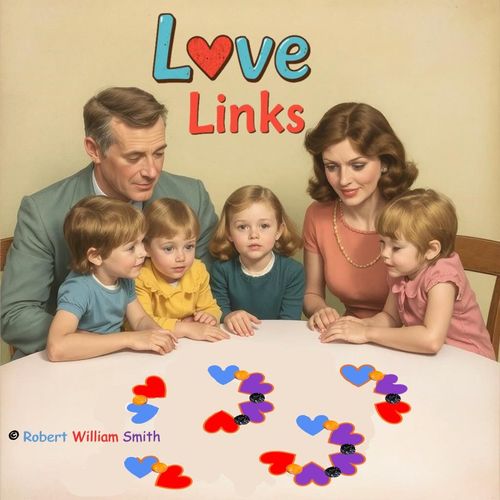
Love Links
Love Links Rulebook
Table of Contents
Table of Contents
Game Pieces
The game pieces are:
- 94 multi-coloured links, of which 35 are edged in bronze, 30 in silver, and 29 in gold. Each link in a player's stock consists of two hearts joined by a placeholder in which the player will place a gemstone. The left heart (blue) shows a number representing the number of rays of the link's key. The key will join to another link's lock. The number in the red right heart shows the number of rays of the link's lock, which will receive another link's key.
- A supply of at least 50 gemstones in each BGA colour. There are sufficient gemstones to ensure that a player will not run out of gemstones during the game.
Game Play
Each player is assigned a gemstone colour, normally the player's preferred BGA colour. The stock of 94 links is separated into groups according to their metal colour: bronze, silver and gold. The game is played over three rounds, with bronze links played in the bronze round, silver in the silver round and gold links in the gold round.
Bronze Round
At the start of the bronze round, each player is given a stock of 5 bronze links chosen at random which display each players' gemstones. 5 bronze links from the remaining link stock, again chosen at random, are placed into the centre of the playing area, and each of these is the starting link for each of 5 bracelets-in-assembly. These links do not have a gemstone, but instead show a blank bronze circle. During play, all players can see all other players' links.
BGA chooses the player order which is reflected in the player panel.
A player's turn comprises two moves. Each move is a set of actions. Light blue shaded areas represent player choices and actions, and green shaded areas are automatically carried out by BGA. On each move, the player:
- chooses one of the links from the player's stock to place on any bracelet-in-assembly in the playing area, bearing in mind the rules for joining links. If the player cannot lay a link to join any bracelet-in-assembly, then the player starts a new bracelet-in-assembly, by placing a link chosen by the player from the player's stock of links.
- scores points if the key and lock ray numbers match on the new join
- if a bracelet is completed:
- scores the points for completing the bracelet, and
- starts another bracelet-in-assembly with a link chosen by the player from the player's stock of links.
- after the player has completed the two moves, the player receives links chosen at random by BGA from the unused bronze link stock to replenish the player's stock to 5 links.
A player cannot elect to start a new bracelet if the player can add a link to an existing bracelet. If a player is unable to lay a link to join an existing bracelet, then the player must start another bracelet, using any link in the player's hand.
When the unused bronze link stock has been exhausted, players play their remaining bronze links in turn. If a player has only one link in stock, then only one placement can be completed. If a player has completed a bracelet but has no link to start a new bracelet, then there will be one fewer bracelet for the remainder of the round.
Silver Round
Players each receive 4 silver links chosen at random by BGA from the silver link stock. If there are less than 5 incomplete bracelets at the end of the bronze round, then silver link(s) from stock are chosen at random by BGA and laid on the playing area to increase the number of bracelets-in-assembly to 5. At the end of a player's turn, BGA replenishes the player's stock of silver links to 4, chosen randomly by BGA.
The first player to lay a silver link will be the player whose turn follows the player who played the last link in the bronze round, whether or not that last link was added to an existing bracelet-in-assembly or used to start a new one. The silver round is played in the same way as the bronze round.
Gold Round
Players each receive 4 gold links each at random from the gold link stock. If there are less than 5 bracelets-in-assembly after the silver round, then gold links from stock are laid on the playing area to increase the number of bracelets to 5.
The first player to lay a gold link will be the player whose turn follows the player who played the last link in the silver round. The gold round is played in the same way as the bronze and silver rounds.
When all the gold links have been laid, and points tallied, the game is complete.
Rules Around Joining Links
Links are joined according to the physical rules associated with the design of links. A join is possible when the raised portion of one link (the key, coloured black) fits into the depressed portion of the other link (the lock, coloured white). There are 9 numbered key and lock patterns, representing star patterns with differing numbers of rays, numbering from 2 to 10. A tenth type of lock – the master lock, shown with an M – allows 2-,3-,4-,5-,6- and 8-ray keys to link to it.
The general rule is that a key will fit into a lock with the same number or multiple of that number, so a 2-ray key will fit into 2-, 4-, 6-, 8-, 10-ray locks and the master lock. 3-ray keys fit into 3-, 6-, and 9-ray locks and the master lock. 4-ray keys join to 4-, 8-ray locks and the master lock. 5-ray keys join to 5-, 10-ray locks and the master lock. 6- and 8-ray keys join to their respective numbered locks and the master lock. Links with 7-, 9- and 10-ray keys can only join to links with their respective numbered locks.
In summary the following 23 link joins are possible:
| Key | Fits locks | Lock | Receives keys |
|---|---|---|---|
| 2 | 2,4,6,8,10,M | 2 | 2 |
| 3 | 3,6,9,M | 3 | 3 |
| 4 | 4,8,M | 4 | 2,4 |
| 5 | 5,10,M | 5 | 5 |
| 6 | 6,M | 6 | 2,3,6 |
| 7 | 7 | 7 | 7 |
| 8 | 8,M | 8 | 2,4,8 |
| 9 | 9 | 9 | 3,9 |
| 10 | 10 | 10 | 2,5,10 |
| M | 2,3,4,5,6,8 |
The metal colour of the link is not important when it comes to joining links. A gold link can join to a bronze link etc.
There are 94 links, each with one lock and one key, and both lock and key have different rays. There are a number of duplicated links, and some combinations of locks and keys on the same link do not exist. The table below shows the numbers of links exhibiting lock and key combinations and also whether they are bronze, silver or gold. The higher the combined ray values of lock and key on any given link, the more likely the link will be silver or gold.
| Key \ Lock | 2 | 3 | 4 | 5 | 6 | 7 | 8 | 9 | 10 | M | Total | Bronze | Silver | Gold |
|---|---|---|---|---|---|---|---|---|---|---|---|---|---|---|
| 2 | 2 | 2 | 2 | 2 | 2 | 2 | 2 | 2 | 16 | 12 | 4 | |||
| 3 | 1 | 2 | 2 | 2 | 2 | 2 | 2 | 2 | 15 | 9 | 6 | |||
| 4 | 1 | 2 | 2 | 2 | 2 | 2 | 2 | 13 | 5 | 6 | 2 | |||
| 5 | 1 | 1 | 2 | 2 | 1 | 2 | 2 | 2 | 1 | 14 | 4 | 4 | 6 | |
| 6 | 1 | 1 | 1 | 2 | 5 | 1 | 1 | 3 | ||||||
| 7 | 1 | 1 | 1 | 2 | 1 | 2 | 2 | 10 | 3 | 2 | 5 | |||
| 8 | 1 | 1 | 1 | 1 | 2 | 6 | 1 | 1 | 4 | |||||
| 9 | 1 | 1 | 2 | 2 | 2 | 8 | 3 | 5 | ||||||
| 10 | 1 | 1 | 1 | 1 | 1 | 2 | 7 | 3 | 4 | |||||
| Total | 5 | 4 | 11 | 6 |
There are very few links with 2-ray locks, 3-ray locks and 5-ray locks, and only links with 2-, 3- and 5-ray keys respectively can join to them. There are many links that have 2-,3- and 5-ray keys as these can also join to links with a wide variety of other locks. Master locks are only associated with links that also have 5-, 7-,9- and 10-ray keys. There are only 9 links with 7-ray locks on them, but 10 links have 7-ray keys on them. Hence if all links are played, there will always be one link with a 7-ray key that cannot be joined to any link and hence one bracelet-in-assembly will never be completed. There are no 2- or 5-ray locks in the silver or gold rounds and only one master lock in the gold round. Some links that are hard to place have additional rewards in the form of precious diamonds, rubies, emeralds and sapphires that provide extra points. Gold links are hardest to add to existing bracelets, silver links are also harder to place than bronze.
Placing Links in BGA
When placing a link, the player must click on one of the links from the player's stock. When the choice is made, the places that the link can be joined to will be highlighted. The player should then click on the chosen highlight. If a bracelet can also be completed with the chosen link, the player is given the choice to complete the bracelet or to extend it further. The player must confirm the final choice of placement, and once made, the choice is irreversible.
Rules Around Bracelets
A completed bracelet must be at least 5 links long but can be any length.
A player does not have to complete a bracelet when laying a link but may elect to lay the link to extend the size of the bracelet.
Any opponent gemstones in the completed bracelet are kept by the player completing the bracelet and the number of these gemstones is used to determine who wins in the case of a tie on points.
Scoring
Points are awarded or deducted for completed bracelets as follows:
- Metal points: 1 metal point is awarded for each bronze link in the completed bracelet, 2 for silver links and 3 for gold links.
- Long bracelet points: If the player completes a bracelet longer than 5 links then the player completing it will receive 2 long bracelet points for every additional link in the completed bracelet. So:
- 2 points for a 6-link bracelet
- 4 points for 7-link bracelet
- 6 points for an 8-link bracelet
- 8 points for a 9-link bracelet, and so on
- Opponent gemstones captured points: 1 point is given for each opponent gemstone that is in the completed bracelet.
- Domination points: A player completing a bracelet where no other player has a gemstone scores an additional 10 points.
- Precious stone points: An additional 10 points for each link with diamonds on the completed bracelet – the diamonds are on 2 links: the link with the 10-ray-key 7-ray-lock (10-K,7-L) and the link with a 7-ray-key 2-ray-lock (7-K,2-L). A score of 5 points for each link with rubies, emeralds and sapphires in the bracelet. These are 4 links each with the three types of precious stones. Rubies are on 5K-3L, 6K-7L, 10K-3L and 8K-9L links. Emeralds are on 7K-6L, 7K-9L and two 7K-10L links. Sapphires are on 4K-2L, 8K-2L, 7K-4L and 10K-9L links. All of these links have limited joining possibilities.
- Matching link points: A score of 4 points if either of the key or lock ray values of the bracelet-completing link are the same as the ray values of lock or the key of the adjoining links. A score of 8 points is awarded if both key and lock ray values match.
- Master lock penalty: 2 points are deducted from the player who lays a link with a master lock on it to complete a bracelet.
Scoring Example
Player A completes a 7-link bracelet that shows 1 of Player A's gemstones, 2 of Player B's, 3 of Player C's. It has a 7K-2L diamond link, and a 10K-7L emerald link in it. The bracelet is constructed from 2 bronze, 3 silver and 2 gold links. Neither end of the link laid to complete the bracelet matched the ray values of the joining points of the bracelet-in-assembly.
- Metal points: 13. 2 lots of 1 point for bronze, 3 lots of 2 points for silver, and 2 lots of 3 points for gold.
- Long bracelet points: 4 as this is a 7-link bracelet.
- Opponent gemstone points: Player A scores 5 points representing the 5 captured gemstones, 2 from Player B and 3 from Player C.
- Domination points: 0 as more than one player has laid gemstones to make up the bracelet.
- Precious stone points: 10 for the diamond-encrusted 7K-2L link and 5 for the emerald-encrusted 10K-7L link.
- Matching link points: 0.
- Master lock penalty: 0. The master lock was not used to complete the bracelet.
Total points 13 + 4 + 5 + 15 + 0 + 0 = 37 for Player A.
Matched link points are awarded when a player lays a link, even though no bracelet is completed. 1 point is awarded where a link is laid where the joining link and key have the same ray value, for example a 10-ray key joining a 10-ray lock, but no bracelet is completed. A further 3 points is available if the second link placed in the player's turn joins a lock and key with the same ray value and neither of the links laid completed a bracelet. The second link placed can be in the same or different bracelet-in-assembly.
If the second link laid in the turn completes a bracelet and the first link laid in the same turn is in the completed bracelet, then the player still receives 1 matched link point for the first link laid, and, for the second link laid, any matching link points as outlined above for completing a bracelet (4 or 8).
Rules Around the End of the Game and the Declaration of the Winner
In the standard game, where all links are played, then the placement of the final link signifies the end of the game. Once all points have been awarded relating to the placement of the final link, then the player with the highest points score wins. If two or more players have the same points score, then the player with the most captured opponent's gemstones is the winner, and if this still results in a tie, then the result is a tie. For clarity, if no bracelets were completed during the game, and the players have the same score, then the result is a tie.
In the short game, then the game immediately finishes when any player reaches or exceeds the target. If by some action, more than one player was awarded points that take more than one player over the winning threshold, then the player with the highest points after the action has been completed is the winner. The rules relating to ties is the same as shown above for the standard game.
Four-Player Game
The 4-player game is played on BGA as teams of 2. Here, team players play alternately in the order team 1 player 1; team 2 player 1; team 1 player 2; and team 2 player 2. Each team has the same player gemstone, and only one points tally.