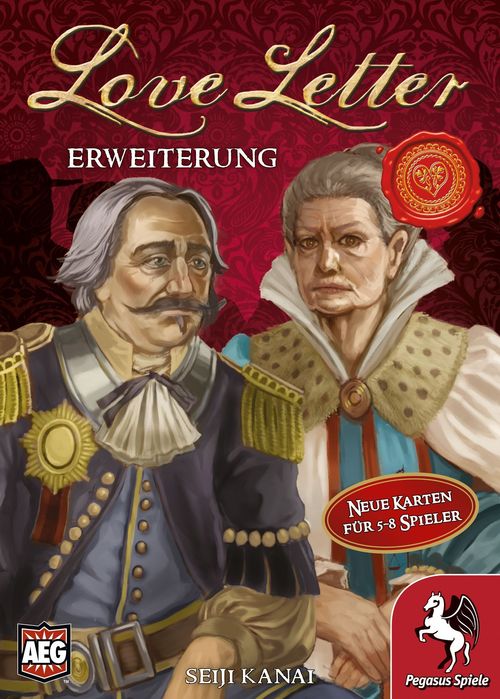
Love Letter: Erweiterung
Love Letter: Erweiterung Rulebook
Table of Contents
Table of Contents
Components
The expansion contains:
- 21 person cards: 16 new persons, plus 5 Guardswomen (Wächterin) with adapted card text. The 16 new persons are used together with the 16 persons of the base game for games with 5–8 players. The 5 Guardswomen replace the base game's Guardswomen.
- 1 Jester card (Narrenkarte)
- 8 hearts (Herzen): place these together with the base game's hearts so that there are enough hearts for 5–8 players.
- 8 overview cards (Übersichtskarten). On one side is a brief overview of the person cards and their functions for games with 2–4 players. On the other side are the persons and functions added for games with 5–8 players. The number in brackets after each person is how many copies of that card are in the game.
The overview cards list the persons added for 5–8 players as follows:
| Value | Person (German) | Count |
|---|---|---|
| 9 | Bishop (Bischof) | 1 |
| 7 | Dowager Queen (Königswitwe) | 1 |
| 6 | Marshal (Marschall) | 1 |
| 5 | Count (Graf) | 2 |
| 4 | Flatterer (Schmeichler) | 2 |
| 3 | Baroness (Baroness) | 2 |
| 2 | Cardinal (Kardinal) | 2 |
| 1 | Guard (Wächter) | 3 |
| 0 |
The other overview cards, for games with 2–4 players, list the base game persons as follows: Princess (Prinzessin) 8 (1x), Countess (Gräfin) 7 (1x), King (König) 6 (1x), Prince (Prinz) 5 (2x), Handmaid (Zofe) 4 (2x), Baron (Baron) 3 (2x), Priest (Priester) 2 (2x), Guardswoman (Wächterin) 1 (5x).
Editor's note: the overview cards are printed in German, and they are the source of the counts above. The card texts themselves are reproduced in the sections below.
Game Idea
The players are admirers of the princess who try to get love letters to her. To do this, they cleverly use the persons at court as couriers for their declarations of love. The closer a person stands to the princess, the more likely that person will be able to deliver the letter to the princess at the end of the day. Whoever wins the princess's heart wins this game.
Setup and Play for 5–8 Players
All 32 person cards are shuffled well. Each player is dealt 1 person card, which he takes into his hand and keeps secret from the other players. In addition, each player takes 1 overview card and places it in front of himself. The remaining person cards are placed in the middle of the table as a face-down draw pile. Finally, the top card of the draw pile is placed face down aside as the reserve card. Place all hearts in the middle of your play area.
The game then proceeds exactly as with 2–4 players.
End of the Game for 5–8 Players
The game ends when a player has 3 hearts.
In games with 5–8 players, players do not only receive hearts at the end of a round. Some persons also give players additional hearts during a round. It is therefore possible for a player to win the game without ever having won a round.
It is also more likely that several players receive the 3 hearts needed for victory at the same time. In this case, the players tied for the lead play one more round to decide alone who wins the princess's favour.
If 5 or more players are in the game, all 32 persons are used. If there are fewer than 5 players, only the 16 persons for the game with 2–4 players are used.
Example: In a round still in progress, only Sebastian and Ronja are left. Ronja plays a person whose function eliminates Sebastian. Ronja therefore receives 1 heart as the winner of the round. Sebastian, however, has the Marshal in his discard pile, so he also receives 1 heart from being eliminated.
The New Persons for 5–8 Players
Bishop (Bischof)
As a cold and calculating person, the Bishop seems prejudiced. In truth, however, he cares greatly for the welfare of his congregation.
When you play the Bishop, choose any other player. You have 1 attempt to guess the value of that player's hand card. It is not allowed to guess a "1". If the player has this value in hand, you receive 1 heart. If you thereby have enough hearts to win the game, the game ends immediately with your victory. (Other persons can produce ties. Resolution is as described on page 9.)
If you received 1 heart, the affected player may place his hand card face up on his discard pile without its function being carried out (unless it is the Princess). He then draws a new person card from the draw pile into his hand. If the draw pile is used up, he takes the reserve card instead. The affected player may also keep his hand card.
At the end of the round, the Princess always beats the Bishop, despite his impressive value of "9". In all other cases, however, his value of "9" applies (for example for the functions of the Dowager Queen and the Baron).
Dowager Queen (Königswitwe)
As the princess's grandmother, the Dowager Queen's greatest wish is to find the right suitor for her granddaughter.
When you play the Dowager Queen, choose any other player. Compare the value of your remaining hand card with the value of the chosen player's hand card by showing each other your cards. Be careful to keep your hand cards hidden from the other players. The player with the higher value is eliminated immediately.
In the event of a tie, no player is eliminated.
Marshal (Marschall)
As leader of the guard, it is the Marshal's duty to protect the princess from all dangers.
The Marshal has no function. After you have played him, you place him directly on your discard pile.
He has the following special feature: If you are eliminated in the current round and the Marshal is in your discard pile, you immediately receive 1 heart. If you thereby have enough hearts to win the game, the game ends immediately with your victory. (Other persons can produce ties. Resolution is as described on page 9.)
Count (Graf)
Out of pure ambition, the Count offers his support always to the person from whom he expects the greatest advantages at court. Once he has made his choice, he works in the background in the interests of his patron.
The Count has no function, so after you have played him, you place him directly on your discard pile.
He has the following special feature: If you have a Count in your discard pile at the end of the round, and you determine the winner by comparing the values of your hand cards, the Count increases the value of your hand card by 1. If you have both Counts in your discard pile, you increase the value of your hand card by 2.
Even if you raise the value of the Bishop to 10 or 11, he still loses to the Princess. If you raise the value of another person to 8 and face the Princess, there is a tie, so you both receive 1 heart.
Example: Ronja has a Count in her discard pile, so her Countess now has an "8" at the end of the round instead of a "7".
Flatterer (Schmeichler)
The Flatterer is a true opportunist. He strives only for the favour of more powerful and influential admirers. Once he has gained their favour, he shamelessly exploits it to raise his own rank at court.
When you play a Flatterer, choose any player (you may also choose yourself).
If the next player plays a person whose function requires him to choose a player, he must choose the same player that you chose with the Flatterer.
Example: Ronja plays the Flatterer and chooses Sebastian. Next, Klaus plays a Priest. Because of the Flatterer, Klaus must look at Sebastian's hand card instead of choosing a player of his own choice.
Baroness (Baroness)
Although the Baroness appears to give the Baron precedence in court matters, this is of course a feint. In reality she spins her intrigues, which often also run counter to the plans of her husband.
When you play a Baroness, choose one or two other players. They must show you their hand card. Look at both cards, but be careful to keep them hidden from the other players.
Cardinal (Kardinal)
The Cardinal is an inconspicuous man, but devoted to the King. His wish is to find a suitable admirer for the princess as quickly as possible, one who, if possible, even matches the princess's ideas.
When you play a Cardinal, choose two players (you may also choose yourself). These two players swap their hand cards. You then look at one of these two hand cards. Be careful to keep your hand cards hidden from the other players.
Guard (Wächter)
Stern and incorruptible like the Guardswoman, the Guard also follows the king's orders.
The same rules apply to the Guard as to the Guardswoman. When you play a Guard, choose any other player. You have 1 attempt to guess the value of his hand card. It is not allowed to guess a "1". In games with 5–8 players, several persons sometimes share the same value. In that case, all person cards with the guessed value are affected. If you guessed correctly, this player is eliminated immediately. If you guessed wrongly, nothing happens.
Example: In a game with 7 players, Sebastian plays a Guard face up in front of himself. He names the value "4", which affects both the Handmaid and the Hofierer, since both persons have the value "4".
Editor's note: the Hofierer is printed in this example but does not appear on the overview cards. The printed name is kept as it is.
Jester (Hofnarr)
Although the Jester is only supposed to entertain the court, he hears and sees more than most of the more respected residents. In this way he can exert an influence of his own.
When you play the Jester, choose any other player, ideally one you suspect will win the round. Place the Jester card in front of the chosen player as a reminder for everyone. If your guess is correct, you receive 1 heart at the end of the round. If you thereby have enough hearts to win the game, the game ends immediately with your victory.
Assassin (Assassine)
The Assassin is a danger to the loyal guards. He acts only in the shadows and is hardly to be tracked down.
The Assassin has no function. After you have played him, you place him directly on your discard pile.
He has the following special feature: If you have the Assassin in your hand when another player chooses you with a Guard or Guardswoman to guess the value of your card, you may reveal the Assassin and show it to all players. The other player is eliminated, while you remain in the round. This also applies if that player correctly guessed the value "0". You must then place the Assassin face up on your discard pile and take a new person card from the draw pile into your hand. If the draw pile is used up, you take the reserve card instead.
Guardswoman (Wächterin)
Replacement cards: the 5 Guardswomen in this expansion have adapted card text. Exchange them for the Guardswomen of the base game.
Card text: "Guess the value of another player's hand card (other than a "1"); that player is eliminated."
This manual gives no further explanation of the Guardswoman. The Guard section above states that the same rules apply to the Guard as to the Guardswoman.