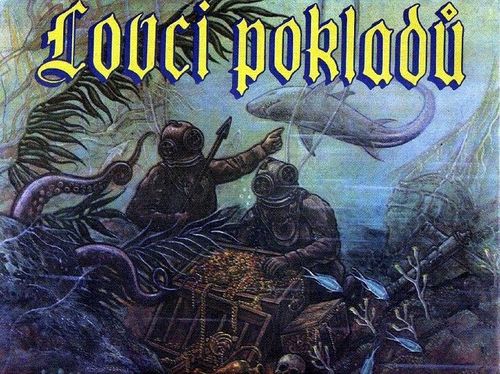
Lovci pokladů
Lovci pokladů Rulebook
Table of Contents
Table of Contents
Contents
- 81 game-board cards
- 4 ship cards
- 41 coin tokens
- 16 sailor figures in 4 colours
Goal of the Game
Each player, a treasure hunter, has a ship and four sailors for their expeditions. The goal of the game is to find the largest possible treasure, protect it from the other players, and bring it to the ship.
Setup
The game-board cards are turned face down, shuffled, and assembled together into a square of 9 × 9 cards. The wind-rose card, which has all of its arrows (points) yellow, is placed in the centre of the square. This is the only card placed face up.
The players agree on or draw lots for the order in which they will play. Each player places their ship next to any card, at the side of the board where that player is sitting (the bow of the ship points toward the card). Each player then places four sailor figures of their colour onto their ship.
Ship Movement
Ships move only along the perimeter of the game board, which represents the sea surface, always one card to the right or to the left. Ships do not enter cards.
A player may choose between moving a ship or a sailor, unless other rules say otherwise. In a single turn, a player cannot move both a ship and a sailor.
Moving a ship around a corner counts as two moves.
Sailor Movement
A sailor may enter the sea only from a ship, and only in a straight (perpendicular) direction. A sailor may not disembark from or board a ship diagonally across the corners of cards.
Inside the playing field, a sailor may move in any direction, straight or diagonal, to any side, but only one square at a time, unless the card they enter directs a different kind of movement.
Basic Rules
The players take turns in the set order, bringing their sailors into the playing field to discover treasures and carry them to their own ship. Before each move, the player turns over the next face-down card that the sailor is about to enter.
The cards, through their symbols, either affect the player's further movement or represent the treasures the player is seeking. After a card is turned, it stays face up for the rest of the game. During the game, any other sailor may enter a face-up card and use it according to its effect.
Card Symbols
Wind rose: The sailor continues on their next move in the direction marked by the yellow arrow. On roses with yellow arrows in several directions, the player continues in one of those directions of their own choice.
Seahorse: Extends the sailor's movement. The player chooses either one square forward and two squares to the side, or two squares forward and one square to the side (like a knight in chess).
Dolphin: The sailor continues one or two squares, at the player's discretion, in any direction.
Starfish: The sailor returns two squares back, in the direction from which they arrived at the starfish. If the sailor carries a treasure, it is left on the last square before the starfish.
Shark: The sailor has fallen victim to a shark and is lost for the rest of the game. The figure drops out of the game, as does the treasure token if the sailor was carrying one.
Stingray: The sailor is thrown off the playing field by the stingray's blow, in the direction of its tail. If the sailor carries a treasure, it is left on the last square from which the sailor struck the stingray. To return to the game, the sailor must first reach their own ship. This is done by moving one square at a time along the perimeter of the board toward the ship, or by the ship coming to the sailor in the same way. If another player's ship blocks the sailor's movement, that ship may take the sailor prisoner, and the sailor must serve its owner.
Turtle: The sailor is delayed by the turtle, and the player may not play with that sailor for one turn. The player may instead make the turn with the ship or with another sailor. A sailor carrying a treasure may also enter this card.
Octopus: A sailor captured by the octopus can be freed only by another of the player's own sailors. If a foreign sailor enters this card, the captured figure is freed but must return to its own ship. If the octopus captures a sailor carrying a treasure, the treasure belongs to the liberator. After liberation, the sailors continue in play with their next move.
Hurricane: The sailor is thrown back onto their own ship. If the sailor carries a treasure, it is left on the square from which the sailor entered the hurricane card.
Island: This card may be entered at any time, but only without a treasure. If the sailor carries a treasure, the sailor must leave it on the last square before entering the island.
Volcanoes: The volcanoes delay the sailor by one to three turns, depending on the number of volcanoes on the card. In the following turns the player must move only with the ship.
Open sea: Cards that do not restrict the sailor in any way.
Treasures
Treasures of various kinds are shown on the cards, with the corresponding values printed above them. Coin tokens of the stated values are placed, in the given number, on a discovered treasure.
The sailor must carry these tokens to the ship one at a time. A token is carried by the player moving the token together with the figure.
The printed value list is: 4 × 50, 3 × 100, 3 × 200, 3 × 300, 1 × 600.
Translator's note: the printed list accounts for 14 tokens, while the component list says the box contains 41 coin tokens. The list is transcribed as printed.
Special Cards
Neptune: A sailor who discovers the Neptune card may use its power to move to any square of the playing field, or to an opponent's ship if no crew is on it. This card may be used only once during the game, and not in the turn in which it was discovered.
Mermaid: Brings its discoverer one of the discovered treasures that is not guarded or carried. The mermaid's help may be used immediately or in later turns, but only once.
If the player decides to use these two special cards later, the sailor must remain on the card until it is used. If an opponent expels the sailor from this card, the spell passes to the opponent. If the sailor leaves the special card before using it, the spell is irrevocably lost.
Tactical Rules
A square occupied by two sailors from the same ship may not be occupied by an opponent.
If a player has only their last sailor in play and turns over a card with volcanoes that requires movement by ship only, that player skips one to three turns.
When a figure is thrown out of play beyond the playing field over a corner card, the player may choose the side of the board that is more favourable for placing the thrown figure off the field.
A discovered treasure does not yet become the property of its discoverer. Other players may also fight for it. A treasure is safe only on the ship, and only if the ship is guarded by at least one sailor.
If an opponent enters a square occupied by one sailor, that sailor is thrown onto their own ship. If the sailor carries a treasure (token), an opponent may seize the token by entering the square occupied by the sailor carrying it. That sailor is thrown onto their own ship, and the token remains on that square.
A sailor carrying a treasure may not enter a card that has not yet been turned over with that treasure. If the player nevertheless wants to turn that card, the player must leave the treasure on the square from which the sailor enters the unturned card, and then, if the card allows, return for it.
If a player's ship is left without a crew, it may be captured by another player's entry, together with all the treasures already delivered to it. Likewise, the sailors at sea belonging to that ship become captives together with any treasures they carry. The player who seized the ship continues in play with the captured ship and the captured sailors. The player whose ship was captured drops out of the game.
End of Game
The game ends when all the treasures have been discovered and carried to the ships, or when one player seizes all of the opponents' ships.
The winner is the player who, at the end of the game, owns the highest total value of treasures.
These rules may be adapted at the players' discretion. Have lots of fun playing!