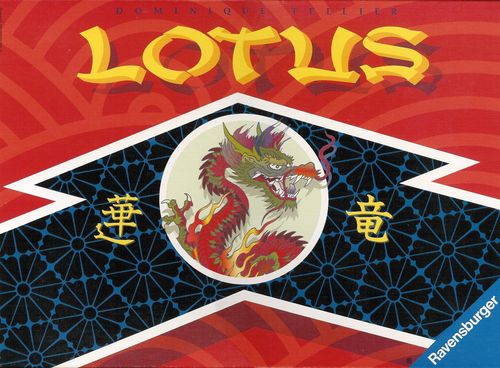
Lotus (1998)
Lotus (1998) Rulebook
Table of Contents
Table of Contents
Goal of the Game
Whoever first moves all of their stones into the goal wins.
Setup
With two players, one player receives the 10 white stones and the other receives the 10 black stones. For each color, the stones are stacked as follows and placed on the start in the middle of the game board:
- one stack of 4 stones
- one stack of 3 stones
- one stack of 2 stones
- one stack of 1 stone
With three or four players, each player receives 6 stones of one color. For each color, the stones are stacked as follows and placed on the start in the middle of the game board:
- one stack of 3 stones
- one stack of 2 stones
- one stack of 1 stone
Course of Play
The youngest player begins. After that, the players take turns, each moving one stone of their own color.
A player may only move a stone that is on top of a stack or stands alone. The distance a stone may move is determined by the height of the stack it is on: it is always as many spaces as the whole stack it lies on is high. Thus:
- a lone standing stone may move 1 space
- the top stone of a 2-stack may move 2 spaces
- the top stone of a 3-stack may move 3 spaces
- and so on
(The rulebook illustrates this with stacks of heights 3, 6, 2, 4 and 1, which may move 3, 6, 2, 4 and 1 spaces respectively.)
Stones move forward only, along the spaces of the game board. There are two entrances (from the start) and only one exit (the goal). Moving backwards is not possible.
(The rulebook shows the START and ZIEL labels with arrows marking the two entrances and the single exit on the board.)
During the game, stones of any color may be stacked on one another in any number. There is therefore no limit on the height of a stack during play.
A player may choose which of their free stones to move. A player may also move a stone that has already been brought into play from the start, even while stones of their own are still on the start.
No Possible Move
If a player is to move and cannot move any of their stones (because none of them is on top of a stack or stands alone), that player may, in this turn, move any one stone belonging to an opponent. Alternatively, the player may pass.
Goal
The goal lies behind the last space of the game board and does not have to be hit exactly. When a player moves a stone into the goal, that player removes the stone from the game board and places it in front of themselves.
Trampoline Space
If, at the end of its move, a stone lands on the "Trampoline space" (the red-outlined blossom), the player may move that same stone once more, by the same number of spaces that the stone had covered up to the Trampoline space.
(The rulebook illustrates the Trampoline space with a diagram of the board.)
End of the Game
Whoever first moves all of their stones into the goal ends the game and is the winner.
Pro Rule
(Advanced players replace the section "No Possible Move" with the following rule.)
No Possible Move (Pro Rule): If a player is to move and cannot move any of their stones (because none of them is on top of a stack or stands alone), that player must pass and wait until one of their stones is no longer blocked.
When the Pro Rule is used with two players, the following must also be observed:
With two players, the player who begins may, on their first turn, set two stones one after the other onto the board according to the known rules. After that, the other player is to move and sets one stone as usual, and so on.