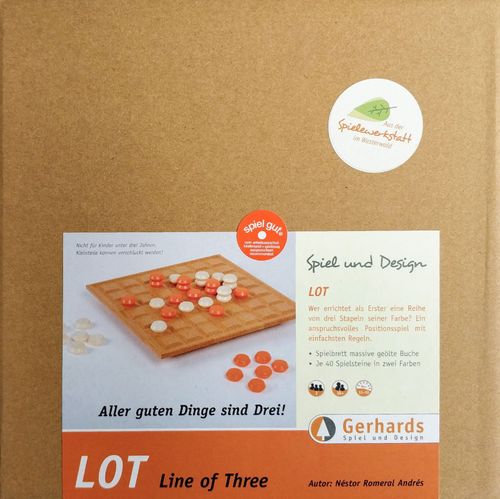
LOT
LOT Rulebook
Table of Contents
Table of Contents
Introduction
LOT is played on an orthogonal grid of 7 x 7 squares.
Two players, black and white, struggle to create a line of three consecutive stacks of 2 pieces each in any direction (orthogonal or diagonal).
If, at the end of the turn, at least one line of three (or more) consecutive stacks of the same colour has been created, the line's owner triumphs. If the board fills up before this happens the game ends in a draw.
Material
- A 7 x 7 board
- 45 black disks and 45 white discs
- Carrying case
Setup
Place the board in the middle of the playing surface. Each player takes a supply of pieces of their colour.
How to Play
White starts. After White's first turn, Black may opt to swap colours (pie rule).
Players alternate turns during the game until one of them reaches the victory condition.
On your turn, do the following in order:
- Lay out a thing on an empty lot: Place a piece of your colour on an empty space of the board.
- Look over that: If at least one line of three or more consecutive pieces (not stacks) in any direction (orthogonally or diagonally) of your colour has been created then you must do the following in order: a. Choose one of the lines of three that have been created and remove two pieces, but leave one there. b. Add one level of tower, by adding another piece of yours to the one you left there, making it a stack.
Example: Black places a piece that creates a line of 3 consecutive pieces. Then removes any two of the pieces of that line and adds a piece on top of the third one, creating a stack.
Example: Black wins with a line of 3 stacks.
Strategy
The 9 centre spaces are too powerful, so if you play with Black, maybe you should swap colours (pie rule) if your opponent makes this opening.
Force your opponent to create an 'undesired' line of three, so he's forced to remove it, thus leaving room for your next move.
Don't make stacks too soon, as you will leave a LOT of room to your opponent.
Block potential lines of stacks, not lines of pieces.
Notes from the Designer
The number of pieces on the board increases by one each time a new piece is added, and decreases by one each time a stack is created. So a turn that creates a line that becomes a stack has no net effect on the number of pieces on the board, but increases the number of free cells by one. This means that, for example, if you could hypothetically fill an entire board with 2-stacks, the number of turns needed to fill up a 7×7 board would be 7×7×3 = 147 moves (but you can't, so the number of turns needed to fill it up as much as possible is a bit smaller). Also notice that the minimum number of turns to win is 9.