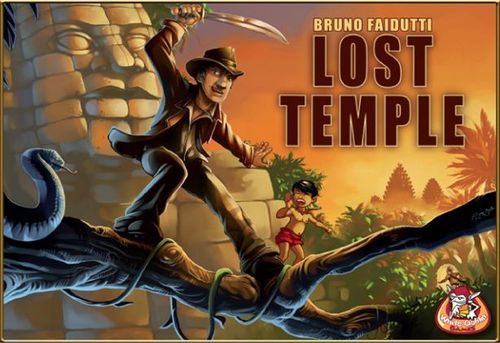
Lost Temple
Lost Temple Rulebook
Table of Contents
Table of Contents
Components
- Game Board
- 8 player meeples
- 9 character cards
- 1 reference card
- 8 player aid cards
- 8 machete tokens
- 18 chance tokens (front and back)
- 1 idol marker
- 50 emerald gems
On the game board:
- This is your starting area.
- Deep jungle space
- Chance space
- Temple
- Village
- End space 6-8 players
- End space 2-5 players
Standard Rules
These rules are for 4 to 8 players. The special rules for 2 and 3 players are at the end of these rules.
Set-Up
- Place the board on the table. With 6 to 8 players, use only the first part of the game board - until you reach the first big temple. With 2 to 5 players, use also the second part of the game board - until you reach the second big temple.
- Each player selects a color and takes the player aid card and the meeple in the corresponding color. Each player places his aid card in front of him to remind everyone of his color.
- Shuffle the chance tokens and place one, face down, on each space with double circles on the game board. The remaining tokens are placed face down, in a reserve, next to the board.
- Shuffle the character cards and deal one to each player. Each player reveals his card and looks at the two icons in the bottom right corner. The leftmost number is the space where the player places his meeple. The rightmost number is the number of gems that the player has at the start of the game. If there is a machete icon next to the numbers, the player also starts the game with a machete token.
- All players give the character cards back. The icons in the bottom right corner of the cards won't be used anymore in the game.
- The first round can start.
- During the whole game, players' belongings (gems and machetes) must be in clear view of all players.
Note: the scout and the child start with a machete.
A Game Round
The game round is made of two phases:
- Character selection
- Movement
Character Selection
If a player drew an idol chance token during the former round, he keeps the idol. Otherwise, the player whose meeple is last in the race takes the idol. If two or more players are tied for being last, the poorest player takes the idol. If there is still a tie, the player who had the idol in the last round keeps it.
The nine character cards are shuffled, and placed face down. Some of the cards are set aside and not used that round, some face up and some face down.
| Number of players | Cards set aside before selecting characters - face up | Cards set aside before selecting characters - face down | Card set aside face down after selecting characters |
|---|---|---|---|
| 4 | 3 | 1 | 1 |
| 5 | 2 | 1 | 1 |
| 6 | 1 | 1 | 1 |
| 7 | 0 | 1 | 1 |
| 8 | 0 | 1 | 1* |
The player with the idol takes the remaining cards. He selects one and places it, face down, in front of him. He then gives the remaining cards to the player on his left, who selects one of the cards and gives the remaining ones to the player on his left, and so on. When the player on the right of the idol player has selected one of the two character cards he received, he discards the remaining one, face down, next to the cards that were discarded at the beginning.
*In an 8 players game, the player on the right of the idol player receives only one character card. He takes the face down character card that was set aside before selecting character, selects one of the two cards he now has in hand, and discards the remaining one.
Movement
After character cards have been chosen, the player with the idol calls out the different characters in the order listed below. When a character is called, the player who has that character shows that card and takes his turn. The player then returns the character card to the center of the table. If no one had chosen this character, the player with the idol moves on to the next character. The players, therefore, do not take turns in seating order, but depending on which character cards they have chosen.
When a character card is called, the player who has chosen this character:
- reveals his character card
- takes one gem from the bank
- uses the movement and/or special ability of his character
The Different Characters
1. Shaman: You call the name of another character. The player who has this character doesn't reveal it yet. Then your turn ends. You don't move your meeple on the track so far.
When the character you have cursed will be called, the player will reveal his character and, before his turn starts, you will swap your meeple with his. This happens even if his meeple is past your meeple in the race and even if it is past a deep jungle space, in which case you don't have to spend a machete. If the cursed character was not chosen by any player, nothing will happen.
2. Thief: You call the name of another character (not the shaman). The player who has this character doesn't reveal it yet. Then you move your meeple forward one or two spaces for free on the track.
When the character you have stolen from will be called, the player will reveal his character and, before his turn starts, you will take all his gem from him. The player will still draw and keep one gem afterwards. If the stolen character was not chosen by any player, nothing will happen.
3. Seer: You look at two of the face down chance tokens on the track. You can then swap them if you want. Then you move your meeple forward one or two spaces for free.
4. Priest: You can pay 2 gems and move your meeple forward to the next temple space. If you can't or don't want to pay, you don't move at all.
5. Elder: You can pay 2 gems and move your meeple forward to the next village space. If you can't or don't want to pay, you don't move at all.
6. Craftsman: You can get a machete from the reserve, for free. Then you move your meeple forward one or two spaces for free on the track. If there's no machete left in the reserve, you don't get any.
7. Scout: You can pay any number of gems and move your meeple forward 1 space for every gem paid.
8. Canoe: You must pay all your gems and move your meeple forward two times that number of spaces on the track, up to a maximum of twenty spaces. You can't choose not to pay, or to pay only some of your gems. If you have more than 10 gems, you must still pay all your gems, but you move only 20 spaces forward.
9. Child: You move for free your meeple forward to catch up with the meeple just before you (even if there is another meeple on the same space as yours).
Deep Jungle Spaces
There are three deep jungle spaces on the track. When the forward movement of a player's meeple would move him through a deep jungle space, the player must, if he has one, spend a machete token to continue his movement past the deep jungle space. If the player has no machete token, he must stop his movement on the jungle space, and will start from here on the next round.
Chance Spaces and Chance Tokens
When a meeple ends his movement on a chance space, the player reveals the token and applies its effect.
Note: if a meeple is on a chance space and doesn't move, he doesn't reveal the chance token. If a meeple is moved to a chance space due to the shaman ability, he doesn't reveal the chance token.
Token Effects
- Take the idol for the next round, even if you are not in last position in the race. If both idol tokens are drawn in the same round, the second one cancels the first.
- Get 4 gems from the bank.
- Move backward 2 spaces.
- Pay 2 gems to the bank.
- Get a machete.
- Move forward 3 spaces.
- Lose a machete if you have one.
The token is then removed from the space and replaced with a random face down token from the reserve, and then shuffled face down with the reserve. If a player loses gems and doesn't have enough gems, he just loses what he has.
Meeples on the Same Space
There is no limit for the number of meeples on the same space.
End of the Game and Victory
When a meeple reaches the last space, the game ends immediately and this player wins. It's not necessary to land exactly on this space, especially when playing the canoe.
The last space is a temple. There's no village past the last temple, so a player cannot reach it with playing the elder.
Rules for 2 and 3 Players
With 2 or 3 players, each player has one pawn but will play two characters every round. The game plays as usual, but each player has two movement turns every round, one for each of his characters. All other standard rules apply.
The Character Selection Is Made As Follows
2 players:
- The idol player (A) shuffles the 9 characters and randomly discards one face up and one face down. He selects one of the 7 remaining characters and passes 6 cards to player B.
- Player B selects one card and randomly discards another, face down. He then passes the 4 remaining cards to player A.
- Player A selects one card, randomly discards another face down, and passes the two remaining ones to player B.
- Player B selects one card and discards the last card face down.
3 players:
- The idol player (A) shuffles the 9 characters and randomly discards one face down. He selects one of the 8 remaining characters and passes 7 cards to player B.
- Player B selects one card and passes the 6 remaining to player C.
- Player C selects one, then passes the 5 remaining cards to player A.
- Without looking at the 5 cards received, player A shuffles them and discards one face down. He then selects one of the 4 remaining cards and passes the 3 remaining cards to player B, etc...
- When all players have chosen their two characters, player C discards the last remaining card face down.