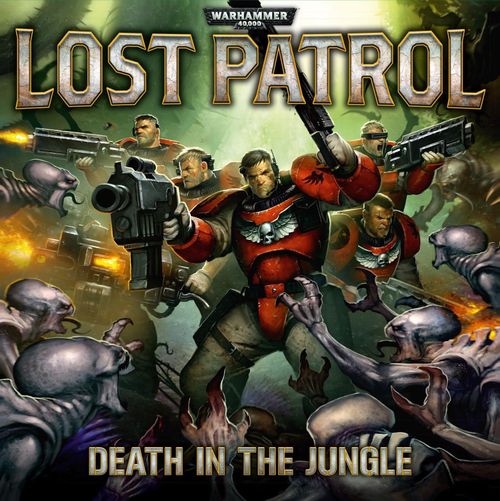
Lost Patrol
Lost Patrol Rulebook
Table of Contents
Table of Contents
The Game
Lost Patrol is a game for two players. One player represents the Space Marine Scout squad and the other player represents the Lurker infested jungle.
This game contains:
- 5 Space Marine Scouts (1 Sergeant, 1 Heavy Trooper, 3 Troopers)
- 30 Tiles (28 Jungle tiles, 1 Clearing tile and 1 Dropship tile)
- 18 Lurker counters
- 3 Dice
Separate the tiles and counters and organise them into separate stacks.
Carefully remove the plastic components from their frames and assemble the Space Marine Scout models as shown in the diagram opposite. The pieces are designed to clip or push together, but you may wish to glue the pieces to make them more durable.
Space Marine Scout Assembly
Carefully remove the plastic playing pieces from their frames (we recommend using clippers if you have them). Fasten the Scout Trooper and Heavy Trooper arms (1x Heavy Trooper arm, 3x Scout Trooper arm) to the Trooper playing pieces and fasten the assembled Troopers and the Sergeant to their bases.
Setting Up
To start the game, decide who will take the Space Marine Scouts and who will take the Lurkers. If you can't decide, roll a dice — the higher scoring player takes the Scouts.
The Lurker player takes the tile stack and removes the Clearing tile and Dropship tile. The remaining tiles are shuffled and placed face down on the table. Place the Dropship tile at the very bottom of the tile stack.
All the Lurker counters are gathered together and placed in a pile or some suitable shallow container. This is the 'Lurker pile'.
Place the Clearing tile in the centre of the table and put the five Space Marine Scouts on it.
The Lurker player places all the jungle paths the Space Marines can see from the Clearing as described opposite. Once the paths are placed, the first turn begins.
The Turn
Play procedes turn by turn until at least one Space Marine Scout escapes or until they are all killed. Each turn is resolved in the following sequence:
- The Scout player takes 'actions'.
- The Lurker removes old Jungle tiles that can't be seen.
- The Lurker places new Jungle tiles that can be seen.
- The Lurker takes 'actions'.
- The Lurker springs ambushes.
- Both players remove overstacked Scouts and Lurkers.
Placing Tiles
The jungle itself is an intelligent, malignant entity controlled by the Lurker player who always places and removes Jungle tiles when required. Although the Lurker player has some choice about exactly how he places new tiles, he must conform to the following rules when he does so.
Each Jungle tile has a path marked on it. Some paths lead straight across the tile from one edge to the opposite edge — these are called straight paths. Other paths curve away, divide or cease abruptly in a dead end.
A Space Marine Scout on a tile is assumed to be able to see along all the paths that lead from that tile to the adjoining tile or tiles. Don't worry about which direction the model is facing — Scouts are highly trained super-fit individuals, so it is safe to assume that they are quite capable of turning to face any direction they want.
In addition, if an adjoining tile is a straight path then the Space Marine Scout can see right along it into the next tile. If that tile is itself a straight path, he can see into the next tile, and so on.
Placing Tiles To Begin The Game
To start the game the Lurker must place Jungle tiles around the Jungle Clearing. The Clearing is unique because it has paths leading in each of the six possible directions. Other tiles have paths going in three directions at the most.
The Lurker player begins by indicating on which of the six open path edges he will place the new tile. Having done so he takes the topmost tile from the face down tile stack. He can rotate the tile any way he wishes, before placing it so that the path joins to the nominated path edge of the Clearing.
Once the first tile has been placed, the Lurker nominates another path edge and repeats the process until all the paths that can be seen from the Clearing are in place.
When placing further Jungle tiles, the Lurker player can rotate the tiles so that paths go in the direction he wants, but he is not allowed to deliberately block a path unless he has no other choice. If he has no choice but to block a path then he must block as few paths as possible. The player can choose exactly how he does this, except that he must always continue the path from the nominated tile.
Note that if a straight path is placed next to the Clearing the Scouts can see right along it, so another tile must be placed on that tile's path edge as well. This can be done straight away or once other paths have been placed — it doesn't matter so long as the Lurker player nominates an edge before placing each tile.
Once no more paths can be seen from the Clearing the game is ready to start.
Placing Tiles During The Game
During the game the Lurker player must place new Jungle tiles when required during the Turn sequence. This is done in exactly the same way as already described, except that the Space Marine Scouts will have moved from their starting position and so will occupy several tiles rather than just the one.
Space Marine Scouts can see down all the paths leading from the tiles they are on, into adjoining tiles and down straight tiles as already described.
The Jungle Got Them!
The jungle is constantly growing and changing, and once in a while it will grow into a loop from which the Scouts cannot escape no matter what they do. If this happens to all the Space Marine Scouts, the Scout player loses — he cannot reach the Dropship and the jungle envelops his troopers.
Separation
Once the Lurker player has finished placing and removing tiles during each turn it is possible to find that the jungle has divided into two entirely separate portions. This happens rarely but it means that the squad is fatally divided and part of it will be lost. The Scout player chooses one portion of the jungle to continue with, the rest is removed along with everything in it! Removed Scouts are dead, tiles are discarded, and Lurkers are returned to the Lurker pile.
Removing Jungle Tiles
Tiles are removed by the Lurker player when required during the Turn sequence. Tiles which are removed are discarded and take no further part in the game.
Tiles are not removed just because they cannot be seen by a Scout from the tile he is in. We assume that it takes a little time for the Jungle to shift and regrow. So, instead, a tile is removed if it could not be seen by a Scout were he able to move up to two tile spaces along the path in all possible directions (ignoring Tangleweed).
Any tile which could not be seen by any Scouts were they to move up to two tile spaces is removed from the jungle and discarded.
When tiles are removed, any Lurkers on those tiles are also removed and returned to the Lurker pile.
The Dropship
The Dropship tile is the last tile in the stack. Once this is placed then no further tiles are removed from the Jungle. From now on the Jungle remains as it is.
Scout Actions
During the Scout player's part of the turn, each Space Marine Scout can make up to two actions.
An action can be to either MOVE or FIRE.
A Scout can therefore either Move and then Fire, Move and then Move again, Fire and then Move, or Fire and then Fire again. Any of these combinations will take up two actions. A Scout does not have to make two actions — it is acceptable to make one action or none at all if the player prefers.
Resolve actions one at a time. So if a Scout Fires but does poorly, the player may decide to Fire again rather than Move.
Each Scout model must complete all of its actions before another model does so. If you only take one action, you cannot go back to that Scout once you have taken actions with other Scouts.
Move
A Scout cannot move off the Jungle paths either into the Jungle or off the tiles. A single Move action will take a Scout one tile space along the path. By expending two Move actions a Scout can move two tile spaces.
The Clearing is especially large and has room for five Space Marine Scouts. All other tiles have room for a maximum of three Scouts. The Scout player may not deliberately move more Scouts onto a tile than it can hold, but sometimes Scouts will be driven into tiles following ambushes. This can result in tiles becoming overstacked.
If a tile contains more Scouts than it can hold then at the end of the turn the excess Scouts stumble from the path into the jungle, never to return! The Scout player may choose which are lost.
Fire
A Scout can shoot at Lurkers in the same tile expending one action as he does so. To determine the effect roll three dice (3D6), or six dice (6D6) if shooting with the Heavy Trooper. Each '6' rolled is a hit and removes one Lurker counter from that tile. Note that Scouts can only fire at Lurkers on the same tile, not at Lurkers which are further away.
Lurker Actions
During the Lurker actions part of each turn, the Lurker player can take up to three actions. These can be all different types of action, or the same, or any mix — it's entirely up to the Lurker player. An action is one of the following:
-
Start a new Lurker Stack. Take two Lurker counters from the Lurker pile and place them on the end of any path to form a new Lurker stack. The end of a path is a tile that leads off into the unknown, so it can't be a dead end tile for example. The exception to this is that the Lurker player can always start a new stack on the Dropship once it has been placed.
-
Grow a Lurker Stack. Take two Lurker counters from the pile and add them to an existing stack. There is no limit to the total number of Lurkers that can form a stack when you do this. However, the most Lurkers you can have in a tile at the end of the turn is six and any excess must be removed. They are returned to the Lurker pile.
-
Move a Lurker Stack. Lurkers do not have to follow paths when they move — they can move from one adjoining tile to another regardless of whether there is a path or not. For each tile space the Lurker stack moves, one Lurker counter is removed from play and returned to the Lurker pile. The stack can move as far as you wish — losing one counter per tile as it does so. A Lurker stack which moves onto a tile containing other Lurkers automatically merges with them to form a single large stack. There is no limit to the size of a stack that has been merged in this way. However, the most Lurkers you can have in a tile at the end of the turn is six and any excess must be removed.
Note that there are 18 Lurker counters in total. This places a limit on the number of Lurkers in the Jungle at a time. If there is only one Lurker left then you may still add to a pile or start a new one, but obviously only the one counter remaining will be placed. If there are no Lurkers at all in the Lurker pile then the player will be unable to start a new stack or grow an existing one until some counters have been killed or removed.
Ambush
Once the Lurker player has finished his actions, any Lurkers on the same tile as one or more Scouts may spring an ambush. This is entirely up to the Lurker player. Lurkers do not have to ambush Scouts just because they are on the same tile — they can just 'lurk' in the undergrowth if preferred.
The Lurker player can also ambush any Scouts which are driven back into a tile containing Lurkers that have not already made an ambush that turn. A Lurker stack can only ambush once in any turn and individual Lurker counters driven into tiles containing Scouts cannot take part in any further ambushes that turn.
It is entirely up to the Lurker player to decide the order in which to launch ambushes.
Tangleweed
The jungle is full of plenty of horrible things besides Lurkers. One of them is Tangleweed. This can be easily recognized by the spikes and thorns as well as the purple spike grass that grows alongside.
Tangleweed tiles have no affect on ambushes or shooting, nor do they affect Scouts moving onto them. However, once Scouts have entered Tangleweed they are liable to get stuck. This means that the Scout player must roll a 4, 5 or 6 on a single dice to move a model off a Tangleweed tile. Roll once per Move action and roll for each Scout separately. If successful, the Scout may move one tile along the path as normal. If he fails, the Scout remains where he is and the action is wasted. However, if this was the Scout's first action of that turn then he may still try to move out with his second action, again needing 4, 5 or 6 to do so.
Tangleweed only affects Scouts. Lurkers actually rather like Tangleweed and aren't slowed down by it at all.
Ambush Score
To work out who wins an ambush, establish the Ambush score for each side.
The Lurker player rolls a dice (1D6). If he rolls the same number as there are Lurker counters in that tile then he adds a bonus of +1 to the total. The Lurker's Ambush score is the dice roll + bonus if applicable, or the total number of Lurker counters in the tile up to a maximum of 6, whichever is greater.
Example: The Scout player rolls two dice (2 & 3) and keeps the 3 because it is the higher result. No bonus applies and 3 is higher then the number of models in the tile, so the Scouts' Ambush score is 3.
The Lurker player rolls a 4, which is the number of counters in that tile, giving him a +1 bonus. His Ambush score is 4 +1 = 5, so the Lurkers win.
The Scout player rolls two dice and keeps the higher score. The lower scoring dice is ignored. If the Sergeant is on the tile add a bonus of +1. If the Heavy Trooper can see the ambush, but is not actually on the same tile, he can give a 'covering fire' bonus of another +1. Either, neither or both of these bonuses can apply depending on circumstances. The Scout player's Ambush score is the dice roll, plus bonuses if applicable, or the total number of Scouts in the tile, whichever is greater.
Note that Scout bonuses may potentially be applied to more than one ambush in the same turn. If the Heavy Trooper can 'cover' several ambushed tiles for example.
Example: The Scout player rolls two dice (5 & 1) and keeps the 5. A bonus of +2 applies (+1 for the Sergeant, and +1 for the covering fire from the Heavy Trooper who can see the ambush, but is not on the tile). The Scouts' Ambush score is 5 +1 +1 = 7.*
The Lurker player has six Lurkers present and rolls a 3. He receives no bonus, which gives him an Ambush score of 6 (as the number of Lurker counters is greater than the number rolled). The Scouts win 7 to 6.
Note: The Heavy Trooper can also provide covering fire for the ambush in the tile behind him if the Lurker player decides to attack there too.
Ambush Results
If both sides have the same Ambush score the result is a draw. Otherwise the side with the higher score wins.
Lurkers Win. If the Lurkers win, one Scout is killed and any remaining Scouts are driven back as described opposite.
Scouts Win. If the Scouts win, one Lurker counter is killed and the rest of the stack is driven back as described opposite.
Draw. In the case of a draw, all the Scouts in the tile are driven back as described opposite. No Scouts or Lurkers are removed.
Removing Kills
Kills are removed by the player who suffers them. In the case of the Scout player, he may therefore decide which of his Scout models will be killed where there is a choice.
'Dead' Scouts are out of the game. 'Dead' Lurkers are returned to the Lurker pile.
Driven Back
If Scouts or Lurkers are driven back then the opposing player may move the models/stack one tile space. The space must be a tile that the Scouts or Lurkers could theoretically move into — Scouts must move along paths for example.
The opposing player may decide to drive the Scouts/Lurkers all back into the same tile or he may split them up over several tiles if he prefers. This is entirely up to the opposing player. Scouts/Lurkers may be deliberately driven into tiles so that there are more models or counters in a tile than is normally allowed. Tiles holding more Scouts or Lurkers than is permitted will suffer extra casualties at the end of the turn when overstacked tiles are reduced.
When Scouts are driven back, they ignore the effect of Tangleweed as described in the Tangleweed special rule.
Note that the Lurker player can deliberately drive Scouts into another stack of Lurkers and ambush them again if he wants! However, each Lurker counter can only make one ambush per turn. Lurker counters which have been driven from an ambush themselves won't take part in further ambushes that turn.
Remove Overstacks
At the end of the turn, players remove Lurker counters and Scouts from tiles which have more Lurkers or Scouts than is permitted. Scouts are swallowed by the Jungle and killed whilst Lurkers are returned to the Lurker pile. Each player removes his own pieces and the Scout player may decide which models he will remove where there is a choice.
There is room on a tile for 6 Lurkers and 3 Scouts, except for the Clearing tile where there is room for 6 Lurkers and 5 Scouts.
Once overstacked tiles have been reduced in this way the turn is over.
Winning The Game
If the Scout player has one or more Scouts in the tile with the Dropship at the end of any turn then he wins.
If all the Scouts are killed or trapped in a Jungle loop (The Jungle Got Them rule) then the Lurker player wins.