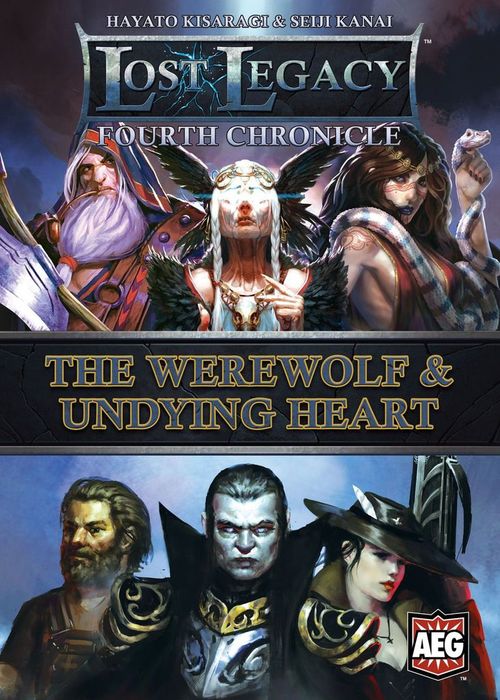
Lost Legacy: Fourth Chronicle – The Werewolf & Undying Heart
Lost Legacy: Fourth Chronicle – The Werewolf & Undying Heart Rulebook
Table of Contents
Table of Contents
Game Overview
Lost Legacy is a game of risk, deduction and luck. Each turn you play a card in order to eliminate other players from the game or discover where the Lost Legacy card can be found. When the deck runs out of cards, the Investigation phase begins. The player who determines where the Lost Legacy can be found wins; if no one finds the Lost Legacy, then everybody loses!
Components
Your game of Lost Legacy should include the following. If it does not, please contact [email protected] for assistance.
- Rulebook (this book)
- 16 Game cards (for The Werewolf set)
- 16 Game cards (for the Undying Heart set)
- 4 Reference cards
- 13 Victory point tokens (used during the Campaign Games optional rule)
2 Games in 1
This Chronicle contains two sets of game cards: The Werewolf and Undying Heart. Each set can be played independently or be mixed together with other sets to create a unique custom set (see "Optional Rules" for details).
Card Anatomy
- Investigation Speed: When the Investigation phase begins, this indicates the order in which players investigate. The lower the number, the earlier you investigate.
- Rarity: The number of glowing dots indicate how many copies of the card there are in the deck.
- Card Name
- Effect: This happens when the card is played.
- Expansion Symbol: This is used to separate cards from the different sets in this Chronicle and when you purchase additional Chronicle expansions. It has no direct influence on game play.
There is a Werewolf expansion symbol and an Undying Heart expansion symbol.
Setup
- Shuffle all 16 game cards to form a face-down draw deck.
- Take the top card from the deck, and without looking at it, place the card sideways next the deck face-down. This forms the Ruins.
- Each player draws one card from the deck. This is the player's hand, and is kept secret from the others.
- Whoever inherited the most awesome legacy takes the first turn.
The basic principle in this game is that all information is hidden. Players may view the cards in their hands, but not the Ruins or the other players' hands.
Example Play Area
The play area consists of the Deck, the Ruins, Your Hand and Your Discards.
How to Play
Lost Legacy consists of players taking turns clockwise around the table. Turns continue until either the deck runs out of cards or all but one player is eliminated.
Taking a Turn
During your turn you must take the following steps, in order:
- Draw: Draw the top card from the deck and add it to your hand. You should now have two cards in hand.
- Play: Choose one of the two cards in your hand and discard it face-up in front of you.
- Effect: Apply any effect on the card you just discarded. You must apply its effect, even if it is bad for you.
- End: If there is at least one card left in the deck, play proceeds to the next player in clockwise order. If the deck is empty, the game proceeds to the Investigation phase.
All discarded cards remain in front of the player who discarded them. Overlap the cards so that it's clear in which order they were discarded, with the most recently discarded card placed on top of the stack. This helps players to figure out which cards other players might be holding in their hand.
Elimination
Some card effects eliminate players from the game. If a player is eliminated, that player discards the card in his or her hand face-up (do not apply the card's effect) and is out of the game: the player takes no further turns and does not participate in the Investigation phase.
If the eliminated player held the Lost Legacy in his or her hand, the card is shuffled into the deck instead of being discarded.
If all but one player is eliminated before the Investigation phase, then the only remaining player wins the game!
Investigation Phase
When the deck runs out of cards, the Investigation phase begins after the player completes his or her turn.
The Investigation phase is resolved in the speed order of the cards the players have in their hands – lowest first. Since players are not allowed to show their cards, someone simply calls out "any 1's? No? Any 2's? Any 3's?" and so on to determine investigation speed order.
Important: If several players have the same investigation speed, they cannot investigate at all.
Also, an X is not a number, therefore that player cannot investigate either.
How to Investigate
Investigation simply means you are revealing a card of your choice, in the hope of finding the Lost Legacy. When you investigate, you must choose to reveal one of the following:
- 1 card from a player's hand (even your own hand)
- 1 card in the Ruins
- 1 card in a player's discards
Then reveal the chosen card to all players. If it is the Lost Legacy, the investigating player wins the game! Otherwise, the next player in investigation speed order investigates. If you have the Lost Legacy, you may investigate your own hand and thus win the game. However, if another player with a lower investigation speed investigates your hand first, then that player will win the game instead.
Each player may only get the opportunity to investigate once during the Investigation phase. Eliminated players cannot investigate.
If no player finds the Lost Legacy during the Investigation phase, then everybody loses!
Optional Rules
To create more variety in your games, there are a number of optional rules you can use. If players want to use any of the rules discussed here, they should make sure that everyone understands and agrees to the rules before the game begins.
Campaign Games
This variant allows players to play multiple games to determine an overall victor of the campaign.
When a player wins a game, he or she receives 1 victory point token, then play a new game following all of the setup rules except the winner of the previous game takes the first turn. A player becomes the victor of the campaign after receiving a number of tokens based on the number of players:
| Players | Tokens |
|---|---|
| 2 Players | 7 tokens |
| 3 Players | 5 tokens |
| 4 Players | 4 tokens |
| 5+ Players | 2 tokens |
Megamix Set
This variant allows up to six players to play the game. Use the following guidelines to create a set of 31 cards:
- Use all 16 cards from two different sets.
- Remove one of the Lost Legacy cards.
If players wish, it's perfectly possible to play with a Megamix Set even with only 2–4 players.
Custom Set
This variant allows players to use cards from both this set and an expansion set to create a unique custom set. Use the following guidelines to create a custom set of 16 cards:
- Have 1 card each with investigation speed 1–5, 2 cards with speed 6 and 3 each with speed 7, 8 and X.
- For cards with speed 6–8 and X, use the cards from only a single set. Don't mix several 7's from different sets, for example.
- Return the unused cards back to the box.
Rule Clarifications
Exploring the Ruins
When another card is placed in the Ruins, place it face-down to the right of any cards already in the Ruins.
When an ability allows you to shuffle the Ruins, mix all of the cards together without looking at them, and then place them in a row.
Start of Your Next Turn
Some effects last until the start of your next turn after you play them. These abilities remain in effect even if the card is removed from your discards before the start of your next turn.
Eliminated Discards
If a player is eliminated, their discards can still be the target for card effects unless specifically stated otherwise.
Face-Down Discards
Any face-down cards in a player's discards lose their effects. However, they can still be the target for card effects.
You may look at any face-down cards in your own discards. You may not look at face-down cards in other players' discards unless an effect allows you to do so.
Missed Turns
If a player must miss their turn and the Investigation phase begins, they still participate in the Investigation phase. If players are using the Campaign Games optional rule, the missed turn does not carry over to the next game.
Card Clarifications
Beastmaster
X is not a number, so a player may play an X and not have to miss their next turn due to the Beastmaster's effect.
The Beastmaster's effect during the Investigation phase only works if another player investigates the card in your hand. You cannot investigate your own hand to win the game.
Crypt Raider
The Crypt Raider can only eliminate a player with one or more face-up X's in their discards: face-down X's are not considered for this ability. If there are no other players with a face-up X, the effect is ignored (you cannot eliminate yourself).
Fortune Teller
The Fortune Teller does not trigger her effect when you play the card (if you play the card, it has no effect). Instead, her effect triggers during your subsequent turns. When you return a card to the top of the deck, be sure to place it face-down without revealing the card to other players.
You cannot use the Fortune Teller if there are no cards remaining in the deck.
Full Moon
If you have more than one card in your hand (by drawing an extra card with the Fortune Teller for example), any of the cards in your hand can be used to eliminate the other player.
If your card is the same as the opponent's card, you may choose not to eliminate the player in order to keep your hand secret or mislead players.
Premonition
If you do not guess correctly, nothing happens. If you guess correctly, you do not have to take another turn or reveal that you made the correct guess. If you guess correctly, you may choose not to take another turn in order to mislead players.
If you guess correctly but must miss your next turn (due to the Beastmaster's effect for example), your current turn ends and play proceeds to the next player as normal. In other words, the extra turn gained with Premonition counts as your missed turn.
Spectre
In order to use the Spectre's investigation effect, it must be in your discards at the start of the Investigation phase.
The Werewolf
The Werewolf may be played, but then must be shuffled into the Ruins instead of being placed in the player's discards.
If the Werewolf is placed in a player's discards for any reason (the player is eliminated for example), the card is immediately shuffled into the Ruins. Therefore, the Werewolf will never remain in a player's discards.
The additional victory point is only awarded If players are using the Campaign Games optional rule.
Undying Heart
This card cannot be played. However, the Undying Heart can still be exchanged with a player's hand or the Ruins by other cards' effects.
Vampire Lord
The Vampire Lord does not trigger his effect when you play the card (if you play the card, it has no effect). Instead, his effect triggers when you are about to be eliminated. When you use the Vampire Lord, you must discard your hand but you are not considered eliminated from the game.
You cannot use the Vampire Lord if there are no cards remaining in the deck.
Village Council
If two or more players are tied for the lowest card, all tied players are eliminated. If this eliminates all players remaining in the game, the player who played the Village Council wins the game. If the player with the lowest card cannot be eliminated (due to an effect like the Villager or Vampire Lord), that player is still considered to have the lowest card and the Village Council is resolved without actually eliminating that player. They must still discard their card and draw a new hand along with all other remaining players.
If you have more than one card in your hand (by drawing an extra card with the Fortune Teller for example), all of the cards in your hand are used to determine the lowest card. If you are not eliminated, you draw a new hand with the same number of cards you had before.
Villager
In order to use the Villager's investigation effect, she must be in your discards at the start of the Investigation phase.
Wolf Attack
The Wolf Attack counts as an X in your discards during the turn that you played it.
If you have two or more X's in your discards, you may choose to look cards in the Ruins and/or another player's hand. For example, if you have two X's you may look at one card in the Ruins and then one card another player's hand.
The Werewolf Lore
One of the Lost Legacies—a device originally designed to save lives—crashed to the ground in the far northern forests. Damaged by the crash, this device was no longer functioning as it was intended. When a handful of injured or sick locals encountered the device, it sought to help them survive in the best way it could—by combining the makeup of their bodies with those of animals. The people affected found themselves into a hybrid of man and beast.
These unfortunate people had become werewolves, shifting between human form and that of a monster under the light of a full moon. When trapped in the werewolf state, the afflicted person is controlled by feral urges to hunt and feed. Werewolves lose the ability of higher reason, trapped by their instincts. Only in rare cases can a werewolf rise above its primal nature. Strong, swift, and lethal, werewolves are apex predators when on the hunt, and no one in the northern forests feels truly safe when the full moon rises.
Beastmaster
An unwary wandering merchant discovered the device, and has slowly begun transforming into a beastman as well. He summons all his strength of will to resist, but the change is inevitable.
Fortune Teller
An exotic woman who seems to know a great deal about the werewolf and the problems plaguing the village. She has advised both those hunting for the beast and those who seek to cure it. She knows of sacred herbs that can miraculously cure any disease, a secret she has shared only with a chosen few.
Villager
This young lass is the sister to the werewolf, making her relationship with the monster unique. Some in the village are suspicious of this girl, believing that she helps the werewolf prowl at night. The truth is that she simply wants her sister back.
Woodsman
A mighty hunter, this veteran man of the woods has sworn to end the werewolf's reign of terror. He has studied the monster's habits, and believes he is now ready to face the creature in combat. He has spent weeks tracking down the werewolf, and on the night of the next full moon, he intends to strike.
The Werewolf
A simple peasant girl from one of the villages in the northern forest was the first to encounter the device and become a werewolf. For many months, she has struggled to resist her werewolf form's urges to hunt and kill. She has only been partly successful, and she fears that she may soon endanger those closest to her. She received a premonition that her fate will be determined on the next full moon. As the pale moon grows in the night sky, so do her fears.
Undying Heart Lore
Ages ago, a strange craft visited this world from beyond the skies. The craft was sundered by a mysterious tragedy, its shards falling to the ground below—scattered across the lands far and wide. On the isle of Vonrathia, one of the Lost Legacies came into the possession of Baron Von Stoke. This nobleman gained possession of the Undying Heart, transforming him into a terrifying vampire. His formerly benevolent rule has turned tyrannical, and he has the used the power of the Legacy to transform his court into blood-sucking creatures of the night.
According to legend, the Baron made an evil bargain with the Undying Heart; upon the rise of a blood-red moon, he will be granted unimaginable power over the people of Vonrathia and begin a thousand years of vampiric rule. A skilled and vengeful vampire hunter has arrived on the island. She has sworn an oath to destroy Baron von Stoke before the blood moon's omen can come true.
Blood Moon
The power of the Undying Heart will reach its ascension when a crimson moon rises, transforming all who live upon Vonrathia into vampires under the Baron's control. Only the death of Baron Von Stoke can stop this terrifying event.
Dark Pact
In accepting the power of the Undying Heart, the vampire lord Baron Von Stoke sealed an unholy bargain—the heart offered him a vision of a thousand-year vampiric empire. In return, the Baron had only to enforce his iron laws and blood tributes upon the entire island of Vonrathia.
Vampire Hunter
Possessing impressive fighting abilities and a grim determination, the vampire hunter stalks her prey with ruthless precision. She intends to slay the Baron and cast his Undying Heart into the sea.
Vampire Lord
Baron Von Stoke was once a responsible and wise ruler of Vonrathia. However, upon his transformation into a vampire, he has become grasping, vicious, and cruel. His only desire is to achieve his apotheosis during the Blood Moon.
Undying Heart
One of the legendary Lost Legacies, the Undying Heart was perhaps originally meant to heal, to extend one's life and salve the ravages of disease. However, this purpose has been twisted into a much darker direction. Now, the Undying Heart sustains life only by taking vital essence in the form of blood from others, transforming those who commune with it into vampires. Eternal life and ultimate power comes with a price...and that price must be paid in blood.