Lost Dice
Lost Dice Rulebook
Table of Contents
Table of Contents
Components
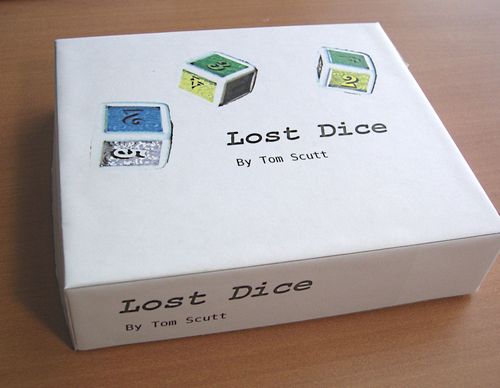
- 3 custom six-sided dice. The faces are given in the designer's post as: die 1
$ 5 4 1 3 2; die 25 4 3 2 1 5; die 31 1 2 5 4 3. The colour faces are printed on the dice template (Lost Dice on the left, Keldice on the right) and are not given as text in the post. - A bit of paper and a pen for each player to keep score.
Rules
Choose a starting player. Players alternate taking turns.
On your turn, roll the three dice.
You can either play the dice or discard the dice.
Playing a Roll
If you play, you choose which die to use for the colour, and the other two add together for the value.
For example, if you throw 2 4 5 you can count that as Yellow 9, Green 7, or White 6.
Black counts as wild if used as the colour, so on a throw of 1 3 5 you can count that as Red 8, Blue 6, or 4 in any colour.
The $ icon stands for investment. This can be used as the colour, in which case it is wild. If used as one of the value dice, the other value die is simply ignored, so a throw of 2 3 $ counts as a Yellow Investment, a Blue Investment, or 5 in any colour.
You must now note this down. The easiest way is to write "R Y B G W" at the top of the paper and list any values and investments underneath.
Normal Lost Cities rules apply: you can only write down a number if you have not previously written down a higher or equal number in that colour/column. The only exception to normal Lost Cities rules is that you can still play Investments in a colour as long as you have not written down more than two numbers in that colour.
If you cannot legally play on your throw, you must instead discard it.
Discarding
If you choose to, or are forced to, discard, then your opponent has the choice to use the result that you rolled rather than throwing the dice on their turn.
You also have the option to 'pass' on your turn. You may want to do this right at the end of the game if you think you are more likely to improve your opponent's position than your own.
Game Ends
The game ends when each player has rolled the dice 25 times. For these purposes, using an opponent's discard or passing still counts as a roll. Keeping a tally of your discards and passes makes it easy to keep track of how many times you have rolled in total.
Scoring
Scoring is exactly the same as Lost Cities. A colour/column is worth 0, unless you have anything in it, in which case it is the total of the values in that column minus 20. Having one, two or three investments in a colour multiplies that colour's total by 2x, 3x or 4x. Finally, if you have a total of eight or more values/investments in a colour, you get a bonus of +20.
Example of scoring from finished game: the designer's post shows a worked example as an image, which is not reproduced in the text.
Notes
Normal Lost Cities strategies work with a few tweaks. It seems to be worth starting a new colour half way through the game to soak up low values that you roll towards the end.
The highest score the designer had reached so far was 58, but the designer is sure you could get over 100 with a bit of luck and judgement.
Solo Play
If you fancy playing solo, the designer advises using 30 rolls rather than 25.
More Players
The designer has not tried playing with more than two, but sees no reason it would not work. Discards go round the table starting with the player on the active player's left, until a player uses it or all players have declined it. If a player uses a discard, they skip their turn. You will probably need to lower the number of rolls to 20 each.
Keldice (Variant)
Keldice is a variant from the same designer's post, with its own rules. It uses the right-hand column of three dice on the template.
This is a variant which also uses three custom dice (the right-hand column of three dice in the earlier template).
It is based on Lost Cities, thus making it the dice game of the tile game of the board game of the card game.
It uses the same basic mechanics as Lost Dice (i.e. throw three dice, choose which to use as the colour, add the other two together for the value). It has the following differences:
- Each player rolls the dice twenty times. As with Lost Dice, if you choose not to use your throw, then your opponent has the choice of whether to keep the values you rolled, or roll the dice again.
- If the two dice chosen for the value have the same bonus symbol, then you get that bonus: 2VP, wishing stone or extra roll. Extra rolls do not count against your 20 rolls.
Example: You roll 4 5 2. You can count this as Red 7, Blue 6 or 9 in any colour. If you choose to count it as a Blue 6, then you get a wishing stone, as the 4 and 2 both have this as the bonus symbol.
Sequences can go either up or down, and it is fine for one of your colours to go up while another goes down.
At the end of the game you score 0, -4, -3, 2, 3, 6, 10 VP for 0, 1, 2, 3, 4, 5, 6+ values in a colour; and -4, -3, 2, 3, 6, 10 for 0, 1, 2, 3, 4, 5+ wishing stones.
Designer's Note on Keldice
Design note from the designer: "I dug this out of my big book of unfinished game designs... I last worked on it in February 2001, but could never quite get it to click. In that version, the player rolled normal d6 and coloured dice. The restriction imposed in this contest of not being able to use d6 made me think about how to combine the colours and numbers into one dice. The result is a much better game... This just proves the point that was made in a design thread elsewhere that constraints often help the design process rather than hinder it."