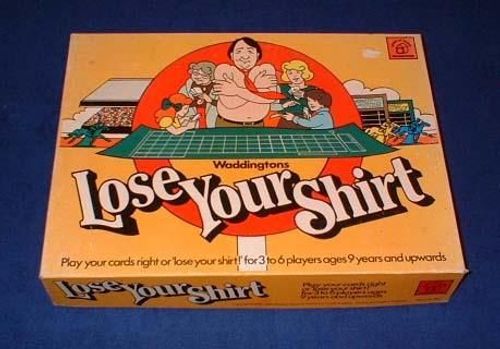
Lose Your Shirt
Lose Your Shirt Rulebook
Table of Contents
Table of Contents
Game Contents
Playing area; 54 cards; 6 horses; money (40 x 10 notes; 40 x 50 notes).
Object
The object of this game is to convert your original 100 stake money into as much cash as possible during the course of a race meeting. Players bet on each race and, by playing their cards right, endeavour to get their horse across the finishing line either in first or second place. But take care - bet too heavily and you can lose your shirt!
Setting the Game Ready
- Each player receives 6 only 10 notes and 1 only 50 note (100 in total). The remaining 10's and the remaining 50's form the bank and all win and place dividends are paid from this.
- Players elect a banker who will pay out all dividends and be the first dealer.
- Place the six horses numbered 1 - 6 in the appropriate starting stalls.
- From the pack of cards take out the 12 indicator cards, i.e. 6 WIN/PLACE cards and 6 JACKPOT/LOSE YOUR SHIRT cards.
- Each player receives a Win/Place card and a 'Jackpot/Lose your shirt' card. If less than six players there will be indicator cards remaining. These are put aside and not used in the game.
- Decide how many races are to be played. Eight races is the suggested number but this may be varied as long as all players agree.
The Cards
The pack consists of 12 indicator cards and 42 playing cards.
Each player receives two indicator cards at the start of play. There is a WIN and PLACE card. The way this is placed will indicate a player's bet, i.e. if WIN is face up on top of a player's stake, this indicates he is betting for a win. There is also a JACKPOT card. When this is placed on a player's stake it indicates the player is betting for the JACKPOT. The reverse of this card has no significance.
The 42 playing cards are used to play the game. These are made up as follows:
- (a) Horse movement cards - there are five cards for each horse number, e.g. Horse 4 forward 2 (2 cards), Horse 4 forward 3 (1 card), Horse 4 forward 4 (2 cards). This makes 30 cards in total (5 cards for each of the 6 horse numbers).
- (b) 'Any horse' cards - there are 6 'green spot' cards which read 'ANY HORSE BACKWARDS 2', and 6 'red spot' cards 'ANY HORSE FORWARD 3'. This makes 12 cards in total.
Dealing the Cards
The cards are used in the following way:
- (a) ALL 42 CARDS ARE USED if 3 or 6 players. The cards are thoroughly shuffled and dealt singly face down to each player (e.g. if 3 players, each receives 14 cards; if 6 players each receives 7 cards).
- (b) ONLY 40 CARDS ARE USED if 4 or 5 players. TWO CARDS MUST BE REMOVED - these are a 'red spot' and a 'green spot' card. These are placed aside with the extra indicator cards and are not used in play. The cards are thoroughly shuffled and dealt singly face down to each player (e.g. if 4 players, each receives 10 cards; if 5 players, each receives 8 cards).
Betting
After consulting cards in their hands, each player decides which horse in his hand he feels will have the best chance of winning. THIS DECISION IS KEPT SECRET AND NOT REVEALED TO ANY OTHER PLAYER EITHER VISUALLY OR VERBALLY.
To record this decision each player takes one of the horse cards of the number he has selected from his hand and places it FACE DOWN on the table beside him. This card is not lost from his hand as he can play it at any time during the race. It merely signifies which horse he has selected to bet on. NO OTHER PLAYER SHOULD SEE THIS CARD.
Once a selection is made it cannot be changed.
Bets are now placed. Players have three options open to them:
- Bet for a win (their selected horse MUST WIN).
- Bet for a place (their selected horse MUST BE FIRST OR SECOND). There is no third place!
- Bet for the Jackpot (to win the Jackpot their selected horse must WIN).
To indicate a bet the appropriate INDICATOR CARD is placed face up on top of the stake money beside each player.
Stakes
- (a) There is no maximum stake for a win. Players may put as much as they choose on a horse for a win. The minimum bet is 10. The return is 5-1.
- (b) There is no maximum stake for a place. Players may put as much as they choose for a place. The minimum bet is 10. The return is 2-1.
- (c) The Jackpot may only be entered with a stake of 50. Obviously the Jackpot option will not become worthwhile until after the first 2 or 3 races BECAUSE IT IS MADE UP OF ALL LOSING BETS. If a player bets and loses, HIS STAKE MONEY GOES INTO THE JACKPOT POOL IN THE CENTRE OF THE BOARD.
If a player bets and wins (on a win or a place bet) he is PAID OUT FROM THE BANK. WIN pays 5-1, i.e. player receives 5 times his original stake from the bank. PLACE pays 2-1, i.e. player receives 2 times his original stake from the bank.
THESE ODDS ARE PAID OUT REGARDLESS OF THE NUMBER OF PLAYERS BETTING ON ANY PARTICULAR HORSE. IF TWO PLAYERS HAVE SELECTED HORSE No. 2, THEN THEY WILL BE PAID OUT ACCORDING TO THE ODDS JUST AS IF THEY HAD BEEN THE ONLY PLAYER ON THAT HORSE.
If a player bets and wins on the JACKPOT, he collects ALL the money in the Jackpot. The losing bets on that race, however, are not included. THEY START THE NEXT JACKPOT OFF.
If more than one player bets on the Jackpot and wins, the money is shared out equally to the nearest 10 and any remaining is left in the Jackpot pool.
IF A PLAYER OR PLAYERS BET ON THE JACKPOT AND LOSE, THEIR STAKE MONEY GOES INTO THE JACKPOT POOL.
The Race
All players MUST bet. When this has been done a race is ready to commence. The dealer starts. He selects a horse card from his hand and plays it face up. (The number in the green circle in the top left-hand corner is the horse number. The red figure is the number of spaces it moves.)
That player now moves that horse the number of spaces indicated. HE MAY ONLY MOVE THE HORSE INTO AN ADJACENT LANE ONCE DURING THE COURSE OF ONE MOVE.
The next player, on the dealer's left, now plays a card and moves a horse in the same manner. Players continue in turn, playing a card and moving a horse.
A GREEN SPOT CARD (move ANY horse backwards 2 spaces) or a RED SPOT CARD (move ANY horse forward 3 spaces) can be played at any time instead of a horse card. The player playing such a card moves any horse he chooses the appropriate number of spaces. THE ONE LANE CHANGE PER MOVE STILL APPLIES.
A player can play his SELECTION CARD (the card face down beside him indicating which horse he has bet on) at ANY time when it is his turn. He moves that horse the number of spaces indicated in the usual way. HE DOES NOT, HOWEVER, PLAY THIS CARD ON TO THE CENTRAL PILE. HE MERELY TURNS IT FACE UP. IT REMAINS BESIDE HIM TO PROVE WHICH HORSE HE BET ON.
General Race Rules
- Two horses can NEVER occupy the same square.
- A horse can only change to an adjacent lane ONCE during the course of one move. If it is blocked it must move the most number of spaces it can.
- A horse MUST be moved the FULL number of spaces indicated in each turn unless it is blocked. This applies to both red spot and green spot cards.
(Illustration note: a horse card with a move of 3 spaces - the horse may move to an adjacent lane once in the course of a move; it can therefore move to a blocked-free lane. A horse with a move of 3 that can only move 2 of the 3 spaces would move to the option so it is clear for a future move.)
Winning the Race
The winner of the race is the first horse to cross the FINISH line. Second in the race is the second horse to cross the FINISH line.
When the second horse crosses the FINISH line the race is ended and the pay out begins. After the pay out all the cards are gathered up, reshuffled, and the next player in turn becomes the dealer.
IF NO HORSE HAS CROSSED THE FINISH LINE AND ALL THE CARDS HAVE BEEN PLAYED, THE CARDS ARE RESHUFFLED AND PLACED FACE DOWN. The selection cards (cards beside each player which will all have been turned over) are NOT INCLUDED in this shuffle. The original dealer turns over the top card and places it face up. He moves that horse, or uses the red or green spot card if it is turned up. Players continue in turn until the second horse crosses the FINISH line.
In some instances the first horse will cross the line before all the cards are played, but not the second horse. In either case the cards are shuffled and played as described above until the second horse crosses the FINISH line.
Pay Out
All win and place bets are paid out by the banker. A jackpot winner or winners receive all the monies in the Jackpot pool, but not the losing bets on the race just concluded. These start the new Jackpot off.
If the bank runs out of money it may issue I.O.U.'s. A player may never issue I.O.U.'s.
Losing Your Shirt
It is possible for a player to 'lose his shirt' or go broke in the course of the game. In this case he is out of the betting part of the game. He will still receive his cards and will play them in the same manner as the other players. HE WILL NOT, HOWEVER, SELECT A HORSE. All his cards will remain in his hand and be played from there.
Strategy
There is some strategy in 'LOSE YOUR SHIRT!' Players will discover this for themselves - sometimes to their cost! In general, however, it does not pay to reveal your selection too soon. In some instances it is better to 'bluff' your opponents into thinking you have selected a different horse. Remember everyone is playing for everyone else. The art is to get your selected horse to the line first, or second!
Rules in Brief
- All players must bet on each race.
- Selected horses MUST NOT be revealed visually or verbally to any other player until after the race has started.
- Bets placed must be visible to all players under the appropriate bet indicator card. Once placed, a bet cannot be changed.
- The selected horse card can be used at ANY time during the race. It is turned over on the table beside the player and NOT played onto the central pile.
- The deal follows in turn from the left of the original dealer.
- The odds on a win are 5-1; the odds on a place are 2-1. There is no maximum bet on a win or a place. The Jackpot stake is a fixed bet of 50 - winner takes all. (If more than one winner, Jackpot pool is divided equally to nearest 10).
- All losing bets including the Jackpot bet go into the Jackpot Pool for the next race or races.
- All win and place pay outs are made from the bank.
- A horse may change lanes only ONCE in the course of a move. It may only move to an adjacent lane.
- If a horse is blocked it must move as many spaces as it can. Two horses can never occupy the same space.
- Unless a horse is blocked, it MUST be moved its full number of spaces.
- The winner of the race is the FIRST horse to cross the FINISH line. Second in the race is the SECOND horse to cross the FINISH line.
- If either first or second hasn't been decided and all the cards in players' hands have been played, including their selection cards, THEN THE CARDS IN THE CENTRE ONLY are shuffled by the dealer and turned FACE DOWN. The dealer starts off by turning up the top card and placing it face up. He moves a horse according to the card. Play continues this way in turn until the race is finished.
- The winner of the game is the player with the most cash at the end of the race meeting (8 races or whatever was decided at the start).