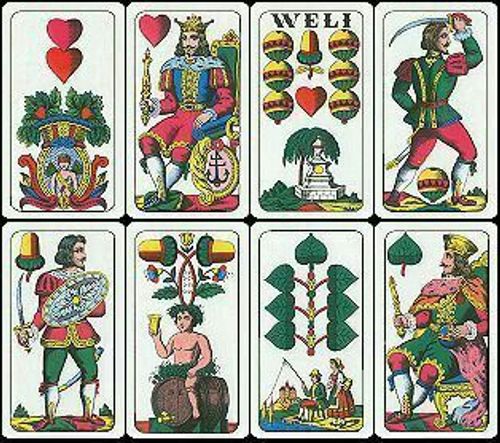
Lórum
Lórum Rulebook
Table of Contents
Contracts
1. Hearts (Pirosfogás)
Trick-taking game in which the aim is to avoid taking hearts. Each heart taken costs 1 chip. If all four players take hearts these chips are paid to the pool. If three players take hearts the fourth player collects the 8 chips. If two players take hearts, the two players without hearts share the chips taking 4 each. But if one player takes all the hearts that player collects 8 chips from each opponent (24 chips in all).
2. Obers (Felsőfogas or Filkós)
The aim is to avoid taking tricks containing Upper Jacks (Obers). The Ober of acorns costs 1 chip, leaves 2 chips, balls 3 chips and hearts 4 chips. As in the first contract the chips are paid to the pool if the players take an Ober each. If three players take Obers the fourth player collects the 10 chips, if two players take Obers the other two collect 5 chips each. If one player takes all four Obers that player wins 10 chips from each opponent (30 chips in all).
3. No tricks (Ütesfogas or Bettli)
The aim is to avoid taking tricks or to win all 8 tricks. Each trick costs 1 chip and the payments work in the same way as in contract 1.
4. Quads (Kvárt or Schnips-schnaps-schnur)
The player to dealer's right leads any card. Whoever has the next higher card of the same suit plays it, then the next card, then the next. The VII counts as the next higher card above the Ace. Four consecutive cards complete the trick, which is set aside. Later in the game a trick may end with fewer than four cards if the next required card is in no one's hand because it has already been played. The trick is set aside and whoever played the last card leads any card to begin a new trick. When a player runs out of cards the play ends immediately. This player is the winner and is paid 1 chip by each other player for each card remaining in their hands.
5. Fast Train (Gyorsvonat)
The player to dealer's right leads any card. The next player must play a card that is one rank higher, but not necessarily the same suit. A player who does not have a card of the required rank must pass and it is the next player's turn. This continues around the table, VII following Ace, until some player runs out of cards. This player is the winner and is paid 1 chip by each other player for each card remaining in their hands.
6. Hairy Monkey (Szőrös majom)
Trick-taking game in which the only aim is to avoid taking the King of hearts. The player who wins the trick containing the King of hearts must pay 10 chips to the pool.
7. Lórum (also known as Dominó)
The player to dealer's right determines the starting rank. Four piles are built up in suit, each beginning with this rank. At your turn you must either start a new pile by playing a card of the starting rank or continue a pile by playing the next higher card of that suit. VII follows Ace. You must play a card if you can. If you are unable to play you pay 1 chip to the pot. The first player who runs out of cards is the winner. The other players must pay 1 chip to the pot for each card remaining in their hands. The winner then takes the whole pot, including any chips paid into it in previous deals.
Variants
Some deal the cards 4 at a time or in batches of 3, then 2, then 3 rather than in pairs.
The selection of contracts and the order in which they are played varies from place to place. Here are some more contracts that are sometimes played in addition to or in place of some of those listed above.
101
Four cards are dealt to each player, and the remainder of the deck is placed face down in the centre of the table as a draw pile. Starting from the player to the right of the dealer, each player in turn discards any one card face up onto a common discard pile, and draws a replacement card from the draw pile. Suits are irrelevant to the play of this deal. When discarding cards, the card value is added to a running total and the new total is announced by the player discarding, using the following values:
- Ace = 11
- X = 10
- King = 4, Ober = 3, Unter = 2
- IX = 0
- VIII = 0
- VII = 0
(By convention, when a card with zero value is played, instead of repeating the current total the player says "potya", a Hungarian word meaning "something worthless, of no value".) Play continues until the running total becomes greater than 101. The first player to discard a card causing the total to equal or exceed 101 loses and must pay 10 chips into the pool. If the draw pile is exhausted before this occurs, play continues without replacing the cards played.
Makk alsó, piros király, utolsó ütés (Acorn Unter, Heart King, last trick)
Trick-taking game in which the player who takes the Heart King, the player who wins the last trick, and the player sitting opposite the player who takes the Acorn Unter must each pay 10 chips into the pool.
Notes
The method of scoring involving a pool which is collected by the winner of the last deal of each set of 7 assumes that the contracts are played in a fixed sequence. The variant in which the first player chooses the contract after the deal is evidently rare in Hungary. It is also incompatible with the variant contract 101 which requires a different deal.