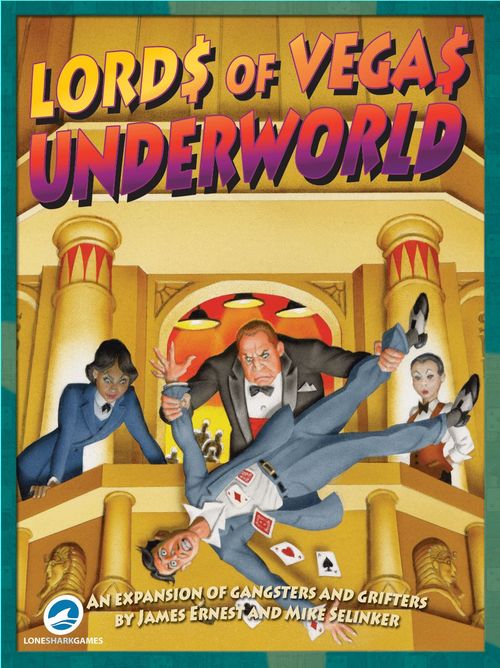
Lords of Vegas: Underworld
Lords of Vegas: Underworld Rulebook
Table of Contents
Table of Contents
Summary
The Underworld™ expansion introduces a new deck of Underworld cards. You can acquire these cards to change how you play the Lords of Vegas™ game.
Components
The Underworld deck contains 52 cards, including 6 rules cards. There is also an Underworld board.
Setup Changes
Set up Lords of Vegas normally (with or without the Up!™ expansion). Shuffle the Underworld deck and place it on the leftmost space on the Underworld board, leaving room for a discard pile.
Give each player a player aid card, replacing the action cards from the base set; it shows how to take a turn on one side and all the actions you can take on your turn on the other.
Gameplay Changes
All rules from Lords of Vegas apply to Underworld. A new action called "Acquire" is added.
Turn Changes
At the start of each turn, before you turn over a property card, turn over an Underworld card onto the board, sliding the rest down. (The first player will have only one card exposed.) If there would now be 4 cards in the line, discard the oldest one; if the deck is empty, no more cards are available. Then draw a property card and play proceeds as normal.
Action – Acquire
Once per turn, as an action, you may acquire a card from the line by paying its cost to the bank.
Example: There are 3 Underworld cards out when Purple begins her turn. She draws a new card, a July 4th Party, and puts it at the back of the line. Then she discards the oldest card, a Shady Deal.
Player Aid Cards
The Underworld player aid cards detail all the actions from the base set, Up!, and Underworld. On the other side are the steps of a turn.
Underworld Card Features
Underworld cards have several features.
-
Costs. All cards have costs in millions of dollars in the upper left corners. To acquire a card, you must pay the cost. A few cards have a $0 million initial cost; these usually get you a benefit up front but at a later downside. (Sometimes a cost is shown with the letter "m," so $5m is $5 million.)
-
Point values. Some cards have point values in the upper right corners. These cards' point values are added to your score on the scoring track if you have them at the end of the game; negative values will lower your score. Cards' end-of-game point values are not subject to the breaks in the scoring track; instead, determine your score on the track, then modify it by the points in the upper right corners of your cards. Regardless of what cards say, if any player reaches the "instant win" space, the game ends immediately; however, the player who reaches the 90-point space might not actually win the game, once all cards are accounted for!
-
Effects. Some cards have effects. Some cards' effects happen right away; these cards are discarded immediately after their effects happen. Some of these effects score or combine with points immediately; these points are subject to the breaks in the scoring track. Other cards stay in front of you until you are told to discard them. Some of these let you take money from the bank or card and put it into your stack of money; if a card says to put money on it, you can't spend it until it tells you to take it off the card.
-
Actions from effects. Some effects are actions. An action can be taken only on your turn, and cannot be taken while you are taking another action. For example, you can't use an Accountant to increase the value of a die in the middle of a reorganization. If a card calls for an action, it does not stop you from doing that action again.
-
Colors. Some effects only affect certain colors of casinos. The logo for a card's color will appear in its upper right corner.
Example: Purple has 18 points. She now has 3 cards to choose from, and already has a Private Jet, which lets her spend $1 million to score 1 point on her turn. After taking some actions, she decides to acquire the card July 4th Party, which she discards to score 4 points. She pays $5 million to the bank and takes the card. Then she spends $1 million to score 1 point from her Private Jet, which she adds to the 4 she gets from July 4th Party. Scoring 5 points, she goes up 2 spaces on the track. She now has 23 points.
(The example's illustration is labeled "discard for 4 points" on the July 4th Party card and "pay $1million for 1 point" on the Private Jet card.)