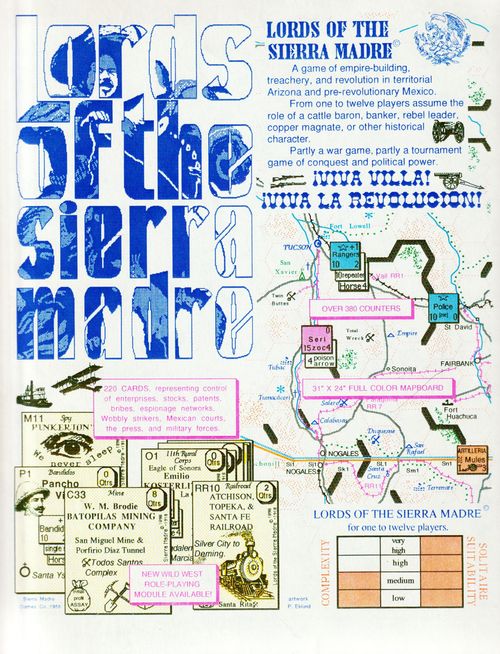
Lords of the Sierra Madre (1988)
Lords of the Sierra Madre (1988) Rulebook
Table of Contents
Table of Contents
- Summary of Play
- 1.0 Strategic Quarterly Turns
- 1.2 Quarterly Turn Sequence
- 2.0 Tactical Turns
- 3.0 Politics and Victory Conditions
- 4.0 Charts
- 5.0 Historical Background
- 5.1 The Hacendados
- 5.2 The Jefes Politicos
- 5.3 The Indian Tribes
- Economics-Only Intro Game
- Explanation of Combat Results on All Tables
Summary of Play
From two to a dozen players randomly select a hacendado identity card, (One of the rectangular cards with C1 through C12 in the upper left hand corner). GOLDEN cards are for the hacendado tournament game; GREEN cards (expansion kit) are for the manifest destiny tournament game.
Shuffle the square cards and place four on each year on the mapboard time track. Flip the first card (for the first quarter 1898) over. Give each player the number of gold pieces (either zero, one, or two) indicated on the lower right corner of the card. Gold pieces (Au) are given from a stack of pennies representing the treasury.
If any player wishes, they may buy, for a penny, any card (except "E" cards) flipped over each quarter. If more than one player is interested in the card, the high bidder gets it. In case of ties, the high roller pays for the card. Pennies paid for cards are given to the treasury. Losing bidders get their money back.
After a card is purchased, it still must be capitalized. The purchaser must pay one penny (abbreviated 1 Au) each quarter for the number of quarters listed in the upper right hand corner of the card. This is kept track of on the hacendado calendar. After the card is completely paid for, or "mature", it is placed on the bottom track of the calendar according to its quarterly profit listed in the lower left corner (if it is a C card) or leadership rating (if it is a troop card such as B, G, O, or P).
Haciendas are different from other C cards (C for construction) in that profit is obtained every summer and not every quarter. Each summer a player with a mature hacienda may either receive his profit or increase the card's position on the profit track one step.
The profit of a mine is found by rolling on Table 1.3.4 (see mapboard) when its C card matures.
The rectangular cards, called THINCARDS, include the control of government troop counters and railroads. They may be bid upon at any time per 1.2.6 & 1.2.11 by players (see Map 4.1 on the back of any of the 12 calendars).
After the last quarter of 1911 (or after the predesignated time limit for the game is up), the player with the most gold wins. (All property is assumed nationalized or burned in the revolution).
EXPANSION KIT: Another tournament game, "Manifest Destiny", using different cards is described in Section 7. Still other Scenarios are described in Section 6; these have tactical turns only with no cards, coins, or strategic turns.
1.0 Strategic Quarterly Turns
1.1 Game Set Up
Hacendado Tournament Game
1.1.1 Shuffle the square golden cards and place four, face down, on each year (1898 to 1911) on the game board track. The thin golden cards are put in a pile face up.
Components: THIN CARDS, Qty: 62. SQUARE (Quarterly) CARDS, Qty: 158.
1.1.2 There are twelve golden thin cards with portraits called Hacendado cards. Hacendados are powerful landowners. Each player chooses one at random. The card specifies the location of the hacienda (ranching farm over 10,000 hectares large) that the hacendado owns at the start of the game. Place a white hacendado counter (marked "0 LEADER") on that mapboard hex, this represents the player's personal man. Mapboard locations are coded with an upper case letter abbreviating the territory, a lower case letter encoding the column, and a number encoding the row. See Map 4.1, page 17.
EXAMPLE: The hacendado card C7 for Don Rafael Ysabel specifies Hacienda Cocorit located at Sp26. That is, the Δ located in Sonora territory, column p, the 26th hex down. This is the Δ labeled "C7" on Map 4.1.
1.1.3 Each player gets a HACENDADO CALENDAR. Place the Hacendado card on the bottom track in the number 1 box symbolizing both the size and yearly income of the hacienda. A turn marker is placed in the "Winter, 1898" box.
1.1.4 Turn over the first card, representing an event or card for sale in the winter quarter of 1898. See 1.2.
1.1.5 A pile of pennies represents the treasury, where each penny denotes a 20 kg gold bar or 1000 gold Eagles, abbreviated 1Au. (Worth 20,000 pesos, or $10,000).
1.2 Quarterly Turn Sequence
(First one is winter, 1898).
1.2.1 Turn over one quarterly card on the time track.
1.2.2 INVESTOR'S CAPITAL Each hacendado is given the amount of investor's gold pieces shown in the lower right corner of the card turned over.
EXAMPLE: [penny symbol] = each player receives 1Au (a penny).
1.2.3 PROFITS Any C cards on the bottom (profit) line of their calendar net a profit per 1.3.3, next page.
1.2.4 CAPITALIZATION One Au is paid for each card on the hacendado's calendar timeline and thus immature per 1.3.1.
1.2.5 CARD AUCTION Except for E cards, the overturned card is bid on by the players. Each one interested puts a penny on the card, and ups the ante if necessary to outbid competitors. In case of ties where none is willing to go higher then the high roller buys it. Losers get their bids back. If no player puts any money on it, it goes into a discard pile.
E cards are also executed and discarded at this time.
1.2.6 THIN CARD AUCTION Players may now purchase thin cards (troops, police, weapons, railroads, transport). They may also sell or trade any of their cards if another player wants it. See Map 4.1, pg 17.
1.2.7 MATURATION Players may flip over any W, C, or RR cards that have matured on their time line and place them into the bottom track of their calendar per 1.3.1. Roll for assay profit if its a mine, see Table 1.3.4 on page 3 or on the mapboard.
1.2.8 COUNTERS If any W, B, G, O, or P cards are purchased, the associated counters are placed on the board per 1.3.
1.2.9 MORDIDO Players announce if playing an M card or a strike card (see 2.7.12) by discarding it.
1.2.10 TACTICAL TURNS (Not used in quick game 3.4) If any players wish to move any of their counters, then Tactical Turn 1 commences (See 2.1).
NOTE: For this Hacendado Tournament Game, the Event Table 4.3 is not used, and no tactical moves are allowed in winter (due to the lack of forage).
1.2.11 On or after the fourth tactical turn, players are allowed to bid for thin O or B cards, (see 1.3).
1.2.12 After all agree that tactical movement is over that quarter, all counters are returned to their home base and reinverted if depleted per 2.6.5. Move the turn markers on each calendar ahead one.
1.3 The Cards
A new card is revealed every quarterly turn. Each card is one of the following types:
- E = Event Card
- W = White Card (Auctionable Item)
- B = Blue Card (U.S. Troop counter)
- O = Orange Card (Mexican Troop counter)
- G = Gray Card (Foreign Troop counter)
- P = Pink Card (Rebel Troop counter)
- M = Mordido Card ("mordido" = bribes)
- C = Construction (building of an enterprise)
- RR = Railroad Card (building of a rail line)
E Cards. These cards represent some event. They are the only cards not auctioned; all other cards are auctioned to the highest bidder (if any) per 1.2.5.
Example card E12, FAMINE! Beginning the E card phase this quarter, lower the profit of all haciendas and slave plantations by three and that of mature mines by one. Gold/Silver and Copper Assay down one. INVESTOR'S QUARTERLY CAPITAL: Each player receives 1 Au this quarter per 1.2.2.
W, B, O, G, P Cards. The player winning a W, B, O, G, or P card places it in the block of his calendar's bottom row equal to its initial leadership (usually zero). The White, Blue, Orange, Gray, or Pink counter shown on the card is placed at the home base listed on the card. Along with the unit are placed any white rifle or transport counters shown on the card. See 2.4 for explanation of unit colors.
Example card B3, Arizona Rangers, Capt. Burton. This is a thin card B3 (B = Blue U.S. counters). In zero quarters (immediately), the purchaser receives these three counters. Place card in the calendar's leadership one block. The ranger's home base in Arizona, coordinate At13 (Bisbee).
M Cards. These cards represent privileges obtained by mordido (bribery, etc.). Most can be used once by discarding the card, some can be reused. Includes lawsuits, revolts, warrants, spies, and elections.
Example card M7, Spy (TONG). If discarded the same turn as an opponent's M card or strike card is played, cancels that M card. M cards may be saved and played whenever needed by discarding it.
C or RR Cards. A player winning a C or RR card (also some M and W cards) must first build it. Until the number of quarters shown in the card's upper right hand corner have passed, it is under construction, that is, immature and can't be used (see 1.3.1). When built, this card is moved onto its initial profit block on the bottom calendar track.
Example card C19, Mine (Chiricahua Development Company, Galeyville Mine, Paradise Ay10). Capitalization period is 10 quarters to mature this mine. Location of mine. After 10 quarters, roll on Table 1.3.4 to determine the initial assay profit of this mine.
1.3.1 CAPITALIZATION Every card (except E cards) has a number called the capitalization period listed in the upper right hand corner. This number is the time, in quarters, from the time the card is purchased until it turns a profit. When a card is brought, place it a number of spaces on the hacendado calendar into the future equal to the capitalization period. Cards with a capitalization period of zero can be used instantly, place on the bottom track of the calendar.
EXAMPLE: A player buys a casino in the spring of 1902. The card has a capitalization of 2 quarters, so it is placed on the calendar two quarters ahead, on the Fall 1902 block. In the summer and fall of 1902 the player must pay 1Au per 1.3.2. Then, the card is placed into the second block of the bottom track (labeled profit 1) because its initial profit is 1 per quarter. Beginning in 1903 therefore, the player receives 1Au every quarter in casino income per 1.3.3.
1.3.2 OUTGO Every quarter, the player must pay 1Au to the treasury for every immature project (those cards on his calendar not in the bottom track).
1.3.3 INCOME Every quarter, the player is paid for all C and RR (lumber railroad) enterprises that have their cards in the bottom track of his calendar, according to the profit block that it is in. This position can vary due to event cards, and the highest position is six.
- MINES are paid from the treasury their assay profit every quarter, rolling on Table 1.3.4 next page for the initial assay.
- HACIENDAS and SLAVE PLANTATIONS are paid from the treasury their profit every summer quarter, see 1.3.6.
- GAMBLING CASINO/BULL FIGHT are paid from the treasury 1Au each quarter, see 1.3.9.
- STORES are paid by players for any W cards they buy and capitalize, see 1.3.10.
- RAILROADS are paid 1Au by players using the rail movement rate that quarter (1.3.15) and 1Au by players obtaining mining/ranching profits using the rail to a city or smelter.
- LUMBER RAILROADS are paid as ordinary railroads plus 1Au from the treasury for each mine linked to them (1.3.11).
- SMELTERS are paid from the treasury the assay profit of a mine they are rail-linked with (1.3.17).
- BANKS are paid double the normal investor's capital each quarter, also can loan to other players from the treasury (1.3.13).
Table 1.3.4 Mining Assay Profits
When a mine matures, roll 2 dice on this table to assay the claim for initial profit and metal type. Roll once for each mine listed on the card, but use only the highest roll. Place the mine in the profit block corresponding to the assay roll.
| Die roll | Result |
|---|---|
| 2 | Salted mine worth 0/Qtr, discard the card. |
| 3 | Gold/silver mine worth 0/Qtr (2/Qtr when rail linked to a city or smelter). |
| 4 | Copper mine worth 0/Qtr (2/Qtr when rail linked to a city or smelter). |
| 5 | Gold/silver mine worth 1/Qtr (3/Qtr when rail linked to a city or smelter). |
| 6 | Copper mine worth 1/Qtr (3/Qtr when rail linked to a city or smelter). |
| 7 | Gold/silver mine worth 2/Qtr (4/Qtr when rail linked to a city or smelter). |
| 8 | Copper mine worth 2/Qtr (4/Qtr when rail linked to a city or smelter). |
| 9 | Gold/silver mine worth 3/Qtr (5/Qtr when rail linked to a city or smelter). |
| 10 | Copper mine worth 3/Qtr (5/Qtr when rail linked to a city or smelter). |
| 11 | Gold/silver mine worth 4/Qtr (6/Qtr when rail linked to a city or smelter). |
NOTE: As a mnemonic aid, store mature mines on the calendar such that their cards read upside down if they assay as a copper (cobre) mine, and right-side up if they assay as gold/silver (oro/plato).
1.3.5 MINES & RAILROADS If one or more railroads link a mine to a major city or smelter, the assay profit of the mine is raised two per Table 1.3.4. The mine must be listed on that RR card. The smelter owner must pay 1Au for each opponent-owned rail used per 1.3.15. (Mine-owner pays rail fees if no smelter). If this eats his quarterly profit to zero, he may shut the smelter / mine down until some agreement is reached sharing the profits. The fee-payer picks which route to trace to which city or smelter if more than one available.
1.3.6 HACIENDAS (also called ranches; symbol is Δ). Each hacienda/ranch starts in profit block one in the bottom track of the hacendado calendar. Each summer the cattle are driven to market and the hacendado receives the Au shown in the profit block. Any summer that the TOTAL ranch profit is immediately reinvested into the treasury raises its C card one to the right. The ranch profit is also raised one if a rail listing that ranch on its card is built linking to a city. Every "profit" summer thereafter, the hacienda owner must pay 1 Au to the owner of the rail line (if more than one line in the link, the penny is given to each owner on alternating summers).
NOTE: A hacienda built on a capitalized rail link to a city starts with its profit one higher than what is listed on the card.
NOTE: The tannery hacienda in San Germán Guaymas is increased one in profit only if the ferry (RR 5) is built.
1.3.7 HORSE LIQUIDATION After tactical turns have started, a rancher may obtain a horse counter (2.3.11) by moving the C card of his ranch one to the left. Before tactical turns, he may receive a horse counter or 1Au for each block the ranch card is moved to the left. E cards or raids can also move the card to the left. Cards going less than zero profit are given up as if a freely-auctionable thin card to be recapitalized. Haciendas at profit zero can go to profit one (any season) by paying 1Au.
1.3.8 SLAVE PLANTATIONS Cócorit (Sp26), La Misa (Sm21), Quieriego (Sv27), San Germán (Guaymas) Sj24, and Navajoa (St29) are treated as other haciendas except that horse counters are not available there. Also, any captured Yaqui or Mayo units may be sent to a plantation, increasing the profit by one. Slaves can be sold, the player receiving one Au by moving the profit of his plantation one to the left. [Each sale represents 150 Yaqui field slaves and 1000 cargas of maize and garbanzo sold to Yucatan.] Conversely, each successful night raid by a Pink unit can liberate slaves, lowering the profit one and raising Pink's leadership one, see 2.5.2 & 2.7.14.
NOTE: The University of Arizona (in Tucson) is treated as a slave plantation, except that Pink units may not be enslaved or liberated there. Also, profits go up one whenever the owner rises in leadership (2.5.2).
1.3.9 CASINO/BULL FIGHTS These rich border gambling establishments receive 1Au every quarter, which is stored in a stack in their hex location. Each quarter the owner may not withdraw more than half the pennies located there for bidding, etc.
1.3.10 BORDER STORES Any gold spent on W cards (either bidding or maturing) goes to the owner of any store, or to the treasury if no store is open or if the purchaser owns the only store. In other words, border merchants have a 100% mark-up.
1.3.11 LUMBER RAILROADS The owner of these RR cards (as noted on Map 4.1) receive 1Au/quarter from the treasury for each mine that they are linked to by rail except for mines that decide to link to an alternate lumber railroad. Moving lumber is exempt from rail fees.
1.3.12 BANKS Players receive double the investor's capital of 1.2.2 for each bank C card they own, stored at the bank map location.
1.3.13 BANK LOANS A player that defaults on a payment for an immature card must take out a loan from any bank. (If none are established, the treasury is used as a neutral bank). First, the bank gives the player the penny required to pay for the card that quarter, using treasury funds. This loan of one Au must be repaid as three Au, paid on the first, second, and third turn after the immature card matures. Failure to make this loan results in the confiscation of the card by the bank. Bank loans are indicated by putting circular "I.O.U" cards on those three turns the loans are due. No more than 2 loans per player at a time, otherwise his C or RR card (player's choice) is repossessed by the bank.
NOTE: Even immature banks can make a loan. Bankers and borrowers can agree on interest rates other than 300%.
NOTE: Players abandoning their capitalization of C card projects discard it for auction and forfeit investor's capital for a year. Other abandoned cards are discarded or sold to other players (retaining remaining capitalization).
1.3.14 BANKRUPTCY The profit of ranches and mines may be changed by event cards. If the card goes BELOW ZERO VALUE, then it is foreclosed by another player's bank (at profit zero) or auctioned if no banks are established. If auctioned, it is treated as a new build to be recapitalized and reassayed.
A player selling or losing his home ranch may purchase (for 1Au plus capitalization) any unclaimed hacendado/ranch card as a new home base.
1.3.15 RAILROAD FEES If any player uses a railroad for something (besides lumber or timbers), he must pay the owner 1Au. This gives him unlimited use of one rail line for that quarter. He must pay for each line used. Use of the trunk lines RR1, RR2, & RR3 is free until their cards are auctioned. Players refusing the use of railroads (even criminals) to paying customers face a possible emergency shareholder's meeting (2.7.20).
1.3.16 PROFIT LOCATION Profits from each "C" card enterprise are considered to be at that mapboard location for that quarter (On subsequent quarters, the profits automatically transfer to the hacendado's home base, 2.7.6). Use of blocks or Monopoly© houses, where each player has his unique color, is recommended to keep track of these taxable locations on the mapboard. A player is free to use funds at any location for bidding, etc., but it is assumed that funds at a player's home base are used first.
1.3.17 SMELTER Three thin cards (C47, C48 & C49) are smelter/concentrators, the purchaser must immediately specify the board location (Morenci, Douglas, El Paso, Cananea, Tónichi) it is being built at. Once built, it returns a quarterly profit (less rail fees) equal to the assay value of any single mine it is linked to by railroad. The profit comes from the treasury. The mine owner may decide which smelter to use if more than one is available.
2.0 Tactical Turns
(each tactical turn = one day)
2.1 Tactical Sequence
Summary: Player one moves any or all of his counters, performs any interdiction attacks, performs any assaults, and defenders perform any counterattacks. Then player two moves, etc.
The player with the most cards on his calendar (spy cards count as 10 cards) goes first (roll if tied), moving any or all of his units up to the number of movement points listed on the transport counter (lower right corner).
2.1.1 ZONES OF CONTROL A non-honcho unit must stop upon entering a hex adjacent to (not over an intervening cliff or lake hexside per 2.2.2, but see 2.3.10) an enemy Indian, rifle, machine gun or artillery counter marked "ZOC".
2.1.2 EVENT ROLL (see 4.3) Not used in the hacendado tournament game. In the scenarios, this table is rolled for each time an unit moves.
2.1.3 WATER Each unit ending their move not on a water hex (settlement, railroad, wagon, motor vehicle, river, or waterhole) is depleted (see 2.6) in men if on foot or horses if mounted. Mules, Tarahumara and Seri tribesmen, and men on balsas or bicycles are also depleted but only if they weren't in, or crossed over, any water hexes in their move, see 2.7.15.
NOTE: In a stack without water, every unit is depleted. The actual counter depleted is the animal doing the transporting. Dedicated transport is also depleted.
NOTE (SUPPLY): Units not on a water hex which do not move are depleted only if farther than 3 movement points from a settlement not occupied or blocked by enemy ZOCs (zones of control, see 2.1.1 above).
NOTE: Units advancing into a water hex during combat are not depleted for water.
2.1.4 INTERDICTION (Artillery and Recon) Before assault combat, artillery, aeroplanes, and grenades may make an interdiction roll using Table 4.7 on the mapboard. All artillery barraging a target hex combine their printed I factors (see Table 4.8, page 6) into one roll. Artillery have ZOCs across blocked hexsides (over cliffs, navigable rivers, oceans) but cannot fire into their own hex position.
2.1.5 SMALL ARMS ASSAULT and NIGHT RAID Units may assault enemies in adjacent hexes (Table 4.5) or night raid in the same hex (Table 4.6). Unmounted enemies assaulted may counterattack, see 2.5.
Go to next player's turn.
2.2 Board Description
2.2.1 HEXES (Each hex is 10 miles across). Hexes can be rough or clear. See Table 2.2.1 on the insert.
Clear hexes, representing llanos (grasslands) or desertscrub, are uncolored. Clear hexes cost 1MP (movement point) to enter, or 10 MP for mechanized transport.
Rough hexes are orange (representing fragoso, or woodland/thornscrub) or green (conifer forests over 2000 meters elevation) or blue-streaked (representing medanos y salinas, or swamps). Rough hexes cost 3 MP to enter, or 30 MP for mechanized transport. Forests in winter or swamps cost 4MP to enter, or 40MP for mechanized.
2.2.2 BLOCKED HEXSIDES (Cliffs, Navigable river, Ocean, Lake) Solid gray hexsides are escarpas (cliffs); no off-trail units may traverse them except per 2.3.4. Hexes and hexsides that are blue are lakes or ocean or navigable rivers. Units cross all-blue hexsides with boats per 2.3.4, swimming per 2.3.4, or over rail bridges or ferries only. Only artillery (including gunboats) have zones of control over these hexsides.
2.2.3 SETTLEMENTS The largest settlements (pop 20,000) are the ciudados (cities), shown by a bulls-eye. Smaller circles O represent pueblos (towns with a pop of 5000). The smallest (o) are the villas (villages), Indian camps, haciendas (Δ), forts, and Mormon colonies, each with a population of 1000. Rails (and railroad HQs), roads, and smelters shown in RED on the mapboard don't exist until constructed using a RR card. Indian camps have a symbol showing what tribe they are affiliated with. Missions and presidios are abandoned after 1894. Mines are not settlements.
The location of settlements is coded on the cards to help find them on the board. The first (upper case) letter in the code is either an A (Arizona), N (New Mexico), S (Sonora), or C (Chihuahua). The lower case letter names the hex column the settlement is in, starting with "a" in the left side of the territory. The number indicates the hex row, numbered from the top of the territory to the bottom. Settlements in Baja, Texas, Sinaloa, etc. are not coded.
All settlements are color coded to show the period in which they were established, as described in the mapboard legend. For instance, the purple settlements were established in 1660. The little cross above their symbol shows that they are Spanish colonial. Spanish colonial pueblos do not exist in scenarios before 1660. Blue and purple frontier forts exist only from 1860 to 1894 and thus are not used in the hacendado tournament game.
2.2.4 RIVERS Even today, rivers (ríos) are the major impediment to travel in Mexico. Counters are not allowed to cross a river in a turn, that is, start on one side of the river and end up on the other. They must stop on the river hex. A unit camped on a river hex may consider itself to be on either side next turn. See 2.2.9.
Rivers navigable by steamships and gunboats are indicated by light blue outlined in darker blue: settlements on these or coasts are called ports.
2.2.5 RAILS Rail lines existing at the start of the tournament game are RR 1 (the SP line to San Francisco, Yuma, Tucson, and El Paso), RR 2 (between Nogales and Guaymas), & RR3 (from El Paso and Parral through Ciudad Chihuahua). The other (red) rail lines shown are those which can be built using RR cards, see Map 4.1. Some rail lines (solid red lines) were actually built around 1910, while others (dashed red lines) remained proposals only.
2.2.6 WAGON ROADS Roads negate other terrain costs so that even rough terrain hexes cost 1MP to enter for all units.
NOTE: The red roads from Tomóchic to Piños Altos, from Bocoyna to La Bufa, and El Tigre to Ysabel exist as a trail until built by cards RR26, RR 27, and RR28, see Map 4.1. These three roads, and the ferry (RR5), are as good as rails when linking mines or haciendas to cities or smelters per 1.3.4, 1.3.5, & 1.3.6.
2.2.7 TRAILS Trails through clear hexes cost 1MP (2MP for mechanized), trails through rough hexes cost 2MP (5MP for mechanized) to enter. Trails also indicate the presence of fords or passes allowing travel across rivers and cliffs.
NOTE: Trails and roads are snowed out in winter forest hexes (Expansion module scenarios 6.0 only).
NOTE: In order to use the road/trail movement rate, units must enter the hex by a road/trail hexside. Units entering a rough terrain hex on a RR, road, or trail must use an extra MP (10 MP if mechanized) if they leave the road/trail. (See Scouts example, 2.3.11).
2.2.8 WATER SOURCES River, waterhole, railroad, and settlement hexes have fresh water, as do all wheeled vehicles. Swamps, the gulf, and lakes are too brackish to be water sources; swamps contaminate any rivers within their hex from being potable.
2.2.9 FERRIES AND FORDS Where roads cross rivers is a ferry, where trails cross rivers is a ford. These negate the river for purposes of movement. During summers (the "monsoon" season) ferries and fords do not exist due to flooding. See 2.2.4.
2.2.10 BRIDGES A railroad crossing a river indicates a bridge, which eliminates the river for movement purposes. 1 Au per line to replace, see 2.3.5 & 2.7.7.
2.2.11 OFF BOARD MOVEMENT Travel off the board is prohibited, although partial hexes may be used. Railroad and road travel is possible between Yuma and Tucson, and also per 3.3.4. Ferry travel is possible between Yuma and Guaymas, where each dash on the blue line connecting them is one hex.
2.3 Tactical Movement
2.3.1 UNITS There are four kinds of units:
- A. Troop counter plus a Rifle counter plus a Transport counter, (2.4).
- B. Police or Striker counter, (2.7.8, 2.7.12). (includes men and arms).
- C. Dedicated Transport (machine gun or artillery counter), (2.3.2). (includes guns, loaders, packers, mules / rail / boat).
- D. Honcho or Hacendado counter, (2.7.2). (includes one man & guards with rifles).
2.3.2 TRANSPORT COUNTERS These include horses, pack mules, wagons, autos, steamers, and others per 2.3.11. All transport counters (except aeroplanes and motorcycles) can carry one troop counter stacked with them. The troop/transport combination is called a unit. The unit's speed is that of its transport alone. (Transport counters show a depleted side, marked D, and the speed in movement points per turn.)
All transport comes with civilian packers, drivers, pilots, etc. so that transport may drop off their passengers at any point in a move and continue on. However, mechanized movement (2.3.6) may not be combined with other movement in the same day (turn).
Dedicated transport is integral with artillery, machine guns, honchos, hacendados, or heliographs; they can't carry passengers. Example is below (I = Interdiction Table Row; ZOC = unit has a zone of control; speed in movement points per turn):
- DEDICATED TRANSPORT: Artillery Mulepack, ZOC, I = Interdiction Table Row, Speed 3.
2.3.3 TRANSPORT CAPACITY Men can carry one rifle or grenade counter. A horse/mule/wagon/truck/stage/auto can carry a troop counter with rifles plus another horse/mule in tow. Wagons can, additionally, carry an extra rifle counter as well. Machine guns and artillery may only be transported by autos/trucks/wagons/mules/stage/steamships/gunboats or rail. Balsas, bicycles, stagecoaches, and limbers can carry one, and steamships can carry three counters (transport or troop). Aeroplanes and motorcycles can carry a honcho / hacendado, or 4 Au. See 2.3.11.
All counters are slowed down by one movement point for each Au they are carrying, except that mules can carry 3Au and wagons, stagecoaches, steam engines, and limbers can carry 6Au without penalty. Railroads and gas vehicles have unlimited gold capacity.
Towing of stalled vehicles can be done at full rail rate or half rate by other transport (rounding down), including foot.
2.3.4 DOUBLE-MOVE can be performed by any non-mechanized units. This automatically depletes (see 2.6.2) the transport (or men if on foot, bicycle, or balsa) by one right after the move. If one half of a double move is on foot, the other half can be on another transport, depleting it. If artillery or machine guns double-move, they may not fire that turn.
An unpinned unit on foot may always move a minimum of one hex in a turn, even if it has insufficient movement points or the hexside is blocked. This is considered a double-move, and it pins the unit next turn unless unarmed. This rule allows swimming and scaling of blocked hexsides (see 2.2.2).
2.3.5 RAIL MOVEMENT Any number of counters (any sort) starting their move at a rail station can move and disembark at any connected rail hex on that or the next rail line. A rail station is any settlement or mine on a rail hex of a completed RR card. For the next move, travel along the next 2 connected rail lines is possible. A rail move of one line can be the first or last half of a double move per 2.3.4; see 1.3.15, rail fees, & 2.4.2 Example.
Units on rails must stop when coming to the red dot showing the end of the 2nd line or when entering an enemy zone of control. If a rail bridge (2.2.10) is burned, no passage is possible until next quarter if the owner pays 1Au per rail line for reconstruction. Trains themselves need no transport counter and are indestructible.
2.3.6 MECHANIZED MOVEMENT Motor vehicle transport uses a special movement point terrain cost [values in brackets on the mapboard]. The number of movement points (MPs) for each mechanized unit for the day is determined by rolling the die and multiplying by five, (ten for gas rail limber). This is the "5X" on the counter. They are considered water sources.
Gas powered transports (autos, trucks, limbers, planes) cannot move unless they start the turn on a mine, ciudad, pueblo O, wagon, or rail hex. They must announce a destination before rolling for their MPs and then move as far as possible toward that destination. They may stop (exc. planes) at the last attainable gas hex.
2.3.7 AEROPLANES These use mechanized movement. Aeroplanes move at a special cost of 10 movement points (MP) per forest hex and 1 MP for every other hex, plus 1 MP to cross cliff hexsides (see 2.2.2). They may only take off or land from prairies (llanos). Landing on rough hexes destroys the plane and crew; landing on ocean or lake forces the crew to swim.
If planes don't make it to their announced destination per 2.3.6, they may glide an additional MP to a prairie.
Enemy stacks not in forests overflown by aeroplanes suffer an immediate interdiction attack per 2.1.4 and Table 4.7; a roll of 1, 2, or 3 pins the stack.
2.3.8 BOATS Gunboats (cañoneros) and steamboats use mechanized movement rules: ocean hexes are 1 MP; navigable rivers (see 2.2.4) are 5MP. See 2.6.3.
2.3.9 BALSAS Balsas are reed canoes. Each counter can transport one troop counter with a rifle counter but no animals along any river or ocean hex at a rate of 5 hexes/turn. Alternatively, they may be carried overland just as if they were a gold piece (see 2.3.3), but ignoring river crossing penalties. Balsas may not double-move if traveling a river upstream, but downstream they may waive penalties while double-moving.
Balsas will not float in any river hex that doesn't have a tributary upstream. Nor will they float in any rivers (except navigable rivers) during the spring or over waterfalls (rivers through cliff hexsides).
Only with balsas can rifle counters extend their zone of control across all-blue hexsides (exception to 2.2.2).
2.3.10 ARTILLERY (See 2.1.4) Uses mule water rules.
2.3.11 SPEEDS AND CAPACITIES OF TRANSPORT COUNTERS (See also Table 2.1.1 on the insert.)
Non-mechanized movement speeds in MPs/turn (allowed to double-move per 2.3.4)
| Transport | Movement points (MPs) and costs to enter hexes | Able to carry ** | Water rules |
|---|---|---|---|
| FOOT | 2MP (1 MP if depleted) also hacendado. | 1 rifle counter | Depleted if not camped on a water hex per 2.2.8.*** |
| INDIAN FOOT | 3MP (2MP if depleted, +1MP if Seri/Tarahumar) also honcho. | 1 rifle counter | Depleted if not camped on a water hex per 2.2.8.*** |
| HORSE | 4MP (3MP if depleted) Plus modifier per 2.4.1. | 1 troop unit | Depleted if not camped on a water hex per 2.2.8.*** |
| MULE | 3MP (also mulepack artillery & machine gun) | 1 troop unit | Depleted unless starts on or crosses a water hex per 2.1.3. |
| STAGE | 6MP (1MP/road or trail, 5MP/rough trail, 10MP/prairie) | 1 troop unit | Depleted unless starts on or crosses a water hex per 2.1.3. |
* Allowed to double-move downstream without depletion, no double-move upstream per 2.3.9.
** For gold hauling capacity, see 2.3.3. For balsa hauling capacity, see 2.3.9.
*** Seri/Tarahumar Indians use mule water rules (2.1.3).
**** The riders of bicycles and balsas are depleted if they don't cross water hexes, not the vehicles themselves.
Mechanized movement. Speed in MPs is equal to five times the roll of a die ("5X"). Acts as a water source.
| Transport | Engine | Movement point (MP) costs to enter hexes | Able to carry |
|---|---|---|---|
| AUTO | gas* | (1MP/road or trail, 5MP/rough trail, 10MP/prairie) | 1 troop |
| TRUCK | gas* | (1MP/road or trail, 5MP/rough trail, 10MP/prairie) | 1 troop, transport, or dedicated Xport. |
| MOTORCYCLE | gas* | (1MP/road or trail, 5MP/rough trail, 10MP/prairie) | 0 troops |
| AEROPLANE | gas* | (10MP/forest, 1MP/all else, +1MP/cliffsides) | 0 troops |
| GAS RAIL LIMBER | gas* | (speed = 10 times roll of a die, rail travel only) | 1 troop |
| STEAMSHIP, GUNBOAT | steam | (1MP/ocean, 5MP/navigable river) {See 2.6.3}. |
* Must start on a gas hex (city, town, rail, mine, or wagon hex) to be able to move.
2.3.12 TACTICAL MOVEMENT EXAMPLE Orange units are moving to assault the rebel-held capital city of Tuape. (The accompanying map diagram is not reproduced.)
- SCOUTS have a 4 + 2 = 6 movement points (MPs). They expend 3 MP for entering a rough hex, 2 MPs for a rough hex along a trail, and 1MP for entering prairie hex F. Per Rule 2.2.7, an extra movement point is expended for leaving the trail in a rough hex. Thus, they actually must expend 3 MP + 3 MP + 1 MP = 7 MP (a double-move). Their horse is depleted for no water per 2.1.3 and again for the forced march per 2.3.4, which eliminates it. The scouts should be locals per 2.7.16 to be able to traverse the cliff pass.
- DRAGOONS can march 2MPs to hex F (assuming they are locals, see 2.7.16) and are depleted for no water. They can't take the train because they are not on a station, see 2.3.5.
- MACHINE GUN (Mulepack) on hex F may move 3 MPs through Hildago village to obtain water and on to hex E for the assault. Alternatively, it may move directly from F to E but must stop due to the enemy zone of control (see 2.1.1) in hex E.
- WAGON must spend 3 MPs to move to B and thus is depleted for double-moving per 2.3.4.
- FEDERALES (depleted) on the waterhole could move to assault hex B but would be replaced by a half-strength counter due to double-move depletion. It isn't depleted for water because the wagon is a water source. It takes 3MPs to move to hex B, but the unit has only 2 MPs even double-moving. Thus, the unit is pinned per 2.3.4 and cannot participate in the assault or move next turn.
- RURALES (depleted) in hex C may move one hex to D to avoid being depleted for no water. They stop upon entering the enemy zone of control.
- ARTILLERY (mulepack) in Dolores cannot attack Tuape even if they double-move since it can't get over the river in one turn. If it moves to hex G, next turn it may move to hex C or D.
- HONCHO has 5 MPs but needs 7 MPs to get to hex D, thus it must double-move which kills his horse (per 2.6.4). Replace the mounted Honcho with an unmounted one, (a lucky event roll that turn, if it is used, can revive it with a +H). If he moves instead through hex H, he would be stopped by the river at G from getting any closer to Tuape.
2.4 Troop Counters
Typical counter: ½ = Half strength; D = Depleted; number of warriors; addition to mounted speed (+2); foot speed in movement points per turn (example: Scouts, 4 foot speed, 2 addition).
All units are color coded as follows:
- PINK & WHITE COUNTERS Are maverick forces that have few restraints, may be used to burn (White machine guns / artillery or Pink only), tax, or rob any W or C enterprise. (See 2.7.7). May be used against any other unit (White, Pink, Blue, Orange, or Gray).
- ORANGE COUNTERS Are Mexican Porfiristas (named after Porfirio Díaz, the entrenched dictator). Can be used against Pink, "criminal" White, or, at the direction of the Mexican President only, Blue. Can move only one night per quarter outside their territory. Can become Pink if a red-flagger rebellion occurs, see 3.2.1.
- BLUE COUNTERS American forces, used against Pink, Gray, White criminals, or (Presidential order only) Orange. May move within the U.S. or one night per quarter in Mexico.
- GRAY COUNTERS German forces with the same limitations as Orange, except that Blue and Gray are at war per 3.3.2.
2.4.1 HORSEMANSHIP A counter's equestrian ability is printed in the upper right corner of the counter, this is an addition to the basic horse rate of 4 hex/turn.
EXAMPLE: An Apache rider with a modifier of +2 can ride 6 clear (prairie) hexes a turn, or 12 if double-moving.
2.4.2 TREATY OF GUADALUPE, ARTICLE XI, THE HOT CHASE "Armed groups of Americans are allowed to cross into Mexican territory only to follow renegades (Pink units). The same for Porfiristas going into the U.S. They may spend only one night per quarter on foreign soil." Apache and Opata scouts are immune from this restriction. Otherwise, if the Guadalupe treaty is broken (by Presidential decree), war rules (3.3.2) prevail.
EXAMPLE: Federales in Juárez Chihuahua (Cv1) can move by rail from RR 3 thru El Paso to RR 4 to Douglas, Arizona (Aw14). Next turn they must march out of the U.S. This actually happened in 1915 to defeat Pancho Villa in Agua Prieta.
2.4.3 STACKING No limits, except that different colors cannot stack together. No troop counters may move over any troops/police of a different color, without permission of the controlling player. Troops may move on or over similarly-colored troops controlled by another player, even without that player's permission.
EXCEPTIONS:
- A. White units are neutral and can stack with other colors.
- B. Units may be brought into existence on top of an enemy unit through the purchase of a B, O, G or P card. The illegally stacked units must move or attack, observing rule 2.1.1, at the earliest opportunity.
- C. Dedicated transport (see 2.3.2) lose their zone of control (2.1.1) if depleted and thus are susceptible to being night raided.
- D. Surrendered units stack with their conquerors.
- E. Police, strikers, and honchos may be moved onto, but not over, by all unfriendly units, (but see 2.7.8).
2.5 Combat
Attacks are conducted in any order against adjacent enemy defending stacks (not over blocked hexsides). First, any interdiction (aeroplane, grenade, or artillery) attacks are made. The artillery units combine their attack upon a defending unit. Then, all attacking troop counters combine their fusillade upon a single defending stack. Any enemy stack may only be attacked twice per turn, once for any interdiction (Table 4.7) and once in assault (Table 4.5).
Assault of unescorted honchos, hacendados, white non-combat units, police, or strikers may only be done by an assault from the same hex. Honchos and hacendados who choose not to fight cannot be assaulted, only night raided (see 2.5.8 & 2.7.2) from the same hex.
2.5.1 FUSILLADE The fusillade is found by adding the rate of fire (ROF) of each unit adjacent to the defending hex. All units must participate (exception: machine guns).
The ROF depends upon the weapon type, see Table 4.8 below or on the mapboard. Rifles multiply their ROF by the number of men in the troop counter carrying them.
Troop counters not marked "ZOC" have a zone of control only when carrying a rifle counter. Rifle counters have a zone of control only when carried by a troop counter. If unescorted or surrendered, they may be acquired (see 2.7.7) by the enemy.
Table 4.8: Rifle Counters and Their Fusillade
| Weapon | ROF / factor | Notes |
|---|---|---|
| Bow & Arrow | ROF = 2N | Also clubs, lances, bayonets. This is the default arm for Indians, Strikers, and Dragoons; no counter is needed on the board. |
| Poison Arrow | ROF = 4N | Used by Seri and Tarahumara Indians only, poison from yerba de la flecha plant. Unloads like a repeater does (with {} and «» results). |
| Single Shot | ROF = 4N | Breechloading .45 trapdoor or rolling block rifles. |
| Repeater | ROF = 10N | Lever action .30 Winchester, or bolt action 7mm Mauser & Krag rifles. |
| Autoloader | ROF = 15N | Semiautomatic .35 Winchester or 7mm Mondragón rifles. |
| Machine Gun** | ROF = 100 or 300* | Gatling or Maxim .30 guns with mules and packers. |
| Artillery** | 1I | Muzzle-loading 12 pounder mountain howitzers with mules and packers. |
LEGEND: N = multiplied by the number of men listed on the counter. I = Interdiction Table 4.7, see mapboard. ROF = rate of fire.
* This higher ROF is used if counterattacking into clear terrain.
** These are dedicated transport rather than rifle counters.
2.5.2 LEADERSHIP RATING All troop cards (B, O, G, P) have a leader named with an initial leadership rating (as shown on the counter). If a leadership-raised (£) result is achieved on the combat chart, the attacking leader has its leadership rating raised by one. As soon as that counter returns to its home base, move its card one to the right on the bottom calendar track.
See 2.5.4 for effect of leadership in combat.
NOTE: Police and artillery units always have a leadership of zero.
NOTE: Honchos and hacendados have leadership too, see 2.7.2. These counters can "assume command" of a friendly force, superseding its normal leadership. Any £ combat results achieved improve the commander's leadership upon return to the unit's home base.
NOTE: All units in the same hex must combine their assault under one leader, even if controlled by different players.
2.5.3 DEFENDER TACTIC Defending troop or transport counters can be either MOUNTED, UNMOUNTED, or PINNED. If a defender has transport (not railroad or foot) and hasn't been pinned by a previous interdiction attack, he has the choice to mount (run away) or dismount (stand and fight). If any defending troops have no transport or the stack is pinned, the defender must use the UNMOUNTED or PINNED tactic, respectively.
2.5.4 DAMAGE EFFECTS Attacker consults the Small Arms Assault Table 4.5 on the mapboard and rolls a die. Cross index the result, depending upon the defender's tactic and the terrain type (prairie or rough/settlement) that the defender occupies. If any attackers have a leadership of one, the attacker may assault at a row one higher; a leadership of two will attack two higher, etc. The leadership of any single attack is that of the greatest leader participating in the attack, or that of the player's hacendado, if he is designated the leader.
Similarly, each leadership rating of the defender lowers the row on the assault table by one. Attacks at less than 10 are not allowed.
The defender may suffer depletions in men (see 2.6.1) or transport (see 2.6.2). (The lower right corner of the mapboard describes all combat results such as D, X, s, or r). Or one combat unit may be forced to surrender. One combat unit may be forced to retreat (along with its transport and rifle counters) one hex (not over cliffs or lake hexsides or else surrenders) as a result of combat. The defender chooses which units take losses, combat effects must be spread over as many of the participating units as possible, starting with the troops.
NOTE: All troop counters present must take a depletion or a surrender or a retreat before these combat results are applied to any dedicated transport (hacendado, honcho, artillery, or machine guns). See example in TACTICAL INSERT.
2.5.5 AMMUNITION DEPLETION If the combat result on Table 4.5 or 4.7 is enclosed in «» or { }, the arms counters of all troops in the attack are inverted. The inverted counter is "depleted"; a further depletion eliminates the arm counter. Only Indians, strikers, and macheteros / lancer troops (marked with "ZOC" for zone of control) can fight without ammunition (reverting to bows & arrow or clubs which don't suffer from ammunition depletion).
NOTE: Depletions upon machine guns or artillery reduce their ammunition by one. See 2.7.1 or 2.6.5 to replenish ammunition at home base or friendly cities, etc.
NOTE: Repeaters, autoloaders and submachine guns are depleted with the { } or «» result; single shots and machine guns are depleted only with the «» result. Honchos and police carry no rifle counters and are immune from ammunition depletion.
2.5.6 COUNTERATTACK If the defender tactic was UNMOUNTED, any surviving units that did not have to retreat may counterattack. The Small Arms Assault Table 4.5 is used. The defender is now the attacker and the attacker is now a PINNED defender. Losses apply to any or all of the adjacent attacking stacks.
NOTE: Pinned units, artillery, or grenades can't counterattack.
2.5.7 ADVANCE If all troop counters have retreated or surrendered, the attacker may advance into the defending hex, capturing any transport or arms counters. Any defending honcho, hacendado, artillery, or machine guns must retreat or be captured. If the attacker advances into a police hex, police counter(s) may be activated (fighting guerrilla fashion) per 2.7.8.
2.5.8 NIGHT RAID A combat unit (only one may try each hex) wishing to rob banks, steal horses, kidnap or arrest hacendados or honchos, or to liberate prisoners from jail must move into that hex and roll on Night Raid Table 4.6. (See mapboard or Tactical Insert).
NOTE: Due to zone of control rules (2.1.1), only units starting in an adjacent hex or coming over a pass may move onto an enemy unit's position to night raid. Indian units [only] may thus night raid combat units for horses or mules.
NOTE: Dedicated transport (2.3.2) loses its zone of control if depleted and may be night raided. Surrendered or captured dedicated transport (that's not white) changes to the color of its captor.
NOTE: Night raids must achieve surprise. Therefore, if a hex is defended by police or other troops, it may be night raided but once per quarter (assassinations, robbing, etc.).
2.5.9 TROOP COMBAT EXAMPLE A Rurale unit (10 men) with repeaters and a Federale unit (15 men) with single shot rifles assault a unit of 10 bandidos in a village. The bandidos decide to dismount (stand and fight). The fusillade of the Rurales (10 X 10 = 100) and the Federales (15 X 4 = 60) is combined for a total of 160 bullets. This is not enough for the 225 row so the 150 row is used. However, the leadership of the Rurales is "one", so the combat row goes up one to the 225 row. Bandidos have a "0" leadership. If Orange rolls a "3", he cross indexes on the small arms assault table to obtain a "D s" result. The bandidos are depleted and the survivors surrender. Also, the attacker's repeaters use up half their ammo (depleted), while the single shots are unaffected.
Therefore, invert the bandido 10 man counter to an 8 man one, and invert the repeater counter (to D).
Suppose Orange had previously executed prisoners, thus Pink does not surrender (see 2.7.3) and the surviving eight may counterattack. Their fusillade with single shot rifles is 32, and Orange is considered "pinned". If a "5" is rolled, the bandidos miss.
Now it is Pink's move. They move and attack Orange's position in the woods outside the village. Orange decides to mount up (withdraw), and if Pink rolls the "3" for an "X" result, Orange decides which horse counter is inverted (to D).
2.6 Depletions
Any counter receiving a depletion (due to combat, event table, no water, or double-moving) is inverted. If already inverted, the counter is eliminated or replaced with a half strength counter.
Depletions do not affect speed, capacity, or firepower except that depleted troops, horse, and honcho/hacendado counters are reduced one in speed. Depleted honchos/hacendados must be hospitalized for two quarters (treated as if arrested per 2.7.11). Depleted dedicated transport (2.3.2) loses its zone of control, but still may attack normally.
The controlling player of enslaved or jailed troops may keep their card, but may do no actions/movement.
Summary of Unit Reduction Steps
- A. Fifteen man troops, Strikers: Striker 15 → depleted Striker 12 → ½ Striker 8 → ½ depleted Striker 6 → Eliminated.
- B. Ten man troops, police: Yaqui +2 (10, zoc 3) → depleted Yaqui +2 (8, zoc 2) → Indian ½ +2 (6, zoc 3) → depleted Indian ½ +2 (4, zoc 2) → Eliminated.
- C. Transport, Artillery, Machine Gun, Honcho, Hacendado, Rifle: repeater (ZOC, 10N) → Eliminated.
Historical note: Actual number of men (not including camp followers, etc.) in a unit is very approximately as follows:
- Leadership 0: Squad of 15 men.
- Leadership 1: Platoon of 60 men.
- Leadership 2: Company of 250 men.
- Leadership 3: Battalion of 800 men.
- Leadership 4: Brigade of 4000 men.
- Leadership 5: Division of 18,700 men.
Crack volunteer and mercenary outfits such as the Rangers and Rurales were more streamlined.
2.6.1 TROOP DEPLETION Troop counters contain ten or fifteen warrior factors when full strength, as listed in the lower left hand corner of the counter. When depleted, the inverted counter shows the reduced effective number of men and speed. A second depletion replaces the counter with an undepleted 8 or 6 man half-strength counter. A third depletion inverts it, and a fourth depletion eliminates it, killing the leader (see 2.6.5D). If all counters shown on a card are eliminated, then the card is discarded. Thin cards thus discarded may be rebid on next turn.
NOTE: Troops are not affected by X combat results.
2.6.2 TRANSPORT AND DEDICATED TRANSPORT DEPLETION These units are depleted by an X, H, or V (if mechanized) result. A second depletion destroys them. Artillery and machine guns are also depleted by ammunition losses. Surrendered equipment may be used by the enemy (non-white dedicated transport becomes the color of their captors). See 2.7.17 for more on captured equipment.
2.6.3 GUNBOATS & STEAMERS Ships use mechanized movement per 2.3.6 and 2.3.10 (navigable rivers cost 5 movement points due to sand bars and tricky navigation). Ships may be damaged only by artillery, ignoring p or s results. They must stop upon entering the zone of control of artillery units only. If the ship receives two X results, all on board must swim. Ships require 4Au to replace or 1Au to undeplete. Gunboats may fire into their own hex, but may not interdict or fire across all orange hexsides. Gunboats are not depleted by ammunition losses. Ships may not be night raided.
Up to 3 troop or transport counters can be carried by a ship. These are considered to disembark at every stop. In an assault, if mounted they defend as "mounted ocean".
Ships are water hexes per 2.1.3.
2.6.4 HONCHOS and HACENDADOS One depletion inverts these units, another destroys them. If mounted, any X or double-move will replace these units with an unmounted unit. A depleted honcho/hacendado is wounded and cannot fight and must return to its home base or a city. (If the Event Table 4.3 is used, depleted honchos may fight at half strength). Wounded players are hospitalized for 2 quarters, treated as if arrested per 2.7.11.
If they are leaders, hacendados may be wounded or killed while stacked with troop counters. This is because of the rule (see 2.5.4) that hits are distributed over all combat units present, beginning with the troop counter(s).
EXAMPLE: A bandido unit stacked with a hacendado takes a "3D" combat result. The bandidos take the first & third depletion, and the hacendado takes the second. The bandidos are half strength and the hacendado is depleted.
2.6.5 UNDEPLETION AND RETURN After tactical moves end per 1.2.12, all units revert to any of the home bases listed on their card.
Exception: White counters, hacendados & honchos can base at any allied "C" card.
If their home base was attacked, destroyed, or occupied that quarter, then 1 Au can be spent to reestablish a new home base on any settlement. Otherwise, all units must return to the base listed on the card (if more than one location listed, then the controlling player can choose). Then the following occurs:
- A. Depleted counters are flipped upright without penalty.
- B. Players or puppets spending 1 Au may rebuild dead half-strength counters or convert half-strength troops into full strength ones.
- C. Troop counters may replace any lost rifles, artillery, machine guns, and/or transport that are specified on their cards, at a cost of 1 Au each (to the store).
- D. Eliminated troop counters (excluding police) have their cards discarded. Thin cards thus discarded are available for auctioning next quarter. They must be rebuilt per B and C above.
- E. Players controlling units that surrender do NOT relinquish the cards; those units languish in jail per 2.7.10.
2.7 Special Rules
2.7.1 HORSES, REPEATERS, WAGONS, MULES These items are available during tactical turns (by using a combat phase) as follows:
| Source | Availability |
|---|---|
| U.S. Ranches Δ or Mormon Colonies ◘ | Will sell* HORSES to Blue, others can night raid**. |
| U.S. Forts or border stores | Will sell HORSES and RIFLES (single shot before 1890) to Blue, others can night raid** opposed by police. Rifles and Blue dedicated transport can be undepleted at a cost of 1Au each during tactical turns. |
| U.S. Cities or Towns O | Will sell HORSES, WAGONS, RIFLES*** or give GAS to Blue, others can night raid opposed by police. |
| Mexican Haciendas Δ | Will sell* HORSES or MULES to Orange, others can night raid**. |
| Mexican Forts | Will sell HORSES, MULES, & RIFLES (single shot before 1900) to Orange, others can night raid opposed by police. Rifles and Orange dedicated transport can be undepleted at a cost of 1Au each during tactical turns. |
| Mexican Ciudados or Pueblos O | Will sell HORSES, WAGONS, or give GAS to Orange, others can night raid opposed by police. |
| Yaqui, Mayo, Apache, Pima Settlements | Will give HORSES to Indians of the same tribe, others can night raid** (opposed by a police counter in the U.S.). |
| Mines | Will give GAS to Blue or Orange, others can night raid. |
NOTE: Except in the scenarios, Blue and Orange non-police units cannot night raid except to capture criminals (see 2.7.9) or in the event of war.
* If the enterprise is controlled by an opponent who refuses to relinquish assets, it must be night raided.
** Defend as if a police hex, and night raiding may be only attempted ONCE per quarter per establishment, (a night raid attempt closes down the establishment, except forts).
*** Rifles are single shot except repeaters in border towns after 1885. Not available in Scenarios before 1800.
2.7.2 HONCHOS & HACENDADOS (See also 2.6.4) If unescorted and not fighting, these units can only be attacked by night raiding from the same hex. They have no zones of control and do not have to stop in enemy zones of control, only at enemy positions.
Both hacendados and honchos can night raid to kidnap or assassinate (3.3.4). Honchos can assault (with a fusillade of 10) in the same manner as troop counters. Honchos never deplete for ammunition.
These units are depleted for water (2.1.3) only if unescorted by troops or dedicated transport.
Honchos and hacendados usually have a leadership (see 2.5.2) of zero. However, their leadership can be raised by £ combat results or newspapers, etc. The card of a honcho is moved on the calendar to show its higher leadership. The leadership of hacendados, on the other hand, is shown on their counters. The counter shown here has a leadership of two.
Hacendados with a leadership above zero are issued a rail pass in accordance with railroad practices of the time. This means that they and their gold are transported free over any rail line, as an exception to 1.3.15.
If mounted honchos/hacendados become unmounted per 2.6.4, they may rehorse at any settlement or horse counter (must night raid if unfriendly per 2.7.1). If depleted, see 2.6.4.
NOTE: Hacendados and honchos are allowed to rebase at any friendly "C" enterprise (haciendas, banks, etc.) per 2.6.5.
2.7.3 LEY DE FUGA Any Orange unit can execute prisoners by declaring "ley de fuga" ("law of flight", i.e., shot while attempting to escape). The consequence of this is that thereafter no units will ever surrender to Orange units in that state, any "s" combat results are ignored. Blue units may declare "ley de fuga" only at the direction of the governor or President. Pink units begin the game having declared "ley de fuga". Captured hacendados may be ransomed or executed.
2.7.4 TAXATION During tactical turns, Orange counters are allowed to move within their territory onto any C (not RR) enterprise hex owned by a player and demand 1 Au in taxes. The taxed enterprise must have made a profit that quarter or have stored gold, and its player must have a gold piece to give. If the player refuses, Orange may raid or assault. Each Orange unit may tax once per quarter (except winter).
Policía may tax or block taxation.
Orange or Blue units in a hex may block taxation. Each location may only be taxed once per quarter. Players may abandon a heavily taxed enterprise by relinquishing its card for rebidding, thus avoiding taxation.
No taxation in winter.
2.7.5 FINDERS-KEEPERS Any counters acquiring gold (for instance, taxation) do not relinquish it to their controlling player (if a hacendado is along when the gold is taken, he may keep 10%). Instead they keep the gold with them on the board to rebuild troops per 2.6.5, buy W thin cards, or even enter in, as a separate bidder, the auctions for W cards. The controlling player must, in other words, spend the gold in the acquiring leader's best interest.
2.7.6 HACENDADO'S HOARDS Money is stored at the C enterprise that earns it, then is assumed to be transferred to the player's hacienda or bank during tactical moves.
Player's are allowed to relocate their HQ (with money & hacendado counter) to any of their mature C enterprise locations in a turn.
NOTE: This gold is stored in a safe (located within the thickly fortified casco, or central residence hall, of the hacienda), and these pennies may be stored on that mapboard hex.
2.7.7 ROBBING/PILLAGING Each Pink or White troop or dedicated transport can spend a combat phase destroying any undefended village, bridge, fort, colony, or C card enterprise located within its hex. (For mines, haciendas & smelters, each combat phase pillaged equals a loss of one in profit. Banks can be robbed, not burned).
Destroyed C cards are inverted in the zero profit square until the owner decides to sell or rebuild (at original capitalization).
W cards can be stolen or burned by Pink or White.
NOTE: W cards or gold can be hidden or buried. Each unfriendly unit can search once per quarter. (a roll of "1" equals found).
NOTE: Gold or W cards in settlements are stored in warehouses or banks and can be night raided by Pink or White. Survivors (from the police assault, if any) can take as much gold as they can carry (see 2.3.3).
NOTE: Any pick up of cash, equipment, etc. takes a combat phase, whether night raided or not.
2.7.8 POLICE One Blue counter of 10 policemen is located in every U.S. town O, Indian camp, Fort Huachuca (Aq13) and two counters in every city. One Orange policía counter is located in every Mexican pueblo O, and two in every ciudad (four counters in Ciudad Chihuahua Cv22). Each territory has a thin card representing control of all the territory's police.
Police do not exist and their counters are not placed upon the board unless an enemy moves into their hex. They have a zone of control only in the hex they occupy (this is designated by the [zoc] on the counter) and cannot attack adjacent units, nor be attacked by adjacent enemy units. They can't be stacked with any friendly units to help defend their city. But they can assault units inside their hex using normal combat rules (2.5).
Police are issued single shot rifles with unlimited ammunition and thus never need rifle counters (and cannot be rearmed). Their leadership is always zero, and they always defend unmounted. They cannot move. If depleted twice, their counter is replaced by a half strength one per 2.6. Police surrender if forced to retreat.
Unlike other units, police can be brought into existence even if their cards are not yet auctioned by players. Police, even if not player controlled, will still automatically assault any criminals (see 2.7.9) in their hex. Nor can criminals, without the permission of the police card owner, move through a police hex without stopping.
Police controlled by a player (with a police card) may interrupt the progress of any unit not of the same color as the police and then, if allowed by 2.4, assault or night raid that unit. They may confiscate equipment (W cards) or gold within their town if the player owning those cards or gold does anything criminal (2.7.9). Material and gold seized by the police is lost.
Police should assault any criminals entering their hex, (if they fail to assault, the player must discard the police card for rebidding next quarter).
Orange police (policía) can tax or prevent taxation (2.2.4) by the controlling player. Police-collected taxes are donated to the treasury.
2.7.9 CRIMES Criminals are defined as those perpetrating a crime that quarter. Only Pink or White units can commit a crime. U.S. crimes include attacks on Blue units, invading America from Mexico for more than a turn, night raids, kidnapping, and burning (in America). It violates U.S. neutrality laws to move any combat units into Mexico or to pick up rifle counters in the U.S.
Mexican crimes include all of the preceding on Orange units, plus evading taxes or being a revolutionary leader. Failed night raids do not make a unit a criminal.
2.7.10 PRISONERS All surrendering units are transported to the penitentiary in the home territory of the capturing units. If they are Yaqui / Mayo, they may alternatively be sold to the owner of a slave plantation for 1 Au/unit (which increases the profit of that plantation by one).
Penitentiaries are located in Yuma, Hermosillo, and Ciudad Chihuahua. The police counter in Yuma uses autoloading rifles instead of single shots, so their initial fusillade is 150!
2.7.11 ARRESTS & ARMS SEIZURES A player may use any of his combat units (including police) to attempt seizure of any White counter (including hacendados), illegally-obtained gold, or differently-colored honcho. (A warrant or direction from the governor is required if the target has not committed a crime that quarter).
The Night Raid Table 4.6 is used, where @ = arrested and sent to the penitentiary per 2.7.10 and (@) = detained in the local jail that quarter only if not criminal. Subtract 2 from the die roll if an arrest is attempted in clear nonsettlement terrain. A fugitive raided in his home base may pick a new one (see 2.6.5) if he escapes.
Arrested players can collect C card profits only. They cannot bid or collect investor's capital, and they cannot control any troop cards. Their haciendas cannot reinvest during summers.
Arrest of hacendados of conspiracy M cards cause all cards of that conspiracy (except the M card) to be relinquished for rebidding next turn. The M card is reapplied if the leader is freed.
NOTE: While off to war (Cards E6, E9, E16), hacendados receive investor's capital but are otherwise treated as arrested.
2.7.12 STRIKES Unlike other P cards, strike cards can be saved like M cards until the owner decides to discard it on any C or RR card. If that card is mature, no profits or use may be derived from it that quarter. If immature, the strike card moves the C or RR card one to the right on the calendar. If the card is not removed that quarter, the same thing will happen next quarter.
A 15 man Pink striker counter is placed upon that position. They are considered armed with clubs (ROF = 2N). It may be removed by a successful small arms assault or by (turn of inception only) a discarded spy card. Like police, strikers (also called huelgistas) cannot move and exert zones of control (2.1.1) in the hex they occupy only. Strikers, like police, surrender if forced to retreat.
A strike boss improving his leadership by a £ combat result immediately improves the leadership of the union (per 2.5.2). Also, the union is now "immortal". If the union counter is destroyed, its card is discarded into the thin cards instead of the quarterly cards. This means that players may bid for it on any turn, at its enhanced leadership.
Strikers cannot burn nor be rearmed until they are assaulted. Strikers and police may not be attacked by artillery or aeroplanes.
2.7.13 LAWSUITS Players playing a lawsuit M card can seize a C or RR card using Orange or Blue troops. (Pink units can only burn, not seize, property). The M card also suppresses any Blue or Orange troops controlled by the victim such that they cannot prevent the seizure. Only Pink or White units may defend against the seizure.
2.7.14 REVOLTOSO RECRUITING Any visiting Pink troop counter can raise its leadership by one by "absorbing" a friendly striker counter (one that is not controlled by another player). A @ or (@) result on Night Raid Table 4.6 is needed for success. Similarly, slaves can be absorbed from slave plantations (see 1.3.8).
2.7.15 WATER BARRELS Normally, all units must end their move on a water hex to avoid depletion per 2.1.3. However, wheeled transport, mules, and Seri/Tarahumara tribesmen carry some water and thus are depleted only if they weren't in any water hexes that move.
Mechanized transport and wagons never need water and act as a water source for other units.
2.7.16 SECRET PASSES Trails through cliff hexsides may only be used by local units having a home base within 5 hexes. Such units may sell this information to others.
2.7.17 CAPTURED EQUIPMENT Rifles and undedicated transport (horses, etc.) exert no zones of control and are automatically captured if unescorted and their hex is overrun or entered by unfriendly units.
Although Indians can be transported by mechanized transport, they may not operate any captured or purchased equipment except for rifles, horses, mules and wagons. Seris and Tarahumara automatically destroy any captured or purchased equipment.
2.7.18 WILLS AND GIFTS Players may freely buy, sell, loan, exchange, or donate their cards or money to other players. If a player is killed, he may designate (in his "will") that his cash and W, C, and RR cards are bequeathed to another player(s). Other cards go up for auction.
Chauvinistically, Card C59 is treated as an M card in this instance, so that the rich widow also goes up for "auction".
2.7.19 SPY CARDS Spy cards can be played if any player plays (discards) an M card or P strike card. For instance, if a player tries to issue a warrant, revolution, lawsuit, strike, or spy card, that card is nullified if his opponent counterplays a spy card. Reusable M cards can be suppressed for only one quarter by a spy card.
Unplayed spy cards count as ten cards when determining who goes first in a quarter (see 2.1).
Presidential edicts and election M cards are immune from spies.
2.7.20 EMERGENCY SHAREHOLDERS MEETING Occasionally a mine or railroad may be voluntarily shut down because it is not economically viable.
EXAMPLE: A profit 2 mine may be linked to a smelter or city by two rail lines, thus the owner must pay 2 Au in rail fees, for a net profit of zero. A shutdown of this mine (shown by inverting the card) is legal (see rule 1.3.5).
But shutting down enterprises while they still make a profit, however small compared to the profits your opponents are making off the same enterprise, makes shareholders unhappy. Thus if any challenger can show that on a previous quarter another player shut down an enterprise (C or RR) that would have made money for that player, but shut it down anyway, thus denying dividends for his shareholders (presumably because he wanted to deny lumber, smelting, or rail profits to an opponent), then that challenger may TAKE OVER the shut-down enterprise in a shareholder's fight by paying 1 Au in court costs.
If there is more than one challenger, players may want to make an M38 EMERGENCY SHAREHOLDERS MEETING card from one of the spare thin cards provided. High bidder gets this card [M38], which should be immediately discarded to seize the contested enterprise.
Shut-down railroads would still be available for rail movement in tactical turns. Per rule 1.3.15, players may deny use of railroads during tactical turns, but this will subject the rail owner to a possible emergency shareholders meeting next quarter.
2.7.21 COMBAT ACROSS BRIDGES & PASSES Assaults across bridges (of navigable rivers) and mountain passes are allowed, at a leadership of minus one, even though a ZOC does not exist over these hexsides. Raiding units must be aware of the pass per 2.7.16. Bridges can be burned per 2.7.7 as a combat phase. Night raids can be performed (as a sortie, so the raiding unit must retreat back using a free MP) across passes and bridges by Indian and honcho/hacendado units.
EXAMPLE: U.S. Cavalry in Nogales, Arizona (hex Am14) does a tactical rail move as part of a punitive expedition against Yaquis at Cajeme (Sq27). Rail travel allows transit along two rail lines, they take RR2 south to Guaymas and then RR 25 to Cócorit, where they are stopped by the Yaqui presence. Note that the cavalry must have concurrence of the Sonoran Police and the Federales in Hermosillo to avoid having to stop at those orange-occupied hexes. The cavalry are permitted one night (combat phase) in Mexico, this is spent in an assault over the bridge across the Yaqui river. First the artillery fires, achieving an Xp result. Then the cavalry assaults with repeaters and machine guns for a fusillade of (15 X 10) + 100 = 250. Because the assault is at leadership -1 compared to the Yaqui's leadership zero, the results are found one row down on the Combat Table, or 150. A roll of a 4 (using the "COUNTERATTACK/DEFENDER PINNED" defense, thanks to the artillery barrage) achieves a 2DXs result. The Yaquis go to half strength, the second X kills their horses, and the survivors surrender and are sent to Yuma. The cavalry must return to Nogales to avoid violating 2.4.2.
2.7.22 RETURN OF STOLEN GOODS Stolen gold and material recaptured by Blue or Orange units from criminals must be returned to the rightful owner only if the crime occurred that quarter. Otherwise, the "law" unit keeps it. Rewards may be offered by the rightful owner for the return of his property.
EXAMPLE: If the Yaquis in the previous example had, on an earlier turn, stolen gold and kidnapped hacendado Rafael Ysábel, these are returned to Cócorit when the Yaquis surrender, less any reward money negotiated by the Ysábel player to the player controlling the cavalry as a condition for the cavalry to enter Mexico in the first place.
2.7.23 PROMOTION OF HACENDADOS War heroes (P, O, B, or G cards attaining a leadership of 2 or higher), may represent this leader by creating a separate hacendado counter for him. This counter is subject to rules 2.6.4 & 2.7.2, and retains his color. Death, depletion, or capture of this hacendado will put unit back to its original leadership.
2.7.24 SISTER CITIES Nogales, Arizona and Nogales, Sonora are sister cities, that is, just across the border from each other. Sister cities are considered ONE CITY for the purposes of RAIL MOVEMENT. Other sister cities are El Paso / Juarez, Douglas / Agua Prieta, and Bisbee / Naco (Naco is half Arizona, half Sonora).
3.0 Politics and Victory Conditions
The player with the most gold by the end of 1911 (optional: 1917) is the winner. The game can also quit at a pre-arranged time. The gold must be stored or moved to the player's home base C card or bank. All other property is assumed nationalized or lost to the Revolution.
A Saturnalian victory goes to the player becoming the next Mexican dictator who gets to live in a fabulous palace and have power beyond imagining before dying violently within a few months.
3.1 Territories
There are three principle territories in the game:
- A. ARIZONA TERRITORY, USA. Capital of Tucson in hex Am8.
- B. SONORA STATE, Mexico. Capital of Hermosillo in hex Sj16.
- C. CHIHUAHUA STATE, Mexico. Capital of Ciudad Chihuahua in hex Cv22.
3.2 Governor-General
3.2.1 GUBERNATORIAL POWERS The governor so elected* raises his leadership by one. He collects all the Orange or Blue cards, including police, within his territory (except for U.S. cavalry/scouts and rurales which report directly to the President). He may use these forces to collect taxes without the 1 Au limit of 2.7.4 (Mexico only). He may announce a red-flagger rebellion, which changes all his territorial forces from orange to pink (Mexico only). He may subsidize the construction of one RR card within his territory using treasury funding, although he must still bid for it out of his own pocket. He may nullify any lawsuits or warrants within his territory, or pardon prisoners. He may issue warrants for the arrest of any White or Pink unit, even non-criminal hacendados.
3.2.2 VOTING Any player may bid for the M card representing the governorship by selecting his hacendado or any of his higher leadership puppets per 3.2.4 as a candidate. Other players may bid on him, their own candidate, or the incumbent. Puppets with tax money, etc. may vote for themselves. All candidates must have at least 1Au on the card to run.
Governors in Mexico must be Mexican, German, or British, and U.S. Governors must be American.
NOTE: Candidates can run if jailed, but since their funds are frozen (per 2.7.11), other players must fund their campaign.
After all gold is down, roll for campaign contributions per 3.2.3 below. A non-player-controlled incumbent (Governor Kibbey of Arizona, Governor Corral of Sonora, or Governor Creel of Chihuahua) is automatically in the race at leadership two.
The candidate with the most gold becomes Governor after the card matures in two quarters. Any ties go to the incumbent, (therefore, the office remains non-player controlled).
Any gold spent in the voting, whether backing winners or losers, is donated to the treasury.
* U.S. Territorial governors were appointed by the President rather than elected.
3.2.3 CAMPAIGN CONTRIBUTIONS Players (or puppets, see 3.2.4 below) running for office in any election may roll a number of die equal to the leadership value of that player or puppet. This roll is the number of gold pieces (Au) representing the campaign contributions donated by the treasury which must be used only toward purchase of that nomination card.
3.2.4 PUPPETS Cards (O, B, P, or M) held with leadership ratings above that of the hacendado player himself may be entered as candidates. The player assumes the power of the office through his puppet, if his puppet is elected, but will lose these powers if that puppet's card is lost for any reason.
Players keep their puppet's taxes and war booty separate from their stash per 2.7.5.
3.3 President
Any hacendado or military commander with a leadership of at least 3 may run for the Presidency of Mexico by bidding for the M2 thin card. The incumbent (Diaz) also bids for it automatically with his leadership of four (see 3.2.2). Other hacendados may bid, backing monetarily either the hacendado challenger, or the incumbent, or themselves if qualified. In election auctions, all gold spent is lost to the treasury whether one wins or loses.
NOTE: If the challenger is a troop leader puppet, than his counter of troops turns pink (as red-flaggers) as a result of entering the Mexican election.
NOTE: After the M2 card is matured in four quarters, the winner assumes power only when he captures or controls a Mexican city in Sonora and Chihuahua using pink forces. This ousts the incumbent dictator (Diaz).
Players trying to become U.S. Presidents must be Americans or have an American puppet with a leadership at least 4. They must win the M1 card (Democratic Primary) and mature it in 4 qtrs.
NOTE: The M1 card is not available for bidding except in U.S. election years, which are 1900 (Republican contender is McKinley), 1904 (Roosevelt), 1908 (Taft), 1912 and 1916 (Wilson). McKinley has a leadership of four, the other U.S. candidates have leaderships of five. During the 1912 election, Teddy Roosevelt with a leadership of four as his own Progressive ("Bull Moose") party, runs against the Democrat Woodrow Wilson.
3.3.1 PRESIDENTIAL POWERS The President collects all his country's troop cards (except for red-flaggers), including discards and any future B or O cards turned up. He has all the Gubernatorial Powers of 3.2.1, and may hire or fire any Governors and Generals. He may shuffle forces between territories. He may subsidize any enterprise for all or part of its maturation using unlimited treasury funding. He must still bid for RR and C cards and for forces outside his country or Pink forces using private funds. He may change any of his Pink forces to the color of his country. He may order invasions and declare war.
The Presidential player or puppet lives with his gold off-board in Washington D.C. or Mexico City.
3.3.2 WAR War actions are crimes or intentional violations of the Treaty of Guadalupe (see 2.4.2) by Blue, Orange, or Gray units. War actions can only occur if war is declared by a Presidential player or puppet, or a war card is played.
Any war actions by a player forces that player to relinquish all his cards of the opposing color. These cards can be bid upon by neutral or opposing players immediately during tactical turns.
In war, all Blue, Orange and Gray troops are freed from any color restrictions, they can attack whoever they want (not of the same color) or may burn or rob just as Pink units, even in their own country. They may move wherever they wish.
Firing artillery into a foreign settlement is an act of war.
If the police defending the capital of a territory are defeated, all the non-Pink units (including police) based in that territory capitulate and are dispersed. Their cards are discarded, the thin ones being available for auction next quarter. If the conqueror buys them, they are considered to be of the conqueror's color. For instance, American forces can annex Sonora or Chihuahua by taking their capitals (one of the victorious troop counters should make the capital its new home base). Conversely, Mexico regains the Gadsden purchase by capturing Tucson.
3.3.3 VETO The President may nullify certain E and M cards marked "unless vetoed" that pertain to his country.
3.3.4 ASSASSINATIONS Honchos (only) are allowed to travel by train (to Wash. D.C. via RR1 or Mexico City via RR3) and night raid the President. [@ = kill and (@) = incapacitate for a year]. An attack upon the assassin is then made with a fusillade of 100 representing a police counter with repeaters. These are Chapultepec Palace guards in Mexico City or Secret Service (after 1901) in Washington D.C.
Assassination attempts are allowed on hacendados and honchos in the same way.
Blue honchos and card B12 (Patton) cannot assassinate nor commit any other crime, except in war. They can stay in Mexico for more than one turn, and can block taxation.
3.3.5 TARIFFS, EXPROPRIATIONS, AND BOYCOTTS The President may levee any tax (tariff) on, or seize (expropriate), any enterprise within his country using federal forces. Each seizure entails an assassination risk, a roll of "1" kills the President (unless 10 Au is paid for each seized card). The President may also enact a boycott against the copper, gold / silver, beef (haciendas), lumber, or store goods of the other country. This lowers the profit of the affected commodities by one, and it also suppresses investor's capital to all players while the boycott is in force.
3.4 A Quick Game
A faster and simpler tournament game can be played for beginners. In this game the mapboard and counters are not used, only the hacendado calendars and Map 4.1. For this game, assume that there is no tactical movement. This means that section 2, pages 4-13, are seldom used, except for 2.7.4 through 2.7.13 and 2.7.19 through 2.7.20.
EXAMPLE: A player bids on and gets card P3, bandidos at Cananea, Sonora. These bandidos are not allowed to move from Cananea, but can tax or burn down the mines at Cananea (if the mines are mature). If any players own the Sonoran Police (Card O8), they must fight the criminals at Cananea or else lose their card per 2.7.8. (This is a rare case of combat occurring in the quick game).
Strike cards are potent in the quick game, but B, P, O, & W cards are often useless.
3.4.1 VARIANT Allow tactical travel but only by rail. Mines and haciendas listed on the RR card may also be reached on that rail.
4.0 Charts
4.1 Thin Card Map, Hacendado Tournament Game
See the map on the flip side of any of the hacendado calendars. These maps show the mapboard location of thin cards: railroad cards, hacendado cards, troop cards, police hexes. They also show the locations of mines and haciendas serviced by the railroads. Additionally, a roster of the thin cards is included. This should be examined by players to see what thin cards are available for them to open bidding per 1.2.5 and 1.2.6.
(The map itself is a graphic on the calendar and is not reproduced here; its location grid is given in 4.2 and its card roster in 4.4.)
4.2 Random Event Location
When called for by an event card calamity, roll first one die and then a second one and cross index to locate the district where the event takes place. All cards, including B, O, G, P, W, M, and C cards, are affected if in any of the settlements mentioned.
EXAMPLE 4.2.1: An event card announces a plague in a random location. Suppose a 1 and a 6 are rolled, this means the plague strikes El Paso, Ysleta, and Juarez. If instead a 6 and a 1 are rolled, the plague hits Guaymas, the tannery-hacienda San German, and the fort at Torin.
Cross index: rows are the FIRST die roll (1-6, printed down the left side); columns are the SECOND die roll (1-6, printed across the top). The printed region headings are ARIZONA above columns 2-4, NEW MEXICO above column 5, and TEXAS above column 6. Where the printed grid places a name across two cells, it is listed in the cell where it appears.
| First die \ Second die | 1 | 2 | 3 | 4 | 5 | 6 |
|---|---|---|---|---|---|---|
| 1 | TUCSON Am8; Twin Buttes AL9; Tubac AL11 | San Carlos Aq1; BENSON Aq10 | Sierra Bonita At6; WILLCOX Au8 | CLIFTON Ax2; Morenci Aw2 | Three Rivers Nf1; Mescalero Nv1; SILVER CITY Ne4; Santa Rita Ng4; Mimbres Nh3 | Fort Bliss; EL PASO; Ysleta; JUAREZ Cr1 |
| 2 | San Ysidro Ac4; YUMA Ab4; Fort Yuma, Calif.; PUERTO ISABEL Se5 | Empire Ao11; Total Wreck Ao11; Salero An12 | TOMBSTONE As12; Gleeson Au12 | Paradise Ay10 | Díaz Cg5; JANOS Cf7; Santa Anita Cb7 | Corralitos Ci9; San Luis Cm10 |
| 3 | Calabasas Am13; Am14; Sischonill Sh0; NOGALES Sj1 | Fort Huachuca Aq13; Duquesne Ao14; San Rafael Ap14; Terrenate Sm2 | Hereford As14; BISBEE At13; Naco Sq1 | Douglas Aw14; San Bernadino Sv1 |
4.3 Event Table
See Expansion Kit or Role Playing Module.
4.4 All the Cards in the Hacendado Tournament Game
Symbols on the printed roster: Δ = hacienda or ranch; [mine ×N] = mine icons (N of them); $ = bank or casino/money entry; "smuggling" is printed beside C14.
Construcción Cards (C = construction; cards in italics on the printed roster are thin cards, see 4.1)
- C1 GREENE San Rafael Δ
- C2 DOUGLAS Empire Δ
- C3 HEARST Babicora Δ
- C4 SHEPHERD San Miguel Δ
- C5 LA HUERTA San German Δ
- C6 SLAUGHTER San Bernadino Δ
- C7 YSABEL La Europa Δ
- C8 RANDOLF Juriquipa Δ
- C9 MAYTORENA La Misa Δ
- C10 VON KLEIST Navajoa Δ
- C11 COWDRAY Santa Anita Δ
- C12 TERRAZAS San Diego Δ
- C13 Hereford Ranch, Ariz Δ
- C14 Culberson ranch, NM Δ (smuggling)
- C15 Silver City, New Mexico [mine]
- C16 Ariz Cu Co, Clifton $ [mine]
- C17 Total Wreck, Ariz [mine]
- C18 Amalgamated Cu, Twin Buttes [mine]
- C19 Galleyville, Ariz [mine]
- C20 Copper Queen, Ariz [mine ×2]
- C21 Duquesne, Ariz [mine]
- C22 Cananea Consol Cu Co $ [mine ×2]
- C23 Phelps Dodge, Nacozari [mine ×2]
- C24 Sno-tae-hae, Sonora [mine]
- C25 Gold-Silver Co, Ocampo [mine ×2]
- C26 La Dura, Sonora [mine]
- C27 Lucky Tiger, Sonora [mine]
Blue American Troops
- B1 Arizona Cavalry
- B2 Texas Cavalry
- B3 Arizona Rangers
- B4 Border Patrol Police
- B5 Sherriff's Posse
- B6 Apache Scouts
- B7 Texas Ranger Honcho
- B8 New Mexican Mounties
- B9 New Mexican Cavalry
- B10 Apache Scout Honcho
- B11 U.S. Navy
- B12 Patton's mechanized MGs
Gray Foreign Troops
- G1 German Navy
White Auction Cards
- W1 repeater
- W2 horses
- W3 wagons
- W4 mules
- W5 mercenary howitzer
- W6 trucks
- W7 cars
- W8 steam traction engine
- W9 aeroplanes
- W10 mercenary pom pom artillery
- W11 mercenary machine guns
- W12 mercenary machine guns
- W13 grenades
- W14 autoloading rifles
- W15 communications equipment
- W16 bicycles/balsas/limbers
Railroad Cards (thin cards in italics on the printed roster)
- RR1 Southern Pacific (built)
- RR2 FC del SudPacifico (built)
- RR3 FC Nationales (built)
- RR4 El Paso Southwest (lumber)
- RR5 Johnson's steamships
- RR6 Twin Buttes RR
- RR7 New Mex & Arizona RR
- RR8 Arizona & Colorado RR
- RR9 Clifton & Northern RR
- RR10 Atchison, Topeka & Santa Fe
- RR11 Duquesne M & R Co.
- RR12 Cananea, Rio Yaqui, & Pacific
- RR13 FC de Nacozari
- RR14 FC de Llanos Carreteras
- RR15 Rio Grande, Sierra Madre RR
- RR16 Mexican National Rail (lumber)
- RR17 Mexican West Rail Co. (lumber)
- RR18 FC de Cananea y Sierra Tigre
- RR19 Noroeste de Mexico (lumber)
- RR20 Kansas City, Mexico, & Orient
- RR21 Chihuahua al Pacifico
- RR22 Call & Pacific RR
- RR23 FC de Rio Yaqui
- RR24 FC de Valle de Guaymas
- RR25 FC del Pacifico
- RR26 Chihua, Shepherd road (lumber)
- RR27 Greene mountain road
Orange Mexican Porfiristas
- O1 Sonora Rurales
- O2 Sonora Federales
- O3 Sonora Federales
- O4 Chihuahua Rurales
- O5 Chihuahua Federales
- O6 Chihuahua Federales
- O7 Chihuahua Policia
- O8 Sonora Policia
- O9 Aux Sonora Federales
- O10 Rail Gun
- O11 Sonora Rurales
Pink Revoltoso Troops
- P1 bandido Villistas
- P2 bandido Orozcistas
- P3 bandido Maderistas
- P4 bandido Castillo
- P5 bandido Urbina
- P6 Wild Bunch
- P7 Yaqui Kelzel
- P8 Yaqui Bule
- P9 Yaqui Tetabiate
- P10 Mayo Obregon
- P11 Seri El Mudo
- P12 Tarahumar Imochic
- P13 Pima Azul
- P14 Apache Cochise
- P15 bandido Chacon
- P16 bandido Madero
- P17 honcho Apache Kid
- P18 Olea revolt
- P19 Chavez revolt
- P20 Magon strike
- P21 Haywood strike
- P22 Mother Jones strike
- P23 Calderon strike
- P24 Diaguez strike
- P25 bandidos Magonistas
- P26 bandido Pryce
- P27 Ariz police corruption
- P28 Yaqui Oroquisimo
Event Cards
- E1 Díaz falls ill
- E2 Halley's Comet
- E3 floods
- E4 drought
- E5 plague
- E6 Spanish/American War
- E7 tariff lowered
- E8 financial Panic!
- E9 War in Europe
- E10 Municipal Land Law riots
- E11 Mine depletion
- E12 Famine
- E13 record crops
- E14 rail subsidies
- E15 garbanzo demand
- E16 Corral's Yaqui bounty
- E17 smallpox
- E18 Díaz bonds & subsidy
- E19 slaves deported
- E20 Alaska gold strike
- E21 Panama Canal
- E22 earthquake
- E23 fire & flood
Mordido Bribe Cards
- M1 US President
- M2 Mexican President
- M3 Arizona Press / Newspaper
- M4 Chih Governor-General
- M5 Son Governor-General
- M6 Arizona Governor
- M7 Chinese Tong Spy
- M8 Furlong Spy
- M9 Catholic Church spy
- M10 Thiel detective agency
- M11 Pinkerton's spy
- M12 El Zoro spy
- M13 US intervention
- M14 Arrest warrant
- M15 Gonzales Revolution!
- M16 Carranza Revolution!
- M17 Corral redflaggers
- M18 Creel redflaggers
- M19 Madera Conspiracy
- M20 Mexican Supreme Court
- M21 Hostile takeover
- M22 Alexander lawsuit
- M23 Sonora court lawsuit
- M24 Chihuahua court lawsuit
- M25 Flipper lawsuit
- M26 Milton SP rail
- M27 Imparcial Newspaper
- M28 German weapons deal
- M29 Díaz tax exemption
4.4.1 Quarterly Cards (square cards) totals: 49 Construcción cards; 0 Railroad cards; 8 Blue U.S. troop cards; 1 Gray German troops; 3 Orange Mexican troops; 28 Pink troop cards; 12 White cards; 23 Event cards; 34 Mordido cards; 158 total cards.
Investment capital: 29% are zero; 67% are one Au; 4% are two Au.
Cards in italics are thin cards (see 4.1).
4.5 - 4.8 Charts
- 4.5 Small Arms Assault Table: See Mapboard.
- 4.6 Night Raid Table: See Mapboard.
- 4.7 Interdiction Table: See Mapboard.
- 4.8 Fusillade: See Mapboard, or see page 8 (reproduced under 2.5.1).
5.0 Historical Background
Sierra Madre: Turn of the Century. Arizona was still a territory, the Santa Cruz river flowed even in spring, longhorns grazed on land unbounded by barbed wire, and Mexico was a semi-feudal oligarchy dominated by the hacienda, the large landed estate. Once the Apache threat was subdued and the world economic crisis ended in 1897, the dictator Porfirio Díaz actively encouraged foreign speculators. He also subsidized national rail lines linking Mexico City to the U.S. through Nogales and El Paso. American, British, and German entrepreneurs invested over a billion dollars in Sonora and Chihuahua and some became fabulously rich.
Men Who Would Be Kings. Governor-Generals Terrazas of Chihuahua and Torres of Sonora secretly raised their own state militia against the porfiristas (Government troops) and paid for it by heavily taxing the American hacendados. They also seized Tarahumara and Yaqui lands and sold the natives into slavery. Americans, such as Colonel Greene, aided the Indians against the "red-flaggers". "Red-flaggers" are state militia rebelling against the central government of Mexico, either covertly or overtly. To maintain control of the landless peasantry, the rebelling Yaqui, and of scheming governors, Díaz established the feared mounted constabulary, the rurales. They practiced ley de fuga, shooting prisoners while they were "attempting to escape".
The Unrest. When governor Corral became vice-President, mass Yaqui slaving and extermination campaigns were renewed. The hacendados like Maytorena (whose fortunes depended upon cheap and peaceful Yaqui labor) backed the rival candidate, Madera, and joined the revolution. Strikes, led by the Utopian rebel Magon, broke out, beginning with the bloody Cananea mine strike, quashed by rangers and rurales in 1906. Magonistas unsuccessfully attacked Juarez from El Paso in 1908. Mass revolts against corrupt appointed mayors sprouted in Chihuahuan villas such as Tomochic (1897), San Andres (1908), Janos (1908), Palomas (1908), Namiquipa (1909), and Bachiniva (1910). Besides the loss of local autonomy and unfair taxes, the 1907 depression, the 1907, 1908, and 1909 droughts and crop failures, and even the 1910 appearance of Halley's comet added to the unrest.
The Revolution. When bandido leaders Pancho Villa and Pascual Orozco captured the city of Juarez, Díaz evacuated the country. The wealthy Coahuila hacendado Madera was President for two years. Orozco rebelled and seized Chihuahua in 1912 but ran out of ammunition when the efficient maderista spy network denied him U.S. arms. However, the general who had defeated Orozco killed Madero and seized power. Sonora under Obregon and Chihuahua under Pancho Villa rebelled and ousted this usurper. After U.S. Marines landed in Veracruz, the scheming hacendado Venustiano Carranza, promising a constitution "in the future", became President in 1914. Carranza blackmailed President Wilson into recognizing his regime by provoking race riots in Texas and even invading it with disguised troops under the red flag in 1915-16. Pancho Villa fought against Carranza as well but was defeated by his one-time ally General Obregon. Carranza was murdered in 1920 and Obregon attained power. He bribed the revolutionaries into pacification, with the aid of Sonoran chieftains Plutarco Elias Calles and Adolfo de la Huerta. When Calles was announced to be Obregon's successor in 1924, De la Huerta revolted unsuccessfully. Pancho Villa was assassinated in 1923 as was Obregon in 1928. And one in eight Mexicans died in the revolution.
The Victors. The Revolution can be seen as an unsuccessful rebellion against capitalism. Many mines and other industries controlled by foreigners kept operating through the worst of the violence in 1915 and even prospered when the price of metals skyrocketed due to the European war. Some of the largest haciendas were broken up but many remained in American control after the Revolution.
The Constitution. Although the porfiristan reign was marked by huge luxurious haciendas, feudalism, and debt peonage, it was not the masses that revolted. The Revolution was fought by young hacendados against a stagnant and corrupt bureaucracy composed of the old hacendados (such as Terrazas, Ysabel). The new hacendados contributed positively to welfare and to the Constitution of 1917, which provided for freedoms of press, assembly, and speech, regionalism, judicial review, and Presidential succession.
5.1 The Hacendados
Hacendados are similar to medieval lords. They live in a fortress-like hacienda where they can protect their serfs from marauding Apache or Yaqui. After Geronimo surrendered in 1886, the railroads moved in and so did American, British, and German entrepreneurs, the new capitalistic hacendados. Public lands, worthless before the railroads, were appropriated. Díaz granted the hacendados unlimited control over their state, including the banks, surveying companies, appointment of judges and mayors, and the military (except for the rurales).
Hacendados (Player Roles)
- C1 Colonel W. C. Greene. Copper king, cattle baron, and promoter extraordinary of Mexico. Once a humble miner who had his thoroughbred shot out from under him by Geronimo (in 1883) and killed his bitter enemy in the O.K. Corral (Tombstone, 1897). He purchased practically all of the Sierra Madre from Cananea to Jesus María, a region 600 miles long and 400 wide. Wiped out by a takeover ploy and the Panic of 1907. San Rafael Ranch (Ap14).
- C2 Professor James Douglas. Mysterious and reticent man behind Phelps Dodge who established Douglas, Arizona. Empire Ranch (Ao11).
- C3 William Randolph Hearst. Press Mongol and Democratic Presidential contender who owned vast Chihuahua holdings. Bought out Orozco's traitorous red-flaggers and thus retained his haciendas until 1952. San Jose de Babicora Latifundium (Ch17) was 350,000 hectares with 20,000 cattle, 20,000 sheep, and 500 horses.
- C4 Alexander Shepherd. His remote outpost in Batopilas delivered $80,000 of smelted silver monthly to Terrazas' banks, and was the first hacienda in Chihuahua with electric generators. San Miguel Hacienda (Cj33).
- C5 Adolfo de la Huerta. Banker, powerful merchant, and manager of the Negociacion Industrial. A liberal who became governor of Sonora, minister of Finance, and, in 1920, interim President. With the backing of British oil hacendados and the Catholic Church, launched a bloody coup against Obregon and Calles in 1924. Tannery-hacienda of San German in Guaymas (Sj24).
- C6 John Slaughter. Rancher, sheriff of Cochise county, Confederate veteran, ex-Texas ranger and wanted in New Mexico. Had a reputation for dragging in riddled desperados without revealing any details. Developer of the city of Douglas and Director of the International Land and Improvement Company. Stood up to Pancho Villa in 1915 when his starving bandidos crossed the Sierra Madre into Sonora and descended upon his hacienda at San Bernadino Land Grant (Sv1).
- C7 Rafael Ysábel. Wealthy ex-governor-general, criticized for inviting the Arizona Rangers into Sonora to suppress the 1906 Cananea strike. A cruel caudillo who maintained a dungeon with torture devices for Yaqui "broncos" in his slave plantation of La Europa (Cócorit, Sp26).
- C8 Epes Randolf. Rail baron who directed the Southern Pacific and had many holdings in Sonora. President and General Manager of the Cananea, Yaqui River, and Pacific Railroad. Hacienda de Juriquipa (St7).
- C9 José Maria Maytorena. Prosperous scion of a prominent hacendado dynasty who depended on Yaqui slavery for the success of their plantations. Secretly aided the Yaqui rebels. Became alienated with Díaz and joined Pancho Villa, becoming the revolutionary governor of Sonora. La Misa plantation (Sm21).
5.2 The Jefes Politicos
Caudillos y Científicos (political leaders)
- Presidente Porfirio Díaz. Ancient and decadent emperor of Mexico since 1877; surrounded himself with científicos and the trappings of royalty. Controlled the populace with an iron hand through the Church and the army. Also established the elite rurales to counterbalance the army's power. Granted huge concessions to foreign speculators. Fled to Paris in 1911.
- Vice President/Sonora Governor Ramón Corral. Former Governor of Sonora who masterminded the Yaqui slave empire; the most hated man in Mexico. Terminally ill.
- Chihuahua governor and U.S. ambassador Enrique Creel. Half American científico who was friendly with cattle barons such as Terrazas and Greene, also Minister of Foreign Affairs. A brilliant financier.
- U.S. President Theodore Roosevelt. First western President, traveled and hunted extensively in the Sierra Madre. Appointed Rough Rider cronies to important positions including head of the Arizona Rangers.
- Territorial Governor Joseph Kibbey of Arizona. Champion of labor and the underdog.
- Governor Oscar Colquitt of Texas. Used the Texas rangers to suppress the Madero revolution, then to support the Reyes invasion of Mexico from Texas, all to further his polical ends.
5.3 The Indian Tribes
- Chiricahua Apache. Fierce nomadic mountain warriors, able to get 70 miles a day out of a horse. Responsible for savage plundering prior to the Civil War. Prohibited by law from entering Arizona after mass deportations to Florida prison camps. Brush wicki-ups. Speak Athapaskan.¹
- Cocopa. Yuman family. Farmers of the Colorado River delta. Traditional enemies of the Quechan. Numbered about 1200 before Laguna dam was built on the Río Colorado in 1909. Without water, this clan dissipated. Speak Hokan (Yuma).²
- Jocome/Opata. Essentially decimated by slavers, the remnants being assimilated into the Mexicans with the loss of the original culture. Speak Uto-Aztecan (Opata).²
- Pima/Papago (Hiat-ab-O'otam "River People" and Tohono O'odham "Desert People"). Hunters and farmers of the Sonoran desert. Outposts from the Gila River to Yepachic, Chihuahua. Arrow-weed wicki-ups. Speak Uto-Aztecan.²
- Quechan. Yuman family. Warlike farmers of the lower Colorado River floodplain. Handy with the warclub, but never acquired the horse. Humiliated the Spanish but easily subdued by U.S. Regulars in the 1850's. Speak Hokan (Yuma).²
- Seri. Fierce and handsome hunter-gatherers of the barren Altair desert. Very fleet of foot and equally at home in ocean-going balsas or in shifting sand dunes. Stronghold on the island of Tiburón. The sole use they have for horses is to eat them. Use poison arrows. Mud, wattle, sponge, and turtle-shell huts. Speak Hokan (Seri).²
- Tarahumara. Large and diverse primitive group, 25,000 strong. They are the world's greatest marathon runners; foot races can be 100 miles/day for 7 days, kicking a ball all the way. Very handy with the sling or axe. Live in caves in the tremendous Chihuahuan barrancas. Speak Tara-Cahitan (Uto-Aztecan).²
- Yaqui/Mayo. Hard working (farmers), prized as laborers. Like their traditional enemies, the Apache, the Yaqui have a raiding tradition. From their mountain strongholds in Sierra del Bacatete, they sacked plantations occupying their traditional homelands in the fertile valley of the Río Yaqui. The Porforistan government responded by ruthless campaigns and mass deportations to the great Yucatan dungeons and slave henequen fields. This culminated in a 1908 mass suicide incident when 400 Yaqui slaves leaped off the steamer "Corral" outside of Guaymas. Adobe/carrizo cane camps. Speak Yaqui-Cahitan.²
¹ Part of the Na-Dene Language family (2nd American immigration wave).
² Part of the Amerind Language Family (1st American immigration wave).
Economics-Only Intro Game
This section is the printed "Fellow Gamer: Read This FIRST & Get Playing FAST!" sheet (PDF pages 23-25), an economics-only introduction to the Hacendado Tournament Game. It is reproduced as printed, after the rulebook's own section 1.0.
1.1 Set-Up (Intro)
- Carefully cut out the yellow cards using scissors. Separate them into three piles according to shape: Square, Rectangular ("thin"), and Circular.
- There should be 158 Square cards, these are thoroughly shuffled. Four cards are placed face down on each of the squares along the lower mapsheet edge beginning with the one labeled "1898". The rest are placed aside, face down.
- You will need to supply one or two six-sided die, also your own 10 kg gold pieces. If you have no gold, about forty or fifty washers, coins, or poker chips work fine. If the chips come in two sizes, the larger are worth 10 of the smaller ones. These chips are dumped into a bowl representing the Treasury.
- A player that is experienced in the rules can be volunteered as a Treasurer to hand out Investor's Capital, profits, and take in capitalization costs.
- Each player is given a hacendado's calendar, a 11" X 17" sheet with a map on the back. There are 12 calendars provided for up to 12 players.
- Out of the 62 Rectangular ("Thin") Cards, there are 12 with portraits of entrepreneurs ("hacendados") on them. One of these "Hacendado" cards, labeled (in the upper left corner of the card) C1 through C12, is given at random to each of the players. The rest of the "Thin" cards are placed aside face up.
- Each player starts with either a hacienda or a slave plantation. Refer to the rules section 1.1.2 or use the map on the back of an unused calendar to locate this enterprise on the mapsheet. If available, Tiddly Winks, Monopoly© houses or Risk© cubes can be placed on the mapsheet at this location. Each player has their own color. Another such cube serves as a turn indicator on each player's calendar. If these components are not available, use a white "Hacendado" counter on the map hex location, and a spare counter as a turn indicator. Turn indicators are placed on each player's calendar in the upper left block labelled "WINTER 1898".
- The bottom row of a player's calendar has seven blocks labeled "PROFIT 0" through "PROFIT 6". An eighth block is unlabeled. This row is called the PROFIT TRACK. Place each player's "Hacendado" Card into the PROFIT 1 block. This indicates that the profit of the player's hacienda or plantation is ONE (in this case, paid summer quarters only per 1.3.6).
- A time should be established for when the game will end, in case the game is running long and the last 1911 turn is not reached. This gives the players the opportunity to plan their empires and their liquidation appropriately.
1.2 Sequence of Play (Intro to Hacendado Tournament Game)
-
REVEAL CARD. Reveal the top Square ("Quarterly") card (beginning with the one corresponding to the "WINTER 1898" turn). Each turn is one season long.
-
INVESTOR'S CAPITAL. From the treasury, give each player zero, one, or two gold ("chips") as shown on the lower right corner of the revealed card per rulebook 1.2.2.
NOTE: Bank owners get double investors capital for each bank C card they have mature.
NOTE: No investor's capital is given if a stock crash card has been revealed and not cancelled by a "two gold chip" E card (E2, E6, E7, E9, E20, or E21), see card E8.
-
PROFITS. Each player collects the amount of gold of each card in his profit track. Haciendas and slave plantations, such as the one that the players start with, will pay out only in summer quarter turns, all other C cards profit every turn the amount of gold in their block. Any hacienda (Δ), slave plantation (Δ), or mine that takes a profit this quarter and is part of a rail network back to a smelter (mines only) or city must pay one gold piece to each railroad owner that is part of this linkage. Cities are located at Tucson (Am8), Bisbee (At13), El Paso (Texas), Hermosillo (Sj16), Guaymas (Sj24), Ciudad Chihuahua (Cv22), and Parral (Cw35), see also the map on the back of any calendar.
-
CAPITALIZATION. Every card on a player's calendar NOT in the profit track is being built ("capitalized"), and one gold piece must be paid for every such card at this time.
-
CARD AUCTION. If the revealed card has a "C" in the upper left corner, followed by a number, it is a C card representing an enterprise which can be auctioned or built. (The Hacendado cards that the players start with are also C cards because they represent already-built haciendas and plantations). This C card is auctioned per rulebook 1.2.5. and placed upon the purchasing player's calendar per 1.3.1. NOTE: The border stores (Cards C41, C42, & C43) cannot be purchased in the INTRO game.
If the revealed card is not a C card but an E card, an event happens. If the event calls for roll(s) on Matrix 4.3, see rulebook page 17 to determine if a C card is destroyed. If the event has a down arrow with a number inside, then lower the appropriate C card on each player's calendar by that amount.
EXAMPLE: "Gold/Silver mines down two in assay." (down arrow 2) This statement on an E card lowers all mining C cards that are "gold/silver" to a profit block two lower. If this lowers the profit to below zero, see rulebook 1.3.14.
Conversely, raise profits if an up arrow (1) is present. Ignore references on an E card to troops, enlistments, and tactical travel as these are not used in the INTRO game.
Other cards (B, O, P, G, W, M) are NOT auctioned in the INTRO game and are discarded. E cards and unbid C cards are also discarded.
-
THIN CARD AUCTION. Thin cards used in the INTRO game are 28 Railroad cards (Labelled RR 1 thru RR28) and the three smelter cards C47, C48, and C49. Any of these unpurchased cards may be examined by players to see if they want to bid upon them at this time. See the map on the back of any calendar for railroad and smelter locations. Rail lines traced in black (RR1, RR2, RR3) on the mapsheet are "trunk" lines already built, players may assume ownership of these lines just by auctioning their cards. Rail lines in red must be built after auctioning, see 2.2.5. The smelters can be built at any of five mapsheet locations: Morenci (Aw2), Douglas (Aw14), El Paso (Texas), Cananea (Sn3), & Tónichi (St19), see 1.3.17.
-
MATURATION. Once the C or RR card is completed ("mature"), place it in the profit track corresponding to the INITIAL PROFIT. This is the number, either 0, 1, or 2, inside the sack of gold on the card's lower left corner. If this says "ASSAY", then the player must roll on Table 1.3.4 (page 3) to determine the mining profit (from 0 to 6). If it says "one mine", then the profit can be set at the same profit of a mining C card that is in the same rail net. If it says "1/mine", then put the lumber railroad card at the profit equal to the number of mines that it is rail-linked to. This number may go up if additional mines or railroads are built, or down if mines are shut down or start getting their lumber from an alternate lumber railroad, see 1.3.11.
When railroads are matured, move the C card of all mines, haciendas, and slave plantations listed on that RR card ahead by TWO on the profit track IF AND WHEN they are part of a rail network to either a smelter (mines only) or city. This is regardless of who owns the C or RR cards.
- ADVANCE TURN MARKER. There are no tactical turns in the INTRO game. Each player's turn marker is advanced one block (to the next season) on their calendar. Go to the next turn.
Additional Rules (Intro)
- Players should read Section 1.3 (rulebook pages 2, 3, 4) except rules 1.3.10 & 1.3.16 are not needed.
- Late players wishing to join should start with extra gold and with their hacienda cards at a higher profit to give them a running start. I recommend a value equal to the number of years of play missed, that is, if a player starts in 1900, he starts with a hacienda at value three and with three gold pieces.
- Players may trade, buy, or sell cards to other players. They may also lend cash at rates different from the bank's rate (1.3.13). The treasury can act as a bank and give out loans ONLY for defaults on capitalization of C or RR cards. Loans are repaid at the rate of one gold piece on the first, second, and third quarter after the liened enterprise matures, defaults on this and the bank seizes the card, see 1.3.13. Use the circular cards to keep track of loan repayments, placing one Loan card on each quarter the loan is to be repaid. The loan card should be right side up if loaning from banks, upside down if loaning from players.
- If an enterprise is voluntarily shut down, or goes bankrupt, flip its card upside down on the calendar's profit track. This is so the Treasurer can tell at a glance that that enterprise delivers no profit. (In the advanced game, the C card is also inverted if it is burned or on strike).
- If an immature enterprise is being subsidized by the government, as specified on certain E cards, flip its card upside down so that again the treasurer can tell that capitalization is not owed on that card. It is important that a treasurer can tell at a glance exactly what each player owes in capitalization. This speeds up the game.
YOU ARE NOW READY TO PLAY!
Explanation of Combat Results on All Tables
Printed on the combat-chart insert (PDF page 27), alongside Tables 4.5 to 4.7.
- D = One combat unit (troop, dedicated transport, or honcho/hacendado counter)* depleted per 2.6.
- 2D = Two depletions per above.
- s = If attacker is BLUE, GRAY, or ORANGE, one combat unit* surrenders, or else, if attacker is PINK, retreats per "r" below.
- r = One combat unit* retreats one hex (not over blocked hexsides or enemy positions) or else surrenders if unable to retreat (For example, police or strikers can't retreat). If the counter with the leader retreats, all else in the hex must retreat. If all troop counters retreat from a hex, the attacker may advance. The defender may retreat any hacendado / honcho and transport / dedicated transport from the hex, but if he does not, they will be captured if the attacker advances.
- X = One transport counter (including dedicated transport such as machine gun or artillery) depleted.
- @ = Gold or one prisoner, horse, mule, or honcho is captured by the attacker.
- (@) = As above except captured counter is depleted (if gold = half gold).
- p = All defending units pinned; unable to move during their next movement and can't counterattack any assault this move.
- £ = The attacking leader goes up one step if this is an assault upon troops (upon return to his home base).
* Counter is of defender's choice except that all troop counters must be affected before artillery, machine gun, honcho, or hacendados take losses. Losses must be spread over as many of the defending units as possible.
EXAMPLE: A blue cavalry unit with machine gun and artillery using a hacendado leader and aided (from another hex) by a counter of Indians assaults a bandido counter. Suppose the artillery misses and the assault goes poorly and the bandidos counterattack, scoring a 2DXs result. The attacker must affect his two troop counters, he could deplete both of them using the "2D", for example. The "s" result must be used to surrender either the hacendado or the remaining Indians (The cavalry can't surrender since blue doesn't surrender to pink). The "X" can be used to deplete either the machine gun or artillery, but the attacker will probably choose to deplete a horse or vehicle counter, if one is available.
4.5 - 4.8 Charts: Transcription Note
The numeric grids of Table 4.5 (Small Arms Assault), Table 4.6 (Night Raid) and Table 4.7 (Interdiction), and the Tactical Turns Tutorial Insert (PDF page 26, a summary of sections 2.0 to 2.3 with Table 2.2.1) are printed as graphic charts on the insert and are not reproduced cell by cell here; consult the printed insert. Table 4.8 is transcribed under 2.5.1.