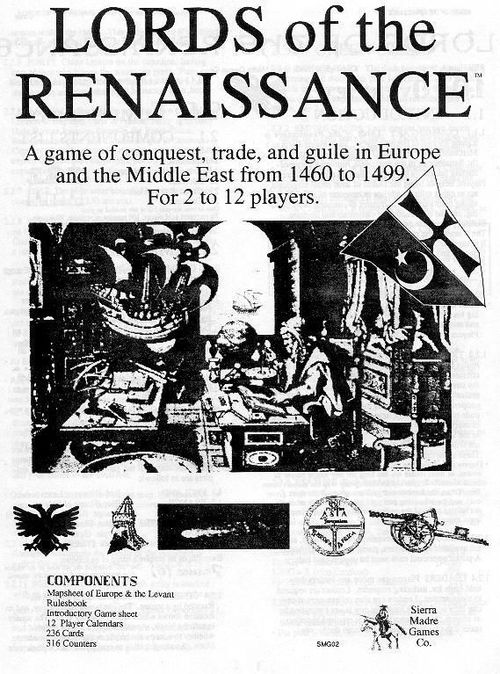
Lords of the Renaissance
Lords of the Renaissance Rulebook
Table of Contents
Table of Contents
- 1.0 General
- 2.0 Components
- 3.0 Initial Setup
- 4.0 Sequence of Play
- 5.0 The Rounds
- 5.2 Revelation and Auction of Seasonal Cards
- 5.3 Building Ships and Recruiting Armies
- 5.4 Reinforcement
- 5.5 Reinforcement and Recruitment of Non-Players
- 5.6 Determining the Order of Movement of the First Player
- 5.7 Player Movement
- 5.8 Conflict
- 5.9 Summer Taxes
- 5.10 Advancing Immature Cards
- 5.11 Declaration of Trade Routes
- 5.12 Atlantic Storms
- 6.0 Winning the Game
- Designer's Errata and Rulings (1996)
1.0 General
1.2 Game Description
1.2.1 Merchant Princes: Each player starts with a small kingdom (Dukedom), a counter representing his trading company and another representing his person. Players align themselves with one of the 6 empires.
1.2.2 Trade Routes: Players establish trade routes from a Bank counter (their own or another player's) to Azov or Erzurum (the end of the Silk Road).
1.2.3 Cards: One card is revealed per season and auctioned.
1.2.4 Lords: Players move the Lords whose cards they hold (including emperors). Lords are needed to move armies or collect taxes.
2.0 Components
2.2 Map
2.2.1 The map represents Europe and the Levant in the year 1460.
2.2.2 Dukedom: The map is divided into Dukedoms. Those that form part of an empire have one of the 6 imperial colours. They may be flat or rugged.
- Flat Dukedoms require 1 MP to enter.
- Rugged Dukedoms require 4 MPs to enter.
- Armies outside a city in rugged Dukedoms are eliminated in winter.
- Otherwise they are completely identical.
2.2.3 Empires:
- L1 ENGLAND - Red (House of Lancaster)
- L2 FRANCE - Blue (House of Valois)
- L3 HABSBURG - Orange (Holy Roman Empire)
- L4 PAPAL STATES - White (Rome)
- L5 ARAGON - Purple (Spain)
- L6 OTTOMAN EMPIRE - Black (Turks)
2.2.4 Cities: Circles in a square. Armies may be in the city (inside the square) or in the Dukedom (outside the square). Only one army colour may be in a city (Exception: sieges).
2.2.5 Ports: Part of the square is in the sea. The only difference from cities is that they may be occupied by armies and ships.
2.2.6 Capitals: If the Capital falls, the empire falls. Otherwise they are normal cities.
2.2.7 Seas: Blue areas bounded by borders, coasts or straits.
2.2.8 Straits: Double-headed arrows. Counters may cross a strait [5.7.8].
2.2.9 Far East Trading Ports: There are 5 ports in the corners of the map, with different goods available:
- Azov: slaves and silk. Exception: Ivan of Russia [3.4.5] may deny this trade to any merchant.
- Erzurum: silk.
- Phocaea: alum.
- Alexandria and Beirut: spices. Exception: Khuscadam may deny this trade to any merchant.
- Timbuktu: slaves and gold.
Other resources are shown, but may or may not be developed during the game.
2.2.10 Storm Line: A border line running East to West with red dots.
2.2.11 Religion: Each Dukedom with a city shows a religious symbol for the 3 religions: Catholic, Orthodox and Muslim.
2.3 Green Cards
2.3.1 There are green cards and pink cards. The 37 green cards are always face up. The pink cards are only revealed when they are going to be auctioned.
2.3.2 Empire Cards: Each empire has two green cards: an L card (Lord or Leader) and a C card (Chancellor), each with a number to tell them apart.
2.3.3 Lord/Bank Cards: The green L cards from L7 to L23 represent the players. They come with a Bank counter and a personal leader counter.
2.3.4 Stature: Each Lord card has a Stature, from 1 to 4, which can change during the game. Stature indicates how many troops the Lord can lead [5.7.1], how much tax he can collect [5.9.4], and who may become emperor [6.2.4].
- VASSAL = 1
- DUKE = 2
- KING = 3
- EMPEROR = 4
2.3.5 Succession: Each Lord card has the name of a colour that indicates the claim to the throne with which a player starts [6.2.2].
2.4 Pink Cards (Seasonal)
- C - Condottieri card
- E - Building card
- P - Pestilence card
- G - Guild card
- L - Lord card
- M - Machiavellian card
- R - Resource card
2.4.1 "C" Cards: Mercenary captains, chancellors, engineers, explorers, etc.
2.4.2 "E" Cards: A Building counter is placed when they are built.
2.4.3 "P" Cards: These are the only cards that are not auctioned. Non-players are immune to them.
2.4.4 "G" Cards: These must first be built in order to receive the corresponding counter.
2.4.5 "L" Cards: An alliance with a Leader. The player may move that leader.
2.4.6 "M" Cards: Kept until they are used. There are several types.
2.4.7 "R" Cards: [2.2.9]. When developed, a counter of the aligned colour is placed. Cards are not needed for the 5 Far East ports.
2.6 Army Counters
2.6.1 Armies: Each imperial army has the colour of its empire. Mercenaries are grey and may change their colour. All have a full-strength side (fresh) and a worn-down side.
2.6.2 Mercenaries: They are always the colour of the player who controls them, if any. If there is none, they are neutral colour. They may be carried by Galleys. Otherwise they are the same as armies.
2.6.3 Stacking Limits: None, but there is a penalty in winter [5.7.10].
- They may enter Dukedoms with allies or enemies.
- Armies of different colours may not occupy the same city (Exception: grey with any colour).
2.7 Naval Counters
2.7.1 All ships may move 5 sea zones in spring and summer. Leaving a port costs 1 MP [5.7.2].
- They may be used as part of a trade route [5.11.5].
- They may transport troops [5.7.6].
2.7.2 Galleys: Affected by winter wear [5.13.1] and must end in port.
2.7.3 Naos: Immune to winter wear [5.13.1] and need not end in port. They may transport Imperial troops.
2.7.4 Pirate Ships: Same as mercenaries [2.6.3]. They may be part of a trade route. Some are galleys and others are naos.
2.8 Worn Counters
Fresh counters (army, ships, caravan) have 2 steps. Worn counters have only 1. If they suffer wear again they are eliminated.
3.0 Initial Setup
3.2 Number of Players
3.2.1 Personal Lord Cards: There are 17 of the L cards marked "Lord/Bank" (Cards L7 to L23). The other 12 are the "Emperor" cards (L1 to L6) and "Chancellor" cards (C1 to C6), which are placed face up like the unused "Lord/Bank" or "Pirate" cards.
3.2.2 Number of Players: Each player receives at random one of the 17 "Lord/Bank" cards. The card specifies the Dukedom that the player owns at the start of the game.
3.3 Initial Placement of the Calendar
3.3.1 Each player receives a template called a "Calendar".
3.3.2 Each player chooses the colour of some empire with which to align. No more than 2 players may choose the same colour (unless there are more than 12 players). Choice is made in order from L7 to L23.
3.3.3 Starting Cards: Each player starts with the 2 imperial cards [2.3.2] (L and C) and his "Lord/Bank" card [2.3.3]. However, if two players choose the same colour, each takes one of the imperial cards (the first chooses which one he keeps).
4.0 Sequence of Play
Each turn of Lords of the Renaissance represents one year, starting from 1460.
Each year is divided into a series of activities (rounds). In each round, the players carry out the indicated activity in order (from L7 to L23, except for movement).
SPRING:
4.1 CARD REVEAL AND AUCTIONS. The top card is turned over. Except for P cards, the card is auctioned among all players. Each interested player places a gold piece on the card, and raises a previous bid if necessary to beat his competitors.
- If nobody raises the bid, the highest bidder wins. The others recover their bids.
- If nobody bids on a card, it goes to the discard pile.
- P cards are not auctioned; they are applied directly.
4.2 BUYING AND REINFORCING ARMIES, SHIPS AND CARAVANS. Both player-owned and non-player Dukedoms pay 5 Au to buy 1 mercenary army [5.3]. Players buy ships, caravans or armies. If a player holds a C card he may use imperial money. A player may reinforce if he holds such a card [5.4].
4.3 REINFORCEMENT AND RECRUITMENT OF NON-PLAYERS. Automatic reinforcement of worn counters and construction of new armies and ships [5.5].
4.4 MOVEMENT / NAVAL CONFLICT. Only ships may move, and only south of the storm line [5.7.2]. Then armies and ships may attack [5.8].
- The number on the M cards indicates the order of movement (in case of a tie, in order from L7 to L23).
- Those holding emperor L cards may move imperial ships.
SUMMER:
4.5 REVEAL CARD AND AUCTION. Another card is revealed and auctioned [5.2.2]. Unused green cards may be auctioned.
4.6 TAX ROUND. Each city or port occupied by armies of the imperial colour, or empty and in an imperial-colour Dukedom, pays 1 Au to the empire [5.9].
- Cities not controlled by an empire that have a leader or building also collect taxes. They are placed on the map.
- From 1466 onward, only buildings collect taxes.
4.7 ADVANCING IMMATURE PROJECTS. Immature cards or discovery voyages may be advanced by paying 3 Au [5.10.1]. E, G or R cards may be subsidised by the empire [5.10.2].
- Mature E, G or R cards place a counter on the map.
- Ships on mature discovery voyages roll the die for their discoveries [6.1.3].
4.8 MOVEMENT / CONFLICT. Each player first moves his ships [5.7.2], then his land forces [5.7.3], and then resolves conflicts [5.8].
- Only players with C cards may move caravans of that empire.
- Only players with L cards may move that leader and his armies.
AUTUMN:
4.9 REVEAL CARD AND AUCTION.
4.10 DECLARE TRADE ROUTES. From L7 to L23, players trace trade routes for each of their banks, guilds or buildings [5.11.5].
4.11 ATLANTIC AND EUXINE STORMS. Ships north of the storm line roll the die [5.12.1].
4.12 LAND MOVEMENT / CONFLICT. In autumn each player may move leaders, armies and caravans to Dukedoms south of the storm line. Then conflicts are resolved.
WINTER:
4.13 REVEAL CARD AND AUCTION.
4.14 WEAR AND TEAR: All galleys, caravans in rugged terrain, and armies outside cities suffer wear [5.13.1]. Extra forces in a city also do. They may be prevented by reinforcements [5.4]. They may be subsidised.
AT ANY TIME:
4.15 MACHIAVELLIAN ACTIONS / CHANGES OF ALIGNMENT. Except during movement/conflict, players may announce changes of colour [5.14.3]. They may also play the M cards they hold [5.14.2].
5.0 The Rounds
5.2 Revelation and Auction of Seasonal Cards
5.2.1 P cards are applied directly. The others are auctioned. If nobody bids, the card is discarded. Only the player's personal money may be used.
5.2.2 Auctions: Each interested player makes his bid. Bidding starts at 1 Au and goes up. If nobody raises, the auction ends.
- Ties are decided by dice rolls. The losers recover their money.
- If nobody puts money down, the card is discarded. Exception: 5.2.3.
5.2.3 L Cards: If an L card is bought, imperial armies without a leader inside the Dukedom change to the colour of the buyer. If it is not bought, it takes the default colour indicated on the card. In both cases, the leader counter is placed in the city indicated (if there is another leader there, he is murdered).
- Any unclaimed green L card may be auctioned after the auction of the pink cards.
- Purchased L cards come only with their leader; the banks and ships are only available to the players who start with that character.
- Players may hold only imperial cards of their aligned empire. They may not bid for other empires unless they wish to change alliance [5.14.3].
5.2.4 Pirate Rental: Any player may bid for cards C7 to C15, unless they have already been claimed [Venice and Genoa].
- They may be galleys or naos.
- They may begin where their card indicates.
- If their maintenance is not paid, they are auctioned again at the next auction.
- If the pirate counter is already on the map, it is assumed that the pirate leader betrays and changes alliance to the player who buys the card.
5.2.5 Fair: Players may buy, sell, lend, exchange or give their cards or money to other players.
- Any card changes hands only once per year.
- The abilities granted by cards are not shared. Only their current owner enjoys them. Exception: Navigation Cards [6.1.6].
- The transfer of princesses requires the approval of the Pope.
- Titles may not be transferred.
5.2.6 New World "R" Cards: Cards R3 and R4 may only be held by players on Discovery Voyages or who have discovered the Caribbean.
5.2.7 Cooperating in Bids: Players may cooperate in a bid, or in maturing a project or discovery voyage. Such agreements must specify how the bid is shared and who keeps the card. The agreements are not binding.
5.3 Building Ships and Recruiting Armies
5.3.1 Recruiting Player-Controlled Imperial Armies: Players with a city in their empire that is NOT occupied by imperial armies (non-mercenaries) may spend 5 Au and recruit an imperial army, placing it in that city. Players with a C card may subsidise this purchase with imperial money. Maximum of 1 army per city each round.
5.3.2 Building Player-Controlled Imperial Ships: Players with a port in their empire may also spend 5 Au and build a galley there (8 Au for a nao). No more than 1 fleet per port per year. The C card allows subsidy.
5.3.3 Building Caravans: Any player may spend 4 Au to build caravans, which may start in any city of the empire. They may be subsidised with imperial money.
- Players who use their own money may build caravans of their colour and place them wherever their counter is.
5.3.4 Mercenary Armies: Any player may spend 5 Au and recruit mercenaries, which come in any city within the player's Dukedom (or satellites [5.11.7]) or in the Dukedoms whose card he holds.
5.3.5 Pirates: Any player may spend 5 Au to build a pirate galley (8 Au for naos). They may appear in any port that has an allied leader. (NOTE: If the card of those pirates appears later, they change to the player who buys it.)
5.3.6 Spending Allied Treasuries: Money in cities controlled by allied leaders may be spent on mercenaries, pirates, buildings or resources. The counter must appear in that city, or its satellites.
- Errata (1996): mercenaries bought using an ally's gold must stay stacked with that leader.
5.3.7 Counter Availability: There are only 10 armies, 10 caravans, 8 galleys and 7 naos. Only 17 mercenaries and 9 pirates. Everything else is unlimited.
5.4 Reinforcement
5.4.1 Worn counters may be reinforced with 1 Au. Alternatively, two worn counters may be combined into one fresh one of the same type.
5.4.2 Imperial Subsidy: Players with the C card may use imperial funds to reinforce armies and ships. Buildings may be repaired with 1 Au (players with an L or C card may use imperial money).
5.4.3 Reinforcing Sieges: Counters in besieged cities may not be reinforced unless there is a friendly fleet or money in the city. Also, the emperor with the most armies in the Dukedom outside the city may allow reinforcement.
5.4.4 Vassalage and Pirate Loyalty: Any player who chooses not to reinforce mercenaries must give the L card to the player who wishes to pay for them. If there is more than one, the L card is auctioned. Mercenaries stacked with the player's personal counter are immune to this effect.
- Players who do not pay to reinforce pirates also give up their C card and counters for auction.
5.5 Reinforcement and Recruitment of Non-Players
5.5.1 Non-Player Reinforcement: If an emperor or leader has gold, he will automatically reinforce, starting with the nearest.
5.5.2 Non-Player Ducal Recruitment: Any non-capital city with gold will automatically convert 5 Au into grey mercenaries.
5.5.3 Non-Player Imperial Recruitment: Any empire whose C card does not belong to any player will convert 5 Au into an imperial army or navy.
- The first force it builds is an army in its capital.
- Then armies in unoccupied imperial cities nearest the capital.
- If all are occupied, it builds ships in imperial ports. The number of fleets is limited to the number of ports.
5.6 Determining the Order of Movement of the First Player
5.6.1 The first player to move is the one with the most M cards (the M card "Spy" counts as 2). The second is the next with the most M cards, and so on.
- First they must move their ships, then armies and caravans. After moving, they roll dice for their combats.
- Ties go in order from L7 to L23.
- Players who do not move a counter may move it (and attack) after all players have moved, in reverse order, L23 to L7.
5.7 Player Movement
5.7.1 All counters have 5 movement points (MPs), and all counters in cities must spend their first MP to enter the Dukedom or sea that surrounds it.
- Imperial Ships: The player may move an imperial navy if he has the L card.
- Pirates: Only by the player with his C card.
- Caravans: Only by the player with the imperial C card of that colour.
- Leaders: Only by the player who holds the L card, including the emperor. Leaders may pick up and drop off armies of all types, as long as the number does not exceed their Stature. Leaders have 10 MPs (not 5).
- Guilds, banks, buildings and resources: They never move.
5.7.2 Naval Movement: All ships move 5 seas. [The source text reads "4 seas" here, but section 2.7.1 and the 1996 errata both give five; five is used.] [Errata 1996: all navies may move five seas, not four.]
- If starting in port, their first sea is the one surrounding the port.
- Entering the port of the last sea entered costs nothing. They may enter ports with armies or navies of another colour.
- Galleys must end in port. Naos may end at sea.
- To enter the Discovery Voyage zone, a Navigation card or explorer is needed [6.1.6].
5.7.3 Army Movement: An army has 5 MPs. Each rugged Dukedom costs 4 MPs and flat ones cost 1 MP.
- All armies must have a leader to move. Exceptions: forced retreats and moving from a Dukedom into the city of that Dukedom.
- Each leader may move as many armies as his Stature number. They may "pick up" and "drop off" armies of their colour during their movement, in a city or Dukedom [5.7.4]. But once an army has moved 5 MPs it may not move further that turn.
- Armies in cities spend their first MP to enter a Dukedom that surrounds the city. If the city square touches more than one Dukedom, the unit chooses in which one to spend that MP. Afterwards, in its movement, entering/leaving cities costs no MPs.
- Armies may end in a city (0 MPs) or remain in the (outside) Dukedom.
- A city may not be entered by armies of another colour (mercenaries are the colour of their leader).
- Armies, leaders and caravans may cross straits [5.7.8].
5.7.4 Leader Movement: They move like armies, but with 10 MPs.
- Leaders may only move mercenaries and imperial armies of their colour.
- They may not pick up armies stacked with a leader of equal or higher Stature without his permission.
- Armies may be picked up from a city without the leader having to enter it (but he must enter the Dukedom). That army pays 1 MP to leave the city.
- Any leader (not the emperor) may go to a city outside the empire that has no army or leader and claim it as his new Dukedom. If he brings mercenaries, he may collect taxes [5.9.4]. The player loses his title if he leaves his native land [6.2.2].
- Emperors must end their movement in their capital or in a city with imperial troops.
- Errata (1996): any gold or mercenaries stacked with leaders must stay stacked with those leaders during movement, except emperors or player leaders, who may "drop off" gold or mercenaries.
5.7.5 Caravan Movement: They move like armies, except that they need no leader and cannot be intercepted.
5.7.6 Land Units at Sea: Land units may move over the sea, as over Dukedoms, using fleets as bridges, under the following conditions:
- Each sea entered costs 1 MP.
- Units must enter/leave through a port.
- There must be a cooperating fleet, in the port or in that sea.
- There must be a fleet in each sea entered (in that sea or in a port of that sea).
- If the landing port is occupied by armies of another colour it may not be entered unless it is besieged. To do so there must be a friendly fleet in that port. This is an exception to the prohibition on entering cities with units of another colour.
- Land units may remain at sea, stacked with naos. Ships do not "transport" units anywhere.
- Imperial troops may not use galleys. Naos may be used.
- There is no limit to the number of units that may use the same fleet.
- Errata (1996): land units may enter a sea from land, and vice versa, only through a port. There should be a cooperating navy, if not in that port, somewhere within that sea. Land units may move from one sea to another via stepping-stone ships; movement from sea to land, or vice versa, must be through a port.
5.7.7 Naval Movement Through Straits: Navies may be intercepted [5.7.10] when crossing straits if there are armies or fleets in the port. Alternatively, they may pay a toll for safe passage.
5.7.8 Land Movement Through Straits: Land units may cross straits following the arrows. They must enter some port on each side of the strait.
5.7.9 Spring and Autumn Movement: In these seasons, no counter may enter a Dukedom or sea north of the storm line, nor a rugged Dukedom. Combat is permitted in all three seasons south and north of that line. There is no combat or movement in winter.
5.7.10 Interception: All armies must stop if they enter a Dukedom with armies of another colour outside the city. Other units may not be intercepted [Exception: 5.7.7].
- Armies may not leave a Dukedom that has armies (not in a city) of another colour without the leader's permission.
- Units at sea may only be intercepted by 5.7.7 or after entering a port with hostile armies/navies.
5.7.11 Automatic Recruitment: If a city is invaded, instantly spend 5 Au (if available) to recruit an army, forcing a siege. Only 1 army per siege.
5.7.12 Invasions of Non-Controlled Empires: If an uncontrolled empire is invaded by armies, its C and L cards go to auction for those not aligned with the invader. The one who wins it controls that colour in addition to his own.
- Note: an exception to 5.14.3.
- These cards are surrendered without the empire falling [5.7.13], or the invader leaving the empire.
- Errata (1996): however, armies thus acquired cannot attack any counters except those invading its borders, or those of the same imperial colour as those who are invading.
5.7.13 Conquest: An invading army that captures a capital may plunder half of the treasury, which goes to the invading leader [5.8.9].
- The empire's C card is confiscated by the invader.
- Errata (1996): the vanquished empire's C card is confiscated by the victorious empire (which allows the conqueror to control the vanquished empire's caravans and build using its countermix). The victorious empire can lead armies of the vanquished colour with its own leaders, plus control its fleets, when and if the vanquished emperor is killed or captured by anyone (which discards the L card). At that point, the two empires are one.
- Players who wish to rule another Dukedom instead of their own may invade it with their leader and mercenaries. They may collect taxes from that Dukedom instead of their own. However, it is forbidden to invade or plunder allies (those from whom one holds some card).
5.8 Conflict
5.8.1 All counters may attack once per movement/conflict round, even if they did not move.
5.8.2 Combat Procedure: In resolution, as many dice are used as there are army/navy steps (fresh counters = 2 steps, worn = 1 step) of the same colour in the same Dukedom.
- Each roll less than or equal to THREE records a wear. Sieges are different.
- The defender rolls dice for counterattack, simultaneously.
- Losses are simultaneous. Each player chooses his losses.
- Losses must be from participating armies. If there are no armies, fleets, caravans or E, G or R counters are worn (the attacker chooses). Each loss wears (inverts) a fresh counter, or eliminates a worn one.
- The losing side must retreat (except from sieges). The loser is the side whose highest-level leader's Stature, multiplied by the number of armies and navies of its colour, is lower after the battle. Exception: sorties [5.8.4].
- Except as stated above, the presence or absence of leaders does not affect combat.
5.8.3 Limitations on Attack:
- If an army has no leader, it may attack if the player has the L card. Mercenaries may not attack without a leader.
- Armies in a Dukedom may only attack counters within that Dukedom or besiege cities of that Dukedom.
- Armies in a city may attack leaders, guilds, buildings or navies in that city.
- Armies in a city may not attack counters in another city.
- Only 1 attack may be made per round. However, there is no limit to counterattacks.
- Forces in a port may be attacked by forces at sea and/or land forces. These would be two different attacks, each counterattacked individually.
- Armies may attack navies in port, which may counterattack.
- Armies of the same colour in the same Dukedom must combine their attack.
- The owner of the highest-Stature leader always decides where the fighting takes place and who fights. Combat is optional.
- Bank counters may not be attacked or robbed.
5.8.4 Sorties: Armies in besieged cities may attack their besiegers in any season (not winter) as a normal attack. Exception: the besieged automatically lose the battle if any army of the besieger survives, forcing it to return to the city.
5.8.5 Sieges: Attacks against armies in a city are sieges. Against fleets, without an army, they are not. Armies in a port may take part in the siege or naval component (if any) of the battle.
- In sieges, only rolls of ONE score a hit (attack and counterattack).
- Sieges follow 5.8.2 and 5.8.3, except for retreats.
- Besieged cities may not reinforce their troops unless there is a cooperating fleet or money in the city.
- When the last besieged army falls, the besiegers may enter immediately.
5.8.6 Naval Combat: Handled the same as land combat. Armies on ships may attack other armies or navies, at sea or in port, the same as on land. Fleets roll dice like armies. Exception: naos roll only 1 die per ship (worn or fresh). Galleys work the same as armies.
- Naval battles only occur between forces in the same location (all at sea or all in the same port).
- Fleets may attack armies at sea or counterattack them at sea or in port. But they may not attack in port.
- Naval or land forces carried on ships never retreat.
- Combat in the Discovery Voyage can only occur if attacker and defender hold the same Navigation Card [6.1.6].
5.8.7 Leaders Killed in Battle: If all armies and navies in a stack are destroyed, each leader has a 50% chance of dying and a 50% chance of being captured.
5.8.8 Pillage: Armies may attack unprotected buildings, guilds or resources (not banks). Rolls of 1, 2 or 3 score a hit. E counters are worn with 1 hit; the 2nd destroys them. G or R counters that receive any hit are destroyed.
- Worn E counters may be repaired with 1 Au.
- If an E, G or R counter is destroyed, its card is placed in the "Immature" block for reconstruction [5.10].
- Mercenaries may not pillage E, G or R counters.
- Armies may not "take" enterprises, only destroy them.
- If imperial forces pillage within the original borders of their empire, the emperor L card is surrendered and goes to auction (unless the player holding it is personally the emperor).
5.8.9 Plunder: Imperial navies and armies, mercenaries and pirates may plunder unprotected gold in a city. Half (rounding up) is lost (in the revelry) and the rest passes to the treasury of the plundering player.
- Gold plundered by armies goes to the leader of the army (player, emperor or other leader). It is placed under the leader's counter and serves to maintain the leader's troops/fleets or to buy mercenaries.
- Gold plundered by pirates or leaderless mercenaries stays under the fleet/mercenary counter. It is used to reinforce damaged units.
- Treasures in banks may not be attacked/robbed.
- Players holding an L card for a Dukedom may not plunder it.
5.8.10 Arrest: Armies and fleets may try to arrest unprotected leaders. Exception: [5.8.7]. To do so, all armies present must attack the leader.
- A single hit captures him.
- Two or more kill him accidentally.
- If a leader dies, his card is discarded unless there is an heir [6.2.6].
- Armies/fleets may not "take" a leader; they may only capture or kill him.
5.8.11 Imprisoned Leaders: Leaders arrested or captured remove their counter from the map and place it on the captor's calendar.
- Players who used mercenaries may ask for a ransom (gold, cards or any other agreement) or execute him at any time. Ransoms for emperors are paid from the imperial treasury.
- If the player used imperial armies, the owner of the emperor L card decides whether to execute him or ask for a ransom.
- The player who holds the card of a captured leader does not surrender it. It is kept until he dies or realigns.
- Money earned from ransoms is stored in his bank or Dukedom, and may not be spent.
- Released leaders return to their specified city.
5.9 Summer Taxes
5.9.2 Imperial Taxes: Each city/port occupied by armies of the imperial colour, or without armies and within an imperial Dukedom, pays 1 Au to the empire.
5.9.3 Imperial Base Tax: The map shows each empire with a number in parentheses that corresponds to the number of cities controlled by that empire at the start.
- The Papal States have a base of 10, which includes their satellites.
5.9.4 Non-Imperial Taxes: A city that is not in an imperial-colour Dukedom and not occupied by imperial troops, but with a leader or building, also collects taxes. These go to a pile in the city, and are controlled by the highest-Stature leader present.
- Taxes collected by the player's personal leader or by a building go to his personal chest.
- Taxes collected by allied leaders remain on the map, to be spent by the player on mercenaries or projects in that Dukedom only.
- For non-players, that money remains on the map until 5.5.2.
- For a leader to collect taxes in a city outside his Dukedom, the presence of mercenaries (not imperial armies) is required. That money goes to the leader.
- Taxes from cities with imperial troops go to the empire.
- Players of Stature 3 may collect taxes from all cities of the Dukedom in which their leader is, not only the one he occupies, including satellites [5.11.7].
5.9.5 Inflation: From 1466 inclusive, only buildings collect taxes.
- Also, galleys do not need maintenance.
5.10 Advancing Immature Cards
5.10.1 Capitalisation: If an E, R or G card is bought, it is placed in the "immature" block of the calendar. The next block is "semi-mature" and finally "mature project". In the Summer Maturation Round a player may do the following:
- Pay 3 Au to advance the card to the next maturation block.
- Pay 1 Au to keep the card at its current level of maturity.
- Pay nothing, which discards the card so that it is auctioned again.
5.10.2 Subsidies: If the building, guild or resource is in an empire or occupied by imperial troops, imperial funds may be used.
- For subsidy, the player must hold the C or L card, or the empire must be non-player.
- SUBSIDIES OUTSIDE AN EMPIRE: If the building, guild or resource is in a city with gold piled up, that gold may be used for maturation. The owner of the card may spend non-player gold, or gold with the permission of the controller of the gold.
5.10.3 Discovery Voyages: [6.1]
5.10.4 Maturation: When the E, R or G card moves to the "mature project" block, a counter is placed on the map where an icon is shown.
5.11 Declaration of Trade Routes
5.11.1 Each player receives THREE GOLD for each mature bank, guild or resource he owns, if it is correctly supplied that season (by a trade route to a building or source of supplies).
5.11.2 Resources: Each mature R counter earns 3 Au each autumn according to the icon on the card. The lower half of the icon indicates the type of supply point to which its trade route must be traced to receive the benefit.
5.11.3 Banks and Guilds: Owners of bank and guild cards receive 3 Au in the same way as R cards.
- Banks always need a route to a silk port. Exception: the Bank of Trebizond, which requires a route to a spice port.
- Guilds come in 4 types: Textile, Naval, Metal or Wool. Textile guilds need alum, metalworking guilds need mines, naval guilds need slaves, and wool guilds need a connection to a building. The Glassmakers Guild (G18) works like the wool guilds.
5.11.4 Buildings: E cards require sugar or spices, or both. They earn 3 Au for a route to a spice port and 3 Au more if they have one to a sugar port.
- Building counters collect taxes [5.9.4].
- Some cities, such as Paris, may have more than one building.
5.11.5 Tracing Trade Routes: A trade route is a series of adjacent Dukedoms and seas, each occupied by a caravan or fleet, respectively.
- Each Dukedom must be occupied by a cooperating army/caravan, inside or outside a city. Armies in cities that form part of more than one Dukedom may be considered within one of them, but not more than one.
- Each sea must be occupied by a cooperating fleet, inside or outside a port. Fleets in a port that touches more than one sea may be considered in one of them, but not more than one.
- If part of the route uses a caravan or fleet of another colour, an agreement must have been reached with its owner (perhaps 1 Au per route used, or something else).
- Armies and caravans in besieged cities do not count.
- If more than one route is available, the route in which the merchant pays less gold is chosen.
- Fleets and caravans may be used in more than one route per round.
5.11.6 Ports in a Trade Route: Trade routes from sea to land or vice versa must go through a port or across a strait.
- Such ports must be occupied by a cooperating unit.
- A fleet in the port also acts in the sea that surrounds it. An army/caravan in the port acts on the Dukedom that surrounds it.
- Errata (1996): the trade port (with the desired resources per 2.2.9) must similarly be occupied.
5.11.7 Tolls: Each Dukedom or sea with a port/city on the route receives 1 Au from the treasury. This includes the initial and final cities of the route. This gold is placed on the map. Cities controlled by an empire pass this money to the empire. Cities occupied by a player's personal leader pass the gold to his chests. Leaders of Stature 3 collect tolls from all cities in the Dukedom they occupy.
- For routes that cross Dukedoms with more than one city, only one of them collects tolls (the merchant chooses).
- For routes that cross seas with more than one fleet, the merchant chooses which one to use (unless he uses a port for land/sea transfer [5.11.6]).
- Dukedoms without cities do not collect tolls, nor do naos not in port form part of routes.
- The following "satellites" give their tolls to some city in their home Dukedom:
| SATELLITE | CITY |
|---|---|
| Lands of the Church | Papal States |
| Anjou (France) | Provence |
| Bristol (England) | York |
| Bruges (Flanders) | Burgundy |
| Caffa (Crimea) | Genoa |
| Modon (Morea) | Venice |
| Ceuta (Marinds) [as printed] | Portugal |
| Beirut (Syria) | Egypt |
5.11.8 Bottleneck: Armies or navies in straits ports may, if they wish, demand a tribute in gold as a toll. This tribute goes to the empire, except for mercenaries and pirates, who keep it and use it for their maintenance.
- Other routes may be cut by destroying the fleets/caravans involved, or by 5.11.6.
- A player may deny the use of resources and guilds that he owns. But this will force the card to go to auction in the next auction round.
5.12 Atlantic Storms
5.12.1 Storm Line: In this round, all ships north of the storm line roll dice. Each nao rolls one die, each galley rolls two. Every "1" rolled equals one wear.
- Fleets inside and outside port are equally affected by the storm.
5.13 Winter Wear
- All armies outside cities, at sea or under siege (without naval support) are worn. Armies outside a city or at sea north of the storm line are destroyed. Armies in rugged terrain are destroyed.
- Each city supports only 1 army. The others are worn.
- All galleys are worn unless 1 Au is paid (not from 1466).
- All caravans in rugged terrain are worn, unless they are in a city.
5.13.2 Reinforcement: All winter wear (except armies under siege) may be prevented by paying 1 Au for each affected unit [5.4].
- Besieged cities only reinforce armies/fleets if there is money in them.
5.13.3 Subsidies: Imperial money may be used to reinforce imperial armies and navies and caravans if the player holds the "C" card.
- Non-player empires reinforce automatically if they have money, starting with those nearest the capital.
- For mercenaries and pirates, money stored in their city may be used.
5.13.4 Sea of Azov: In winter and spring this sea is frozen. Moving fleets from this sea to the Euxine Sea causes winter wear.
5.13.5 End of Game Roll: (Added by 1996 errata.) As the last action of a year, roll two dice to see if the game ends suddenly. Add to this roll the number of P cards (pestilences) in the discard pile. If the modified result is 13 or more, the game ends.
5.14 Machiavellianism and Alignment
5.14.1 In any round (except movement/conflict), players may change colour or play an M card.
5.14.2 Playing M Cards: M cards are kept on the calendar until they are played.
5.14.3 Player Alignment: Players may change colour by bidding for the L or C cards of another empire. The card auctioned must not be claimed, and the winning bidder surrenders (for auction) the L or C cards of his colour.
- Errata (1996): "bidder" should be "winning bidder". A player aligning to an empire should bid separately on both the imperial C and L cards, if he wants both.
- A player may attack an empire with mercenaries if he is not aligned with it.
- A player may be aligned to only one empire (colour). Exception: [5.7.12 and 5.7.13].
- Players with L or C cards of conquered empires are treated as being of their own colour [5.7.13].
5.14.4 Colour Change of Counters on a Change of Alignment: When a player changes alignment, the following counters change to the new colour:
- Guilds, resources and banks change colour.
- Each leader with a Stature lower than that of the player. Others, such as the emperor and the chancellor, go to auction. Turncoat leaders stacked with imperial troops may be arrested by the new player who controls the imperial L card.
See the Card Relations section for an explanation of the Machiavellian cards.
Errata (1996): 5.14.6 Heresy (added): emperors are immune to heresy.
6.0 Winning the Game
6.1 Discovery Voyages
6.1.2 Start of a Discovery Voyage: A player with an explorer card may begin a discovery voyage. He must indicate it by moving one or more naos into the Discovery Voyage sea. The explorer card is placed in the immature block of the player's calendar. From there it may mature like other cards [5.10.1].
- Players with a C card may subsidise this maturation with imperial funds.
6.1.3 Discovery Table: When fleets on a discovery voyage mature, a die is rolled on the following table:
| Roll | Result |
|---|---|
| 0 | Discovers at Choice: take Navigation Card X1 or X2 |
| 1 | Discovers the Cape of Good Hope; the ship returns to the Sea of Darkness and gains Navigation Card X1. |
| 2 | Discovers the Caribbean Islands; the ship returns to the Sea of Darkness and gains Navigation Card X2. |
| 3-4 | Returns without success (to the Sea of Darkness). Subtract 1 from future discovery voyages. |
| 5 | Scurvy, one ship lost; the voyage continues. (Roll again in the next round of immature cards.) |
| 6 | Malabar Pirates, two ships lost; the voyage continues. (Roll again in the next round of immature cards.) |
- Cartographers and "experienced" explorers (who have returned from voyages) subtract 1, but no more than 1 may be subtracted.
- Players who discover something already discovered get to discover at choice.
- Explorers are assumed to survive if any ship returns; otherwise their C card is discarded. Cartographers do not die if the voyage fails.
6.1.4 Cape of Good Hope:
- While a player with the Cape of Good Hope navigation card maintains a fleet of naos in the "Discovery Voyages" sea zone, spices and silk are available there and NOT in Alexandria, Erzurum or Azov. Furthermore, this player may deny any fleet (without a navigation card) the acquisition of spices/silk in this sea zone, or charge a toll for them.
- Players who buy/discover the Cape of Good Hope may acquire spices/silk without dealing with the original discoverers.
6.1.5 Discovering the New World: Discovering this is not an advantage unless a mine or plantation is discovered there (cards R3 and R4) [5.2.6].
- Exception: Players on an exploration voyage who buy the R3 or R4 cards discover America automatically (without a roll on the Discovery Table).
- Note: If card R3 or R4 is in the discard pile, it may be recovered and auctioned by any player with a Caribbean navigation card.
- Errata (1996): card R3 or R4 may be matured by any empire with a rutter.
6.1.6 Navigation Card: If a player sells a navigation card to another, both have the card and the knowledge to make the voyage.
- A Navigation card must be held to enter the Discovery Voyage (DV).
- There are two Navigation cards (X1 and X2). Each piece of knowledge is worth 10 Au at the end of the game.
6.2 Change of Stature
6.2.1 Becoming a King: Players may raise to Stature 3 (king) when they gain 4 allies (L cards) of Stature 2 or 1.
- Kings have the advantages indicated in 5.7.3, 5.9.4 and 6.2.
- NOTE: Non-player L cards may not increase in Stature.
6.2.2 Claim to the Title ("Pretender to the Throne"): All players (except Ivan, Fugger and Khuscadam) begin with a claim to a particular throne (colour indicated on their card).
- Titles are not transferable [6.2.5].
- Leaders lose their titles if they are outside their city of origin. They recover them when they return to their city.
- Players may obtain a second title claim if the corresponding M card appears.
6.2.3 Princesses: Marrying a princess is simply acquiring the card in an auction. If she is Catholic, the player may not be married.
- Each princess is associated with an empire.
- If there is a dowry, those cities become satellites [5.11.7].
- Marriage serves to legitimise heirs [6.2.7].
- NOTE: Popes may not marry.
6.2.4 Death of an Emperor: If an emperor/pope dies in battle or plague, the leader or heir who meets the greatest number of conditions in 6.2.5 becomes the new emperor at the next auction.
- The pretenders may be the player himself, or allied leaders of the player.
- The legitimate heir (if there is one on the L card) is a pretender. If he wins, he becomes an unaligned emperor.
- Pretenders may not be emperors.
- If an allied leader becomes emperor, the player will get the imperial L card.
- In case of a tie, the pretender with more armies in the Dukedoms of the original imperial colour of the disputed empire at the end of the next movement becomes emperor.
- If a player personally becomes emperor, he combines the imperial treasury with his own, and gets the imperial L and C cards.
- If an emperor dies when his capital is occupied by foreigners, no new emperor is chosen. The fallen empire is governed by the conqueror [5.7.13].
6.2.5 Pretenders to the Throne: Conditions to meet (the one who meets the most becomes the new emperor/pope). The legitimate heir meets the first 2. Ties go to the heir. Further ties go to the side that controls the greatest number of armies in the empire.
- Having Stature 3, but not an emperor.
- A claim to the throne [6.2.2].
- Married to a princess of the empire. Counts as 2 conditions.
- Holding a spy card of the imperial colour.
- Holding a revolt card of the imperial colour.
- Controlling the majority of the invading armies in the empire.
- A Papal Coronation [6.3.3] (only for the thrones of Aragon, France and Habsburg).
- Holding the imperial C card.
6.2.6 Death of a Leader and Heirs: The death of a leader removes him from play (except an heir listed on his card). There may be an heir of an heir.
- If a player dies, his heir retains his father's gold and the personal L card (with bank). However, all other cards go to auction.
- The death of the last heir on a personal Lord/Bank card removes the player from play.
- When a (non-player) leader with an heir dies, his L card goes to auction. This includes emperors. If there is no heir, or the last one dies, it is permanently discarded.
- The death of a C card removes it from play (Exception: imperial C cards go to auction).
6.2.7 Heir Stature: Heirs begin with their counter on the lowest-Stature side.
- If a player dies without marrying, his heir is illegitimate. The bastard heir discards all L cards of Stature 2 or higher (including emperor) for auction.
6.3 Papal Powers
6.3.2 Excommunication: A player with the Papal L card excommunicates any Catholic player. The excommunicated player must surrender for auction a card of the Pope's choice. Any card may be chosen except the starting cards.
- A player may only be excommunicated once in the game.
- Each excommunication costs 5 Au. Imperial money may not be used.
6.3.3 Coronation: A player with the Papal L card may crown the head of the Holy Roman Empire, the French Empire or the Aragonese Empire, giving another player a Title to one of these empires.
6.3.4 Divorce: A player with the Papal L card may annul another player's marriage so that he may marry again. Discard the princess card.
- Orthodox and Muslim players are free to have multiple wives and do not need divorce.
6.3.5 Crusades: The player with the Papal L card may begin a crusade, which forces 5 armies or fleets in Catholic Dukedoms to turn white. Black armies are immune, as are armies in their capital or under a leader.
- Errata (1996): crusades cost 10 Au of Papal money plus 5 Au of personal gold.
- Errata (1996): only one crusade may be announced.
- After the announcement of a crusade, all white counters are forbidden to attack any colour other than black until there are no black armies in Catholic Dukedoms.
6.3.6 East-West Unification: A player with the Papal L card who pays 5 Au may unify the Catholic and Orthodox Churches. An army in an Orthodox Greek Dukedom must become white.
6.3.7 Trials: The owner of the Papal C card may cancel any Catholic trial.
6.4 Victory Conditions
6.4.1 The winner is the player with the most gold in his personal account at the end of the game. Each Navigation card is worth 10 Au at the end of the game.
6.4.2 End of the Game: The end comes when any of the following occurs:
- All players agree to end.
- The treasury runs out of funds.
- A predetermined time is reached.
- The year 1479 has been played. The hardier players may play until 1499.
- Errata (1996): the end of game roll is 13 or more, per 5.13.5.
Designer's Errata and Rulings (1996)
The following is the designer's errata to Lords of the Renaissance (revision of February 26, 1996) and rulings from Phil Eklund's correspondence, compiled by Rick Heli. Each item that changes a rule is also noted inline above where it applies. Correspondence headers and contact details are omitted.
Designer's Errata (Revision February 26, 1996)
- 5.3.6 (Add): Mercenaries bought using an ally's gold must stay stacked with that leader.
- 5.7.2 (Change): All navies may move five seas, not four.
- 5.7.4 (Add): Any gold or mercenaries stacked with leaders must stay stacked with those leaders during movement, excepting emperors or player leaders, who may "drop off" gold or mercenaries.
- 5.7.6 Land Units at Sea (Change 2nd bullet): To enter seas from land, and vice versa, land units must go through a port. There should be a cooperating navy, if not in that port, somewhere within that sea.
- 5.7.12 Invasions of Non-Controlled Empires (Add): However, armies thus acquired cannot attack any counters except those invading its borders, or those of the same imperial colour as those who are invading.
- 5.7.13 Conquest (Change first bullet): The vanquished empire's C card is confiscated by the victorious empire (which allows the conqueror to control the vanquished empire's caravans and build using its countermix). The victorious empire can lead armies of the vanquished colour with its own leaders plus control its fleets when and if the vanquished emperor is killed or captured by anyone (which discards the L card). At that point, the two empires are one.
- 5.11.6 Ports in a Trade Route (Add, to first bullet): The trade port (with the desired resources per 2.2.9) must similarly be occupied.
- 5.13.5 End of Game Roll (Add this section): As the last action of a year, roll two dice to see if the game ends suddenly. Add to this roll the number of P cards (pestilences) in the discard pile. If the modified result is 13 or more, the game ends.
- 6.1.5 Discovering the New World (Add): Card R3 or R4 may be matured by any empire with a rutter.
Rulings from Correspondence
Strict reading of profits (5.11): Question: if a Glassmakers Guild is connected to an Edifice, and the Edifice to a Sugar Plantation, by valid trade routes in all cases, but the Sugar Plantation is not connected to Slaves, do the Edifice and the Glassmakers still receive profit? Answer: yes. Strict reading of the rules shows that the Edifice gets its profits by being linked to Sugar, and the Glassmakers by being linked to the Edifice. It is not required that the Sugar has Slaves, nor that the Edifice has Sugar, for this profit to be obtained.
Navies as stepping stones (5.7.6): Land units may move from one sea to another via stepping-stone ships. Movement from sea to land, or vice versa, must be through a port.
Constantinople (2.2): Constantinople is only in the Sea of Marmara, and not in the Black Sea as well.
Split L and C imperial cards: The L card owner controls the movement of the Emperor himself and any navies. The C card owner controls the movement of any caravans. Any leader may lead imperial armies if allied to the empire. Tax income goes to the imperial treasury, stored on the map, which can be spent only by the holder of the C card. Customs collected within an empire go to the imperial treasury; otherwise they are stored in the city where they were collected. The L card receives no income other than occupation taxes. Personal funds may be spent by the player in any manner he chooses (including on ships or caravans, and on maintenance); imperial funds may only be spent by the holder of the C card.
Satellites (5.11.7): A satellite such as Modon does not pay taxes to Venice if unoccupied, unless the leader in Venice is of Stature 3. It pays customs duties. There is no L card for Modon; a leader placed there would accumulate the taxes. Taxes go to Venice only if the leader in Venice is of Stature 3.
Phocaea alum (2.2.9, optional): The designer suggests an optional green card representing the Phocaea alum mines (marked R19, "Bartolomeo and Piero Zorzi", matured, "Phocoea Asian Alum", Sarukhan, Ottoman Empire, 3 Au if linked with slaves). It would be available from the start of the game; the first Duke to successfully bid on it gets the mines. A special rule says the mine is already built and does not have to be matured.
Timbuktu (2.2.9): No card is made for Timbuktu. It sits on a slave source, so little of a route could be established for it.
Unit without funds (5.3.7): The question is not preserved in the compilation. The designer's answer: "The way the rules are written now (5.3.7) state that the unit is out of luck."
Conquest of the Papacy (6.2.6 / Papal powers): If the Habsburgs conquer the Papacy, the Pope's C card is confiscated. Its holder can spend the Pope's treasury to use its countermix, and move the Pope's caravans. Existing Papal pieces are not removed and are usable by the conqueror, and the Papal countermix is usable by the Habsburgs. If the Pope dies (he has no heir), his L card is discarded under 6.2.6; if no one becomes the new pope because the papacy is conquered, its special powers are gone. The Papal States cannot be reconstituted after such a catastrophe.
Emperor death and bidding (5.14.3): Question: if a player loses his Emperor card to death but keeps the C card, and another player gains the Emperor card, what happens to any Empire C and L cards that second player already holds? Answer: he gives up both the pre-existing C and L cards. The second player may bid on the Emperor card. Bidding on the imperial C and L cards is done separately (see the 5.14.3 errata above).
Trade route choking (5.11.8): A land or navy unit denied usage of a strait per 5.11.8 cannot be used as part of a trade route through that strait for any player, nor for naval movement of land units.
End of game roll (5.13.5): The designer's alternative proposal was to roll one die at the end of each year (after winter wear), adding the number of P cards in the discard pile, with a modified roll of 7 or better halting the game. The adopted errata above uses two dice and a target of 13 or more.