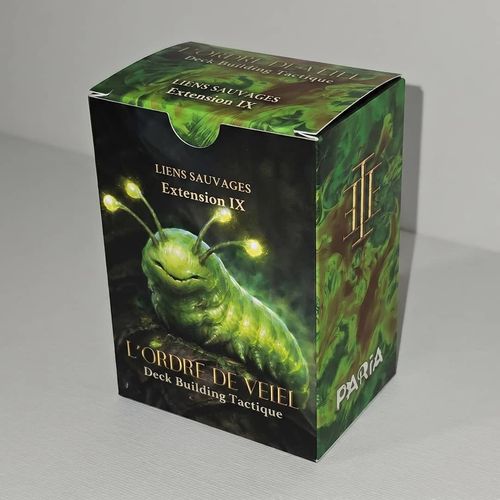
Ordre de Veiel: Deckbuilding Tactique – Extension 9: Liens sauvages
Ordre de Veiel: Deckbuilding Tactique – Extension 9: Liens sauvages Rulebook
Table of Contents
Table of Contents
Contents
The French booklet describes the expansion as containing 130 cards:
- 7 heroes, their abilities and base deck
- 3 enemies
- 108 Familiar and action cards
- 6 equipment cards
- 6 reward cards
You may add the cards to the base game, except for equipment and Familiar cards. Some of these cards have more complex effects than in the base game, so make sure you have mastered the base game rules before adding them.
Familiars: General Rules
Obtaining Familiars
At the start of the game, after the Novice hero cards have been selected, each player may choose a single Familiar. Each Familiar has its own deck.
Leave an area near you to form two piles: Deck and Discard.
The hero then takes the action cards of their Familiar. They shuffle the Initiate action cards and place them on the table to form their Familiar's deck. Set the Adept and Master action cards aside for now.
At the start of each battle, after placing their hero, the player places their Familiar wherever they wish on the board.
Strengthening Your Familiar
After completing a battle:
- If you have just completed the 1st battle, add your Familiar's Adept action cards, then shuffle the Familiar's deck and discard pile together.
- If you have just completed the 2nd battle, add your Familiar's Master action cards, then shuffle the Familiar's deck and discard pile together.
Recovering Action Cards from Your Familiar
At the start of each of your turns, after resolving your effects if you have any and before you begin to play, you may recover action cards from your Familiar. To do so, discard from your hand the number of cards shown on your Familiar's card, then recover the number of action cards shown.
You may perform this manipulation as many times as you wish, as long as you can discard the required number of cards from your hero's hand.
For example, here you may, as many times as you like, discard 2 of your cards to recover 2 action cards of your Familiar.
The printed illustration on the Grisard card shows this: discard 2 cards (−2) to recover 2 action cards (+2).
Playing Your Familiar's Action Cards
During your turn, your Familiar may play action cards in the same way as your hero. As with your hero, you may also discard an action card of your Familiar in order to have it perform a movement.
Resolved or discarded cards of your Familiar are placed in its discard pile. Once its deck is exhausted, shuffle its discard pile to reform its deck.
Interactions Between the Familiar, Enemies and Heroes
All entities may pass through Familiars. An entity (hero or enemy) may also end its movement on a space occupied by a Familiar. In that case, the Familiar is immediately moved to the nearest empty space. If several spaces are possible, the Familiar's Master chooses the space it is moved to.
Familiars may pass through heroes and other Familiars. However, they may not stop on a space occupied by a hero or a Familiar. They may not pass through enemies.
Familiars do not have the Ally keyword and are not considered heroes. Effects that affect heroes can therefore never affect Familiars, unless an effect explicitly says so.
If a Master dies, their Familiar is removed from the board. It may be placed wherever you wish when the Master returns to life.
Enemies never attack Familiars and ignore them completely. For their movement, targeting and attacks, enemies behave as if Familiars did not exist.
All effects of Familiars that interact with enemies are considered attacks, even if they do not inflict damage as such. For example, moving an enemy or removing its passive ability is an attack.
Advanced Rules
Before going into more detail on each Familiar, let us look at the specifics of action cards. For simplicity, when you obtain them, we encourage you to place your Familiar's action cards in your hand. However, note that action cards are not part of your deck. This means that:
- It is not your hero who plays an action card, but your Familiar.
- If your Familiar plays an action card, this does not break your hero's card sequence.
- You may not discard, exile, or do anything else with an action card of your Familiar in order to resolve the effect of one of your hero's cards.
- When an effect makes you draw a card, unless it is explicitly stated, you may not draw from your Familiar's deck.
New Range for Familiars
Some cards have letters in their range, as with the hero duo of Expansion 8. The letter "F" designates the Familiar and the letter "M" designates the Master. For example, this is the case for the "Ethical Harvest" card of the Mandrake.
Generating a Corpse
When you must generate a corpse, take an enemy card from any pile and place it on the board.
Familiars in Scenario Expansions
At the start of a scenario, each hero may take a Familiar even if the scenario does not indicate it. The Tamer, of course, must take 2. The Adept and Master action cards are recovered at the same time as the hero recovers their Hero: Adept and Hero: Master cards.
The Familiars
For your first game, if you want to start with simple Familiars to master, we suggest playing the Grizzly, the Grisard or the Pelagor.
Let us now briefly look at the themes of each Familiar.
Caustrel
The Caustrel excels at controlling the battlefield thanks to its network of underground tunnels. It moves with ease, using its secret passages to strengthen its actions. The more it uses its galleries during its Master's turn, the more effective its effects become. When it is Buried, it resolves the classic effect of its cards, to which the Buried effect is added.
Grisard
The Grisard excels at observing the battlefield from above. It Marks heroes and enemies in order to reveal opportunities and prepare more effective actions. Once the terrain is marked, new synergies open up and effects become more powerful.
Use its tokens to remember which entities are Marked.
Grizzly
The Grizzly is a Familiar specialised in repositioning heroes. It allows you to control the pressure from enemies while offering new movement options on the board. Thanks to it, heroes can move more freely and secure their key actions.
Mandrake (Mandragore)
The Mandrake is a powerful but unstable Familiar, capable of sowing chaos on the battlefield. Its Panic effects can disrupt your plans as much as those of your enemies. When well controlled, its wild nature becomes a formidable weapon.
Pack (Meute)
The Pack fights in coordination and turns every hunt into a collective assault. It excels at continuous pressure and the accumulation of attacks. The more you play with the Pack, the more impact your actions have. The Pack is especially strong when many heroes are in play.
Nibble
The Nibble depends entirely on its Host to survive and act. Heroes must pass it to one another to make full use of its potential. Each change of Host opens up new opportunities and synergies.
Use its token to place it on its Host, and keep its card close to the board so you can consult its Passive.
Pelagor
The Pelagor excels at recovering objects. It brings its Master and its allies treasures from the ocean depths. Used well, it gives access to powerful resources at the right moment.
Scalel
The Scalel is an opportunistic Familiar that clings to its enemies to draw sustenance from them. Jumping from enemy to enemy, it excels at gradual attrition and continuous pressure on an enemy.
Use its token to place it on its Host, and keep its card close to the board so you can consult its Passive.
Skeleton (Squelette)
The Skeleton draws its strength from the death around it. Every corpse on the battlefield becomes an additional resource to exploit. The more enemies fall, the more your options multiply.
The Tamer (Dompteuse)
The Tamer must choose 2 Familiars at the start of the game. She is the only hero who may play with 2 Familiars at the same time. She may have 3 when she obtains her Hero: Adept card.
Each of her Familiars has its own deck and its own discard pile, which are completely independent of one another. Furthermore, if an effect of a card you play or trigger mentions "your Familiar", you must choose which of your Familiars is concerned.
When recovering action cards, the Tamer may recover action cards for either or both of her Familiars, following the normal recovery rules. These actions are independent: recovering action cards for one Familiar does not prevent you from recovering action cards for the other, as long as the conditions are met.
Even though she has no colour, when building the starting decks, the Tamer may choose from any colour. This includes the Hero: Novice cards and the Equipment. On the other hand, during each reinforcement phase, the Tamer reveals 3 colourless cards.
The Tamer has a hand of 6 cards. She therefore dies if, at the end of her turn, she cannot form her hand of 6 cards.
Equipment
Equipment first appeared with Expansion 6, named Arsenal. If you do not own that expansion, you can consult its manual by scanning the QR code printed in the French booklet. (The QR code itself is not reproduced here.)
Glossary of Effects
Panic
The Mandrake has Panic cards that can attack enemies or heroes. Cards bearing this keyword are resolved during the enemies' turn. When the Mandrake plays Panic cards, it will therefore resolve them during the enemies' turn.
The Mandrake takes its turn following the enemy resolution logic, following the reading order of the board.
If several Panic cards must be resolved during the Mandrake's turn, its Master resolves them one after another, in the order they wish.
To choose targets, the Mandrake behaves like an enemy for all targeting, movement and range effects. Consider that enemies always have more threat than heroes. If the Mandrake must choose between several enemies, its Master chooses.
Buried and Marked
The French booklet gives these keywords in capitals, "ENFOUIE" and "MARQUÉ" (English: Buried and Marked).
These keywords are tied to the specifics of certain Familiars. They have no associated rules other than the effects explicitly stated on the Familiars and their action cards.
Host
The Scalel and the Nibble use the Host keyword. For the Scalel, enemies serve as Hosts; for the Nibble, the Hosts are heroes. This keyword has no effect in itself, but the effects of cards refer to it.
Let us discuss cards that have a duration and use this keyword. For example, if you play the Nibble's "Symbiotic Power" card, the card increases the attack cards (a) of the Host. If the Nibble's Host changes after you have played this card, "Symbiotic Power" remains on the previous Host. The effect of these cards therefore stays on the hero who was the Host at the moment you played the card.
Amorce
The French booklet prints this keyword as "Amorce" and does not give an English name for it; it is kept here as printed.
For its cards bearing the Amorce keyword, your Familiar must follow the same rules as you. As a reminder, its action cards are not part of your deck. You may therefore play your Amorce cards once your Familiar has played its action cards (even without the Amorce keyword). Conversely, your Familiar may play its action cards once you have played cards without the Amorce keyword.
Master
Some cards bear the Master keyword. The Master is the hero who chose the Familiar at the start of the game. Familiars trigger the effects of enemies that should normally be triggered by heroes. In that case, resolve the effect as if the Master had triggered it.
For example, if a Familiar makes the "Grand Priestess" (Enemy - Boss) lose a life, the Passive triggers as if the Master had made the life loss.
Volatile
Some cards bear the Volatile keyword. This is the case for most action cards of Familiars. At the end of your turn, before refilling your hand, if a Volatile card is in your hand, you may not keep it: return it to its discard pile.
Other Keywords
The French booklet refers readers to a QR code listing the keywords that appeared in previous expansions. (The QR code is not reproduced here.)
Other Expansions
The booklet's list of the publisher's other expansions, for reference:
- Expansion 5: Les Archives oubliées (The Forgotten Archives): a scenario-driven dimension for your games.
- Expansion 6: Arsenal: unleash the power of Equipment. Activate it at the right moment and reload it to adapt your hero to each situation.
- Expansion 8: Créations de la Communauté (Community Creations): L'Ordre de Veiel, by the players, for the players. Discover cards designed by the community and try out innovative mechanics devised by other enthusiasts.