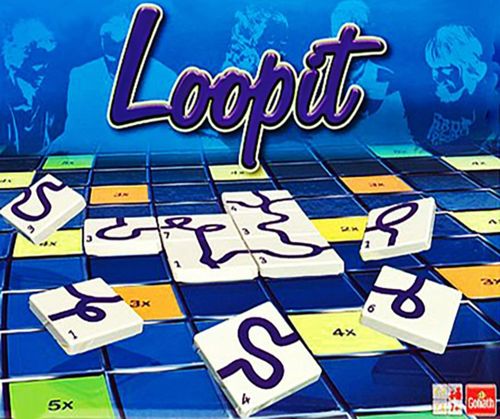
Loopit
Loopit Rulebook
Table of Contents
Table of Contents
Players
For 2-4 players age 7 and up.
Object of the Game
To score as many points as possible by playing tiles that connect to and continue the line that has already been created.
Contents
81 tiles, 1 bag, 4 playing racks, 1 game board, score pad, and rules.
The Tiles
Each tile shows wavy and looped lines that have to be connected to other lines on other tiles when the tiles are placed next to each other. The tiles have different values, from 1 to 8.
Game Preparation
The board is placed in the centre of the table. Each player is given a rack. The tiles are kept in the bag. Without looking, each player draws five tiles from the bag and places them on his rack.
How to Play
One tile, the "starting tile", is drawn from the bag without looking and placed on the board so that it covers the central square in the same reading direction as the reading direction of the board. (The tiles are made so that they will only fit properly in the correct direction.)
The youngest or oldest player starts. This player and each following player, proceeding clockwise, tries to place any three tiles from their rack onto the board so that they connect with a tile or tiles already placed.
At the end of each turn the score is noted and it is then the next player's turn.
Editor's note: the English text does not state the rack refill step. The French, Dutch, German, Spanish and Portuguese texts of the same leaflet say the player draws replacement tiles from the bag for each tile played (French: "piochant autant de tuiles que vous en avez posées"; Dutch: a new tile from the bag for each tile placed; German: refills the rack from the bag by the same number of tiles played). That step is not in the English text and is not added to it here.
Rules for Placing the Tiles
(See illustration)
- Tiles must be placed touching at least one side of any tile that is already on the board, connecting to at least one line (See fig. 1) and not blocking an existing line (See fig. 2).
- All tiles must be placed in the same reading direction as the board.
- In each turn a player can place a maximum of three tiles on the board.
- If a player cannot place all 3 tiles, he can choose to place 1 or 2 tiles only. Obviously his score in that turn will then be lower. If a player is unable to play any tiles on the board, he is allowed to throw back all 5 tiles and draw 5 new replacement tiles. He than loses his turn and he score for this player in this round will be "0"
- The three tiles can be placed adjacent to any tile already placed on the board in series (next to each other) or in different places.
- A tile cannot be placed so that a line ends at the edge of the board. (See fig. 3)
Scoring
- Points are awarded for any tile that is placed on the board, according to the points on the tile And
- Additional points are awarded for the tile or tiles that the newly placed tiles are connected to. And
- Bonus points are awarded for playing a tile on any of the bonus squares. The value of the tile is multiplied by the number shown on the bonus square.
Example
The example illustrated below is for a player who in the same turn places three tiles in the order shown:
- Illustration A: The player places a tile with 2 points on it (marked with a red arrow), which connects to the tile with 7 on it and scores 9 points. (2+7=9)
- Illustration B: The player gets a further 9 points by placing the tile with 3 on it (marked with a green arrow) next to the two tiles with 4 and 5 on them, continuing the lines on them. (3+4+5=12)
- Illustration C: The player gets a further 4 points by placing another tile with 2 on it (see blue arrow) on the "2x" bonus square. 2 X 2 =4 (bonus square) x (the value of the tile) = 4 points. Plus extra points are also given for connecting to tile with 3 on it, even if it has been placed in the same turn. The player does not score for the adjacent tile with 5 on it as no connecting line has been made.
Total score 9+12+4+3 = 28 points. This total is entered under the player's name on the score pad.
End of the Game
The game ends when players cannot place any more tiles or when all the tiles have been used.
The Winner
The player with the highest score is the winner.
New Game
Put all the tiles back into the bag and start all over again.
A Different Way to Play
In this variant you play an agreed number of rounds.
- For 4 players: Set the total number of rounds at 7 and play according to the above rules.
- For 3 players: Without looking, draw 2 tiles from the bag and place them out of the game. Set the total number of rounds at 9.
- For 2 players: Without looking, draw 4 tiles from the bag and place them out of the game. Set the total number of rounds at 13.