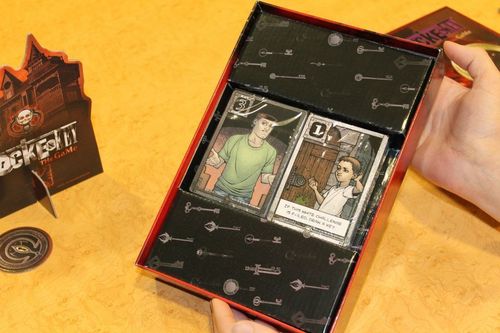
Locke & Key: The Game
Locke & Key: The Game Rulebook
Table of Contents
Table of Contents
- Object of the Game
- Challenges
- Strength
- Prep
- Start of Each Round
- Play
- Overcoming Challenges
- Playing Keys
- Determining the Winner (If Any) of a Challenge
- Clean-Up
- End of Game
- A More Thorough Examination of a Challenge Resolution
- Ties
- Resolution of Effects
- Card Effects
- Combos
- The Keys
- Stealing and Trading Keys
- Angel Key (Reusable)
- Animal Key (One-Shot)
- Anywhere Key (Reusable)
- Echo Key (Reusable)
- Gender Key (Reusable)
- Ghost Key (One-Shot)
- Giant Key (One-Shot)
- Head Key (One-Shot)
- Hercules Key (One-Shot)
- Mending Key (Reusable)
- Music Box Key (One-Shot)
- Omega Key (One-Shot)
- Philosophoscope Key (Reusable)
- Shadow Key (Reusable)
- Skin Key (Reusable)
- Sequence of Play
Object of the Game
Score more points than your opponents by overcoming Challenges and capturing secret victory points.
Challenges
The Challenges the Locke family faces range from the psychological to the spooky to the downright evil. In the game, these Challenges are broken up into three colors: White, Blue, and Black. Challenges have a color and a difficulty rating that ranges from 5 to 8. The higher the difficulty, the harder the Challenge will be to overcome. The color of the Challenge tells you something about the nature of the encounter.
White Challenges are personal and psychological problems, but can also be human encounters, like Sam Lesser.
Blue Challenges are the mysterious, otherworldly events the Locke family encounters, like the Living Echo.
Black Challenges are the creatures and entities of the Shadow Army that attack in the "Crown of Shadows" series.
Strength
To overcome these Challenges, the family needs to draw upon its strengths. Each player in the game will have a hand of Strength cards that are played to overcome Challenges. Strength cards have a color and a value ranging from 1 to 7, though there are no 5 or 6 Strength cards.
White Strength cards represent character and self-realization.
Blue Strength cards represent resolve and reason.
Black Strength cards represent fearlessness and conviction.
Prep
- Shuffle each deck separately.
- Count six cards from the Challenge deck (face down).
- Place the "Game Over" card face down amongst those six, then shuffle the resulting pile of seven cards together and place it face down on the bottom of the Challenge deck.
- Deal four Strength cards to each player.
- The person whose birthday is closest to today (looking forward only) gets the Lock.
Start of Each Round
- Reveal the top card of the Challenge deck for all to see. Read aloud the title and color of the Challenge, the difficulty rating, and the second place reward (in case some players can't see it).
- Deal one Strength card to each player. It's a good idea to have one player remain the dealer for the whole game.
Play
Starting with the player with the Lock and proceeding clockwise, each player may pass, play, or search for a key.
- If you pass, draw a Strength card from the deck and your turn is over.
- If you play, you may play up to three Strength cards from your hand in any mix of colors and denominations. These cards are typically played face down, though certain cards have game text that generates bonuses when they are played face up.
- If you search for a key, discard any two Strength cards from your hand. Then draw a Key and your turn is over.
Overcoming Challenges
After the last player has performed one of the above actions, all players reveal the cards they played. Add up all of the on-color Strength cards played by all players. A Challenge is overcome when the collective total value of on-color Strength played meets or exceeds the difficulty of the Challenge. Only cards that match the Challenge's color count towards overcoming the Challenge. Each player's on-color cards contribute to this total.
Example: On a Black Challenge with a difficulty of 8, Cory plays a Black 4, 2, and 1; Mike and Rumi both pass; and Scott plays a Black 3. The collective strength of Black cards played is 10. This Challenge has been overcome, as 10 strength exceeds the difficulty of 8.
Playing Keys
After all players have revealed their plays, each player has a chance to play any relevant Keys that may affect his or her Strength total, starting with the Lock player and proceeding clockwise. Players can play Keys whether or not the Challenge was overcome at the first reveal of Strength cards. Once each player declines to play any more Keys, determine whether the Challenge has been overcome or not.
Determining the Winner (If Any) of a Challenge
- Success: If the Challenge has been overcome, the player who played the highest total value of on-color Strength cards scores the Challenge. The player who played the second highest total of on-color Strength cards earns the second place reward.
- Failure: If the Challenge's difficulty rating is not overcome, place the Challenge on the bottom of the Challenge deck, and no one scores it or earns the second place reward. There are no other penalties for failing a Challenge.
Clean-Up
- Each player places all of the cards he or she scored this round face down into a pile near his or her play area (but not too close—they need to be kept separate from the players' hands). These are the players' score piles. You may examine the cards in your score pile, but other players may not.
- Discard all Strength cards played during the Challenge.
- Pass the Lock to the winner of that round's Challenge. If the Challenge was failed, the Lock does not move.
- Return to "Start of Each Round."
- If the Strength deck runs out of cards, reshuffle it.
End of Game
When the "Game Over" card is revealed from the Challenge deck at the start of a round, the game ends immediately. Remember that this card can appear at any time after you've played through the first twelve Challenges. Add together all of the cards in your score pile. The player with the highest point total wins. If there is a tie for the highest total, those players share the victory.
A More Thorough Examination of a Challenge Resolution
During the resolution of a round, there is bound to be more going on than described earlier. Various cards have effects that can earn you secret victory points, Keys, and extra Strength cards.
Example #1: During the resolution of an 8 difficulty Black Challenge, two players reveal Black Strength cards. One reveals cards with a total value of 2, and the other reveals cards with a total value of 4. They see that they are currently failing the Challenge, so one of them plays the Giant Key from his hand, raising his total from 2 to 7. After both players pass, the final determination is made. With a collective strength of 11, the Challenge is now overcome. The player with 7 strength is the winner of the Challenge, scoring the 8 VPs of the Challenge card, while the player who played 4 strength earns second place, drawing two Strength cards.
Example #2: During the resolution of an 8 difficulty Black Challenge, two players reveal Black Strength cards. One reveals cards with a total value of 5, and the other reveals cards with a total value of 6. They see that they have overcome the Challenge, but one of them gets greedy and plays the Giant Key from his hand, raising his total from 5 to 10. After both players pass, the final determination is made. With a collective strength of 16, the Challenge is overcome. The player with 10 strength is the winner of the Challenge, scoring the 8 VPs of the card, while the player who played 6 strength earns second place, drawing two Strength cards.
Ties
When two or more players are tied for the highest value of Strength cards played or second place on a Challenge, the tie is broken by the order of play that round, based on the position of the Lock. The earlier in the round you played, the better your tiebreaker.
Example #3: During the resolution of an 8 difficulty Black Challenge, three players reveal Black Strength cards. Two players reveal a total of 4 strength, and the third reveals a 3. They have overcome the Challenge, but two players are tied for most with 4. If neither wishes (or is able) to play a Key to break the tie, the player who acted earliest in the round wins the tie and scores the Challenge card. The other player at 4 earns the second place reward. The player who played the 3 earns nothing. Ties for second place are resolved in the same way. If all three players had played a 4, the tie for the winner would be resolved, and then the tie for second place would be resolved.
Resolution of Effects
When a player scores a Challenge card or earns a second place reward, those rewards are gathered in turn order. In addition to scoring the Challenge card, there are various Strength cards with game text that resolve at the end of the round. Starting with the player with the Lock, each player shows the other players the effects he or she needs to resolve. The player who scores the Challenge and the player who earns the second place reward only collect them when their turns come up during the resolution of effects.
Example #4: During the resolution of an 8 difficulty Black Challenge, three players reveal Black Strength cards. Two players reveal a total of 4 strength, and the third reveals a 3. The player who missed out on scoring the card or earning second place happened to play a card that reads, "If this Black Challenge is overcome, draw two Strength cards." When her resolution phase comes up, she draws two Strength cards from the main deck and adds them to her hand. During this final resolution, the winner and second place players have already been determined and will not change.
Card Effects
Face-Up Strength Cards
Some Strength cards ask you to play them face up to get the effect written on the card. If you wish to get the effect, you must play the card face up when you make your play. You can't wait until the resolution phase to reveal it if you want the effect. If you choose to play the card face down, its game text will not be active this round. You may even play a card face up under a color-changing Key (more on Keys later).
Receiving Cards from the Top of the Strength Deck
- When a card says to draw a Strength card, it comes from the top of the Strength deck and goes into your hand.
- When a card says to score a card from the Strength deck, it comes from the top of the Strength deck and goes into your score pile, face down.
- When a card says to put cards from the Strength deck into your play, the cards come from the top of the Strength deck and are placed face down in front of you, though you may look at them. You may place a card received this way under an Echo, Gender, or Mirror Key (see "The Keys" for more information). If a card received this way has an ability that activates if you play it face up, you may choose to flip it face up at this time.
Combos
There are several cards that reward you for playing certain patterns of cards. A Combo card is only active while it matches the color of the current Challenge. However, that does not mean you can't play off-color cards—in fact, you may outright bluff with off-color cards. But more importantly, you can play off-color cards along with your Combo cards. All Combo cards resolve whether or not the Challenge is overcome. Here is a list of the possible Combos:
1-2-3 Combo
If this 3 Strength card matches the current Challenge's color, it doesn't matter what color the other two cards are. If they are all on-color, great! But if you aren't so lucky, you may play an off-color 1 and 2 to get the reward. When you complete the 1-2-3 Combo, draw a Key during your end of round resolution.
2-2-2 Combo
If this 2 Strength card matches the current Challenge's color, it doesn't matter what color the other two cards are. When you complete the 2-2-2 Combo, you earn the second place reward during your end of round resolution. This does not deny the rightful player from earning the second place reward during the Challenge resolution, and if you are also the second place player, you earn the reward twice. If you play multiple 2-2-2 Combo cards of the correct color (like two White 2-2-2 Combos on a White Challenge), each of them resolves.
Multicolor Combo
If this 1 Strength card matches the current Challenge's color, the other two cards you play must be of the other two colors to complete this Combo. During your end of round resolution, choose any player (you can even choose yourself) and take a random Strength card from his or her hand. You score that card.
On the Money Combo
You must play on-color Strength cards with a total value equal to that of the current Challenge's difficulty to complete this Combo. If you do, you get to steal a Key from any player during your end of round resolution. You have to be right on to complete the Combo. If the difficulty of the Challenge changes so that it no longer matches your play, or you reveal a total value that does not match the Challenge's difficulty, you do not complete this Combo.
The Keys
When a player earns a Key, that player draws a Key card off the top of the Key deck and adds it to his or her hand. That Key will help the player in future rounds of play. If there are no Keys in the Key deck, effects that would reward a player with a Key do nothing.
There are two types of Keys: one-shot and reusable. One-shot Keys are held in your hand until you wish to use them. After using a one-shot Key, immediately shuffle it back into the Key deck. Reusable Keys are held in your hand until you wish to reveal them. When you reveal a reusable Key, place it face up in front of you. It then remains face up in play for the rest of the game. You may reveal a Key at any time.
Stealing and Trading Keys
When selecting a Key to trade for or to steal, you may choose a Key that has been revealed, or you may steal a Key from a player's hand that he or she has not revealed. You do not get to see an unrevealed Key ahead of time, so you are picking it blind.
Here are the Keys:
Angel Key (Reusable)
Receiving an extra card from the top of the Strength deck is optional. If you choose to take it, the extra card does not count against your three-card limit. You are not required to have played any cards from your hand to get this effect. If the free card is on-color, great! If not, it won't count towards the current White Challenge . . . unless you also have the Echo Key. You may place the free Strength card under a color-changing Key if you wish.
Animal Key (One-Shot)
Play this Key to increase the total value of one of your Blue Strength cards. This can be used to overcome a Challenge you might otherwise fail or to beat another player who played a higher total value of Blue strength. The best part is, you can use it after seeing each other player's cards at the end of the round. You must have played at least one Blue Strength card to be able to use this Key. This bonus is only temporary, so if you score a card that was boosted this way, it is only worth its printed value at the end of the game.
Anywhere Key (Reusable)
When you win a Challenge, you may play this card from your hand. If you do, draw two Strength cards and add them to your hand. This Key remains in play and will also trigger each time you win a subsequent Challenge.
Echo Key (Reusable)
After revealing this Key, place it face up in front of you. During any Challenge, you may place a Strength card from your hand underneath this card. That card counts as one of the three you are allowed to play each turn. The card you place under this Key counts as a White Strength card for this Challenge. In addition, any color words on it change to White. When you turn the Strength card face up, place it on top of this Key as a reminder of the color shift.
Example: On a White Challenge, you place a 1 Strength Blue card under this Key that reads: "If this Blue Challenge is failed, draw a Key." When you reveal this card at the end of the round, it is counted as a 1 strength White card with text reading, "If this White Challenge is failed, draw a Key."
Gender Key (Reusable)
Same as the Echo Key, but changes the color to Blue.
Ghost Key (One-Shot)
After revealing this Key at the end of a round, play a single Strength card from your hand. You may even do this if you already played three Strength cards during your turn. This is a great way to increase your total value over an opponent's. It can also mean the difference between success and failure on a Challenge, and the best part is, you can use it after seeing each other player's cards at the end of the round. You don't need to have played any Strength cards during your turn to play this Key.
Giant Key (One-Shot)
Same as the Animal Key, but adds 5 to one of your Black Strength cards instead.
Head Key (One-Shot)
This Key does not have be played on your turn. You still take your turn as usual after playing this Key. You must discard every Strength card in your hand when you use it, but you'll then draw that many new ones. This Key is a great way to change up your hand when you don't have the Strength cards you need. You can even play it after you've played a Strength card or two and want to find more on-color cards to play.
Hercules Key (One-Shot)
Same as the Animal Key, but adds 5 to one of your White Strength cards instead.
Mending Key (Reusable)
Same as the Angel Key, but used during a Blue Challenge.
Music Box Key (One-Shot)
This Key is best used when you are acting late in the round, as you only steal Strength cards from your opponents who have already taken their turns. Any who passed give you nothing. Each opponent who has played Strength cards must choose one and give it to you. The cards you are given become your play for the round. You can't add anything to them.
Omega Key (One-Shot)
This Key must be revealed during your turn, so it is best used when you are acting late in the round. You can then play up to three Strength cards as usual. Any off-color cards played this round add to the difficulty of the current Challenge. If the Challenge is failed, you score it, and no one earns the second place reward.
Philosophoscope Key (Reusable)
This Key allows you to get the truth from an opponent by peeking at his or her played Strength cards. You can then play your Strength cards using that information to your advantage. You can't show other players the cards you peek at.
Shadow Key (Reusable)
Same as the Angel Key, but used during a Black Challenge.
Skin Key (Reusable)
Same as the Echo Key, but changes the color to Black.
Sequence of Play
Start of Each Round
- Reveal the top card of the Challenge deck.
- Deal one Strength card to each player.
Player Turns
Play starts with the player with the Lock and proceeds clockwise. On your turn: pass, play, or search for a Key.
- Pass: draw a Strength card from the top of the deck, and your turn is over.
- Play: play up to three Strength cards from your hand face down in front of you.
- Search for a Key: discard any two Strength cards from your hand. Then draw a Key and your turn is over.
Resolution
- Determine if the Challenge has been overcome or not.
- Resolve effects in turn order.
Clean-Up
- Discard all Strength cards played this Challenge.
- Pass the Lock to the winner of the Challenge.
- Return to "Start of Each Round."
You can reveal a Key from your hand at any time.