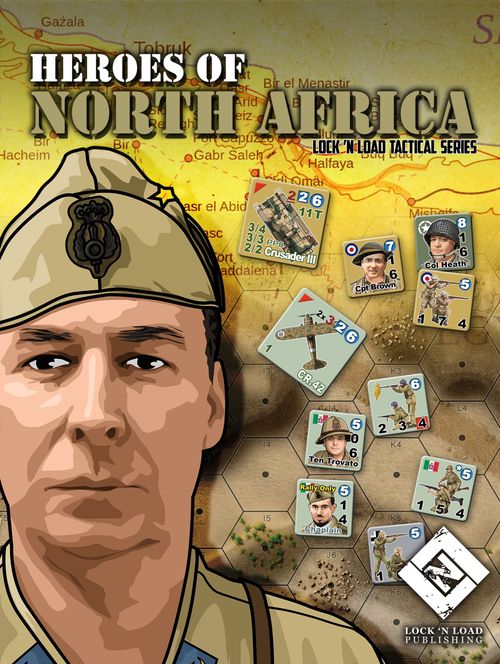
Lock 'n Load Tactical: Heroes of North Africa
Lock 'n Load Tactical: Heroes of North Africa Rulebook
Table of Contents
Table of Contents
- Community & Support
- Heroes of North Africa Module Rules & Scenarios
- 1.6.4 Brixia 35 (45 mm) and 51 mm Mortars
- 1.6.5 Molotov Cocktails
- 1.6.6 20 mm Solothurn ATR
- 1.7.1 Weapon Teams in Heroes of North Africa
- 5.7 "E"-Superscripted Firepower (Well-Equipped/-Trained)
- 6.6 Hit & Run Movement (HRM)
- 6.7 Opportunity Movement (OM)
- 7.1 Smoke in Heroes of North Africa
- 10.4.1 Terrain Characteristics in Heroes of North Africa
- 10.5 Terrain Markers
- 10.6 Desert Terrain
- 10.7 Bogging Down
- 10.8 Dust Clouds
- 10.9 Rooftops
- 11.7 Piper
- 11.8 Chaplain
- 13.1 Italian Forces
- 13.2 British / British Commonwealth Forces
- 13.3 French Forces
- 13.4 German Forces
- 13.5 American Forces
- 15.3.1 Overruns in HoNA
- 15.5.1 Continuous MU Movement
- 15.7 1*-FP MGs Range
- 15.8 No Rear Armor
- 15.9 Open-Topped Vehicles
- 15.10 Autoblinda 41
- 15.11 M11/39
- 15.12 L6/40 and R35 One-Man Turrets
- 19.1.2 Air Support in Heroes of North Africa
- 20.2.1 Starshells in Heroes of North Africa
- 21.4.1 Mines Against Vehicles
- 21.4.2 Immobilized Tanks
- 21.5 Sangars
- 21.6 Craters
- 21.7 Tank Emplacements
- 23.0 Mounted Units
- 24.0 Scenario Information
Community & Support
If you have any game questions, or if you are just looking for other gamers with whom to chat, you can find quick replies on our Forums: http://forums.lnlpublishing.com.
If any parts of this game are damaged, or you have any other support needs, please open a support ticket on our Support Ticket section: http://support.lnlpublishing.com.
You can also find additional game resources such as scenarios, counters, special rules and other community design ideas in our Resource section: http://forums.lnlpublishing.com/resources.
Heroes of North Africa Module Rules & Scenarios
Presented here are the Heroes of North Africa (HoNA) module-specific rules. All rules section numbers in these module rules work off of those in the v4.1 Core Rules (1930 - 1959), and refer only to this module.
1.6.4 Brixia 35 (45 mm) and 51 mm Mortars
These Mortars were issued to Italian and British units. They are treated as a Support Weapon (1.6) not as a Weapon Team (1.7), and must be carried, crewed and fired by a MMC or eligible SMC. They CANNOT be fired from Building or Bunker hexes, but can be fired from a Rooftop (10.9).
The Mortars have a FP of one (1) for the 45 mm Mortar and two (2) for the 51 mm Mortar, which is never halved as part of a multi-unit attack (but IS halved if fired by a lone SMC), a minimum range of two (2), and a maximum range of eleven (11) for the 45 mm Mortar and nine (9) for the 51 mm Mortar. The Mortars can only fire at spotted hexes, but can attack in one of two ways:
-
The Mortar can fire directly at units in spotted hexes in its LOS. Roll 2d6, choose the higher of the dice and add it to the TOTAL FP of the attack the Mortar is participating in, apply all DFT modifications and resolve the attack.
Example: If a 1-5-4-*5 Royal Army Squad with a Brixia 35 Mortar fires at a target five (5) hexes away, the Italian player rolls 2d6, selects the higher die, adds it to two (2) (2 = the Squad's FP + the 45mm Mortar's FP), and resolves the attack.
-
The Mortar can fire indirectly, and does not need to have a LOS to the spotted hex if the unit crewing the Mortar is adjacent to a friendly unit that does.
A unit can spot a hex and still direct the Mortar's fire in the same impulse. A Leader's Leadership Modifier (LM) does NOT affect the Mortar's FP when firing indirectly, nor does degrading terrain reduce it, but other DFT modifiers apply. Do NOT place a FFE marker in the target hex in either of the above cases when firing the 45mm or 51 mm Mortars; these Squad-level weapons rarely expended the amount of ammo needed to create a barrage. Units that direct the Mortar's fire are marked Ops Complete. Medics, Chaplains, Pipers, Snipers and Weapon Teams cannot direct the Mortar's fire. These Mortars cannot Opportunity Fire, and they are not Melee-eligible SWs.
The Mortars cannot be moved when the assembled (FP and Range showing) side is up. A Good Order MMC or SMC(s) can flip the counter in the Rally Phase. If forced to retreat from a hex because of an Overrun (15.3), a Flamethrower (1.6.3) or a Molotov Cocktail attack (1.6.6), the Mortar is abandoned and left in the hex. The Mortars can also be voluntarily abandoned during the Operations Phase if the possessing/crewing MMC or SMC(s) choose to leave the hex.
1.6.5 Molotov Cocktails
Molotov Cocktails are single-use Support Weapons with unique characteristics, including a range of 1 hex and an IFP of 1.
Molotov Cocktails can be used whenever a unit is eligible to use a Support Weapon. They are used once and then removed from play. They can be used along with a MMC or SMC's IFP to attack infantry and vehicles on the DFT. They can also be used in Melee or added to a unit's IFP when Close Assaulting a vehicle (17.1). If a Molotov, or a multi-unit attack that includes a Molotov, Shakes an enemy unit when firing on the DFT (not when used in Melee) the enemy unit must retreat one hex, as described in 1.6.3 for Flamethrowers.
If a Molotov, or a multi-unit attack that includes a Molotov, Shakes a vehicle when firing on the DFT the Crew must Abandon the vehicle and retreat.
Leadership Modifiers (LMs) DO affect Molotov attacks, unless the Leader is throwing the Molotov himself. Molotovs receive no other DFT modifications, although a MMC using its IFP in addition to throwing the Molotov receives DFT modifications.
Molotov FP is not halved when used by an eligible SMC (Leader, Hero).
1.6.6 20 mm Solothurn ATR
The Italian 20 mm Solothurn ATR was a heavy weapon (54 KG) and thus cannot be carried by a lone SMC.
1.7.1 Weapon Teams in Heroes of North Africa
The Italian Cannone da 90/53, the German 88 mm ATG and the British 25 Pounder cannot move. They use their Movement Factor (MF) to pivot within its hex.
5.7 "E"-Superscripted Firepower (Well-Equipped/-Trained)
The "E"-superscript next to an MMC or SMC's IFP designates the unit as well-equipped and trained when compared to other units in its army.
When an even number is rolled during a DFT attack, add one (1) to its IFP for the attack being resolved. One (1) is added for EACH stack containing an "E"-superscript, NOT for each "E"-superscripted unit taking part in the attack.
This does not apply to the FP of any SW used by the MMC, or SWs crewed by SMCs.
In HoNA, only the Italian Bersaglieri (13.1.4) MMCs have an "E" superscript.
6.6 Hit & Run Movement (HRM)
Units with a red Movement Factor (MF) (MUs, for example) can perform HRM. These units' intentions are declared at the beginning of their impulse and they are marked with an H&R marker. SMCs stacked with H&R-eligible units can also H&R move.
A unit (or stack) that is HRM-capable can spend up to one half of its MF and fire at any time during its movement. When firing, two (-2) is subtracted from the unit's (or stack's) total FP.
Example: A Cavalry MU (12 MF) can spend 2 MPs, fire (-2 to its FP), and then spend its remaining 4 MPs. It need not move first and then fire.
6.7 Opportunity Movement (OM)
HRM-capable units can Opportunity Move (OM) if not marked with a Moved, H&R, Fired or Ops Complete marker. Op Movement occurs at any time a unit would normally be eligible for Opportunity Fire (no range conditions are required); such units can activate and perform any type of eligible movement and fire.
7.1 Smoke in Heroes of North Africa
All units in HoNA have a Smoke-laying Capability of two (2), with the following exceptions, which CANNOT lay Smoke: Italian Mounted Units (MUs, Horse and Motorcycle) and the Free and Vichy French.
10.4.1 Terrain Characteristics in Heroes of North Africa
The TM from Sangars and Dust are cumulative with the other terrain in a hex, up to a maximum of +4.
10.5 Terrain Markers
Terrain markers for this module include Buildings and Gum / Palm Trees, and are placed as directed by the Scenario Special Rules. They assume all the characteristics of the listed terrain. When determining Line of Sight (LOS), consider the counter to fill the entire hex.
Hence, LOS traced through ANY part of a Gum / Palm Trees counter degrades the LOS. Building markers are played as Light Construction Buildings but have a TM of +3 as denoted on the counter.
10.6 Desert Terrain
The desert terrain has many unique features that affect gameplay. Consult the TEC for most of the details on terrain in HoNA. More common terrain and distinct characteristics are revealed below.
10.6.1 Sand
Sand is considered open terrain and provides no defensive cover (TM = 0). When entering a Sand hex, vehicles must make a Bog Down Check (10.7).
Note: Sand is in effect unless altered by a Scenario Special Rule (SSR); when Sand is not in effect, consider it to be Clear terrain.
10.6.2 Scrub
Scrub represents thorn brush common to the North African landscape. It provides no defensive cover (TM = 0) but it negates the +1 moving or Moved marker penalty a target unit incurs. Scrub is degrading terrain.
10.6.3 Gum / Palm Trees
Gum / Palm Trees represent light trees that provide defensive cover (TM = +1) and degrade LOS.
10.6.4 Hammada
Hammada represents hard, wind-swept bedrock covered in sand, pebbles and rock, and provides defensive cover (TM = +2). Hammada is degrading terrain. When entering Hammada hexes, vehicles must make a Bog Down Check (10.7).
10.6.5 Wadis
Wadis represent shallow, dry (except during the rainy season) stream beds that provide defensive cover for infantry (Leg) units only (TM = +1). Wadis are open terrain for spotting and LOS. Vehicles in a Wadi can only be hit by ordnance (OFT weapons) in their turret when fired on from any other non-continuous Wadi hex; hull hits are considered a miss. Sangars (21.5) cannot be placed in a Wadi hex. See TEC for more on Wadis.
10.6.6 Buildings
Light Construction Buildings in HoNA have a black dot, and they only have a TM of +2 instead of the normal +3 in most LnLT modules. Heavy Construction Buildings have a red dot and a TM of +4. All Building hexes are Level-1 in height unless noted as Level-2 in a Special Scenario Rule. The Building counters, as mentioned in 10.5, are Light Construction Buildings and do have a TM of +3.
10.6.7 Grove
A Grove represents a well-spaced cluster of olive or fruit trees. Groves are degrading terrain with a TM of +1 and a Level-1 height.
10.6.8 Under the Bridge
Only Leg units can move Under the Bridge. When Under the Bridge, from contiguous Wadi hex to Wadi hex, it's open for LOS and spotting, no TM. Units Under the Bridge have a +3 TM against fire from any other hex and against on-Map Mortars and Off-Board Artillery. From Under the Bridge, you can only move to another contiguous Wadi hex. Leg units on the Bridge cannot move over the Wall-sides of the Bridge.
Units Under the Bridge are considered to be in a hex separate from those on top of the Bridge for spotting and stacking. Units under the Bridge cannot fire at units on the Bridge, and vice-versa.
10.7 Bogging Down
Sand and Hammada hexes hinder movement for vehicles, motorcycle-mounted units (MMUs, 23.2), and infantry, and affect these units in the following manner:
-
For Vehicles and MMUs: See TEC for MP costs on vehicles/MMUs entering Sand and Hammada. After entering the hex, roll 2d6: if the result is a 2 or a 12, the vehicle Bogs Down and must end its movement for the impulse; if the result is a 3-11, the vehicle/MMU can continue to move, but must check again if it enters another Sand or Hammada hex. R-Class vehicles Bog on a roll of 2, 11 or 12. When a vehicle/MMU Bogs Down, place a Moved marker on it; any AM- or HRM-capability is forfeited.
Though a Bogged-Down vehicle/MMU is technically at a halt, in game terms it is a moving target-it's a time continuum thing. When entering a Sand or Hammada hex via a Road hex, vehicles/MMUs pay the Road MP cost and do not have to take a Bog Down Check. Vehicles changing facing within a hex do not have to take a Bog Down Check. Horse MUs (23.1) do not have to make a Bog Down Check.
-
For MMCs/SMCs: Infantry units pay the standard 1 MP to enter a Sand hex and 2 MP to enter a Hammada hex; however, MMCs and SMCs using Double-Time movement only add 1 MP to their total MF if they enter at least one Sand or Hammada hex during their impulse.
A vehicle that Bogs Down after entering a hex in which it was attempting to make an Overrun (15.3) forfeits its Overrun attack. Enemy infantry in the hex is considered to have survived the Overrun attack and can attempt a Close Assault following the standard procedure in 15.3.
If the infantry do not destroy the vehicle in the Close Assault, they must retreat to the adjacent hex of the owning player's choice; they are marked with a Moved marker and are subject to Opportunity Fire.
Vehicles that Bog Down are free to move again on their next impulse.
10.8 Dust Clouds
When a vehicle or Motorcycle MU (MMU) enters a Sand hex, it creates a Dust Cloud in the hex it currently occupies and also in the hex that it previously occupied if that hex is also a Sand hex. If a vehicle enters a non-Sand hex from a Sand hex, a Dust Cloud is only in the Sand hex it previously occupied. The following rules also apply to Dust Clouds:
- Dust Clouds are Level-1 in height.
- Dust Clouds affect LOS and attacks into and out of any non-covered-arc facing of the vehicle's hex (or non-front three hexsides of a MMU), and into, out of and through the previously occupied Sand hex as if it were a degrading hex (-1 to DFT attacks and +1 to OFT to-hit rolls).
- Dust negates the +1 Moving or Moved marker penalty for Leg-movement-type units in its hex.
- Dust Clouds' effects are cumulative. If LOS is traced through two Dust Cloud hexes, the effect is a -2 on DFT attacks and a +2 on OFT to-hit rolls. If LOS is traced through three or more Dust Cloud hexes, LOS is blocked.
- Any overlap of Dust Clouds results in the placement of a Dust 2 marker, which is the lone instance of a hex being double-degrading. There can never be more Dust in a hex than what is represented by a Dust 2 marker.
- Movement into a Dust 1 or Dust 2 hex costs one (1) additional MP for all units. MMC/SMCs participating in a Coordinated Move (6.5) with a vehicle producing a Dust Cloud do not pay an additional MP per hex unless a Dust Cloud marker was already in the hex in which they entered.
- Dust does affect vehicles that Bog Down.
At the end of a vehicle/MMU's movement, Assault Movement or H&R Movement, place a Dust 1 marker in the unit's hex and the last hex it occupied (moved from). This includes MMUs entering Melee. Keep the markers in these hexes until the next turn, even if the vehicle/MMU is destroyed. During the next turn's Operations Phase one of three things can happen:
- If the vehicle/MMU fires, the Dust markers are removed. Dust does not affect fire unless the vehicle pivots or its turret rotates outside the covered arc not affected by the Dust.
- If the vehicle/MMU moves, the existing markers are removed and new ones are placed in accordance with the above rules.
- If the vehicle/MMU was destroyed during the previous turn, does not perform any actions during the current turn, remains locked in Melee (MMU only), or is Shaken by enemy fire, the Dust markers are removed during that turn's Administrative Phase.
Though Dust provides no TM, during the Rally Phase, a unit in a Dust hex does gain the -2 to the die-roll for being in a hex with a positive TM.
During Night scenarios, Dust Clouds are in play the same as during the day.
Dust does not affect air support (19.1).
10.9 Rooftops
The Building hexes in HoNA have functional Rooftops that are considered to be a separate hex within a hex. It costs 1 MP to move from inside the Building onto its Rooftop or from a Rooftop down into the Building. Rooftops are considered degrading terrain for Spotting and have a TM of +1. All Support Weapons (including Mortars) and ordnance with a tube caliber of 20 mm or less that use the OFT can fire from a Rooftop. Units on a Rooftop are considered at Level-1. Units in the same Building but in different hexes and on different levels are not considered adjacent and do not have LOS to each other.
A unit on a Rooftop is considered adjacent to units within or on the Rooftop of a non-contiguous Building hex, and vice-versa. The stacking limit on a Rooftop is one MMC, two SMCs, and any SWs they possess.
Units cannot move from one Rooftop hex to another unless both hexes are a part of the same Building, in which case it costs 1 MP to move into the adjacent hex. Use a Rooftop marker to identify units on a Rooftop.
10.9.1 Rooftops and Spotting
Units on a Rooftop are considered to be in a separate hex within a hex for rallying, stacking and targeting/firing purposes but NOT for spotting; if the Building or the Rooftop is spotted, the entire hex is spotted.
11.7 Piper
The British Piper has a Leadership Modifier (LM) just like a Leader, but this rating can only be used to rally Shaken MMCs or SMCs. A Piper can attempt to rally all Leg units in its hex and ONE Leg unit in any ONE adjacent hex, but if he does, his hex-but NOT the adjacent hex, if it rallied a unit in an adjacent hex-is Spotted at the start of the Ops Phase. Pipers cannot use Double-Time movement (6.2), perform spotting attempts, and are not Melee-eligible units. A just-rallied Piper can attempt to rally other units as per the above rules. Pipers can Self-Rally.
11.8 Chaplain
Chaplains frequently risked their lives and accompanied troops into battle, bravely rescuing the wounded or providing consoling words to Shaken soldiers.
Chaplains have a Leadership Modifier (LM) just like Leaders, but these ratings can only be used to rally Shaken MMCs or SMCs; they cannot be used to assist Damage Checks or assist in fire attacks. Chaplains cannot perform spotting attempts.
Chaplains do not attack or defend in Melee. During Melee, if all friendly MMCs and Melee-eligible SMCs in the same hex as the Chaplain are eliminated, the Chaplain is eliminated too.
13.1 Italian Forces
The Italian Army is at the core of Heroes of North Africa, and they are well represented by Royal Army, Bersaglieri, Alpini and Folgore Leg units, as well as motorcycle and cavalry mounted units and a variety of armored units. They also have numerous Support Weapons, Weapon Teams and a pair of fixed-wing aircraft. Each of their Leg-unit types have some special characteristics and limitations, which are delineated below.
13.1.1 Royal Army (Unpredictable)
Royal Army units, both first and second line, were unpredictable when determining how well they would fight. To address this, Royal Army units have an asterisk before their Morale value. When the Italian player rolls an unmodified 6 on his initiative roll, each Royal Army unit with an asterisk adds one to its Morale for the current game turn. Keep track of this with the Unpredictable marker on the Turn Track.
13.1.2 Folgore
The Folgore were tough paratroopers who were revered by both their British enemies and German allies. Shaken Folgore units can attempt to rally if an enemy unit enters their hex for Melee. Leaders attempt to rally first, and then the other units in the hex. Good Order Leaders apply their LM as described in 3.0, but a Good Order Leader IS NOT necessary for the Folgore units to attempt to rally before Melee. Units that fail to rally are eliminated; those that do rally can fight in the Melee.
Note: If the only Good Order units in the hex after the rally attempts are non-melee eligible units (non-machine gun equipped Leaders for example), they are eliminated.
13.1.3 Alpini
Alpini units were elite units and received special training in mountainous areas. To reflect this elite trait, Alpini units do not pay the additional MP for moving up one level or down two levels of Hills, from one hex to another. They also have the "A"-superscript on their IFP (5.6).
13.1.4 Bersaglieri
Although better trained and equipped than standard Royal Army troops, Bersaglieri units were not on par with the Italian Folgore and Alpini units. However, to give the Bersaglieri units a boost for their added training and equipment, they are given an "E"-superscript to their inherent Firepower (IFP).
When an even number is rolled during a DFT attack, add one (1) to their IFP for the attack being resolved. One (1) is added for EACH stack containing a Bersaglieri unit with an "E"-superscript, NOT for each "E"-superscripted unit taking part in the attack.
This does not apply to the FP of any SW used by the MMC, or SWs crewed by SMCs.
Example: If three Bersaglieri Squads engage in a DFT attack and roll an unmodified even # on their opposed die roll, add one (1) to their FP (1 for the lead Squad + 1 (0.5 for each of the two supporting Squads) + 1 for rolling an even # = a FP of 3. If one of the Squads fires a Breda 37 SW (2 FP), the stack's total FP is five (5).
13.1.5 Low on Ammo
The Italian military was not prepared for war and thus its military was constantly short of food, clean water, good boots, ammunition, weapons, transports and vehicles.
To reflect this in game terms, when an Italian unit fires (be it a vehicle, SW, WT, Squad, etc.) or Opportunity Fires, and rolls an unmodified six (6) on the 1d6 attack roll (if firing ordnance, if one of the two dice rolled for the to-hit roll is a 6, the Italian player must roll for Low on Ammo for that piece of ordnance), it must roll a second 1d6 to determine if a unit is low on ammunition.
If the Italian player rolls a five (5) or six (6) on this second roll, mark a unit Low on Ammo. If the attack included multiple units and SWs randomly determine which unit or SW is Low on Ammo. The FP of this unit is still added to the current attack.
Example: Two Italian 1-5-4-*5 Squads, one with a Breda 30 SW, Opportunity Fire on a moving British stack. In its ensuing 1d6 to determine the effects of its fire, the Italian player rolls a six (6), requiring a second 1d6 roll to determine if an Italian unit is Low on Ammo. It then resolves its Opportunity Fire attack first, then rolls a second 1d6 to determine if one of its units is Low on Ammo. The Italian player rolls a five (5) to have one of its units being Low on Ammo.
The Italian player determines that if a 1-2 is rolled, the Squad without the MG will be Low on Ammo; on a 3-4, the MG will be Low on Ammo; and on a roll of 5-6, the Squad with the MG will be Low on Ammo. The Italian player rolls a five (5) to have the Squad without the MG being marked with a Low on Ammo counter.
The following details the effects of a Low on Ammo counter for units:
Units that use the DFT:
The unit that is marked with a Low Ammo marker is Low on Ammo for the remainder of the scenario and is still able to Fire, Opportunity Fire and Melee but with only a FP of 0, and its range being reduced to half (round fractions up). For Melee, they are considered 0-FP units (8.3).
Units that use the OFT (including Vehicle MGs):
A unit that is Low on Ammo still follows the same to-hit procedure (and MG attack procedure in the case of vehicles) and attack resolution, but after the Low-on-Ammo unit resolves this attack, the Low on Ammo marker is flipped over to its Out of Ammo side. This unit can no longer attack, Opportunity Fire or Melee for the remainder of the scenario.
The number of units that can be Low on Ammo/Out of Ammo in a scenario is limited to the number of Low Ammo/Out of Ammo markers provided (4).
Allied units that fire captured Italian SWs must also roll for low ammo.
13.1.6 Italian Squad Reduction
- When a Royal Army First Line 1-5-4-*5 Squad is reduced, roll 1d6: if the result is odd, replace it with a 1-4-4-*5 Half-Squad; if the result is even, replace it with a 0-4-4-*4 Half-squad.
- When a Royal Army Second Line 1-4-4-*4 Squad is reduced, replace it with a 0-4-4-*4 Half-squad.
- When a Bersaglieri 1E-6-4 Squad is reduced, replace it with a 1-4-4-5 Half-squad.
- When an Alpini A1-6-4-6 Squad is reduced, replace it with a 1-4-4-6 Half-squad.
- When either a Folgore 2-3-4 or 1M-5-4 Squad is reduced, replace it with a 1-3-4 Half-squad.
- When a 1-4-12 Horse Cavalry Squad is reduced, replace it with a 0-4-12 Half-squad.
- When a 1-4-20 Motorcycle Squad is reduced, replace it with a 0-4-20 Half-squad.
13.2 British / British Commonwealth Forces
Great Britain and her Commonwealth allies from Australia, New Zealand, India and South Africa, among others, fought the Italians first in East Africa and then in Egypt and across the Western Desert.
The Eighth Army became a renowned fighting force, most notably after defeating Rommel at El Alamein in 1942, the turning point in the war in North Africa. The British and the British Commonwealth forces share units. They have MMCs and SMCs, Support Weapons and a many anti-tank gun Weapon Teams. Their armored vehicles range from lightly armored Mark VI Bs to heavily armored Matilda IIs, three models of Crusaders, plus American-made Grants, Honeys and Shermans, to name a few.
13.2.1 British Squad Reduction
- When a 1-7-4-5 Squad is reduced, roll 1d6: if the result is odd, replace it with a 1-5-4-5 Half-squad; if the result is even, replace it with a 0-5-4-5 Half-squad.
- When a 1-7-4-6 Squad is reduced, replace it with a 1-5-4-6 Half-squad.
13.3 French Forces
Both the Free French and the Vichy French use the same counters in Heroes of North Africa. The Free French played a crucial role in the defense of the Gazala Line, at El Alamein and, later, during the push for Tunis. The Vichy French controlled Algeria and most of Morocco, and had the difficult task of defending against the joint Anglo-American invasion force during Operation Torch. The Free/Vichy French forces have two different types of MMCs, SMCs, some machine-gun Support Weapons and Weapon Teams that include a mortar, a heavy machine-gun and their reliable, old 75 mm anti-tank gun. The aging Renault R-35 tank is their only armored vehicle.
13.3.1 Foreign Legion (SRP)
The Free French Foreign Legion MMCs are elite units with a special characteristic.
SRP: Units marked with SRP on their Shaken side can Self-Rally, but, to rally, they must roll a pair-any pair-on their Morale Check. Terrain does not affect the die-roll. SRP MMCs can attempt to rally normally, with a Leader or Hero; however, a SRP MMC cannot attempt to rally twice during one Rally Phase-once normally, with a Leader or Hero, and, if that fails, again using SRP. A SRP unit stacked with a Shaken Leader can use its SRP instead.
13.3.2 French Squad Reduction
- When a 1-6-4 Squad is reduced, replace it with a 1-4-4 Half-squad.
- When a 2-3-4 Squad is reduced, replace it with a 1-3-4 Half-squad.
13.4 German Forces
Rommel. The Desert Fox. The Afrika Korps. Panzerarmee Afrika. These words all have a psychological edge to them, a hint of menace and invincibility.
Though the Italians are the Axis side's focus in Heroes of North Africa, the Germans still have a part to play, and their panzers get into the action with the Mark III and Mark IV Specials, the III J and the IV f/2. They also have plenty of 88 mm anti-tank guns and supporting MMCs and SMCs, as well as Ju-87 Stukas ready to dive from the sky.
13.4.1 German Squad Reduction
When a 1-6-4 Squad is reduced, replace it with a 1-5-4 Half-squad.
13.5 American Forces
The Americans entered World War II as green as their uniforms, and Operation Torch was their baptism of fire. In Heroes of North Africa they are introduced to combat against the Vichy French in battles for strategic places in Morocco and Algeria. They have MMCs, SMCs, some Support Weapons, 37 mm anti-tank guns and M5A1 Stuart tanks for armored support. They are well-equipped, and, as always, had plenty of artillery support.
13.5.1 U.S. Rifle Squads
Due to the extra Firepower of the M1 Garand semi-automatic rifle and the proliferation of the Browning Automatic Rifle (BAR) among U.S. Squads, additional U.S. Squads in multi-MMC attacks from the same hex do NOT halve their IFP as described in 5.2; but Half-squads DO halve their IFP as described in 5.2.
Example: Three U.S. 1-6-4 Squads have a combined FP of 3 when firing together.
13.5.2 Well Supplied
In any scenario in which Americans are allocated Off-Board Artillery Fire Missions, they can continue to request Artillery after they have used their last Fire Mission allocated in the scenario's Order of Battle.
To do so, they call for an additional Fire Mission as described in 18.2. After placing the Spotting Round marker, but before rolling for scatter, roll 1d6: if the result is <= 3, continue resolving the Spotting Round and subsequent Fire Mission; if the result is > 3, the Americans receive no more Fire Missions for the rest of the scenario.
13.5.3 American Squad Reduction
When a 1-6-4-4/5 Squad is reduced, replace it with a 0-5-4-4/5 Half-squad.
15.3.1 Overruns in HoNA
In HoNA, vehicles can perform Overruns in Clear (or any other non-water open-terrain hexes), Road, Sand, Hammada, Scrub or Wadi hexes.
15.5.1 Continuous MU Movement
Good Order Mounted Units (MUs, 23.0) marked with a Moved, Assault Move (AM) or Hit & Run marker (HRM) have the option of continuing their movement during the next Operations Phase. If desired, leave the marker on the vehicle in the Admin Phase, but turn it 180 degrees. During the next Ops Phase a MU marked as such must continue its movement, but can switch to AM or HRM, or vice-versa. This allows a targeted moving MU to retain the +1 to-hit modifier on the OFT and -1 DFT modifier from one turn to another.
15.7 1*-FP MGs Range
The British Bren Carrier, Valentine and MH Mk III, and the Italian M13/40, all have a 1*-FP MG. These MGs have a range of seven (7) hexes.
15.7.1 British Bren Carriers
The British Bren Carriers have two 1-FP Bren MGs, one in a fixed forward-firing (covered arc) position and one on a 360-degree mount (the 1*). If firing together at the same target, their FP is 2 and their range is 10. Their MGs can also fire at separate targets (in the same impulse) in different hexes with a FP of 1 and a range of 7.
15.8 No Rear Armor
The Italian Semovente L.40 da 47/32 is considered unarmored when targeted by small-arms fire from the rear, and is also considered an Open Topped-Vehicle (The British Bren Carrier is also an Open Topped Vehicle, but does have an armored rear.).
15.9 Open-Topped Vehicles
The following vehicles are always in open status: Semovente L.40 da 47/32, the SdKfz 251 and the Bren Carrier.
15.10 Autoblinda 41
The Autoblinda 41 (AB.41) had a rear driver, and therefore does not pay the move-in-reverse penalty as stated in 15.1.
15.11 M11/39
The M11/39's main gun was mounted in the hull, and can only fire at targets within its covered arc. To fire at targets outside of its covered arc, the M11/39 must pivot, and thus pay the +1 DRM penalty for a non-turreted vehicle firing outside its covered arc. Its machine gun was mounted in the turret, and can fire 360-degrees without having to be in open status. The MG can also (in the same impulse) fire at a target different from the main gun, even at targets in a different hex.
15.12 L6/40 and R35 One-Man Turrets
The Italian L6/40 and French R-35 had only one position in their turret, for a leader, main gunner, observer or loader, etc. To reflect this, an open L6/40 or R35 does not gain the -1 benefit on their OFT to-hit roll.
19.1.2 Air Support in Heroes of North Africa
Dust does not affect attacks by fixed-wing aircraft. Also, due to the large amount of Clear terrain and/or terrain that is easily visible from the air, fixed-wing aircraft can attack enemy ground units in hexes that are not already spotted or are not in the LOS of a friendly Leader. To do so, the aircraft must perform a spotting attempt of its own: rolling a four (4) or less if the target is in degrading terrain and a three (3) or less if the target is in blocking terrain.
20.2.1 Starshells in Heroes of North Africa
All nationalities' units in HoNA have Starshell Capability of two (2), with the following exceptions: The Italian Royal Army (not Folgore & Alpini) has a Starshell Capability of one (1); Italian MUs and the Free and Vichy French CANNOT fire Starshells.
21.4.1 Mines Against Vehicles
When Mines attack vehicles, they attack the vehicle's lowest HULL armor divided by 2 (round fractions up). No other modifiers (TM, DFT, OFT, etc.) If the Mines' attack result (1d6 + 1 FP (or 2, if that's the case) vs. 1d6 + lowest HULL armor divided by 2, rounded up) is greater than the vehicle's defensive result, roll 1d6 on the Mines vs. Vehicles Table:
| Mines vs. Vehicles Table | |
|---|---|
| 1 | No Effect |
| 2-3 | Shaken |
| 4-5 | Shaken & Immobilized |
| 6 | Destroyed (including Crew) |
21.4.2 Immobilized Tanks
Place an Immobilized marker on Immobilized vehicles. If a vehicle is Immobilized, it can no longer move, but, once it has rallied, it can fire and rotate its turret if it has one.
21.5 Sangars
Sangars are fortified areas similar to Foxholes in other LnLT modules. They are open terrain but provide a TM of +1. They are placed during setup, and are allowed in all hex-terrain types except Buildings (and Rooftops), Wadis, Ponds and Ocean. Units in a Sangar in an open-terrain hex do gain the -2 on their rally die-roll for being in a hex with a positive TM.
21.6 Craters
Craters markers represent the devastation from previous Artillery barrages or aerial bombardments. They are always placed according to a scenario's instructions, not as a result of game play. They are represented by a +1 Craters marker. TM is cumulative with other terrain in a hex and/or Vehicles/Wrecks and Smoke, etc. Craters and Sangars cannot be in the same hex. They are considered Degrading terrain for spotting and LOS purposes. Craters affect movement costs, in addition to normal MP cost of the hex, as follows: +1 MP for T and Leg units, +2 MP for O units, Prohibited for R units.
21.7 Tank Emplacements
Tanks in a defensive position were often dug into an Emplacement in order to provide them with extra protection. Emplacements provide no +TM but all hull hits against a tank under an Emplaced marker are negated, and the targeted tank does NOT have to take a Morale Check. Tanks under an Emplaced marker can only move out of the Emplacement by reverse movement into one of the two rear hexsides directly opposite the tank hull's covered arc vertex. Once a tank has exited from under an Emplaced marker, the marker is removed from the Map. If an Emplaced tank is destroyed, replace the Emplaced marker with a Wreck marker. Emplaced tanks do not need to be spotted unless required by other terrain in the hex.
23.0 Mounted Units
MUs are MMCs on motorcycles or horses. They represent 5 to 10 individuals and their mounts. They are considered a MMC except as noted below:
-
Stacking: MUs are considered Squads, but no more than two MUs can be in a hex, e.g., you can have two MUs and one Squad, or one MU and two Squads, but not three MUs.
-
Movement: MUs use the O-column on the Terrain Effects Chart. MUs cannot use Double-Time Movement (6.2).
-
MUs cannot Low Crawl (6.3).
-
Units subtract one (-1) from their Firepower (FP) when firing at MUs either moving or marked with a Moved or H&R marker.
-
Add one (+1) to FP when firing at a MU that is not moving or not yet marked with a Moved or H&R marker (exposure).
-
Units add one (+1) to their OFT to-hit die roll when firing at MUs either moving or marked with a Moved or H&R marker.
-
Units subtract one (-1) from their OFT to-hit die roll when firing at a MU that is not moving or marked with a Moved or H&R marker (exposure).
-
Mounted MUs do not spawn Heroes.
-
MUs can enter Melee.
-
SMCs can accompany MUs as if the MUs were MMCs. SMCs can move with any MU with whom he is stacked, and share the mounted status and Movement Factor of the unit with which they are stacked.
-
MUs can utilize Continuous Movement (15.5.1).
-
Dismounting: MUs can dismount during their impulse by expending half of their Movement Factor (MF). They are then replaced by their corresponding foot unit, which is marked on the top center of the counter.
These units can still spend half of their (new) MF. Enemy units can Opportunity Fire on MU units in the hex in which they dismount, and receive +1 on the DFT for such fire and -1 on the OFT. Mounts are considered abandoned and cannot be used for the rest of the game.
23.1 Horse Mounted Units (Cavalry)
Cavalry cannot use Support Weapons (SWs) when mounted. They can, however, carry SWs as delineated in 1.6.
Cavalry can Charge when entering Melee if the Charge is executed against a unit that was at least two hexes distant at the beginning of the Charging unit's movement (count the target hex, but not the attacker's hex.). The target of the Charge cannot occupy a Building, Bunker or Dense Palms hex.
The target can be in a Hammada hex, but the Charging unit(s) cannot pass through another Hammada hex on its way to the target hex. When Charging, Cavalry double their FP for the first round of Melee. Units targeted by a Charge must pass a Morale Check (TM applies); if they fail, they only defend (do not counterattack) during the first round of Melee. A Leader that does not pass the Morale Check cannot lend his LM to the attack either.
23.1.1 Dismounted Cavalry
When dismounted, Cavalry units use Royal Army First Line units: 1-5-4-*5 Squads and 1-4-4-*5 Half-squads; and their Squads always reduced to a 1-4-4-*5 Half-squad.
23.2 Motorcycle Mounted Units
MUs on motorcycles are Motorcycle-Mounted Units (MMUs). These units follow all the rules for MUs, with the following exception:
- When mounted, MMUs can fire SWs with a FP of 1 or less as long as the SW does NOT use the OFT.
23.2.1 Dismounted Motorcycle Units
When dismounted, Motorcycle units use Bersaglieri Squads and Half-squads.
24.0 Scenario Information
The scenarios in this module are laid out, for thematic effect, in date order. If you are new to the LnLT system, a good starter scenario in this module is "Bunker Busting"; it's played on one Map, so it has a small footprint, and it uses only MMCs and SMCs and introduces players to all the basics of the game, including Movement (6.0) and Direct Fire combat (5.0), as well as Indirect Fire (18.0). "Mountain-Top Drama" is another good introductory scenario. It adds a few vehicles (15.0), but they do not have ordnance. The Italian defenders do have a Solothurn ATR that uses the Ordnance Fire Table (14.0) and allows players to learn how to fire ordnance. Both of these scenarios also don't have Sand, Bogging Down (10.7) or Dust Clouds (10.8), which are crucial aspects of desert combat but are new to the LnLT system and thus can be distracting to those who are still learning the basics.
To learn about tanks and ordnance-firing Weapon Teams, try out "Why Oh Y". To add in Sand, Bogging Down and Dust Clouds, try out "Is Anyone Out There?" This scenario also introduces players to Fixed-Wing Aircraft (19.1). Once you have these rules down, you'll be ready to play all the scenarios in this module; though please note that "Night Moves" is not for beginners.
List of Italian Ranks and American/English Equivalents
- Serg - Sergente: Sergeant
- Ten - Tenente: Lieutenant
- Cap - Capitano: Captain
- Magg - Maggiore: Major