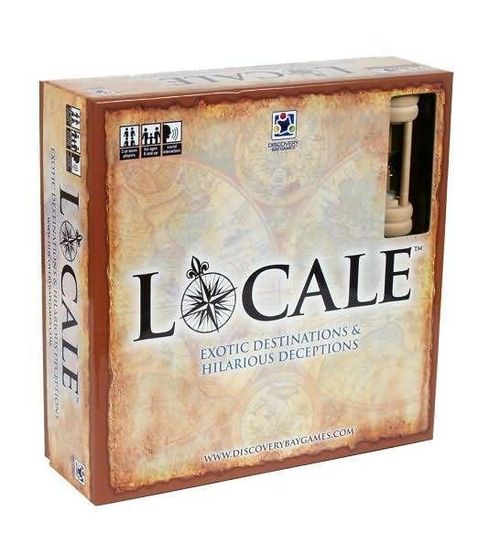
Locale
Locale Rulebook
Table of Contents
Table of Contents
Object of Play
To make up a story explaining the geographic location and origin of its name that will convince other players that yours is the correct version. Each player votes for the story he or she believes is the actual Locale. Players can earn points by either writing an explanation good enough to fool the other players into voting for it (whether actual or not) or by guessing the correct Locale after all entries are read or by guessing the correct coordinates on the map.
Game Contents
- 300 Game Cards
- 4 Answer Sheet Pads
- 1 Score Pad
- 4 Pencils
- 1 Timer
- 1 Game Board
- 8 Locale Compasses
Set Up
- Each player is given an answer sheet and a pencil.
- Place the Locale card box and the timer in the center of play.
- Open the game board and place in the center of play.
- Place Locale Compasses near the board.
Playing the Game
-
Choose one player to be the reader. The reader begins the game by drawing a single Locale card from the box and reading just the name of the Locale out loud.
-
The reader may read the Locale again if requested. Then he or she starts the round by turning over the timer and telling players to begin.
-
Each player, except the reader, has 90 seconds to write a location and a story behind the name of the Locale, which could be anywhere in the world. Write the real Locale if you know it. Be as outrageous or creative as possible! Players should also look at the game board and write the grid letter and number that corresponds with their guess.
Hints:
- Make your handwriting as legible as possible – printing is best. This will help the reader avoid giving away the fact that yours is not the true Locale.
- Sometimes adding little details such as a nearby city ("ten miles to the north of Chicago") or concerning the naming of the Locale ("local folklore suggests it was named after the area's first farmer in 1841") can be quite convincing.
-
While the other players are composing their Locales, the reader copies the real Locale and map coordinates on an answer sheet, and quickly turns the sheet over. If the Locale card contains a "fun fact," the reader will keep the card handy to share that at the end of the round. Otherwise, the reader should replace the Locale card to the card box at the end marked "discard here."
-
When finished, each player must print their name on their answer sheet.
-
When time is up, each player must hand their answers to the reader face down. The reader then reviews each answer to make sure it can be read. If the reader cannot read an answer, he or she should either return it face down to the player who wrote it and ask them to rewrite it legibly, or quietly ask that player about any illegible words.
Scoring the Round
- 2 points are given to a player for each vote received for his or her answer.
- 1 point is given to each player correctly guessing the actual Locale.
- 1 point is given to each player correctly guessing the actual map coordinates of the Locale.
- 3 points are given to the reader if no players get the real Locale.
Winning the Game
The first player to 30 points wins!
Variations for Team Play
- With team play, teams alternate between authoring and guessing Locales.
- The authoring team selects one reader. Play proceeds as in regular play with the reader writing the actual Locale and map coordinates and the other members of the authoring team writing their Locale bluff. No collaboration or discussion should take place.
- The reader from the authoring team mixes the answers with the real Locale and reads all the answers out loud.
- The guessing team discusses the answers and comes up with a single team vote.
- Teams alternate between authoring and guessing Locales. Readers rotate to the left within the team.
Team Play Scoring
- 3 points are given to the authoring team if the other team guesses the wrong Locale.
- 3 points are given to the guessing team for correctly guessing the actual Locale.
- 3 points are given to the guessing team if they correctly guess the actual coordinates of the Locale.
The first team to 30 points wins!
Note
Some of the Locales are found in more than one location in the world. If your guess for the Locale is found elsewhere than the answer on the card—and you can prove it—give yourself 1 point!