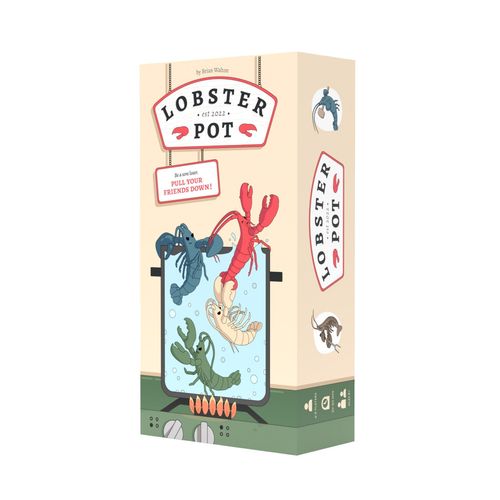
Lobster Pot
Lobster Pot Rulebook
Table of Contents
Table of Contents
Setup
A ready-to-play game of Lobster Pot should look something like this:
- Place the game board in the center of the table.
- Shuffle the Escape Cards and place them near the top of the board.
- Shuffle the Conflict Cards and place them beside the board.
- Shuffle the Chaos Cards and deal 2 to each player. Place the remainder beside the game board.
- Place the 1-6 dice and the negative dice within reach of all players.
- Each player picks an available lobster color and the corresponding color of Dominance Token, Lobster Cards, and Player Menu.
- Each player places their Dominance Token on their Player Menu on the space that says "0. Wimpy".
- Place the Round Cards along the bottom of the game board, with Round 1 flipped to the green side.
- Place each player's lobster token on the lowest space in the pot.
- Optional: Set out some lobster themed snacks to eat. (Snacks not included with game.)
Gameplay
Lobster Pot is played over the course of multiple rounds. Each round consists of 4 steps. Each player completes step 1. Then each player completes step 2. Then step 3. Then step 4, which finishes the round. Repeat rounds until a lone battle-hardened lobster emerges from the pot as victor.
The "LL" Token
The LL Token is a badge of shame to be held by the player whose lobster is farthest down the pot, with the lowest dominance. The player in possession of the LL Token at the time each step begins goes first. The lobster token only gets passed when another lobster moves LOWER in the pot or is tied but with lower dominance.
Note: The LL stands for any of the following that you prefer: Loserest Lobster. Lazy Lobster. Lobster in Last, Lamest Lobster, Lowest Lobster, Languishing Lout, Lamentable Languid, and so on. Under no circumstance is the LL token to stand for anything positive.
Choose Starting Position
To start the game each player rolls a 1-6 die. Starting with the player that rolled the lowest and going clockwise around the table, each player uses their roll to move up spaces in the pot and/or gain dominance. They can divide their roll as they see fit. E.g. Blue rolls a 4. They choose to move up the pot 3 spaces and up 1 dominance level.
Step 1. Choose Lobster
Each player looks at their Lobster Cards and secretly chooses either:
A) A different color lobster to pull down or B) Their own color lobster to move up
Place the card face down on the player menu in the spot that says "This turn".
Note: A player cannot use the same Lobster Card two rounds in a row.
Step 2. Move Lobster
Starting with the player holding the LL token, then going clockwise around the table each player reveals which lobster they selected and rolls a die to move them. Players can perform this step simultaneously if you don't mind the extra chaos (See alternative rules on page 7).
If a player selected to pull another lobster down: they roll the negative die. That roll can either be used to move that lobster down in the pot or make them lose dominance.
If a player selected their own lobster: they roll a 1-6 die. That roll can either be used to move upward in the pot or gain dominance.
Note: Rolls can be split up as a player sees fit. E.g. If a player rolls a 5 for their own lobster, they could move up 3 spaces in the pot and their dominance level up 2.
Step 3. Resolve Conflicts
Lobsters are territorial. If 2 or more lobsters are on the same space when this step begins, they must resolve the conflict through fierce competition. This is done by picking up and completing a Conflict Card. Conflicts take place from top to bottom.
Each card lists the rewards for winning and the penalties for losing. Winning lobster(s) get all rewards listed on the card. Losing lobster(s) take all the penalties listed on the card. Use 1 conflict card per space that lobsters are sharing.
Note: Once a lobster has participated in a conflict, they don't engage in any other conflicts until the next round's "Resolve Conflicts" step. In other words, the result of a conflict doesn't trigger more conflicts.
Some Conflict Cards require the participation of someone who's not directly part of the conflict (to act as a judge, spotter, facilitator, etc). If no such person is available, pick up a different Conflict Card.
More details and clarifications are available for some cards later in this instruction book.
Step 4. Chaos Cards
After all conflicts are settled, if a player is on a +1 space, they pick up a Chaos Card (or 2 if on a +2 space).
Starting with the lobster lowest in the pot (the lobster that has the LL token) then going around the table, each player can play a Chaos Card. A player can also opt to pass. This step ends when everyone has had the opportunity to play a Chaos Card once.
Resetting the Round
- Move the Lobster Card you chose for the round from the "This turn" spot to the "Last turn" spot on your player menu.
- Flip the next Round Card from the gray side to the green to indicate the start of the next round.
Keep repeating each step until a Lobster makes it to the Splash Spaces at the top of the game board or you reach the end of the 6th round.
Dominance Level
In Lobster Pot, players can adjust theirs or another lobster's dominance level to give them an edge. Adjustments to dominance can come from Conflict Cards, Chaos Cards, or from rolling a die during the "Move Lobster" step.
Dominance levels, from highest to lowest:
-
- Alpha: +1 to die rolls
-
- Aggressive
-
- Average
-
- Lowly
-
- Wimpy: -1 to die rolls
Alpha & Wimpy Dominance
Lobsters who max out their dominance level get 1 added to their rolls when moving themselves up or when moving other players down (in the pot or dominance level). Lobsters who end up with the lowest dominance level get 1 subtracted from their rolls. The +1 and -1 doesn't affect Chaos Cards, Conflict Cards, or Escape Cards, unless specified on the card.
Note: The reward/penalty (+1 or -1 to die rolls) is based on the dominance level before the die is rolled. Or, in the case of step 4, before the card is played.
So if a player rolls a 2 and they use both points to max out their dominance level they don't get an extra +1 to use that turn.
How to Win
The game can end 1 of 2 ways. Either a lobster makes it to a splash space, meets the conditions of an escape card, and wins the game, or you complete all 6 rounds of the game.
[Transcription gap: the printed lead-in to the following sentence falls in a layout gap in the source text layer and could not be recovered from the page image. The sentence as printed reads:] usual winning/losing effects. Instead, the winning lobster stays where they are and the losing lobsters go down to space 10.
Escape Sequence
When a lobster makes it to one of the splash spaces at the top of the board (spaces 11, 12, or 13), they trigger the escape sequence. The escape sequence goes as follows:
- Finish the current step. Each player finishes the current step. (Example: If a lobster made it to a splash space in step 4, anyone who hasn't gone yet takes their turn for step 4 before continuing the escape sequence.)
Note: The escaping lobster can still be pulled down as players finish the current step. If the escaping lobster is pulled down to space 10 or lower, the game continues as normal.
-
Resolve splash space conflict (if any). If multiple lobsters end up in any of the splash spaces by the end of the step, it is considered a conflict and needs to be resolved with a conflict card. [Transcription gap: the lead-in to the following printed fragment could not be recovered from the page layout; see the note under How to Win.] usual winning/losing effects. Instead, the winning lobster stays where they are and the losing lobsters go down to space 10.
-
Draw Escape Card. The lobster left on a splash space picks up the top Escape Card, reads it aloud, then follows the instructions on it.
If the Lobster meets the conditions of the escape card they win the game, and escape to freedom!
Boiling Point
At the end of the 6th round the water reaches boiling point and the lobsters are going to start dying off. For the record, this isn't how you actually cook lobsters. For safe and real ways to do so, please consult the internet, an old-timey sailor, or someone from Maine.
Fish out the Escape Card titled, "Boiling Point" and follow it's instructions to end the game.
More Ways to Play
The following are some other fun ways to play Lobster Pot. These variants are not recommended on the first playthrough.
Informal Step 2
On Step 2 "Move Lobster", rather than taking turns, some people like to have everyone reveal their chosen lobster, roll dice, and move all at the same time. This can move the game along faster. However, follow this rule to avoid some potential complications:
- After everyone has revealed the lobster they picked, everyone who's pulling someone else down goes first, then everyone that's moving themselves up.
Note: Normally changes to dominance and the resulting rewards/penalties take effect after each player's turn. In this variant you apply the rewards/penalties as they were at the beginning of this step.
E.g. If a lobster was at Alpha dominance but then another player made them lose dominance, they'd still use their +1. Or, if a lobster was at Wimpy dominance and they used their roll to gain dominance, they'd still have -1 applied.
When playing informal step 2 with dummy lobsters (see 2-3 Players below), the steps are handled as follows:
- Step 1: Played out the same as the base game, but no lobster is chosen for the dummy characters.
- Step 2: Played out the same as the base game but at the end of this step move the dummy lobster(s) up the pot 2 spaces (Taking into account their dominance level, so 3 spaces when they're at Alpha or 1 space if at Wimpy).
- Step 3: Pick up a Conflict Card and compete with all player characters (regardless if you're sharing a space or not).
- Step 4: Played out the same as the base game, but dummy characters don't get or play any Chaos Cards.
- Winning/Losing: Played out the same as the base game, but if a dummy lobster makes it to a splash space, the game is instantly over and no players win. If a dummy lobster makes it to a splash space within the same step as a player, ignore the dummy lobster, and take an escape card. If the player fails to escape, the dummy lobster wins and the game is over.
Bigger Conflicts!
If you prefer bigger conflicts, try this gameplay variant. Instead of triggering conflicts by 2 or more lobsters sharing a space try just having 1 conflict per round during the "resolve conflicts step" where every lobster is involved no matter where they are in the pot.
Other rules: Some cards involve all lobsters in the pot (Like Stir Up the Pot and several Escape Cards. When these show up treat them like normal but roll the necessary dice on behalf of the dummy lobsters.
Shorter Game
To ensure a shorter game, simply reduce the number of round cards. That's all.
2-3 Players
Lobster Pot can be played with 2 or 3 players! There are just a couple changes to the rules to make this work.
Setup: Add dummy lobsters so that there are at least 4 total lobsters in the pot. The more you add the more difficult the game. Set the dummy's corresponding player menus to the side of the board with their dominance token set to Alpha. Choose your starting positions like you do in a 4-6 player game. Place the dummy lobster's tokens on the lowest space in the pot. Make sure each player has lobster cards in their hand for each of the lobsters in the pot (including the dummy lobsters).
[Transcription note: in the printed layout the sentence "pot. Make sure each player has lobster cards..." sits in a neighbouring column; it is joined here because it completes the setup paragraph.]
Cards & Descriptions
Chaos Cards
A Challenge to a Duel
This card can only be played at the end of the "Resolve Conflicts" step after all other conflicts have been resolved. Move up the pot to share a space with the closest lobster above you and challenge them to a conflict.
A lobster can be challenged to a duel using this card even if they have taken part in a conflict this round.
Burst of Energy
Double your next die roll.
Conditions: Roll can't be used for dominance. You must move all spaces even if it means bouncing back from the top of the pot.
This roll can only be used for movement in the pot. Players can't move their own lobster down the pot, but if a player makes it to the highest splash space and still has some of their roll left, they must continue moving, but down the pot until they have moved the full number they rolled x2. The same rule applies when pulling a lobster down in the pot. If they reach the bottom of the pot with some of the roll left, they start moving up the pot with the remainder of the roll. The reward or penalty of one's dominance level doesn't get doubled.
Extra Dash of Chaos
When using this card, play 2 additional Chaos Cards at the same time.
If a player has both of these cards in their hand, they can "Extra Dash of Chaos" an "Extra Dash of Chaos" card to play even more cards (provided they have enough Chaos Cards in hand to play). Players can play their additional Chaos Cards in any order they like. For example, a player could use one card to adjust their dominance. Their newly applied dominance would apply for whatever card they play next.
Intimidation
During the next "Move Lobster" step, you can't be pulled down by any lobster that has a lower dominance level than you. You're just too intimidating.
Lobsters with lower dominance than you can choose your lobster in the "Choose Lobster" step, but, if they still have lower dominance by the time it's their turn in the "Move Lobster" step, their roll will have no effect.
Place Your Bets
This card can only be played during the "Resolve Conflicts" step. Before a conflict is read, indicate who you think will win. If that player wins, the rewards for winning that conflict also apply to you.
If the lobster who was bet on loses, the penalty from losing does not apply to the player who placed the bet.
Rubber Bands
Choose any Lobster Card from another player. That player cannot use that Lobster Card for 1 round.
This can be any Lobster Card, whether on the other player's menu or in their hand.
Sit This One Out
This card can only be played during the "Resolve Conflicts" step. Choose another player to take your place in a conflict. The decision to play this card can be made after the Conflict Card is read.
When you play this card, the winning/losing conditions no longer apply to you, but to the lobster you chose to take your place. The lobster who is chosen to participate in the conflict doesn't change spots in the pot.
Stir Up the Pot
Everyone rolls a die. Whoever rolls the highest gets the current leader's space. Then, everyone else rolls again but for the 2nd position, then 3rd, and so on.
- Start with the highest lobster's space (Red Lobster in this case). Everyone rolls a die. Whoever rolls the highest wins that space. Let's say Yellow rolls the highest. Red and yellow lobsters would switch places.
- Now move on to the next player's space (Green in this case). Everyone but the yellow lobster rolls for this space. Let's say blue lobster rolls the highest. Green and blue lobsters switch spaces.
- This continues with each lobster's space moving down the pot until each space with a lobster on it has been rolled for.
If there is a tie for the highest die roll, settle it with another roll just between the tied rollers. If multiple lobsters are sharing a space, roll for that same space once for each lobster on that space.
Conflict Cards
Aquatic Animals
A player not in the conflict chooses a letter and declares it. The first person in the conflict to call out a marine animal that starts with that letter wins.
An aquatic animal refers to any animal that lives in water for most or all of its lifetime. If there is a tie, just the tied players repeat the conflict but with a different letter. If nobody can guess for 15 seconds, a player not involved in the conflict picks a new letter. If an unresolvable dispute arises, repeat the conflict but with a different letter.
Aquatic Abomination
A player, not involved in the conflict, chooses 2 aquatic animals and draws them as 1. The first player in the conflict to correctly identify both animals wins. If nobody gets it after 30 seconds, choose new animals or pick a new conflict card.
Need some ideas? Starfish dolphin. Crocodile jellyfish. An electric eel seahorse. How about a hammerhead shark octopus?
Bocce Die
Find a flat surface with some space for distance die rolling/sliding. A player outside the conflict rolls a 0-2 die. In order from lowest to highest dominance, each player takes a turn sliding, rolling, or tossing their die near the 0-2 die. The player whose die ends up closest to the 0-2 die after everyone's turn, wins.
It is acceptable for a player to use their turn to just try to knock another player's die away from the negative die. If there is a tie (if 2 or more players' dice are the same distance from the negative die after everyone's turn) repeat the conflict among the tied players until there is a clear winner.
Consecutive Roller
Starting at the same time, all players in the conflict roll a die as fast as they can. The first player to roll 2 of the same numbers consecutively, wins (E.g. roll a "3" and then another "3" right after).
This is a speed game. Players should roll as fast as they can to try to get the same number back to back. Players don't have to pick the number ahead of time.
Die Bowling
Using 5 dice, build a tower somewhere on a flat surface where you can have some open rolling space. From about 5 ft away, players in the conflict take turns rolling a die, trying to knock down the tower. Each player should get an equal number of tries. Repeat if tied.
If one player knocks the tower over on their second try and the other player(s) has only had 1 turn, the tower gets reset so that the other player(s) can get their second turn. If the other player also knocks down the tower on their second turn, there is a tie and each player needs to go again to try to resolve the tie.
If the challenge is too hard or too easy, adjust the distance from the tower accordingly.
Die Shuffleboard
Find a flat surface with a ledge. From an agreed upon distance, each player slides their die as close to the ledge as they can without going over. Players should go in order from lowest to highest dominance. A player's die slide can affect the already placed dice.
Note that players are to slide the dice, not roll in this case. It is acceptable for a player to use their turn to just try to knock another player's die off the table with their dice slide.
Die Toss
Place the game box 5 ft away from the players in conflict. Each player tries to throw their die into the box. Repeat until someone is successful. Each player in the conflict should get an equal number of tosses. If tied, repeat until there's one winner.
The die must stay in the box. Bounce outs don't count. If it ends up being too easy, try moving the box farther away.
Fierce Glare
Each player in the conflict proves their dominance by glaring fiercely at the other players in the conflict. Players who show weakness by laughing or smiling lose. The player who maintains a fierce glare the longest wins.
Players must be looking at the other players in the conflict. They can blink and can switch between who they are looking at, but if they avert their eyes away from the other players, they lose.
In most cases, if a player cracks a smile they lose, but in some cases, a sinister smile is acceptable as a display of dominance. Players not involved in the conflict must be the judge of whether the smile is an effective display of power or merely a player crumbling under the pressure of the other dominant glares.
Players not involved in the conflict may make whatever kind of face they wish.
First to Roll...
Starting at the same time, all players in the conflict roll a die as fast as they can. Whoever rolls a certain number (specified on the card) first wins.
This is a speed game. Players should roll as fast as they can to try to get the specified number.
First to Roll to 10
Players in the conflict repeatedly roll a die as fast as they can, adding up the results until they reach 10. First player to do this wins! If anyone rolls a number that takes them over 10, they re-roll (from the last number) until they get exactly 10.
This is a speed game. Players should roll as fast as they can to try to add up to 10. If anyone goes over 10, they needn't start again from 0. They can start from the last number they were at before they went over.
How the Tables Have Turned
The player with the lowest dominance level wins. If tied, choose a new conflict card.
The lobster with the highest dominance level and the lowest switch dominance levels. Lobsters in between do nothing. If there is a tie for highest or lowest all tied lobsters take part in the switch.
Example: Four players are in the conflict. Brock's lobster has Alpha dominance. Kacy's lobster is also at Alpha dominance. Shanlee's is at Average. Dana's lobster has Wimpy dominance. Dana would now get to move her dominance to Alpha, while both Brock and Kacy have to move theirs to Wimpy. Shanlee's stays the same.
Laugh and Stop
Each player in the conflict attempts to boisterously fake laugh for 5 seconds then abruptly stop, holding a serious face as long as possible. Whoever holds their serious face the longest without smiling or laughing wins. If there appears to be a tie, consult the rule book for more options.
If it's too difficult to tell who won, players not involved in the conflict can decide based on the boisterousness of the laugh or the intensity of the serious face held after.
If the serious face holding goes on for longer than 30 seconds call it a draw, and everyone who held it that long gets the winning conditions of the card. If the serious face-holding goes on for longer than 1 minute then you are clearly not having fun and should maybe play a different game.
Match the Die
A player (preferably not in the conflict) rolls a die. The first player in the conflict to rotate (not roll) their own die to match what was rolled wins. Note that the number on the top, numbers on all sides, and angle of the die must match. Players must shout "lobster pot" to indicate they are done.
Note that this is not a dice-rolling challenge. Players may pick up and handle their die to get it to the proper position. If there is a tie in speed, have players not involved in the conflict analyze which match is more accurate. Repeat the conflict if still tied.
Example of a match: a rolled die is shown beside the player's own die, with the two faces matching in number, layout, and angle.
Rock, Paper, Lobster Claw
If an even number of players are involved in the conflict, pair off and have a Rock, Paper, Lobster Claw (Scissors) tournament. If there is an odd number of players, everyone rolls a die. The highest roller sits out the first rounds then plays the champ.
If there is an even number of lobsters in the conflict, players pair off and play rock paper scissors. The winners of each paired-off game play each other until there is 1 winner.
Roll Highest Without Going Over
Each player in the conflict rolls a die repeatedly, adding up each result. Each player can stop and lock in their score at any time. The goal is to roll the highest total without going over 15.
Going all at once, players in the conflict roll their die and add up the rolls to get the highest total without going over 15. At any point players can choose to lock in their score (be done rolling). If any player ends up rolling a total that adds up to more than 15, they not only lose the conflict but have to lose 2 dominance. If feasable, it is recommended to have spotters help keep track of players' rolls.
Seafood Sound Off
Starting with the most dominant and moving clockwise, each player in the conflict has 5 seconds to name a different type of seafood. If they can't, they are eliminated. Keep going until there is only one winner.
Seafood is defined as, edible aquatic animals, excluding mammals, but including both freshwater and ocean creatures.
The types of seafood can be as broad as "Lobster" and specific as "Bavarian Sage Crusted Lobster Rolls". They can also be categories like "sushi."
A player in the conflict can call out another player if they question the validity of the called-out seafood. Whoever is proven wrong after looking it up, loses the conflict. (Example: Mike doesn't believe Brian that Bavarian Sage Crusted Lobster Rolls are a thing. They search online and find no instance of this very specific seafood. Brian is revealed to be a lying simpleton and loses the conflict.)
If a debate can't be settled by looking it up, have players not involved in the conflict vote on it.
Spoons
Every player in the conflict places a die in the center. Now remove just one die. A player who is not in the conflict rolls until they get a 5. The conflicting players can then snatch a die from the middle. The player left without a die is out. Repeat until there is only 1 winner. Any players who touch a die before a 5 is rolled move down a space.
It's like the game "Spoons". Or, musical chairs, but with no music, and dice instead of chairs. For maximum fairness, hands must be kept at least a foot away from the dice before a 5 is rolled.
Staring Contest
If an even number of players are involved in the conflict, pair off and have a staring contest tournament. If there is an odd number of players, everyone rolls a die. The highest roller sits out the initial rounds then plays the winner.
In a staring contest, players look into each others eyes. The player who blinks first loses.
If there is an even number of lobsters in the conflict, players pair off and have staring contests. The winners of each paired-off game play each other until there is 1 winner.
Components
- 1 Game Board
- 9 Escape Cards
- 36 Lobster Cards
- 37 Conflict Cards
- 6 Round Cards
- 62 Chaos Cards
- "LL" Token
- 6 Lobster Tokens
- 6 Dominance Tokens
- 6 Player Menus
- 6 Dice (1-6)
- 6 Negative Dice