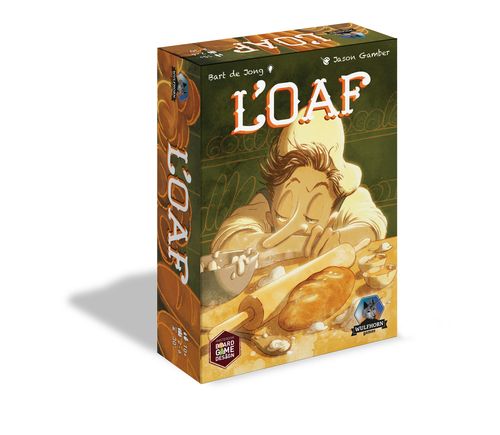
L'oaf
L'oaf Rulebook
Table of Contents
Table of Contents
Components
- 72 work cards (12 in each of 6 player colours, numbered 0-11)
- 6 baker figures (one in each of 6 player colours)
- 12 basic double-sided round cards (with an order side and a review side)
- 12 advanced round cards (marked by the croissant symbol on the review side)
- 1 reputation board
- 2 Boss cards (a Happy Boss and an Angry Boss)
Setup
- Place the reputation board in the middle of the play area. Place the 2 Boss cards next to it.
- Each player chooses a colour and takes the 12 work cards (numbered 0-11) and a baker figure in the same colour. Take the cards into your hand.
- Place the baker figure on the 0 space on the reputation board. Shuffle the round cards (if this is your first game, leave the cards with the croissant symbol on their review side in the game box). Place them in a pile next to the reputation board, with the order side up.
Goal of the Game
Have the most points at the end of the game, without getting fired. Cards left in hand at the end of the game are worth their value in points.
Summary
A game of L'Oaf lasts between 5 and 9 rounds. During a round all players simultaneously play one work card from their hand to contribute to a communal target indicated by a round card. Then, the group adds the values of their cards and compares their total to the order, to determine if they succeeded or failed the round. Each success or failure causes at least one player to gain or lose reputation with the bosses. It also triggers one of the effects on the review card that affects some players, or changes a rule in the game for future rounds.
The game ends once there have been 5 successful rounds or 5 failed rounds. Then, each player counts their points. Each work card still in your hand is worth its value in points. You can also score bonus points with a positive reputation and some review cards. The player with the most points is the winner. However, if the game ends because of 5 failures, each player with a negative reputation is eliminated before scoring!
Round Cards
The round cards are double sided; they have an order side and a review side. Each round, two round cards are in play; one order and one review.
Order
The order side shows the total amount of work that players need to play on that particular round. It shows the order both as an average per player and as a total for each player count.
The "average per player" value is also important for adjusting players' reputations (see Structure of a Round).
Review
The review side shows two effects, one of which will activate at the end of the round. The icon at the top (a smiling face or a frowning face) shows whether the effect activates on a success or on a failure. The icons in the effect box tell what the effect does when activated. The reference cards explain the meaning of each icon.
For a full explanation of every card, see Effect Reference.
Advanced Review Cards
Some round cards feature a croissant icon on their review side. These are the advanced round cards. Their effects are more elaborate and varied than the basic effects. We recommend not using the advanced effects when playing L'Oaf for the first time.
You can find a full explanation of every advanced effect in the Advanced Effect Reference.
Structure of a Round
Play in L'Oaf is completely simultaneous; there is no first player or turn order.
A round plays as follows:
- Draw the top card of the round deck, flip it, and place it next to the deck. This is this round's review card. The card that is now on top of the deck is this round's order card.
- Each player: play one work card of your choice from your hand, face down.
- Simultaneously reveal your cards.
- Add up the total value of work cards, and compare it to the total value on the order card.
- If the total is equal to or higher than the target value: Your bosses are happy! The player(s) who played the highest card increase their reputation, equal to the difference between their work card value and the order's average value per player.
- If the total is lower than the target value: Your bosses are disappointed! The player(s) who played the lowest card lower their reputation, equal to the difference between their work card value and the order's average value per player.
Example: The order for the round is 5 per player, or 15 total for 3 players. Zach plays a 6, Steve plays a 4, and Jason plays a 7. Their total is 17, so the round succeeds. Jason played the highest card. The difference between his card (7) and the order average (5) is 2, so he moves his figure 2 spaces up on the reputation track.
- Place the review card under the Boss card corresponding to the round's result, either the Happy Boss or the Angry Boss. Slide it under the card so that only the fail or success effect part is visible. Place new review cards under existing ones, so that all their effect parts are visible.
- If the review card has a direct effect, resolve it now (see Effect Reference).
- Each player discards the card they played face down into their personal discard pile.
- Does one of the rows have 5 cards in it? Then the game ends (see End of the Game). Otherwise, a new round starts.
Note: players may negotiate which cards to play. However, any deals made are non-binding, and players may never exchange cards or reputation.
Adjusting Reputation
When you increase or lower your reputation, move your baker figure up or down the specified number of spaces on the reputation track. If your figure reaches the 10 while going up, stop moving. You can not gain any more reputation. If your figure reaches the -10 spot while going down, you also stop moving, and can not lose any more reputation.
End of the Game
Once either the Happy Boss or the Angry Boss card has 5 cards under them, the game ends. Which boss triggers the end, affects scoring.
If the Angry Boss card has 5 cards, all players with a reputation below 0 are fired. These players do not participate in scoring and cannot win the game. If the Happy Boss card has 5 cards, no players are fired, and all players proceed to scoring.
Scoring
If you are not fired, add up:
- The values of all work cards still in your hand.
- Your bonus points if you have a positive reputation value. Note: you do not lose points for a negative reputation value.
- Any bonus or minus points from active review cards (only when playing with advanced round cards).
The player with the highest score is the winner! In case of a tie, the player among them with the lowest reputation wins. If there's still a tie, the tied players share the victory.
In the event that all players are fired, there is no winner.
Effect Reference
The effects on the basic review cards activate immediately at the end of the round. They always apply to a certain player or group of players, indicated by the target icon.
| Target | Explanation |
|---|---|
| (crown icon) | The player(s) with the highest reputation… |
| (broken crown icon) | The player(s) with the lowest reputation… |
| (+1 icon) | All player(s) with a good reputation (0 or higher)… |
| (-1 icon) | All player(s) with a bad reputation (lower than 0)... |
| Effect | Explanation |
|---|---|
| +X | …increase their reputation by X. |
| -X | …lower their reputation by X. |
Advanced Effect Reference
The advanced review cards are marked by the croissant icon. They include new types of effects.
- End of game effects add a new scoring rule. The bonus or minus points are awarded to players who meet the requirement at the end of the game.
- Empty effects do nothing, but count for two successful or two failed orders on one of their sides.
| Target | Explanation |
|---|---|
| (0 icon) | All players with a reputation of exactly 0… |
| Effect | Explanation |
|---|---|
| X (discard icon) | …discard a card of their choice from their hand. |
| (retrieve-lowest icon) | …take the lowest value card from their discard pile back into their hand. If your discard pile is empty, this has no effect. |
| -X (take-back-lower icon) | …take their played card back in hand. Then, they discard a card that is at most X lower than the played card. If they can't, they discard the played card instead. |
| +X (take-back-higher icon) | …take their played card back in hand. Then, they discard a card that is at least X higher than the played card. If they can't, they discard the played card instead. |
| +X (bonus points icon) | …gain X bonus points at the end of the game. |
| -X (minus points icon) | …take X minus points at the end of the game. |
The following effects apply to all players:
| Effect | Explanation |
|---|---|
| +x2 | All bonus points are doubled at the end of the game. |
| -x2 | All minus points are doubled at the end of the game. |
| (double-success icon) | If this order succeeds, it counts as 2 success cards. |
| (double-fail icon) | If this order fails, it counts as 2 fail cards. |