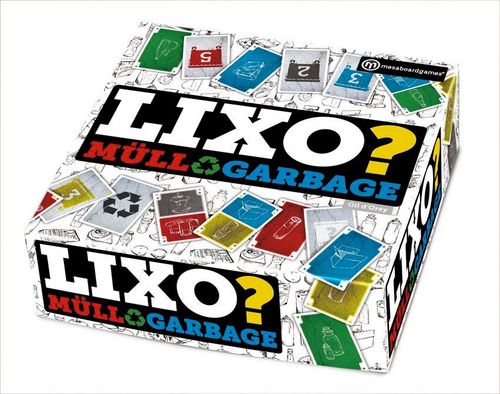
LIXO?
LIXO? Rulebook
Table of Contents
Table of Contents
Components
- 25 bin cards, each with its own colour. The colour of a bin shows the type of waste that may be placed in it:
- Plastic and metal (yellow square): yellow.
- Paper and cardboard (blue triangle): blue.
- Glass (green cross): green.
- Batteries (red star): red.
- Food waste and other rubbish (grey circle): grey.
- All bin cards are numbered 1 to 5. The number is the number of points the bin card is worth.
- 5 recycling cards. When such a card is revealed, each player takes 5 rubbish cards into hand, and immediately afterwards the active player changes.
- 180 rubbish cards. Each card shows one or two types of waste. If you fail to recycle this rubbish, each such card gives -1 point at the end of the game. It is possible to end the game with a negative score.
Setup
In the centre of the table
- Shuffle all rubbish cards and place them in one face-down stack here (the stack with the "Переработка" back, on the left).
- Take the bin cards and the recycling cards and shuffle them together into one deck (the deck with the "?" back, on the right).
- Leave a space beside the rubbish stack for the recycled rubbish cards: this is where recycled rubbish cards are laid out during play.
- Leave a space beside the bin deck for the open bin cards: this is where revealed bin cards are laid out during play.
For each player
- Each player takes 5 rubbish cards and holds them in hand, without showing them to the other players.
- Each player has a discard (сброс). Here the player places the bin cards they have won, and the rubbish cards they could not recycle.
The youngest player is the active player on the first turn. After that, the active player role passes clockwise at the end of each turn.
Play
- Reveal a bin card.
- Each player in turn, starting from the active player, may place any number of rubbish cards of one colour to try to win the bin. Only rubbish cards of the same colour as the bin may be placed.
- A bid can only be made with more cards than the bids placed by the other players. For example, if the player before you placed 2 rubbish cards, you may only place 3 or more.
The player who placed the largest number of rubbish cards wins the bin. This means they have managed to recycle their rubbish and receive points. Their bid cards are laid face up next to the rubbish card deck. The won bin card is placed on the table next to the player.
Rubbish cards placed by the other players (those who lost the bid) are laid face up in front of each player. This means those players could not recycle this rubbish, and they cannot use it further in the game. At the end of the game, all unrecycled cards give -1 point each.
A player is not obliged to bid. They may skip the first round and bid in the second round, if there is one. There are no limits on the number of cards a player may place.
If no player bids on a bin card, it remains face up in the pile of revealed bin cards. It is not used again.
If, instead of a bin card, you reveal a recycling card, each player immediately receives 5 new rubbish cards. After this, the active player changes.
There is no limit on the number of rubbish cards that one player may hold.
If a player spends all of their rubbish cards, they must wait for a recycling card to appear in order to receive new rubbish cards, and then make a new bid.
If all the players together spend all of their rubbish cards, each of them immediately receives 5 new rubbish cards.
End of the Game
The game ends when the bin deck runs out. Then scoring takes place: bin cards give points, and unrecycled rubbish cards subtract one point each.
Example from the rulebook: unrecycled rubbish cards: -3 points. Bin cards 3, 5, 2 and 2: +12 points. Total: 9 points.