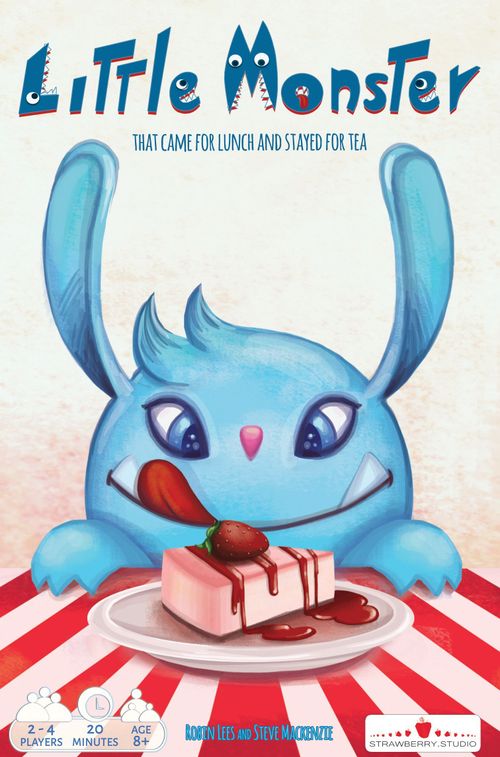
Little Monster That Came for Lunch and Stayed for Tea
Little Monster That Came for Lunch and Stayed for Tea Rulebook
Table of Contents
Table of Contents
Game Overview
Potworek Głodomorek is a race game in which the clever use of the cards you hold is the key to success. From 2 to 4 players can take part, and a game lasts about 20 minutes. Each player takes charge of 2 sweet Little Monsters, which they will lead in the race. By playing cards, players move their monsters along the table, which represents slowly satisfying their hunger. The player whose monsters are the first to go all the way around the table wins, and can then sit down calmly to drink a cup of tea.
Components
The game contains 54 cards, 14 tokens and this rulebook.
- 40 Food Cards
- 14 Monster Cards
- 14 Monster Tokens
Setup
- Divide the cards into two decks: the Monster deck and the Food deck. Shuffle each deck separately.
- Place the Food deck on the table so that all players can easily reach it. Leave some space nearby for a discard pile.
- Deal each player 2 Monster cards. Players place both cards face up in front of them.
- Give each player the tokens showing those monsters that appear on the cards they hold. Return any unused tokens to the box.
- From the four Monster cards that have not yet been dealt, face down, build the race track (the "laid table"), as shown in the illustration below.
- Each player places the tokens of both of their monsters in the bottom-right corner of the race track (see the illustration below).
- Deal each player 2 Food cards. Players hold these cards in their hands and do not reveal them to the other players.
- The starting player is the player who had breakfast most recently today. You may also choose the starting player in any other way.
Illustration captions from the manual: Example of a plate. Direction of monster movement. Starting plate: all monsters start the race on this plate. Finish: a monster that lands on the finish is immediately moved onto the card showing its picture.
Race Track and Monster Tokens
All monsters are represented by their tokens. When you must move a monster, move its token to the next plate. With each plate, the monster comes closer to the finish. Note that the quarter-plates in the corners of the race track are treated exactly the same as the half-plates along the sides: in both cases, each is treated simply as one "plate" on which monsters may stand.
A monster finishes the race when it reaches the finish, that is the top-right corner of the race track. When this happens, place that monster's token on its card. Whenever a card tells you to move a monster, you must do so; you cannot decline the movement.
- If a card tells you to move a monster 1 plate forward, move the monster's token one plate towards the finish.
- If a card tells you to move a monster 1 plate back, move the monster's token one plate towards the start.
- A monster can never be moved backwards past the starting plate.
- When a monster reaches the finish, its movement ends immediately, even if for some reason it should have moved further.
Gameplay
Players take their turns starting with the starting player and continuing clockwise. In each turn, a player performs these 3 steps:
- Activating monster abilities.
- Drawing a Food card.
- Feeding a monster.
1. Activating Monster Abilities
Each monster has some unique ability. The description of some of them begins with "at the start of your turn...". If the player whose turn has just begun has 1 or 2 monsters with such an ability, they must perform it at this moment.
2. Drawing Food Cards
Simply draw a new card from the Food deck. You may hold any number of cards. However, if after drawing a card the total taste value (described exactly on the next page) of all cards in your hand is greater than 30, you must feed a monster during this turn. If you have to draw a card and the Food deck is exhausted, shuffle the discard pile, make a new deck from it, and draw a card from that.
3. Feeding a Monster
Note: If you wish, you may skip this step and end your turn without feeding. However, if the sum of the taste values of the cards you hold exceeds 30, you must feed a monster.
- Choose one of your monsters.
- Play a number of cards from your hand so that the total taste value is 15 or more.
- Move the chosen monster 1 plate forward. If it reaches the finish after this move, immediately move its token onto the card showing its picture. A monster that has reached the finish has finished eating and cannot be the target of any special monster abilities or any actions described on Food cards.
- If the total taste value is exactly 15, skip steps 5 and 6 and go to step 7.
- If the total taste value is more than 15, cover one of the cards and add up the taste values again.
- If the total taste value is still more than 15, take the card you covered back into your hand and cover another card. Repeat this step until the total taste value of the uncovered cards is 15 or less.
- When the taste value of all uncovered cards is 15 or less, you must perform, in any order, all actions described on the uncovered cards.
- Discard all Food cards lying in front of you onto the discard pile (if you wish, you may choose the order in which you place the cards on the discard pile).
After finishing feeding one of your monsters, you may, on the same terms, perform a second feeding (but not a third). You may feed the same monster again or your other monster.
Food cards and their taste values: the manual shows a sample Food card with taste value 2, whose action reads "Draw 2 cards from the deck, then discard 1 card from your hand". The manual also shows a row of sample Food cards with their taste values printed on them.
Note: There are 2 monsters in the game (Renatka and Kondzio) whose special abilities change the taste value needed to feed them. Each time you feed one of these monsters, apply the rules described above, replacing the number 15 with the number that applies to that monster (12 for Renatka, and 20 for Kondzio). Similarly, if you feed Renatka or Kondzio by playing cards whose total taste value is higher than the lowest required, you must cover cards until their total taste value is 12 or less for Renatka, and 20 or less for Kondzio.
Example:
Ania plays Food cards with taste values 5, 4, 1 and 5. The total taste value of the cards she has played is therefore 15. After moving her chosen monster, Ania must perform the actions described on all the cards she played, and then discard all the played cards onto the discard pile.
Bartek plays cards with taste values 9, 4 and 3. The total taste value of the cards he has played is 16. After moving his chosen monster, Bartek must cover one of the played cards and perform the actions described on the 2 remaining uncovered cards, and then discard all the played cards onto the discard pile.
Paulina plays Food cards with taste values 7, 5, 4 and 3. The total taste value of the cards she has played is 19. After moving her chosen monster, Paulina has two options:
- Cover one of the cards that reduces the total taste value to 15 or less, that is cover a card of value 7, or 5, or 4, and perform the actions described on the remaining three uncovered cards, and then discard all the played cards onto the discard pile.
- Alternatively, she may cover a card of value 3, which reduces the total taste value to 16 (still above 15). Therefore Paulina must take this covered card back into her hand and cover another card. After covering the second card, the total taste value will certainly fall below 15, so Paulina performs the actions described on all uncovered cards, and then discards onto the discard pile all the cards lying in front of her (two uncovered and one covered).
Fastest and Slowest Monsters
Many cards refer to the fastest and/or slowest monsters.
The fastest monster is the one whose token is closest to the finish. Remember that this does not apply to monsters that have already finished the race.
The slowest monster is the one whose token is closest to the starting plate, and furthest from the finish.
If two or more monsters could be regarded as the fastest or slowest (they are on the same plate), then none of them is regarded as the fastest or the slowest.
Some cards refer to "your fastest" or "your slowest" monster. In such a case, you look only at your own monsters and completely ignore the monsters of other players. Thus "your fastest" monster is the one closer to the finish, and "your slowest" monster is the one further from the finish. If both of your monsters are on the same plate, then neither of them is the fastest or the slowest. Also, when one of your monsters has finished the race, the other one, which is still in the game, is neither "your fastest" nor "your slowest" monster (although it may still generally be "the fastest" or "the slowest" in the game, if a card refers to all monsters and not only to "your" monsters).
Resolving Actions and Special Abilities
If it is impossible to determine the fastest or slowest monster at a given moment, actions and abilities that refer to such a monster are ignored.
If you cannot fully perform an action or ability, you do not perform it at all. The only exception is when you cannot move the stated number of plates because the monster reaches the finish during the movement. In that case, the "excess" movement is simply ignored.
Winning the Game
The player who first brings both of their monsters to the finish wins the game!
Reminders
- Rules on Food cards and Monster cards may change the rules described in this manual (but they never apply to monsters that have finished the race).
- Performing the actions described on Food cards is generally mandatory. However, if an action description says you may do something, then you are not obliged to perform that action.
- If you cannot perform an action in full, you do not perform it at all.
- If both of your monsters are on the same plate, or only one of your monsters is still taking part in the race, you cannot use actions and abilities that refer to "your fastest" or "your slowest" monster.
- Place used cards on the discard pile.
- If you have fed a monster, you must move it.
Note on Card Text
The manual does not reproduce the individual ability text of each Food card and Monster card. These abilities are printed on the cards themselves, and in the manual's card illustrations they are partly covered or too small to transcribe reliably. Where a card's action or ability is referred to above (for example, "your fastest monster" or the 12 and 20 feeding values for Renatka and Kondzio), the rule is transcribed as printed in the manual. The exact text of each card should be checked against the physical or printed card.