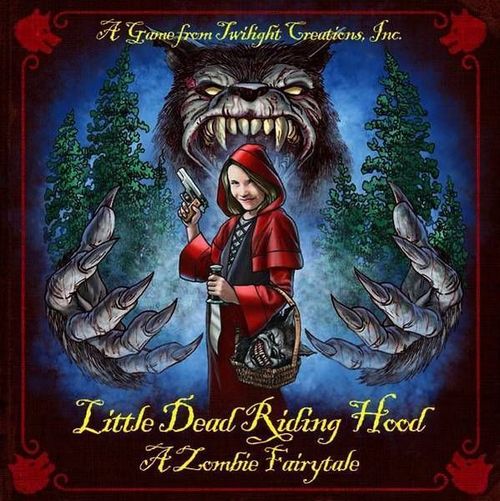
Little Dead Riding Hood
Little Dead Riding Hood Rulebook
Table of Contents
Table of Contents
Game Contents
- 1 Board - divided for 2, 3, 4 and 5 players
- 46 cards (40 events and 6 helpers)
- 75 tiles (starting marker, path and obstacles)
- 50 chits (47 bullet and 3 wolves)
- 1 fabric bag (combat bag)
- 5 player pawns (Little Red, Little Blue, Little Black, Little Green and Little Yellow Riding Hoods)
- 25 Zombie Wolves
- These Rules
Game Objective: Be the first Little Riding Hood to get to Grandma's House.
Game Setup
- Place the board in the middle of the table.
- Remove the helper cards and place them to the side of the board.
- Shuffle the remaining cards and give each player 3.
- Shuffle the tiles face down and place them to the side after removing the starting marker tile.
- Give each player 3 bullet chits and place the remainder to the side.
- Give each player a pawn and place the pawn on one of the starting spaces, youngest player choosing first.
- Place the fabric bag, the wolf figures and the two wolf tokens to the side (not in the bag).
Game Play Sequence
- Choose a helper and resolve it if appropriate.
- Pre-movement combat (if there are any zombie wolves on your square).
- Movement.
Game Play
- The youngest player goes first. This player takes the starting marker tile.
- The first player chooses a helper. If the helper has an immediate benefit, it is resolved. Otherwise it is resolved when appropriate.
- If there is a zombie wolf on the same path piece as a pawn, combat is resolved. Combat begins with the starting player and proceeds to the left around the board (see Combat below).
- Beginning with the starting player, each player may play one card to move (see Card Play below). Any zombie wolves encountered must be fought immediately before advancing any further (see Combat below).
- The helpers are returned to the side of the board and the starting marker is given to the next player on the left.
The Board
The board consists of a starting area with numbers that indicate starting spots for the pawns. Next to the starting spots are the woods where the wolves live. At the end opposite the starting spaces is Grandma's house. Once your pawn passes the edge of the woods (indicated by a line) you arrive at Grandma's house and win the game. (For further explanation see the illustration on the last page.)
Helper Cards
These fairy tale characters will help you in the game and sometimes do some nasty things to the other players.
- Prince: You may move one space and switch 2 tiles. You can do these actions in either order. Wolves and bullets on the tiles that you switch are moved with the tiles and placement must be legal (see Tile Placement below). The tiles that are switched must not contain pawns.
- Wicked Queen: Move up to 2 zombie wolves. Remove up to 2 zombie wolves from any tiles and place them on any other legal tiles. They may be placed on tiles with other players, but there may only be one wolf per tile.
- Huntsman: Take 3 tiles from the tile pool and place them on the board. All other players place 1 tile. In a 5 player game, all other players will place 2 tiles. Starting with the player who selected the Huntsman, place the tiles that have been drawn. The Huntsman places all three of his tiles, and then going clockwise the other players place theirs. (See Tiles below).
- Fairy Godmother: You may take one card, one bullet and place one tile. All other players may take either a card, a bullet or place a tile. Tiles are placed immediately, going clockwise.
- The Youngest Brother: You may play an additional card this turn.
- Evil Stepmother: You may draw 2 cards and make one other player randomly discard a card from their hand.
Cards
- The cards have an effect as well as a movement value printed on them. You can use the card for EITHER the effect OR the movement.
- Each player may only play one card per turn (unless a card or helper effect allows otherwise). This is true whether you are using a card for the effect or the movement value.
- Cards can be played at any time during a turn, even when another player is taking an action.
- There are cards that counter cards played on a player. These do not counter the helper cards and their effects unless specifically stated. The only cards that can be played before a card effect takes place is a counter card. Specifically, you cannot play a card if you have to discard a card randomly or trade hands, etc. unless it is a card that specifically cancels the one played on you.
- Once a card is played it is discarded.
- You draw a card when you place a path piece that does not have an icon on it (either a wolf or bullet icon) or by card effect. That is the only way you get cards.
Tiles
- All tiles are either path pieces or obstacles and are played face up when drawn.
- Make sure that the tiles are touching going from the bottom of the board (starting line) towards Grandma's house. They will shift a bit in play when tiles are moved, but as long as they are touching the line to Grandma's house, that is all that really matters. (It takes 10 tiles to go from the start line to the finish line.)
- The first tile past each start space must be a path piece and must be placed at the start line. No player may place an obstacle in any first position.
- If, at any time, you draw an obstacle piece and cannot legally play it, you may discard it and draw again until you get a path piece. All pieces discarded in this way are returned to the tile pool.
- Any time a tile is drawn that can be legally played, you must play it.
- All subsequent tiles may be placed off of a tile anywhere on the board. It does not have to be placed as part of your own path.
- Obstacles may be placed off of any tile on the board, but there may only be one obstacle tile attached to any one tile. Specifically, you can never have two obstacles placed off of the same tile.
- When you place the tile, if there is a wolf or bullet token icon on it, place a wolf or bullet token on the tile as noted. If it is a path piece without an icon, take a card when you place it.
- A path piece may contain both a bullet token and a zombie wolf.
Movement
- During the movement phase, if you have not already played a card from your hand, you may discard a card to use its movement value. Move the designated number of spaces. This number is found on the bottom of the card.
- You can move all or part of the designated movement.
- You may move forward, sideways or backwards. You may not move diagonally.
- Note that the tiles to the side might not be exactly touching a path piece, but you can still move to it.
- If you encounter a zombie wolf, you must fight it before advancing. If you fail to kill the zombie wolf, move back a tile. You may continue to move after failing a combat draw if you have additional movement remaining.
- You can move onto someone else's path, but you may not end your movement on the same path piece as another player. You may however move through a path piece containing another player's pawn.
- When you land on a tile with a bullet and no wolf, immediately take the bullet token. If there is a wolf present, immediately proceed to combat.
Combat
- When you share or land on a path piece with a zombie wolf, combat ensues.
- Take the fabric bag and place one wolf token in it. Now place as many bullet tokens as you wish into the bag. Hold the top of the bag so that no pieces will come out and shake. Draw one of the tokens without looking at it until it is out of the bag. If it is a wolf token, you move back a path piece. If you draw a bullet token, remove the zombie wolf from your path tile. All bullets are discarded whether you kill the zombie wolf or not.
- If you have enough movement left after a failed combat, you may move onto the path piece with the zombie wolf and try an additional combat. You may also choose to use an alternate path.
- If you do not have any bullets, you may not attempt combat.
- If you are on a tile with a wolf and have no bullets, you must immediately move back one space.
Card Effects in Further Detail
- Cake and Wine: Discard this card to double the number of bullet tokens during this combat draw. If the combat is not successful and is retried, the card effect does NOT continue.
- Trail of Bread Crumbs: Play to draw a different path piece. This card is played right after you draw a path piece. It may only be used on you and not another player. Place the first path piece back with the other tiles, face down.
- Who's Been Sitting On My Chair?: Trade hands with another player. You may trade hands with any other player even if either player does not have any cards.
- Who In The Land Is Fairest Of All?: Play to make a player choose a different helper. The original helper is returned and may be chosen by another player.
- My...What Big Hands You Have?: Target player moves back one path piece. You get to choose onto which path piece the player is moved.
- Off The Path: Discard to remove one end tile. This can be a path piece or an obstacle.
- Wolf!!!: Target player skips their next turn. That player takes no actions on their next turn. This includes placing tiles with the Huntsman or effects from the Fairy Godmother.
- Once Upon A Time: Discard to redo a combat draw. All tokens in the bag remain in the bag for the second draw. No additional tokens may be added.
- Picking Flowers: Discard this card to replace one path piece with another one on the board. These must be unoccupied path pieces, but they may contain a zombie wolf or bullet token.
End of the Game
The first player to land on a path piece that crosses the line out of the woods wins the game (see illustration).
Board Explanation
- For a two player game use the uncolored starting spaces and lanes. For three players add the blue spaces and lanes. Add the red for four players and the yellow starting spaces and lanes for five players.
- The sample board in the rulebook is for three players. (Diagram not reproduced.)
- The "X's" mark spaces where it would be ILLEGAL to place an obstacle tile. (There are more illegal spaces, these are just possibilities.)
- The "Y's" mark spaces where a path piece could legally be placed. (There are more legal spaces, these are just possibilities.)
- If player "1" began his turn on the space marked with the "A," the "B's" mark all of the spaces where he could land with a movement of three. Notice that it is possible to use paths in other lanes. Also, keep in mind that the player would have to defeat the wolf on the "B*" space before being allowed to end his movement there.
- Finally, the first player to reach the space marked with the "F" in this example would win the game. Of course, other paths could continue to be constructed and used to win as well.