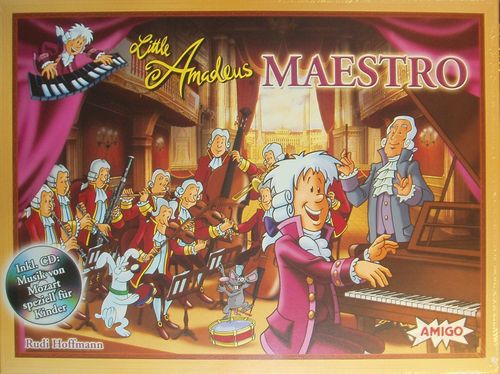
Little Amadeus Maestro
Little Amadeus Maestro Rulebook
Table of Contents
Table of Contents
Components
- 1 game board, showing the score-scale spaces, the musical pieces (each with 4 instruments), the start space with four figures, and spaces for the applause cards
- 4 agencies (player boards), each in a player colour: Amadeus (red), Beethoven (yellow/orange), Haydn (black) and Nannerl (blue)
- 4 player figures
- 46 musician cards (instrumentalists)
- 10 conductor cards
- 14 applause cards
- 1 Devilius card
Setup
- Place the game board in the middle of the table.
- Each player chooses a figure and an agency (Amadeus - red, Beethoven - yellow/orange, Haydn - black, Nannerl - blue). He places his figure on the start space and places his agency in front of him. Unused figures and agencies go back into the box.
- Place the Devilius card next to the game board, near the start space.
- Each player receives one conductor card.
- Shuffle all remaining conductor, musician and applause cards face down, then divide them into four face-down stacks. Place each stack at a corner of the game board.
- Each player then takes two cards from stacks of his choice and places them, together with his conductor card, on one space each in the bottom row of his agency.
- If any applause cards are among these, place them on the applause spaces on the game board. Replacement cards may be drawn so that each player has three cards on his agency at the start of the game.
Course of the Game
The player who can sing the highest begins. The other players then follow in clockwise order. A player's turn consists of two actions:
- The player may place any number of cards on the game board.
- The player must draw 1–3 cards from the stacks. Before drawing, the player must announce aloud how many cards in total he intends to draw. He decides which stacks he draws from, and how many cards he takes from each stack.
Note: In the following text, the instrumentalists and the conductor are always referred to as musicians.
Action 1: Place musicians on the game board
The player may perform this action, but does not have to. If he wants to perform it, he places cards in the rows of the musical pieces.
The first musician in a piece of music must be a conductor. The conductor has no space of its own, so the conductor may be placed on any instrument space. The player whose turn it is decides on which instrument he places the conductor. Only one conductor may lie in any one piece of music.
Further musicians in a piece of music must be placed directly adjacent to an existing musician, to the right or to the left. There may be no gap between an already placed musician and a new musician. Each musician must be placed on its matching instrument space. In this way a row can be started, continued or completed.
Diagram captions on page 2: "Correct", "Wrong: there is a gap here", "Wrong: the conductor is missing here".
Note: A player may place musicians into different pieces of music. In one turn, however, he may complete only one piece of music.
Normally the player takes cards from his own agency. He may, however, also take any number of cards from the agencies of other players during his turn and place them on the game board. But he may take cards only from the upper row of another player's agency! Musicians in the lower row of another player's agency may not be taken.
Action 2: The player must draw 1–3 cards
In his turn the player must draw at least one card from a stack. Drawn musicians are placed on free spaces of the player's own agency. Once placed, they may not be moved within the agency. The player may not draw more cards than he has free space on his agency.
In the rare case that the player's own agency is full, the drawn musician must be removed from the game.
Note: If the player draws one or more applause cards, they are placed face up immediately on the applause spaces of the game board. Replacement cards are not drawn for them.
Diagram captions on page 3: "Upper row", "Lower row".
The player's agency
Each agency has a total of 10 spaces in two rows. The player may decide whether to place musicians in the upper or the lower row. Musicians in the upper row may be taken by other players. A player who takes musicians from another agency must always place them on the game board, never in his own agency.
Musicians in the lower row are protected from other players.
The Devilius card
If a player occupies the last space of a piece of music, he receives the Devilius and places it face up in front of him. As soon as another player completes a piece of music, that player receives the Devilius.
Scoring
For each musician (conductor or instrumentalist) that the player places on the game board, he earns one point. His figure is moved forward on the score track accordingly.
If a player begins a piece of music and completes it in the same turn, he earns two points for each musician placed in that row.
Whoever holds the Devilius receives a bonus of five points when a row is completed.
Example: Nannerl holds the Devilius and has first placed a flute in the piece "Kontretanz in D-Dur". She then completes the row "Klaviertrio in C-Dur" – all three spaces, with conductor, piano and cello – in one turn. She earns one point for the flute and 2 x 3 = 6 points for the piano trio. Because she holds the Devilius, she additionally receives 5 bonus points. Nannerl may move her figure forward a total of 12 spaces.
End of the Game
There are 14 applause cards. The game ends immediately as soon as the last applause card is placed in the applause row.
Each player must now add up the notes on the musician cards that are still on his agency. For each note the player must move his figure back one space. For a conductor the player must move back five spaces. The player whose figure is furthest forward on the score track wins.
Example: At the end of the game Haydn has earned 30 points. However, he has musicians with a total of 8 notes left in his agency. He must therefore move back 8 spaces and now has 22 points.
General Notes
The notes on the cards show how often each musician appears in the musical rows. The background colour of the cards shows which instrument family a card belongs to. All rows are pieces of music by Wolfgang Amadeus Mozart, in approximately authentic instrumentation, although for reasons of game balance not every instrument is played in every piece.
Variant
If mostly younger players take part, the rule that no gaps may arise in the musical rows may be dropped. In that case the middle diagram on the lower part of page 2 would also be correct.