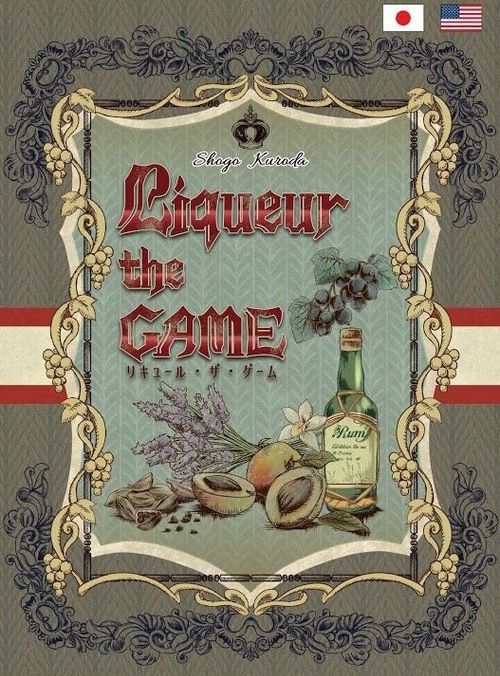
Liqueur the Game
Liqueur the Game Rulebook
Table of Contents
Table of Contents
Components
- 16 Base cards (5 types). Each shows a Maximum value (number) and a Parameter (Rich/Sweet/Aroma).
- 28 Flavor cards. Each shows a Flavor type (Plants / Fruits / Specials / Additives), a Flavor cost (number), a Parameter (Rich/Sweet/Aroma), and a Ravel (lower name).
- 16 Trend cards.
- 16 Order cards.
- 3 Liqueur Award cards.
- 20 Achievement tokens (natural).
- 15 Sales tokens (black, orange, grey, pink, blue).
- 1 Sales calculation board.
Set Up (for three and more players)
- The player who has most recently visited a bar becomes the start player. Otherwise, determine the start player in a fair way you like.
- Shuffle all the Base and Flavor cards face down and place them as a deck within a reach of all the players. (This is called the Market deck.)
- Draw 15 cards from the top of the Market deck and place them face up in a 5 (row) × 3 (column) grid in the center of the table. Then move the 5 cards forming the bottommost row slightly away from the other rows. (This grid of face-up cards is called the Market.)
- Shuffle the Order cards face down, form them into a deck, and place the deck separately from the Market deck within a reach of all the players. Then flip the deck's topmost card face up. (This deck is called the Order deck.)
- Shuffle all the Trend cards face down (Gray side), draw the same number of Trend cards as the number of players, and place them face up in a row separately from the Market. Starting from the player at the right of the start player (the last player in the turn order), the players draw 1 Trend card each in counterclockwise order. Each player places the Trend card they have drawn face up in front of them.
- Mix the remaining Trend cards face down with the Market deck and shuffle them.
- Place the 3 Liqueur Award cards on the table where it is visible to all the players.
- Each player receives 1 Achievement token. Place the remaining Achievement tokens aside as the Token Area.
- Each player picks up same color three "Sales tokens", puts them in front of you, and sets the Sales calculation board aside. The Sales token and the Sales calculation board are used for score calculation at the end of the game.
How to Play
In this game, the players take turns in clockwise order. In your turn, perform the following 3 phases in turn.
A) Market phase ⇒ B) Blending phase ⇒ C) Shipping phase
A) Market Phase
In the Market phase, take 1 card from the Market. The current player takes 1 card from the bottommost row of the Market.
By paying 1 Achievement token, you can take a card from another row of the Market instead of the bottommost row. Put the paid Achievement token to the Token Area.
After taking a card from the Market, to fill the unoccupied space, move the corresponding column (vertical line) of cards down by one row. (This will not be done after taking a card from the topmost row.)
Then draw 1 card from the Market deck and place it face up to fill the unoccupied space in the topmost row.
When you take a Base card, also take the topmost card of the Order deck and place these 2 cards together. These cards will be placed in front of you in the Blending phase (to be described later).
When taking a Flavor card, the procedure is the same except that you do not take the Order card.
When taking a Trend card, place it in front of you. Trend cards provide you extra sales (bonus points) at the end of the game if their criteria are met.
After taking an Order card, flip the topmost card of the Order deck face up.
Even if the Market deck runs out of cards and you cannot replenish it, continue the game. (The end condition is to be described later.)
B) Blending Phase
In the Blending phase, blend the card you have taken in the Market phase with another card(s).
As the current player, place the "card you have just taken in the Market phase" on top of a "card you have taken previously", with part of the bottom card showing, as a "set".
This action to place a card on top of another one is called "adding" and the formed set of these cards is called the "liqueur set". You may choose where to add the card you have just taken according to the following rules for adding.
Rules for Adding
-
The Order card taken together with a Base card must be included in the same liqueur set as that Base card.
-
When forming a liqueur set, you can add multiple number of Flavor cards to each Base card.
-
After adding a Flavor card, you cannot move it to another liqueur set.
-
The cost of the added Flavor cards must not exceed the Base card's maximum value.
-
If both a "Base card without any added Flavor card" and "Flavor card not added to any Base card" are placed in front of you, you must add that Flavor card to the Base card.
Note: If you only have liqueur sets of "Base card with 1 or more added Flavor cards" in front of you, you do not need to add the "Flavor card not added to any Base card" in front of you to any of your sets.
Note: However, if you then take a new Base card, you must add the Flavor card in front of you to the new Base card.
-
You cannot add Flavor cards to a liqueur set which have been shipped and flipped face down (to be described later).
It is recommended to place the cards forming each liqueur set in the way that the cards overlapping in horizontal rows with their corners showing their maximum values, costs, and parameters. You can produce any number of liqueur sets during the game.
Important 1: Base cards without anything added and Flavor cards must be added first to form sets.
Important 2: If you have two and over flavor cards, you can adding one flavor card or both flavor cards on taken a base card.
Example: Uwe got a lychee flavor card from the market. Uwe has a brandy liqueur set added with cardamom. The liqueur set has a brandy MAX value of 5 and a cardamom flavor cost of 2. The flavor cost of lychee earned earlier is 3, so you can add lyche to the liqueur set. Also, you can keep it alone to lychee to for add a prospective liqueur set.
C) Shipping Phase (optional)
In this phase, you can "ship" a "liqueur set of a Base card with 1 or more added Flavor cards" up to twice in each turn.
Choose a liqueur set to ship, flip that liqueur set face down, and then place the Order card of that set on top.
The liqueur sets thus flipped face down are considered to have been "shipped".
After shipping, add up each parameter on the cards in the liqueur set.
Each parameter's total indicates that liqueur set's richness, sweetness, and aroma. Higher values indicate more richness, sweetness, and aroma. Each parameter is counted to check if they meet the Order and Trend card criteria (to be described later).
Liqueur sets make sales by being shipped.
Sales: In this game, the players score point by making sales. [1 million sales (Ms) = 1 pt]
You can make the sales stated on each Order card by meeting the criteria indicated on the Order card included in each Shipped liqueur set.
For example, if the required parameter indicated on an Order card is "4 or more [rich]", you can meet the criteria if the liqueur set's total parameter for richness is 4 or more.
If a liqueur set meets an Order card's criteria, flip that Order card face up.
If an Order card's criteria is not met, the set including that Order card is counted as having achieved only 1 million sales (1 Ms) and that Order card remains face down.
After shipping a liqueur set, announce the liqueur's name (formed by combining the name of the labels included in the set) and the set's sales.
Golden King Leaf Vodka, 6 million sales!
If you manage to ship a set whereby "the Flavor cards' total cost matches the Base card's maximum value", take 1 Achievement token.
Maximum value = Flavor cards total costs
Divide the shipped liqueur set from other cards and sets.
After shipping a liqueur set, the player who shipped it can check it any time, but other players cannot do so.
After the Shipping phase, the turn of play moves to the next player in clockwise order and the next player takes their turn from the Market phase.
End of the Game
The game ends when the Market runs out of cards at the end of any player's turn.
When end of the game, each player uses the Sales token and Sales calculation board to count the all provides sales.
First of all, it sum sum all generated generated from each shipper liqueur set, and puts one sales token in one place equal to the sales total value on the sales calculation board.
No sales will be provides from the liqueur set not shipped.
If you have Trend cards, check and count the sales made from the Trend cards meeting their criteria.
Next, determine the players who receive the 3 Liqueur Award cards according to the parameters [rich], [sweet], and [aroma].
First, determine who receives the Liqueur Award card for richness. The player who has the liqueur set with the most [rich] in total receives the Liqueur Award card for richness. (In case of a tie, none of the players receives the Award.)
Likewise, determine who receives to Liqueur Award cards for sweetness and aroma.
Each Liqueur Award card provides 9 million sales (9 Ms).
Each of your Achievement tokens that you have kept provides 3 million sales (3 Ms).
The player who has achieved the most sales in total wins the game as the world's No.1 liqueur producer!
In case of a tie, among the tie players, the players with more Achievement tokens are ranked higher. If the ranking cannot be determined by this, determine the winner by drinking showdown.
Two Players Variant Rule
When preparing the game, we randomly remove from game, various kinds of cards for each kind as follows. (It would be nice to put the bundle of various shuffled cards face up and pull out the cards that came out in order from the top while confirming the type.)
- Base card: 5 cards
- Trend card: 6 cards
- Flavor card: 9 cards (Total 20 cards)
Remove 5 cards randomly from the deck of the order card from game.
Other than that it is the same as normal rule.
Note: The English text is reproduced as printed, including the publisher's own typos (for example "sum sum all generated generated", "count the all provides sales", and "lyche"/"lychee").