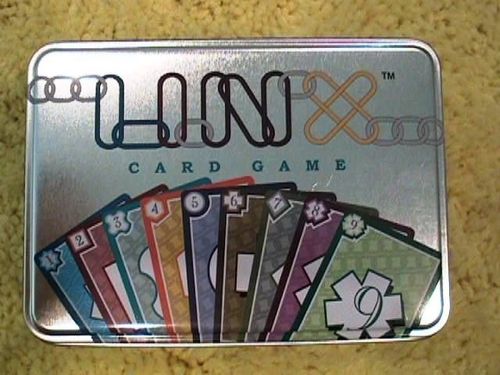
Linx
Linx Rulebook
Table of Contents
Table of Contents
Object
Players build a chain of cards connecting any 2 or more of the 4 Anchor cards on the table. A chain is a series of cards each linked to its neighbors by a matching number or symbol.
Setup
Separate the Playing cards and the Scoring cards. Shuffle the Playing cards.
The Deal
- Deal each player 9 Playing cards, face down.
- Deal 4 Playing cards face up on the center of the table to form the Anchors. The remaining Playing cards are placed face down to form the Stock.
- Turn over the top card of the Stock to start the Discard pile.
- Spread all Scoring cards, face up, on the table. Place the Length and Pattern Scoring cards separately.
Your Turn
- If you have a full hand of 9 cards, start your turn by drawing either the top card of the Discard pile, or the top card of the Stock. If the Discard pile is empty, draw from the Stock.
- If you have fewer than 9 cards, draw 2 cards instead of 1. You can draw both from the same pile or one from each, and you can look at the first one before deciding where to draw the second one from.
- Then, if you want to, you can play a chain of cards connecting 2 or more of the Anchors. (Remember, you can hold on to your cards and wait for a higher-scoring chain.)
- If you play a chain, take all of the cards in the chain including the Anchors. Also, you can take 1 Length Scoring card if your chain is at least that long, and one Pattern Scoring card if you connected the Anchors as shown.
- If you play a chain using all of the cards in your hand, you can take any one of the Length Scoring cards, even if your chain is shorter.
- If you play a chain using all of the cards in your hand and you connect all 4 Anchors, the game is over and you win immediately!
- If you don't play a chain, discard one card from your hand face up into the Discard pile.
Legal Chains
- Any pair of Anchors in a chain must be connected by at least 1 card, even if they already share a number or symbol. Therefore the shortest possible chain is 3 cards.
- The chain shown on any Pattern card is also valid rotated or mirrored.
- The length of a chain includes the Anchors that the chain connects.
- A chain doesn't have to match a Scoring card. You still win the chain and the Anchors.
Note: the number of links shown on Pattern cards isn't important, just the pattern.
Winning the Game
- When the Stock is empty, the game is over.
- Add up the points in your Scoring pile, counting Playing cards as 2 points each.
- High score wins. Use the highest value Scoring card to break ties, then the 2nd highest, and so on.
Match Play
- The winner of each game gets a 100-point bonus. With 3 or more players, 2nd place gets 50 points. With 4 or more, 3rd place gets 25 points.
- Scores are added up at the end of each game. The first player to 500 points (or any agreed-upon total) wins the match. If tied, play another game.
Example
Here's an example of a more complex chain, connecting all 4 Anchors in a "Z" pattern.
The "Z" is rotated and mirrored. The Anchors are shown with black outlines.
This chain is 11 cards long, including the Anchors. This could score 75 for each Scoring card (if still available) and 22 for the 11 Playing cards for a total of 177 points, or an instant win if the player had exactly 8 cards.
Editor's note: the printed total of 177 does not reconcile with the printed components (22 for 11 Playing cards plus 75 per Scoring card). It is transcribed as printed.