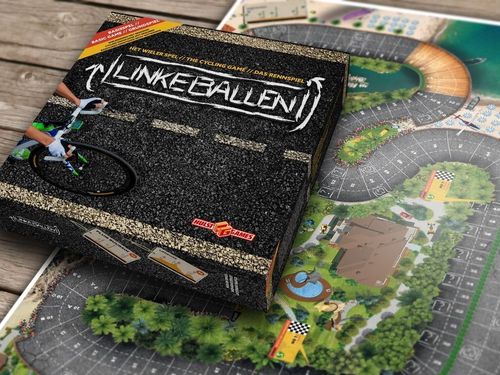
Linkeballen
Linkeballen Rulebook
Table of Contents
Table of Contents
- Introduction
- Game Material
- Preparation
- Particular Boxes and Happenings on the Game Board
- Start of the Game
- Start of Stage 2 and Following Stages
- Advantage of Wind (Drafting)
- Mountainous Stages
- Falls
- Chance Cards
- Passing Principle
- Final Score
- Bonus Seconds
- Bonus Points
- Possible Play Version (Alternative Playing Method)
Introduction
In this game you play as a team in the stages of the cycling party game. A team consists of three bikers. The basic game can be played with 2 up to 4 players. The duration of the game with 4 players is appr. 1.5 hours.
It is of importance to gain the best possible results with your team. Ratings are kept per player and per team. A Tour consists of a number of stages in which the fastest biker will ride a number of stages wearing the yellow jumper. You yourself determine how many and which stages you want to play.
The game is played with seconds cards. By placing a seconds card on the table you determine yourself how fast the biker moves over the track. You try to race as efficiently and tactically as possible and leave someone else to do the front riding taking advantage of the wind by drafting. Keep your good cards for putting on a sprint, just at the beginning of the race, when you have the feeling that your opponent cannot do that at that particular moment. In short: "Linkeballen"!
Game Material
- Two game boards, a flat and a mountainous stage
- 168 seconds cards
- 48 chance cards
- 4 teams with 3 bikers each
- 4 legends
- 1 yellow jumper biker
- Rules of the game
Preparation
You agree with each other how many and which stages you want to ride. In the box you find a two-sided game board. On one side a flat stage is printed, the other side a mountainous stage. Each stage has its own particulars. We advise you to start with the flat stage. Determine which player may start first by drawing the highest seconds card.
Shuffle the cards and hand them out 15 cards for each player. When in the course of the game all seconds cards are used you receive fifteen new seconds cards (5 per biker).
Particular Boxes and Happenings on the Game Board
Exchange boxes: You will find exchange boxes (seconds card) on the game board. Arriving in such a box with your biker you must exchange 3 seconds cards. If you have less cards at hand at that moment then you are to exchange all your seconds cards (so 1 or 2).
Chance boxes: Next to this you will find chance boxes on the game board. Arriving in such box, you must take a chance card.
Particulars: When you arrive in another chance card box on implementation of a chance card with the biker you are playing with, then you must make use of this chance card. This also applies to the seconds card exchange boxes.
Short bursts: Extra time bonus seconds and time bonus points can be gained in a stage at different passing points. This depends on the fact in which order a passing point has been passed. It is not of importance how far a biker passes the related line where points can be gained. Note these seconds and/or points directly with the related biker in the list of ranking. The time bonus points may be deducted and the time bonus points added after the stage to determine the intermediate list of rankings.
Start of the Game
The cards are handed out, the game can begin. The first player chooses one of his seconds cards and puts this on the table. He moves his first biker with the number of seconds (boxes) that corresponds with the seconds card put on the table.
Do you wish to cycle in front, then it is of importance to toss up a high card – do you prefer to follow first and to take for example advantage of the wind in the 2nd round then you should toss up a lower card. You determine your own speed. Possibly you can attune this to chance or exchange boxes.
It is only allowed to move straight on or diagonally. Thus, you may not cycle sideways or backwards to the same box numbers.
You may not either cycle over boxes where there is already a biker (in that case see chapter 'Falls').
After player 1 has placed his first biker, the other players get their turn to play their first biker. Also they determine their own speed and can attune to chance or exchange boxes. At the same time they can make use of advantage of wind (see explanation in chapter 'Advantage of wind').
When all players have had their turn (clockwise) with their first biker, player 1 gets his turn again to play his second biker. Thereupon the other players get on the move with their second biker. This goes on until each player has placed all his bikers. We call this a tour.
After completing this first tour and all bikers are on their way, other rules are applicable for the order of bikers to be played. From tour 2 the playing order shifts to a dynamic playing order. The biker heading the tour at the beginning of tour 2 is first to move on. Thereupon the biker gets to place 2, 3, 4 etc. until all bikers have had their turn.
For bikers being in the same box number it applies that the biker at the edge of the woods may start first. At one side of the tract there is always a bushes edge represented which protects you a little from wind while cycling. There are often inside and outside bends, taking into account that the outside bend has more boxes. In that case the additions A, B, C, etc. are meant as an aid which is meant to determine which biker's turn is first (first A, then B, etc.).
Start of Stage 2 and Following Stages
When starting a new stage the player that started second in the previous stage may start first with a biker.
Thus, it is of importance when playing to be in the same place/order at the table. You are not obliged to begin with your first/best biker in the first round. You may choose to begin with for example your worst biker to bring the team closer together. Of course you may start with your best biker to be ahead of the other bikers with the aim to gain and keep the yellow jumper. Determine your own strategy/tactics in this.
Advantage of Wind (Drafting)
Advantage of wind (and as a consequence of this drafting) arises when riding in a platoon or behind another biker. With advantage of wind you can/may get on 1 second further in a flat stage than the card value you have tossed up if you can join another biker. This means, if you can get 1 or 2 second(s) behind another biker with your tossed up seconds card you can/may take 1 second advantage of wind in a flat piece of stage.
You can end up just behind or next to the biker. Thus, the biker being in front position can never profit from advantage of wind but often functions as a puller for the followers.
Example:
- The green biker is in box 10. The yellow biker is in box 9.
- The green biker tosses up a 10 on the table and moves on to box 20.
- The yellow biker is next and tosses up a 9 on the table.
- The yellow biker moves his biker to box 18.
- Owing to present advantage of wind the yellow biker may draft and move his biker to box 19.
A second possibility for biker YELLOW is to toss up a 10 on the table and move the biker to box 19. Owing to advantage of wind the yellow biker may now move his biker to box 20 next to the green biker. (On condition that there is sufficient space / a box on the track.)
You may draft, this is not obliged.
Remark: It is not possible to pass on a flat stage by means of advantage of wind, thus it is just behind or direct next to the biker.
If the yellow biker tosses up an 11 he also moves to box 20, without drafting.
Mountainous Stages
The speed uphill is considerably higher than on flat stages. Uphill is recognizable by red arrows in the boxes.
For the biker's speed this means that the value of the card must be halved and rounded off.
Example:
- You toss up a 6 on the table for your biker. You may then move on 3 boxes.
- You toss up a 9 on the table for your biker. You may then move on 4 boxes.
- Cycling uphill one may/cannot draft.
Very often the biker, who passes the top first, can gain more time bonus points. Moreover, extra time bonus points can be gained for the points in the list of rankings. This is mentioned at the passing points of the round/track.
Downhill you can take 2 seconds advantage of wind (drafting). Downhill is recognizable by the blue arrows in the boxes. For the explanation the same rules go for the flat stages with that difference that 2 seconds advantage of wind may be taken. There is another remarkable difference: by making use of 2 seconds advantage of wind you may/can also pass the leading biker. You can/may arrive one box at a maximum before the preceding biker and thus take over the lead. This also goes for drafting, it is allowed but not obliged. You may also take 1 instead of 2 if this suits you better.
Example in a downhill tour:
- The green biker is in box 120A in a downhill position. The yellow biker is in box 110 (also in the same downhill position) and it is his/her turn. If the yellow biker tosses up a 6 he/she moves to box 116 (110+6).
- He/she cannot take advantage of wind and does not get extra wheels. The same as in the boxes 115 and before that.
- If the yellow biker tosses up a 7 he/she moves to box 119A (110+7+2 seconds advantage of wind).
- The yellow biker tossing up an 8 comes next to the green biker A in box 120B (110+8+2).
- The yellow biker tossing up a 9 comes in box 121A before the green biker (110+9+2).
- The yellow biker tossing up a 10 comes in box 121A before the green biker (110+10+1).
The yellow biker tossing up an 11 comes in box 121A before the green biker (110+11+0). As perhaps is remarkable only 1 draft can be made by tossing up a 10 and by 11 no drafting at all. Downhill can lead to 1 wheel before your preceding biker at a maximum.
Advantage of wind (drafting) only possible if both bikers:
- are on the same flat level (max. 1 second advantage of wind)
- are on the same downhill level (max. 2 seconds advantage of wind possibly incl. taking over the lead)
- going over to a downhill tour (max. 1 second advantage of wind)
- going from a downhill to a flat tour (max. 1 second advantage of wind)
Thus: a biker still being in an uphill tour cannot draft on a biker being in a downhill or flat tour. This also counts the other way round: a biker being in a flat tour cannot draft on a biker who is in an uphill tour.
Falls
Unfortunately, when taking risks in this busy world and definitely when racing falls happen. Falls can cause a lot of misery in this tour. A fall can exist through a chance card (see particular boxes) or through unfavorable tours of yourself or fellow 'linkeballers'. When you are involved in a fall with a biker you are to skip the next turn. This turn you are to hand a second card.
N.B. When a fall is caused through a chance card then the chance card must be put underneath the stack of cards after which all chance card are to be shuffled again.
It is possible to try and organize falls deliberately in which opponents have more trouble than you yourself (typical a form of "Linkeballen"): For this an important extra condition is stated to prevent a negative tour: racing a narrow tour deliberately slow, so that followers have to brake and possibly and get involved in a fall, it is allowed if the first follower in a flat or downhill tour can toss up one second card at a minimum with the value 4 (4 boxes). In a mountainous tour this must be a 6 (3 boxes).
If you have only lower cards left (has that been wise?) – then oversee the consequences.
N.B. It is possible that a fall cannot be prevented.
- If a catching up biker cannot do anything otherwise then getting in the box a preceding biker already is, a fall exists.
- The catching up biker is obliged to show his/her cards to the fellow players in order to prove that he cannot go any slower and cannot prevent the fall.
- A fall always takes place over the full width of the road (all boxes of the same numbers).
- See example below:
Example:
- The blue biker tosses up a 5 on the table.
- He moves to box 15B and gets into a fall with the yellow jumper. The green biker, however, is also in box 15 and because of this gets into the same fall.
- The red biker can stop in time. He/she has a 5 and because of this moves to box 14.
- The pink biker's lowest card is a 9. He/she cannot do anything else then playing this card and because of this fall moves to box 15B.
- The white biker's lowest card is a 7 and moves to box 15C. Also here the biker gets into the fall – after all bikers in the same box are involved in the fall.
The bikers being involved in the fall are:
- The biker causing the fall.
- The biker colliding.
- All bikers in the same box number, incl. A, B, C etc.
- All bikers in the same tour that cannot slow down in time and get into one of the boxes involved.
By performing your chance card (for example three boxes forward) and getting in an existing fall, you are also to place your biker in the fall (line up with the bikers that are outside the track).
N.B. With separated roadways the bikers do not get involved in the fall. In that case the related box must be completely secluded from the boxes involved. See examples below:
Examples:
-
The yellow, red, blue and white biker are all in the same box number. The purple biker cannot stop in time and gets into a fall with the yellow and red biker. (c and d are higher than a and b). The blue and white biker do not get into the fall – they are behind the separated roadway.
-
The green biker has taken a chance card which says: 'Fall, all bikers up to 2 boxes before and behind the place of fall also get into the fall'. In our example all bikers that are possibly in the green crossed boxes also get into the fall. You place the fallen bikers next to the track, there where the accident took place.
In the tour in which may be started again the order of boxes for the order of the bikers to start is of importance (26, 25, 24, 23, 22). In the same box the bikers outside the track are placed from biker that arrived first until the biker that connects last into the fall (this is after skipping the turn also the start order for the next tour). At the moment that the bikers involved in the fall are next to the track and skipping their turn the other bikers can pass normally again.
N.B. If you cannot prevent a collision with your biker and you can choose from several box numbers then the fall takes place in the box with the highest box number.
Example:
- The purple biker (in 44) has a 5 and thus collides with his leaders. Box 47 is higher than box 46.
- The fall then takes in box 47. The purple, blue, green, red and grey biker get involved in the fall.
If you have a choice to choose from more lanes and in both choices will cause a fall in the same box number (in this case 54) then you are to cause the fall in the box that is furthest away from the edge of the wood.
- The orange biker's lowest card is a 5 and collides then with the brown biker (furthest from the edge of the wood).
- If the orange biker had not had a 5 as the lowest card but for example a 9 and the pink biker was not there, then he/she collides with the dark green biker (the biker in the highest box number).
Chance Cards
If you intentionally or unintentionally get in a chance card box, you must take a chance card. The chance card counts for the biker that is next / takes the chance card. The task of that chance card (unless indicated otherwise) is to be carried out immediately.
- If according to your chance card you have to move forwards or backwards, and the track is blocked by other bikers, you get involved in a fall. Skip turn and hand in card).
- If according to your chance card have to move forwards or backwards, you can get involved in an existing fall. Back in line with the bikers already fallen and of course skip a turn and hand in card.
- If your chance card puts you in a new chance card or exchange box you are obliged to carry this out.
- Captain is understood to mean the biker of the team that takes the lead in the first stage and was in the best position in the 2nd and following stages in the final intermediate list of ratings. (Thus your team's best biker to begin this stage.
Passing Principle
To avoid a number of falls as much as possible, the biker having a negative card or deliberately racing gently is to consider the biker's turn after him/her. The rule of thumb you have to stick to is: give the first following biker after you space to toss up a seconds card with a value 4. Uphill this is seconds card value 6 (3 boxes).
With negative cards, in some cases, you cannot go back boxes at all: you are to consider the minimum number of boxes/seconds for the first following biker, in this case you are lucky and you cannot carry out the negative chance card. No need to take a new card.
Final Score
The final score of a stage is calculated as follows: the biker that comes furthest over the finish line in the same round has the best time and thus has won the stage. He/she gets as final time for the finish the number in the last stage box minus the number – seconds that he/she passes over the finish. Each box difference after the finish gives -1 second difference in time.
After the finish line no seconds of advantage of wind (drafting) can be taken anymore. Moreover, no fall can occur after the finish, the biker can come in and line up as far as the acceleration lane offers space. If you have tossed up a higher seconds card the rest value expires. Should two or more bikers, in the same lap, come equally far over the finish line (for example as 2nd and 3rd) then the one that has placed his biker at the edge of the wood has finished 2nd and the one next to the finished biker has finished 3rd. Both bikers have noted the same time.
Example:
- The green biker passes the finish line of a stage that consisted of 80 boxes and because of the finish gets in box -5. He/she places the cyclist at the edge of the wood. His time is then 75 seconds (80-5).
- If the red biker, in the same track, also passes the finish line and gets in box -6 then the time of that biker is (80-6) 74 seconds. (It is not a matter of who gets over the finish line first in a turn but who passes the finish line furthest in that turn).
- If after that the blue biker also arrives in the same track and gets to box -5, then his time is also 75 seconds, and gets next to the green biker. Thus, both 75 seconds, but the green has become 2nd and the blue biker 3rd.
- If the yellow biker, being in box 77 tosses up an 8 he would normally enter in box -5. This will not succeed because there are already 2 bikers. Also a 10 or an 11 has no sense.
The remaining/following bikers apparently do not come over the finish line either, but stick somewhere in a box before the finish line. The end result is then: the red biker is 1st with 74 seconds. The green biker is 2nd with 75 seconds. The blue biker 3rd with 75 seconds. The yellow biker 4th with 76 seconds. After each track we add 10 seconds to the final time.
If the not yet finished bikers get over the finish line in the following track then their time is: 80 seconds + 10 seconds for the following track – the number of boxes over the finish.
Example: Biker 5 arrives in box -8 in the following track. His time then is 80+10-8=82 seconds.
Example 2: Biker 6 has still not arrived, but in the track later in box -4. His time then is 80+20-4=96 seconds.
In this way all bikers finish the playing rounds until everybody is in. Keep in mind that every time there is a new play round that 10 seconds are added to the final time for the remaining bikers, as described before.
To keep the correct number of seconds cards in hand a seconds card is to be handed in at the beginning of a new track for each biker that has already finished. In this way all players, for each biker still on the move, have an equal number of seconds card in their possession. If subsequently you have run out of seconds cards at the end of a round, new seconds cards are handed out.
You receive 5 seconds cards for each biker that is still on his way. (Bikers coming in do not need to receive seconds cards anymore. Of course there is no need either to hand in a second card).
Immediately after a track (after all bikers have had their turn), the bikers that have come over the finish line, after their time, place and points have been noted, are taken from the track. They then cannot form a blockade for the bikers of the next track.
Bonus Seconds
During the stage we have been able to earn bonus seconds at different passing points. These seconds count to determine the final time of the bikers for the continuation of the course. We will work out our example more extensively. Suppose the blue biker has gained four bonus seconds then his ultimately noted time is 75-4=71 seconds. Because of this he/she does not become the winner (biker 2 remains the winner with 74 seconds). Bonus seconds are only included when determining the intermediate and final ratings.
Summary: in calculating the stage result in time we do not add the bonus seconds yet. Calculating the intermediate ratings (yellow jumper) these bonus seconds, however, do count. In our example the blue biker wears the yellow jumper. After all his time in the intermediate ratings is 71 seconds.
Bonus Points
In various stages extra points can be gained for the points classification. The points classification counts for the whole team. The gained points of all bikers of a team are added per team. The points classification is a score of gained points for the whole team and counts for the final points classification (see further explanation in chapter points classification). You can gain these points for your team when passing a stipulated point in the stage as 1st/2nd biker. The points are mentioned in the stage at the point of passage.
Points Classification: Results per Stage and Gains in the Final Ratings
- The points classification is a classification that is valid next to the yellow jumper and team time.
- The points classification is a team aimed scoring. So you can gain your points with all your bikers for your whole team.
- In each stage you can, next to the bonus points mentioned above, gain points on the basis of the place your bikers achieve in this stage.
- No. 1 receives 10 points, No. 2 receives 9 points, No. 3 receives 8 points,
- No. 4 receives 7 points, No. 5 receives 6 points, No. 6 receives 5 points,
- No. 7 receives 4 points, No. 8 receives 3 points, No. 9 receives 2 points,
- No. 10 receives 1 point, Nos. 11 and further receive no points.
- A useful formula in this is: points = 11 – position (with this the number of points is never lower than nil).
At the end of the game all points gained by a team in all stages are put together and a team points classification exists. The one that has gained the most points at the end of the game is the winner. Of course a 2nd and 3rd place is also honorable.
A. Stage Prizes
In the Tour you can go for the stage prizes, such as the winner of the stage (the fastest biker) and the fastest team (the times of all bikers added). The team time is the most important part of the game and yields extra important points in the list of ratings. In various stages bonus seconds and/or points can be gained. These are included in the intermediate and final ratings.
B. Intermediate Ratings
The yellow jumper is a piece of clothing that is desired by all bikers. It is of importance to conquer this yellow jumper and to remain riding in it. It yields extra points. The biker, that has the fastest total time, is in the intermediate ratings the fastest biker and receives the yellow jumper and may ride in it in the following stage. (= time first stage – bonus seconds first stage + time second stage – bonus seconds second stage, etc.).
After each stage new intermediate ratings are calculated and a yellow jumper wearer, fastest team and leader of the bonus points classification is announced.
C. Final Classification
Next to the stage prizes of the related stages we calculate, after playing, the final classification. Next to the honor to have had the fastest team or biker we want to announce an overall winner:
We also translate the time/final results into points to ultimately determine the overall winner of the played tour. We add the following points to the points already gained:
- The best team receives on the basis of the seconds general classification 40 points extra,
- The second team receives 15 points extra and the third team receives 5 points extra.
- The fastest biker (the wearer of the yellow jumper) receives on the basis of his/her seconds 15 points extra, 2nd biker 10 points, 3rd biker 5 points.
- By means of the QR-code on each game board and your smart phone you can make use of our supporting Tour calculator. This aid can help you to keep scores etc. (making an account for free on our site is necessary)
- Of course you can also keep these scores manually on the added score forms.
Note: Don't you have a smart phone but you do have a PC/laptop/Mac? You can find the Tour calculator via our website.
Possible Play Version (Alternative Playing Method)
Next to the manner of playing mentioned before you can also choose for a team time-trial. The team time-trial works with relation to the carrying out completely deviant. Each player gets 5 cards for each biker of his team. One gets new cards only once if there is 1 card left for each biker.
In a turn you play all your runners (complete team) directly one after another. The trick is to keep the team as close as possible in order to take time/advantage of wind as much as possible. Exchanging cards can be of essential importance.
Start of a Team Time-Trial
During a team time-trial players within the same team may consult each other and share their cards. Bonus points and seconds, however, cannot be gained in a team time-trial.
Example in 3 Bikers per Team
A player tosses up 3 cards on the table (1 for each biker), places his bikers in accordance with the card values taking as much advantage of wind as he can. For explanation we call this team, team A.
- After this team A is next again, again using 3 cards and may move his bikers in accordance.
- After this team B is next using his first three cards.
- After this team A is next again. (3rd turn)
- After this team B. (2nd turn)
- After this team C is next using his first three cards.
- After this team A is next. (4th turn)
- After this team B is next. (3rd turn)
- After this team C is next. (2nd turn)
- After this team D is next 1st turn)
- After this team A is next. (5th turn)
- After this team B is next. (4th turn)
- After this team C is next. (3rd turn)
- After this team D is next. (2nd turn)
- And so on.
When this scheme which is considered too complicated, you can also choose to play with each team separately (so first take the entire course for the entire team until the cards are gone before the next player plays with the next team).
If eventually all your cards are played, you are finished with your riders somewhere on the course. On the route are shown, the times that were used for counting the boxes. In the team time trial, take the number 200 and count here the box number of your last finisher rider off. (Your worst rider in this stage) All your riders get this time.
It is important that immediately after the times of the riders are listed and all the teams have had a turn, the riders will also be removed from the course. They are never an obstacle in the following riders. To riders who have taken from the course, you can't take any wind advantage of them.
During the team time trial you earn points, different from the standard to earn points. In the team time trial, the earnings for the points classification as follows:
- Team no. 1 receives 18 points
- Team no. 2 receives 12 points
- Team No. 3 receives 6 points
- Other teams unfortunately get no points.