Linkage
Linkage Rulebook
Table of Contents
Table of Contents
Components
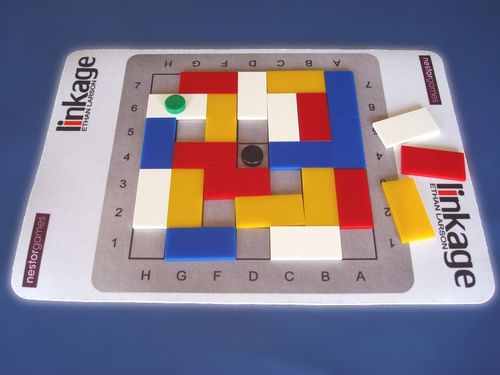
A Linkage set includes:
- A board with a 7x7 square grid
- 24 playing pieces, 6 of each color (white, blue, red, and yellow)
- 1 black counter and 1 green counter ('ice' white for the Deluxe Edition)
Game Rules
The game begins with the board empty, except for the black counter, which is placed on the center square.
Players choose who will be More and who will be Fewer.
The More player always goes first. Each turn consists of choosing one of the remaining pieces and placing it on the board, then placing the green counter on top of that piece. Note that neither player owns any of the pieces; they may choose any color to place on each turn.
When placing a piece, it may be placed anywhere it fits without overlapping other pieces or the black counter. There is, however, one restriction: the piece may not be placed so that it touches the previously-placed piece which is marked by the green counter.
If a player does not have a legal move because of the location of the green counter, he removes it from the board and passes that turn.
Play continues until there are no more available moves.
End of Game
Once no more moves can be made, the number of color groups on the board is counted. A color group is any set of one or more pieces of the same color that are connected vertically or horizontally. If there are 12 or more color groups, More wins the game. If there are 11 or less, the Fewer player wins.
Optional Rule
At the time this is being printed, Linkage strategy has developed somewhat and shows a slight advantage for the More player. So the following rule can be played both to mitigate this advantage, and to add some variety to the starting configuration.
When beginning the game, one player starts by placing the black counter anywhere on the board. Then the other player chooses whether to play More or Fewer. Play then continues normally, with whoever is More going first as usual.