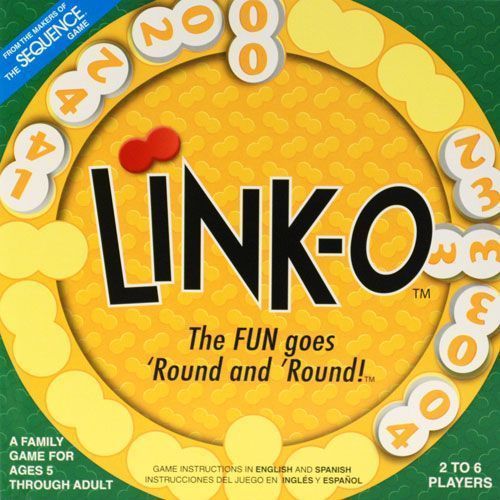
Link-O
Link-O Rulebook
Table of Contents
Table of Contents
Components
- Game board
- LINK-O tiles
- Draw bag
- Instructions
Object of the Game
Place all of your tiles in connecting order within their matching colored circles. The first player to play all his/her tiles on the game board wins the round. Point totals from tiles left over in opponent's possession are counted as points for the player who wins the round. The first player to score 64 points from cumulative rounds wins the game.
Game Set-Up
Place the gameboard on a flat surface in the center of the players. With all tiles in the bag, each player draws 8 tiles from the tile bag without looking at the tiles. Each player may then look at their tiles and stand them on edge with numbers facing them so the other players cannot see them.
Game Play
Decide who will start the game. The first player begins by placing any one of his/her LINK-O tiles or a Double tile (0/0, 1/1, 2/2, 3/3, 4/4) onto any of the "Link-O or Double" connector spaces on the board that matches the color on the tile. Each player must play a LINK-O or Double tile on their first turn. If a player does not have one of these tiles, he/she must "dig" from the tile bag until one of these tiles is drawn.
On subsequent turns, players may now place any tile on any space on the board as long as:
- The color of the numbers match the color of the circle.
- A tile must be placed next to another tile on the board and the tile end must match the adjacent tile.
- Only Double tiles or LINK-O tiles can be placed on the spaces marked "Link-O or Double". LINK-O tiles are wild and can be played anywhere next to an adjacent tile on the game board.
- To fill a space between 2 tiles, each end of the tile must match each adjacent tile.
- A LINK-O tile played in the connector Link-O or Double space that joins the circles holds the value of the adjacent connector space. If there is no tile in the adjacent connector space, the LINK-O tile absorbs the value of the regular adjacent space inside its color circle (if a tile is already there) or the subsequent tile value if one is played after a LINK-O tile is played.
(See diagrams for examples below)
An Example of Typical Tile Placement
"LINK-O" or Double tiles can be placed on any space on the game board, but ONLY these tiles can be placed on the "LINK-O or Double" spaces.
Example of tiles used in a CONNECTOR SPACE:
If the connector space is open on the right circle and the adjacent connector space in the next circle is a 3/3 double tile and the spaces on either side of the connector space are open or match the 3, then a player may play a "LINK-O" tile or a 3/3 double tile. This "LINK-O" tile must hold its value (3) for subsequent adjacent tiles.
"Blocking Play" Example
A 2/2 tile is played in a "LINK-O or Double" space. In an adjacent different colored circle, a tile with a 3-end is played in the space adjacent to a "LINK-O or Double" connector space. This play blocks the "LINK-O or Double" connector space so NO TILE can be placed there.
Winning a Round
The round is over when:
A. A player plays all of his/her tiles and calls out "LINK-O!" The winner now collects and counts the values of all tiles left in opponents' possession and adds this total to his/her score. Point values of each tile are the sum of the 2 numbers on each tile. For example: a 3/4 tile = 7 points, a 2/1 tile = 3 points, and so on. "LINK-O" tiles are worth 16 points.
B. There are no tiles left in the draw bag. Play continues until no more tiles can be played. Each player then adds up the values on their tiles in their possession. The player with the LOWEST point total is the winner of that round, and then collects the other points from his/her opponents to add to his/her score.
After each round, all tiles are collected and placed in the bag and play begins again.
Winning the Game
The first player to reach 64 points (or more) is the winner of the game.
Spanish-Edition Additional Statements
The Spanish section of the same publisher page contains the following statements that do not appear in the English section. They are reproduced here in English translation, labelled as Spanish-edition text, and are not part of the English rules above.
- Play a tile every turn. Every turn, a tile must be played. If a player has no tile that can be played, he/she must draw tiles from the bag until a playable tile is found. (The English section gives this draw rule only for the first turn.)
- Tiles drawn are added to the hand. All tiles drawn from the bag are added to the player's tiles. (Spanish game-play text.)
- Circle-completion bonus. If during the game a player places a tile that completes a circle, that player scores 16 points, whether or not he/she wins the round. (Spanish "must play a tile" paragraph. The English section does not state this bonus.)
- Four LINK-O tiles suggested. The Spanish section notes that, to make the game more exciting, only four LINK-O tiles (one of each color) should be used. (Spanish game-play rule 3 note.)
- Wild-tile placement wording. The Spanish text describes LINK-O tiles as wild and placeable anywhere next to the adjoining tile of the same color on the game board. The English text is "next to an adjacent tile on the game board."