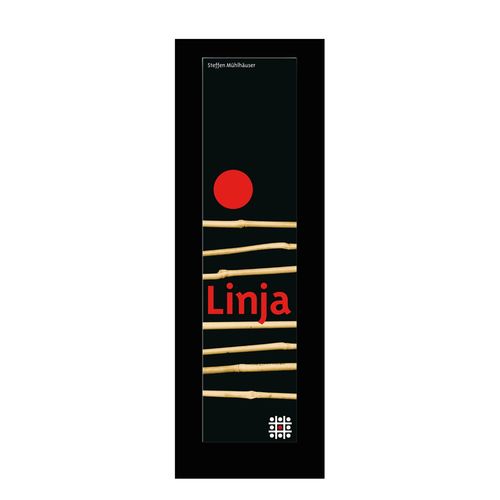
Linja
Linja Rulebook
Table of Contents
Table of Contents
Components
7 bamboo sticks 2 x 12 wooden pawns
Goal of the Game
Win as many points as possible by moving your pawns as far as possible towards your opponent's starting line.
Setup
Each player chooses a color and arranges their 12 pawns as shown on the diagram. Randomly choose a player to go first.
The bamboo sticks divide the play area into rows. Each player's starting line holds 6 of their pawns, along the outer edge of the play area on their own side. The 6 rows between the two starting lines each begin with 1 black pawn and 1 red pawn, placed at opposite ends of the row.
How to Play
A single turn can include up to 3 actions: an 'Opening Move', a 'Follow-Up Move' and a 'Bonus Move'. Take turns to play, always in the direction of your opponent's starting line. Moving backwards is only allowed with a 'Bonus Move' action (see Bonus Move, below).
Opening Move: On your turn, always begin by advancing 1 of your pawns by 1 row, jumping over a stick.
Follow-Up Move: After your Opening Move, you may make a Follow-Up Move. Choose any 1 of your pawns (including the one you just moved) and advance it by a number of rows equal to the number of pawns in the row you moved to during your Opening Move.
The pawn you used for the Opening Move is not counted towards this total.
Example: Red advances their pawn by 1 row. This means they can make a Follow-Up Move of 4 rows (the pawn used for the Opening Move is not counted). They choose 1 of their pawns and advance it by 4 rows.
Special Cases
If a pawn reaches the opponent's starting line with moves remaining, these extra moves are ignored.
If a pawn lands on an empty row or reaches its goal (the opponent's starting line) during its Opening Move, it does not trigger a Follow-Up Move.
Bonus Move
If a pawn reaches the opponent's starting line by moving the exact number of rows allowed, the player receives a Bonus Move and may play again. The player may move any 1 of their pawns forwards or backwards by one row. The turn then passes to their opponent.
Pawn Limit
The inside rows may not contain more than 6 pawns each. A moving pawn can still move past a full row, but may not end its movement there. The 2 starting lines on the outside of the play area can contain an unlimited number of pawns.
End of the Game
The game ends when all the pawns of the 2 colors have passed each other. The active player still gets to finish their turn. The points are calculated according to the following weighting scheme.
Each pawn still located on its own side of the play area at the end of the game causes the player to lose 1 point.
Each of the 4 rows on a player's advancing side of the play area is worth points, increasing the further a pawn has advanced: 1, 2, 3, and 5 points, with the row nearest the opponent's starting line worth the most. A pawn scores the value of the row it occupies at the end of the game.
Example Scoring
In the example, Red has 5 pawns in the row worth 5 points, 3 pawns in the row worth 3 points, and 3 pawns in the row worth 2 points, plus 1 pawn that has not advanced past its own side and loses 1 point: 25 + 9 + 6 − 1 = 39 points for Red.
Black has 6 pawns in the row worth 5 points, 4 pawns in the row worth 3 points, and 2 pawns in the row worth 2 points: 30 + 12 + 4 = 46 points for Black.
Points for Black: 46 points Points for Red: 39 points
The player with the most points wins the game. The losing player starts the next game.
Optional Bonus Rule
To spice up the game, you may add the following rule: during a Bonus Move, the player may move any 1 of their pawns forwards or backwards by 1 row, or move any 1 of their opponent's pawns. The opponent's pawns that have reached their goal are 'locked' and can no longer be moved.