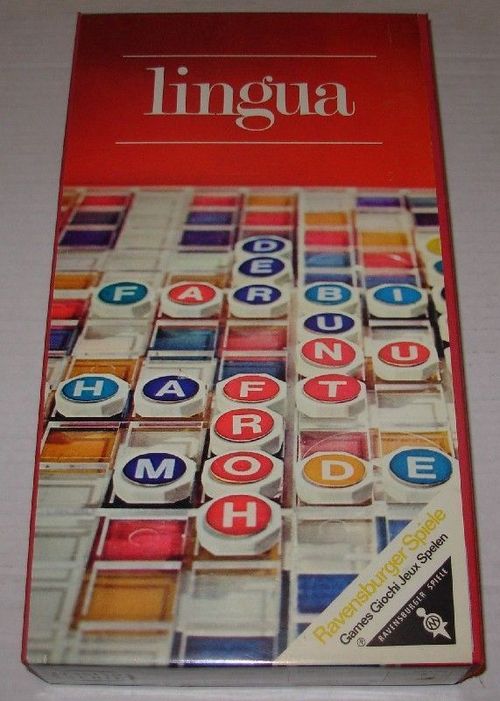
Lingua
Lingua Rulebook
Table of Contents
Table of Contents
Contents
The game contains: 1 game board, 132 letter tiles in 4 colours, 4 letter racks, 1 scoring pad, and 1 bag.
Object of the Game
Using the coloured letter tiles, words are laid on the board, similar to a crossword puzzle. The letters used and the skilful use of the colours determine the point value of each word. Whoever has the most points at the end wins.
Preparation
Before the first game, push the letter tiles out of the punched sheet from the back; this special back keeps the tiles from slipping. Put all the letter tiles into the bag.
Each player draws 12 letters from the bag without looking and places them on his letter rack so that the other players cannot see which letters he has. The two-level rack makes it possible to place vowels and consonants separately, or to keep ready-made words available.
One of the players should keep the score. Lots are drawn to decide who begins.
Rules of Play
Each round, every player may lay one word. The first player begins his word on the field marked "Start"; this first word is laid horizontally and must consist of at least four letters. The second word must be laid vertically. After that, players are free to lay their word vertically or horizontally at any suitable place (see the examples in the Examples section). The following rules apply:
- Every new word must connect to at least one existing word, so that the words share at least one letter in common. The new word may touch or cross further words.
- Wherever letters meet, a meaningful word must result. Example 4 illustrates this: the player lays the word RASEN horizontally, and at the same time the words ER and ES vertically. The word RATEN may not be laid at that spot, because it would form the vertical word ET, which is not meaningful.
- Each word may be laid only once in the course of a game.
- Unless otherwise agreed, place names, personal names, abbreviations and dialect words should not be used. In case of doubt, a dictionary may be consulted.
The points scored are noted immediately. The player then tops up the letter tiles on his rack to 12 again, by taking the required number from the bag without looking.
If a player cannot lay a word, he passes and may exchange two of his letters: he returns two letters to the bag and takes two new ones.
Multiple Word Formation
A connection to a word already laid can also be made so that a letter of the new word meaningfully extends the word already on the board. This extended word then also counts as a new word and is scored in full in addition. In favourable cases several words can be extended at the same time, and all of them are scored in full.
Example 5 shows two of the many possibilities for meaningful extensions. Other possibilities are, for example: SPIEL – SPIELT, TISCH – TISCHE, LEID – KLEID, and so on. (The first pair is printed in the source without its connecting mark; it is shown here with a dash, by analogy with the other pairs.)
It may be agreed that forming a new word is enough when an already laid word is simply lengthened (Example 6: SAGEN + AN = ANSAGEN). In that case it should be settled from the outset whether such extensions may consist of one, two or more letters. (This is not to be confused with Example 5, where the N is laid as part of the new word REIN.)
This way of playing is simpler, and one can often profit from the opponents' words, but only if not everyone takes care to lay words that cannot easily be extended!
Scoring
The colour of a letter tile determines its value: yellow = 1 point, red = 2 points, light blue = 3 points, dark blue = 4 points.
The values of all the letters of a word are added together and give the point value of the word. Connecting letters that the new word shares with words already laid are counted as well. The player always scores this point value. However, with skilful use of the colours, the same word can additionally bring considerable bonus points, through scoring as a colour word and through scoring aces.
Colour Word
A word that consists entirely of letter tiles of a single colour is a colour word. In addition to its point value, the player receives 25 bonus points for each letter of his colour word. These bonus points are added to the point value immediately and noted.
Ace
If the colour of a letter tile and the colour of the board space on which it lies match, this counts as an ace. Aces that the new word shares with words already laid also count for the new word. Aces also count in addition in colour words.
Important scoring advantages depend on the number of aces a player has scored during the game. Therefore the aces are first marked in the column "As" (ace) on the scoring pad. As soon as a player has reached his 10th ace, the point value he scores from then on with his words is noted doubled. This applies already to the word with which he reaches his 10th ace, and it also applies to all bonus points. From the 15th ace on, the points scored are tripled, and from the 20th ace on, they are quadrupled.
From the 10th ace on, the following benefit also applies when forming a colour word. If the player has all the letters of the word together, and only one of them does not match the colour, he may search the board for the same letter in the matching colour. If that letter is there, he may exchange it for his non-matching letter and build it into his colour word. (The score of the word in which the letter is exchanged does not change afterwards.)
The aces bring not only scoring advantages: each ace also counts 10 points in addition to the value of the letter (20 points when doubled, and so on). These points do not need to be calculated and noted during the game, because they are already printed on the scoring pad. At the end of the game, the ace points are added to the other points. (Example: 16 aces marked = 250 points.)
End of the Game
The game ends as soon as a word reaches at least one of the four target fields in the lower right corner of the board. For this word, in addition to all other points, the target bonus is credited: the point value on which the last letter of this word lies. If the last letter is an ace, the target bonus is multiplied according to the number of the player's aces; for example, it doubles if the player has reached 11 aces.
The winner is whoever achieves the highest total score, regardless of who ended the game.
Tactical Tips
Every letter occurs in the game as often as it does in the German language. It is easy to lay all the vowels soon, but it is more successful to be a little economical with these letters, which are especially important for word formation.
One should not try too hard at the start to find the "very best" laying option. Quick decisions make the game more varied. Short words can practically always be laid, and even with only one letter (words such as ER, SO and so on) over 50 points can be achieved.
Lingua is a game with a start and a finish, and one can work towards ending the game at the most favourable moment. If one still wants to collect points and therefore wants to postpone the end of the game, one will not lay one's words so that they lead closer to the target field. If, on the other hand, one has a favourable points lead, one will try to reach the target field as quickly as possible, and to reach it oneself. In that case it is especially important not to give the other players any opportunity to extend a word all the way into the target field.
Examples
The illustration for the following examples is on the back of the box cover (not reproduced here). It shows the state of the game after the six moves described below have been played:
- Player A lays the opening word SPIELE. He notes his first to third ace and 14 points.
- Player B lays the second word KLANG. First ace, 145 points (20 points and 125 bonus points for a colour word of 5 letters).
- Player A lays the word SAGE. Fourth and fifth ace, 13 points.
- Player B lays the word RASEN and at the same time the words ER and ES. Second ace in RASEN, third ace in ER, fourth ace in ES; 15 points for RASEN, 58 points for ER (8 points and 50 colour-word bonus points), 52 points for ES (2 points and 50 colour-word bonus points). RATEN could not be laid instead of RASEN at this place, since ET is not a meaningful word.
- Player A lays the word REIN and, by extension, at the same time the words SPIELER and SAGEN. Sixth to eighth ace in SPIELER, ninth and tenth ace in SAGEN, hence a doubling of points! 26 points (2 x 13) for REIN, 36 points (2 x 18) for SPIELER, 34 points (2 x 17) for SAGEN.
- Player B lays the word ANSAGEN. Fifth and sixth ace, 19 points.