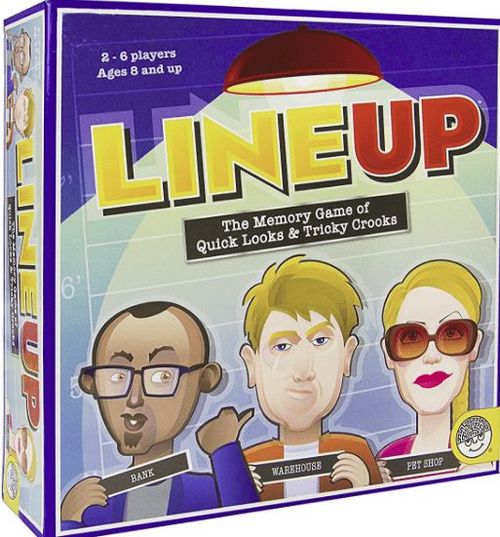
LineUp
LineUp Rulebook
Table of Contents
Table of Contents
What's Inside
- 1 game board
- 6 player pawns
- 6 coloured markers for setting the number of suspects in a lineup
- 1 die
- 1 screen
- 16 suspect cards from the "Bakery" crime scene
- 16 suspect cards from the "Bank" crime scene
- 16 suspect cards from the "Car Shop" crime scene
- 16 suspect cards from the "Pet Shop" crime scene
- 16 suspect cards from the "Warehouse" crime scene
- 16 suspect cards from the "Pier" crime scene
- 10 card stands with stickers (1 labelled "Guilty", 9 labelled "Innocent")
- 26 Lucky Break cards
Object of the Game
Be the first player to collect 4 suspect cards from different crime scenes. To collect a card, you must correctly identify the culprit in a photofit lineup.
Setup
Attach the "Guilty" and "Innocent" stickers to the card stands. Shuffle each suspect deck separately, then place these decks face down on their matching spaces on the board ("crime scenes").
Shuffle the Lucky Break deck and place it face down on the spaces marked "Lucky Break" on the board.
Each player takes a round marker for setting the number of suspects in a lineup (in their own colour). At the very start of the game, these markers are placed in the police station on the space showing the number 4. This means each player's very first lineup will consist of 4 photofits. During the game these markers move to other spaces depending on how successful the players are. If a player correctly identifies the culprit in a lineup, their marker moves +1 (for example, from 4 to 5, meaning the next lineup will have 5 photofits).
If a player makes a mistake, their marker moves to a lower value (for example, from 4 to 3, and this player will conduct the next lineup with three suspects).
A lineup may never have fewer than 3 or more than 10 photofits.
The youngest player starts. Play passes clockwise.
Playing the Game
Roll the die and move that many spaces (in either direction). At the start of the game you will need to move towards the crime-scene spaces to see your first suspect. After that, you may choose to move to a new crime scene to see new suspects, or return to the police station to hold a lineup with the photofits.
To enter a police station or crime-scene space, you do not need to roll the exact number. Any number of players may be on the same space at any time, whether it is a crime scene, the police station, a street space or a Lucky Break space.
On a Lucky Break Space
Lucky Break cards help you move around the board, identify suspects, and place obstacles for other players. When you land on a Lucky Break space, you may draw one card (provided you have fewer than three Lucky Break cards in front of you). Read the card you drew (to yourself) and decide whether to use it right away on this turn or save it for later. After use, return the card to the bottom of the Lucky Break deck (face down).
At a Crime Scene
There are 6 crime scenes in the game: Bakery, Bank, Car Shop, Pet Shop, Warehouse and Pier. When you land on a crime-scene space, take the top card from the deck lying on that space to find out who committed the crime. You have 5 seconds to memorise the culprit's face. Try to remember the smallest details, because shortly you will need to identify the culprit from a photofit lineup.
Place the suspect card face down in front of you. Your turn then ends. On your next turn you must go to the police station and, while the culprit's face is still fresh in your memory, identify them. Or, if you feel sure you will not forget, you may continue moving to new crime scenes in order to identify several culprits later.
Important: you may not look at the card lying in front of you showing a previous culprit.
At the Police Station
On a police-station space you may begin a lineup for one or more photofits, provided you have at least one suspect card in front of you (the one you drew at a crime scene and placed face down). After the lineup your turn ends. If you are already at the police station at the start of your turn, you may choose either to stay there and continue lineups, or to roll the die and move on.
Lineup of Photofits
In a lineup (identification) you must determine the guilty party. You will be shown a card with the image of the real culprit (identical to the one lying face down in front of you) and several cards with portraits of innocent bystanders who look very similar to the culprit.
Lineups are conducted as follows: you pass your own culprit card (still face down, without peeking) to another player, who attaches a "Guilty" sticker to this card, and then picks from the deck cards of bystanders who resemble the culprit and attaches "Innocent" stickers to them. The total number of cards in the lineup is determined by the position of your marker on the police-station track showing the numbers 3 to 10.
The player who helps you with the identification procedure and prepares the cards must keep them behind the screen the whole time, so that you do not accidentally see them.
Try to recall which of the people shown to you you have seen before at a crime scene.
Remember that from all the cards shown to you, you must choose only one: the picture of the character you believe is guilty.
If you correctly identify the culprit (the card with the "Guilty" sticker), place that character's card in front of you, now face up, and move your lineup-size marker one position forward (+1 to the number the marker is currently on). This means that at the next lineup you will have to choose from one more card.
The other suspect cards are placed at the bottom of the Suspect deck.
If you still have suspect cards to identify, you may do so on this same turn. You may begin new lineups on your turn for as long as you do not make a mistake. As soon as you make a mistake, your turn ends.
If you identify a character whose card carries an "Innocent" sticker, you may then look through the remaining suspect cards to find the culprit. But then all suspect cards are returned to their respective decks, and you move your marker to the space with a value 1 lower (meaning the next lineup will have one fewer character).
On your next turn you may revisit the same crime scene and hold a repeat lineup with a newly drawn card.
Important Notes on Suspect Cards
-
You may not hold more than one suspect card from each crime scene.
-
If you land on a crime-scene space for which you already have a suspect, you do not draw a card from that space.
-
You may not look at your suspect cards that are lying face down.
Winning the Game
The winner is the first player to identify 4 suspects. That is the player in front of whom lie 4 suspect cards from different crime scenes (face up).
Increasing the Difficulty
For players who find the standard rules too simple, there is a way to raise the difficulty: start the game with your marker on the space showing the number 6 (and therefore choose from at least 6 suspects), and continue playing until one of the players identifies 6 suspects from different crime scenes, that is, one from each crime scene in the game.