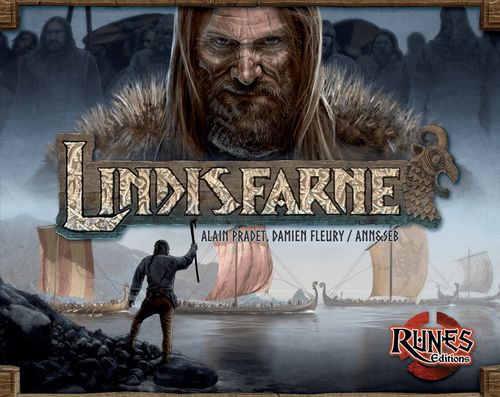
Lindisfarne
Lindisfarne Rulebook
Table of Contents
Table of Contents
Contents
- A — 3 boards forming a nautical map
- B — 6 dice
- C — 38 destination cards
- D — 20 objective cards
- E — 24 Viking tokens (6 per player)
- F — 12 rune tokens
- G — 1 first player pawn or card (representing a Jarl)
- 2 rule books (English and French)
Content Details
- A — 3 boards with different conditions to take the lead.
- B — 6 dice.
- C — Destination cards: 5 different countries with five or six cards each.
- D — Objective cards, which each include 3 different sets of countries.
- E — 24 Viking tokens (6 per player).
- F — 12 rune tokens.
- G — 1 first player pawn or card (representing a Jarl).
- Norway cards, where players trade and acquire bonuses and effects (Effects are detailed in a separate sheet).
Setup
- Place the 3 boards at the center of the table, to create the nautical map. Draw 8 Norway cards randomly and shuffle them with the other 28 destination cards, to form a draw pile composed of 36 cards. The remaining Norway cards are discarded, as they won't be used for this game.
- Place 2 destination cards next to each board as shown in the illustration.
- Shuffle the objective cards.
- Each player takes the 6 tokens of his clan. One player is chosen to be the first player and takes the Jarl pawn.
Round of Play
A game of Lindisfarne is made of 6 expeditions; each one is composed of multiple rounds.
Starting with the owner of the Jarl pawn and continuing clockwise, each player will choose one of two actions:
- Prepare to depart
- Return to the village
Prepare to Depart
A player who wants to prepare to depart will roll as many dice as he has Viking tokens (At the beginning of an expedition, each player has 6 tokens).
Then the player needs to attribute at least one die to one of the 3 boards. He can add as many dice as he wishes to the same board for that turn. In order to do so, the player will place a Viking token on each board below the corresponding die value. He can only attribute the other dice to that same board during that turn.
If the player is already present on the board, the new tokens are added to the same line. If a token is already present on a die value, the following token is stacked on the previous one.
If he was not present, the player places his token on the open line that is the furthest north.
Only one line per player and per board is allowed.
The more you use Viking tokens, the fewer dice you will use at the following turn.
Example: Blue throw his three dice. He decides to place his two "5s" on the first board.
A player can spend one or more rune tokens to modify a die result by +/-1. The tokens can be applied to the same die or applied to multiple dice.
Be aware: A die with the value 6 cannot receive an adjustment "+1" as a die with the value 1 cannot receive an adjustment of "-1".
During his turn, a player can use the effect from his Norway card. Each effect can be used one time per game. Then tilt the card as a reminder it can no longer be used.
Return to the Village
Before rolling the dice, a player can decide to return to the village. In this case, he won't be playing for that expedition and cannot use effects from cards. If he is the first player to come home, he gets the Jarl pawn (and will be the first player at the next turn). The player also gains 1 rune token per remaining Viking token still present on his hand (If he has not used all of them). A player without Viking tokens must return!
It is now the next player's turn.
One or more players may still play several turns even if one player has already returned to the village.
Example: In the following turn, Blue decides to "Return to the village". He is the first player to choose this action; therefore he takes possession of the Jarl pawn. The player also takes one rune token, because he has one Viking token remaining.
Rune Tokens
Rune tokens: The rune tokens are acquired when you return to the village, if the player still has Viking tokens or by using specifics cards. These tokens can be spent during the player's turn to modify the value of a die by +/-1. The tokens can be applied to the same die or applied to multiple dice during the same turn.
End of an Expedition
When all the players have returned to the village, the expedition ends. The players lead their raids and harvest the fruit of their labor. There are 6 countries: 5 where the players conduct raids and Norway where the players trade.
Evaluate each board one after another from north to south, beginning with Scandinavia.
For each board, you will determine the player with the lead. In case of a tie, the player who arrived first (The northernmost line) is considered the leader.
- On the first board, add the value of each player's Viking tokens. The player with the highest total becomes the leader and so on.
- On the second board, look for the longest suit in the same line. The player with the longest suit become first, and so on.
- On the third board, look at the highest stack of tokens. The player with the highest becomes first, and so on.
The leader of each board can choose a destination card from that board, then the second player will do so, and the third, and so on.
A player can refuse a destination card in order to draw an objective card instead. In that case, he draws two objective cards, picks one of them and discards the other one at the bottom of the pile of objective cards.
To draw an objective card, the player needs to be able to refuse a destination card. If the two first players took the two destinations card, the remaining player present on the board draws nothing.
To complete an objective, the player must collect cards from the three countries indicated on the objective card.
In every case, a player can only acquire one card (destination or objective) per board.
When all the boards have been evaluated, if some destination cards are leftover, because the players drew objective cards, those destination cards are placed in the discard pile.
Then draw two new destination cards per board. The player holding the Jarl (or Viking ship) pawn (The first to return to the village during the previous expedition) starts a new expedition.
Example: Yellow is leading and decides to take a destination card. Bleu is second and decides to pass in order to pick up an objective card. Black is third and also decides to pass in order to pick up an objective card. The remaining destination card is discarded.
Example: Blue (10) is leading and decides to take 1 destination card. Black (9) is second and decides to take the remaining card. Yellow (6) is third and cannot take a card.
End of the Game
The game ends after the 6th expedition.
Turn the 3 boards over to create the scoreboard.
Each objective completed earns 10 prestige points.
For each country, the player with the most cards gains 4 prestige points. In case of a tie, all players score the 4 points.
Each destination card earns 0, 1 or 2 prestige points.
The players also score bonus points if they manage to recreate part of a fresco, depending on the number of cards that connect (The shields on the cards indicate the position in the fresco):
| Connected cards | 2 | 3 | 4 | 5 | 6 |
|---|---|---|---|---|---|
| Prestige points | 2 | 6 | 10 | 14 | 20 |
It is possible to make several small series for the same fresco.
Don't forget that some Norway cards modify the points to calculate leads as well as the points earned with a fresco.
Destination card can only be used for one objective, but is also used to determine the lead and the bonus points from the fresco.
Each player adds his own prestige points. The one with the most points becomes the most prestigious Jarl, and is invited to take his place on King Harald's council.
Variation for 2 Players
During a game with two players, a neutral player is added. Before each expedition, roll the 6 dice and place the Viking tokens of a neutral color as follows:
- the 5 and 6 on the first board (The northern most)
- the 3 and 4 on the second board
- the 1 and 2 on the last board (The southern most)
During the evaluation, the neutral player always takes a card if it is one of the leaders and it is discarded in the discard pile.
If the neutral player is the first leader on a board, it is the last player on the board (Or the absent player if he is not present) who chooses which card to discard.
If the neutral player is the second leader on a board, the player with the lead chooses the card to be discarded by the neutral player.