Limit (2009)
Limit (2009) Rulebook
Table of Contents
Table of Contents
Material
Two players, White and Red, each have eight balls of their colour and share a common pool of 32 'holed' hexagonal tiles.
LIMIT includes also 8 black balls for the 3-player version.
Rules
The playing surface is initially empty.
Placement Phase
White places two adjacent tiles and puts a white ball on one of them. Red places two tiles and places a red ball on one of them. Each tile after the first pair must be adjacent to at least two other tiles.
Example: A typical opening sequence
Players then take turns adding two tiles (adjacent to at least two other tiles) and placing a ball of their colour on one of them. There are two constraints:
-
Balls of the same colour cannot be placed next to each other.
-
Every ball must be adjacent to at least one empty tile (i.e. must have at least one freedom).
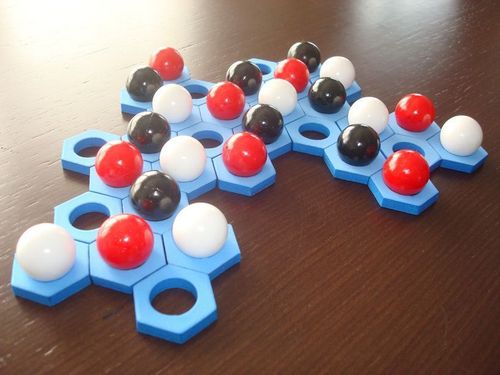
This figure shows a typical game after all pieces have been placed. Note that no two balls of the same colour are adjacent, and that every ball has at least one unoccupied neighbour.
Completed tile placement with balls added
Movement Phase
White player starts. Play then alternates with each turn consisting of:
-
moving a ball, and
-
removing a tile.
Both actions must be performed or the mover loses.
Figure: A White move that removes the last freedom of a red group to capture it.
1) Ball Move: The current player must move a ball of their colour to any empty tile that can be reached by a series of steps through adjacent empty tiles (i.e. balls block other balls). Groups of enemy balls with no freedom are then captured and removed; a group has freedom if it is adjacent to at least one empty tile.
2) Tile Removal: The current player must then remove any tile that has at least one free edge. Any subsets of empty tiles isolated by the removal are themselves removed from the game; it is not permitted to isolate tile subsets containing balls. Groups of enemy balls with no freedom are then captured and removed, then friendly groups of balls with no freedom are captured and removed (self-capture is possible).
Figure: A tile removal that both disconnects a tile and captures a red ball.
First Move Equaliser
The opening player cannot capture any balls on their first move.
Aim
Any player who cannot both move a ball and remove a tile is eliminated. The last surviving player wins.
Three-Player Version
Limit may be played with a third player (Black). Placement is the same, except that the tiles will run out before players have placed all of their balls. When this happens, players take turns adding a piece of their colour to any empty tile that is not adjacent to another ball of the same colour and is not the last freedom of any ball. Any unplaced balls remain unplayed.
Movement is the same, except that only the last player to move can capture on the first round.