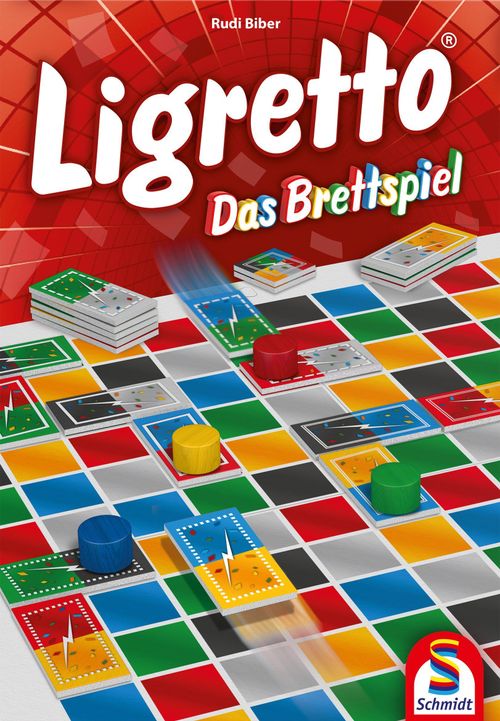
Ligretto: Das Brettspiel
Ligretto: Das Brettspiel Rulebook
Table of Contents
Table of Contents
Game Components
- 9 board sections
- 60 cards (15 for each player)
- 8 joker tiles (2 for each player)
- 4 Ligretto tokens
- 4 player boards
- 66 score chips (24 x 1, 28 x 2, 14 x 5)
Object of the Game
The object of the game is to quickly put down your stack of cards on the matching spaces on the game board. The first player to properly put down all of their cards says "Ligretto stop" out loud and wins the round.
Game Preparation
The game board is placed so all players can reach it well. With 2 players, 6 sections are used. With 3–4 players, all 10 board sections are used.
Every player receives 15 cards with the same border (with solid lines, double lines, dashes or dots), the matching player board and 2 joker tiles that also have matching borders.
Every player shuffles their 15 cards and holds them in their hand in a pile face down.
(The source prints "the their hand"; "their hand" is corrected here.)
For the first few rounds, our recommendation is for players to put the Ligretto tokens on the indicated board sections.
(Setup diagrams for 2 players and for 3–4 players, and the indicated starting sections for 2 players and for 3–4 players, are illustrations in the source and are not reproduced here.)
Gameplay
Before every round, the players put all four of the Ligretto tokens on the game board on the square spaces of their choice.
As soon as someone gives the command "Start Ligretto" the game begins and all players play at the same time. Every player picks up their pile, turns over the top card and checks if that card can be placed next to a Ligretto token. If this is the case, the player puts down the card so the colours match. If the card does not match, the player puts it face up on the table. All of the cards that a player is not able to put on the board are placed on the table to create a discard pile.
As soon as a player has played all of the cards in their hand, they turn their discard pile over and put it in their hand. Just like in the beginning, the player now turns over the top card and puts it on the board where it matches (or starts a new discard pile).
IMPORTANT: Every player can put a card next to any one of the 4 Ligretto tokens.
Playing Cards
A card matches if it has the same colours as the free spaces next to a Ligretto token. A card that has just been played has to always touch at least one of the edges of a space with a Ligretto token.
(Example: in the source's illustrated situation, the players have 9 different options for playing their next card.)
Players are not allowed to put down a card that would conceal a card that is already on the board.
Players are not allowed to put down a card that would only touch the space or card of the Ligretto token with one of its corners.
(Example: no cards may be played on the indicated spaces because for (a), a card would conceal a card that is already on the board and for (b), a card would only touch the Ligretto token diagonally with one corner.)
Every time you play a matching card, move the Ligretto token to the card that was just put on the board. The Ligretto token is always placed on the colour that is further away from the previous position of the Ligretto token. The new position of the Ligretto token now determines where subsequent cards can be played.
(Example: after playing the blue/yellow card, the player moves the Ligretto token to the blue space.)
Cul-de-sacs
If a player has put their card on a cul-de-sac, which means the new position of the Ligretto token does not provide any options for playing a new card, that player puts their next card on any free space on the board that matches the colours on their card. That player immediately puts the blocked Ligretto token on one of the two new spaces. Cards are then played from this new position.
If by playing a card a player blocks another Ligretto token on the board, the player proceeds with the blocked Ligretto token as if they had just placed the token on a cul-de-sac. The player looks for any free space for their next card and immediately puts the blocked Ligretto token on that card.
Joker
Sometimes there is a space in a different colour between a space with matching colours and the Ligretto token. That's where jokers fortunately come in!
A joker is used as a bridge on spaces in any colour. To play a joker, put it on one of the three free and permitted spaces next to the Ligretto token and immediately move the Ligretto token to the joker. Only the player who used the joker is allowed to put a card next to it. That card needs to be played immediately after playing the joker.
Note: players are allowed to use both jokers one after the other and right next to each other. However, players should use their jokers as sparingly as possible to remain flexible until the end of the game.
Ending Rounds and Scoring
As soon as a player has put all of their cards on the board (they do not have to use their jokers), they call out "Ligretto stop" and the round is over. The other players are no longer allowed to put down cards.
Now all together, the players make sure the cards have been positioned on the board properly. If a player made a mistake positioning a card, that player does not participate in the subsequent scoring of the round:
- First, the player who put down all of the cards in their hand takes one of the two-point victory chips.
- The rest of the players count up the remaining cards in their hands. The player with the fewest cards in their hand takes one one-point victory chip. If there is a tie, the players who tied each take one one-point chip.
- The remaining players do not score any points. Instead, they each put two of their cards on their player boards. These players will have a slight advantage in the subsequent rounds, because they will have fewer cards to put down.
Remember: A player who makes a mistake positioning cards does not score any points and is not allowed to put any cards on their playing board.
Exception: In a game with two players, only the player who ends the round scores points. The other player does not score any points, but is allowed to put two of their cards on their player board.
You are allowed to "exchange" your score chips using the chip supply at any time (in accordance with their value).
Example: In a game with four players, Rudi is the first to put down all of his cards, which means he ends the round. All of the players positioned their cards properly and participate in the scoring of the round. Rudi scores two points. Lena and Fabian each have two cards left, which means they score one point each. Alex still has four cards left, does not score any points, but does put two of his cards on his player board.
After completing scoring, all of the players look at their player boards. If every player has cards on their player board, then all of the players take exactly two cards off their player boards.
In most cases, one or more players will not have any cards on their player boards. In this case, no one takes any cards off any player boards. Finally, all of the players take their cards off the board, add these to the cards they took off their player boards along with the cards that are left in their hands and then shuffle them all together. Now a new round can start.
End of Game
Before playing, the players determine how many rounds they would like to play. For the first game, we recommend playing six rounds. The player who scores the most points in the predetermined number of rounds wins the game.
If you frequently play with the same group of players, you can write down the number of cards each player had on their player board at the end of the game and then start with the same set-up the next time you play.
Information
-
Players are only allowed to have their hands over the game board for the amount of time that is necessary to put down a card and move the Ligretto token. Blocking other players' view of the board is unfair.
-
Because all of the players play at the same time, the rule is: the early bird catches the worm. The card that is placed on the board first is allowed to stay on the board.
-
If it is not possible for any of the players to put down a card, the round ends immediately. The player who was able to put down the most cards wins the round. Scoring is conducted just like for a normal round.
-
If a player puts a card on the board incorrectly (the colours match those on the spaces but are the wrong way around), those playing decide whether it counts as a mistake or to turn a blind eye.
Different Board Configurations
Experienced players can be flexible in how they set up the board and use different configurations. Examples for possible board configurations are illustrated in the source (three board layouts of different shapes) and are not reproduced here.