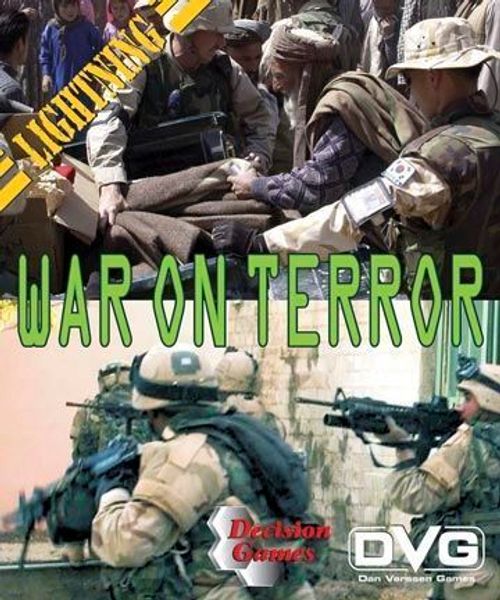
Lightning: War on Terror
Lightning: War on Terror Rulebook
Table of Contents
Table of Contents
Set Up
- Separate the 10 "country cards" from the remaining "force cards."
- Shuffle the country cards and place them face-down in the center of the table to form a separate, small deck.
- Shuffle the force cards and place them face-down near the center of the table to form a second, larger deck.
How to Win
The first player to liberate 10 or more victory points' worth of hostile regimes (country cards) wins. In a four-player game, the first player to earn 9 or more victory points wins.
Card Types
There are two general categories of cards in the game: country cards and force cards. In turn, there are five types of force cards. Each type of force card is indicated with its title in the lower-left corner:
- Aircraft
- Commando
- Ground
- Propaganda
- Ship
How to Play
The eldest (or best looking) player should turn face-up the top country card in that deck.
That same player should then deal each player, one card at a time, the number of face-down force cards equal to the turned-up country card's victory point value (the large number, from "1" through "5," printed in the upper-right corner of each country card's map).
Each player may look at his or her own cards, but should keep their front sides out of sight of the other players.
The player who turned over the country card may then choose to pass or play face-up the first force card, from his or her own hand, into the center of the table.
Play proceeds clockwise around the table from the first player, with each subsequent player having the choice to pass or play one card from his or her own hand.
Each circuit of play around the table is called a "round." Rounds continue until all the players have had the chance to play the number of their cards equal to the turned-up country card's victory point value. If a player passes in one or more rounds, that still counts as having had a chance to play.
Every force card has a number in its top-left corner called its "force points."
The player who, at the end of the proper number of rounds, has played the highest total of face-up force points has "liberated" (won for himself) the face-up country card. If there is a tie, there is an "extra inning" round in which only the players who are tied may play one more card from their hand. If there is still a tie, the players involved in the tie draw one card from the deck and compare the force point values to break the tie (tie break cards have no effect other than to compare their force points to break the tie); higher value wins. If still tied, repeat this tie-breaking draw until one player wins.
Also discard for the rest of the game all the force cards from all players that are on the table after a country has been liberated (or even if a successful liberation failed to take place because of a tie in force points).
The player who liberates a country places that country card next to him or her and then turns face-up the next country card in the country card deck. Then he or she deals out the proper number of face-down force cards to each player based on the victory point value of the new country card that's about to be fought over. For example, if the "Yemen" country card were newly turned over, every player would get just one new force card, and then just one round of force card play would follow (because Yemen's victory point value is "1"). The player to the dealer's left makes the first force card play of the new round, and play proceeds clockwise around the table from there.
Rounds continue until one player has liberated 10 or more victory points' worth of hostile regimes (9 points in a four-player game).
Further Explanations
Players don't discard the cards remaining in their hands when a country has been liberated. Force cards carried over from one round to the next don't work to decrease the number of new cards each player receives when a new country card is turned over. Every player receives the number of new force cards equal to the victory point value of the new country about to be fought over.
Players aren't limited as to how many cards they can hold in their hand at any time.
Some cards allow, as part of their play, for you to "turn over" (turn face-down) one or more of the other players' already played force cards. (Your own play of "turn over" cards never causes any of your own already played force cards to be turned over.) Whenever that happens, the other players' turned over force cards no longer have any affect on that round or that game; their force points have simply been expended without effect. Note, however, later play of other such "turn over" force cards allows for face-down force cards to be turned back up (and therefore bring their force points back into play). That can happen with the same or different cards any number of times per round. There are also other force cards that, when you play them, cause all the other players (but not you) to turn face down any one of their own already played force cards (their choices).
Some force cards have the following admonition printed on them: "This card may not be turned over." That statement means just what it says: such cards are not affected by the play of other force cards that otherwise allow for cards to be turned face-down.
Some force cards have the following printed on them: "You may discard this card from your hand to prevent one of your cards from being turned over." Such cards may be played in one of two ways. First, they may be played as a normal force card, simply placed face up on the table in order to rack up that many force points. Or, alternatively, they may be shown the instant any other player seeks to use a card to turn over one of your already played, face-up on the table, force cards. In those cases, simply show your "prevent card" to all the other players, then put it into the permanent discard pile. It's effect is to keep your already played force card from being turned face-down; the prevent card itself is simply discarded and doesn't rack up any more force points for you. Such prevent card play takes place entirely during the attacking player's turn and therefore doesn't work to use up your turn in that round.
Some force cards have the following printed on them: "If this is the first card you play to liberate a country, draw one card." That means, if such a force card is indeed the first one you actually put on the table in that round, as soon as you've done so you're allowed to pick a new force card from top of the deck and add it to your hand.
Some force cards have printed on them: "Trade this card for another player's played card of your choosing." That means, when playing that card, you should look over all the other players' face-up force cards then on the table, select the one you want the most; add it to your own hand, and then put your trade card face-up on the table in place of the card you just took into your own hand.
Some force cards have printed on them: "Trade all the cards in your hand for all the cards in another player's hand." That means you may select, but without getting to look to see exactly what he or she may be holding by way of good cards, any one other player at the table and demand they turn over their entire hand of cards to you. At the same time, you give that player your hand of cards. It doesn't matter how many cards each of you has in your original hand; one complete hand of cards is simply traded for the other. The trade does use up your turn for that round.
Some force cards have printed on them: "Draw two cards if you liberate this country." That means, at the end of a round, if you turn out to be the player who liberated the country that was being fought over, and that "draw two" force card had been played by you and remained face-up on the table when you won that round, you then get to immediately pick two, free-bonus, force cards from the top of the deck and add them to your hand.
Also note each of the country cards has a special instruction on it. In general, those instructions come into effect every time during that country's round that any player commits a triggering action. For example, when it's the round during which Iraq is being fought over, every time any player plays any aircraft card, he immediately also turns face-down any one played card of any other player.
Note: During the Yemen round, every player is allowed to play two cards at one time. That doesn't mean you're required to do so; you may choose to play only one.
If the Force Card deck runs out, shuffle all the discarded force cards to refresh the deck and continue play.
The 'historic flavor' texts on the cards (printed in a smaller, green font) have no effect on play.