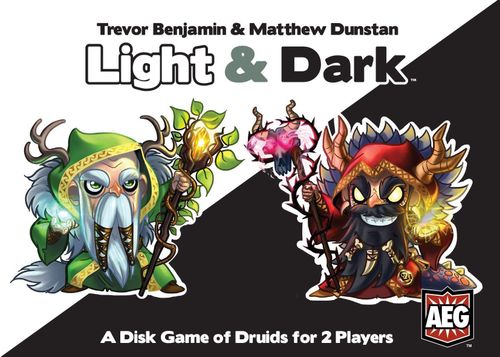
Light & Dark
Light & Dark Rulebook
Table of Contents
Table of Contents
Overview
In Light & Dark players control opposing factions of druids - one light, one dark. Each turn you will flick one of your druids, trying to hit the druids and torches controlled by your opponent. When you hit an opposing disk, you flip it, converting it to your side. You win if you flip either all the druids to your faction or all the torches to your faction (lit for light, unlit for dark).
For 2 players, ages 14 and up.
Components
- 6 Druid disks (double sided: light druid / dark druid)
- 5 Torch disks (double sided: lit torch / unlit torch)
- 8 Power Cards
- Rulebook
Setup
Light & Dark can be played on most flat surfaces, such as a table or the floor. The surface you choose must allow the pieces to slide freely and be accessible from all angles. A portion of this surface must be defined as the play area with boundaries clearly marked, e.g. by a table edge, a line of books, or a piece of string.
- Setup Druids: Each player chooses a faction (light or dark) and takes three druid disks. They place their druids at opposite ends of the play area, in their start areas as shown in the example setup diagram. A starting area consists of the space about three inches (a finger's length) from the edge of one side of the play area. Each player then flips their disks to the side showing their faction. This signifies that these druids are their followers, and under their control. Druids may be flipped during the game, changing the faction that they follow.
- Setup Torches: Place the five torch disks in the center of the play area, between the players' start areas. Three torches should be flipped to their unlit side and the remaining two torches to their lit side. The diagram shows the recommended formation.
Players are now ready to begin the game!
For your first game, or when playing with younger players, it is recommended that you do not play with power cards. See "Power Cards" below for details.
How to Play
The light faction takes the first turn of the game. Players then alternate taking turns until one player wins (see "End of the Game").
Taking a Turn
On your turn, choose a druid disk (you cannot choose a torch) controlled by your faction and flick it once. If this disk hits any other disks, the hit disks may be flipped as follows:
- If the druid you flick hits any druids or torches belonging to the opposing faction, flip them over. You have converted them to your faction.
- If the druid you flick hits multiple opposing disks, flip all of them. However, do not flip any disks that are hit by another disk, that is, by ricochet.
- If any of the other disks (druids or torches) controlled by your faction are hit, do not flip them.
Flicking
A flick is performed by using one finger to flick your druid disk. Players may use their thumb to create additional resistance for their flicking finger, which creates a stronger flick. Not using your thumb usually results in a weaker but more controlled flick.
Players may move around the play area in order to get a better position to flick. If players want a more challenging game, they must remain seated in the same position during the entire game.
Example
The dark player flicks one of her druids, hitting a light druid and a lit torch. The light druid that was first hit then ricochets and hits another light druid. The lit torch and the light druid that was first hit are flipped. The light druid that was hit with a ricochet however, is not flipped.
Disks Leaving Play
If a disk falls off the table or otherwise leaves the play area, it should be placed in its starting location in the state it was in when it left play, as follows:
- Druid disks should be placed in the start area of the player who controlled them before they left play. Their current controller chooses where precisely along this edge they are placed.
- Torch disks should be placed as near to the center of the play area as possible, in the state they were in when they left the play area (so lit if they were lit, unlit if they were unlit).
End of the Game
A player wins the game when they end their turn and either all druids or all torches have been flipped to their faction.
The light player wins if either:
- All five torches are lit, OR
- All six druids are flipped to their light side.
The dark player wins if either:
- All five torches are unlit, OR
- All six druids are flipped to their dark side.
Optional Rules
The following optional rules are presented here to add more variety in your games. Players should agree upon which optional rules to use at the start of the game.
Power Cards
Experienced players may wish to play with the power cards. These cards grant players special abilities which can be used once during the game. During setup, randomly deal each player one (or in later games, two) of these cards. Players should keep their power card facedown and only reveal the card to their opponent when they choose to use it. The card's ability describes when it can be played. After a power card has been used, it is removed from the game and returned to the box.
Team Play
Light & Dark can be played with more than two players using the team play variant. Try to distribute players as evenly as possible in two teams. Teams alternate taking turns until one team wins following the standard rules. The players within each team must alternate taking turns, so that each player gets an equal number of turns.
Longer Games
We recommend playing best 2 out of 3 games. For a more challenging contest, play best 3 out of 5.
When a player wins a game, they receive 1 victory point token such as a coin or bead. Then play a new game following all of the setup rules except players should switch factions. A player becomes the victor of the overall contest after receiving the required number of victory point tokens.
Terrain
Players can use additional obstacles available to make the game even more challenging. Some obstacles could include a cup or glass, pencil, book, even the game box. It is suggested that a larger play area is used when playing with the terrain variant.
First complete the standard setup rules. Once players have decided on which obstacles to use, place them off to the side. Then starting with the dark player, players take turns placing one obstacle anywhere in the play area (but not starting areas). Once all of the obstacles have been placed, players are now ready to begin the game.
Mega Set
Players may combine two sets of Light & Dark to create a mega set. This allows players to play with up to twelve druid and ten torch disks. It is suggested that a larger play area is used when playing with the mega set variant.
Players should agree on the number of druid and torch disks to use before the setup of the game. If players want a more challenging game, increase the number of torch disks and decrease the number of druid disks. If players want a tactical game with more options, increase the number of druid disks and decrease the number of torch disks.