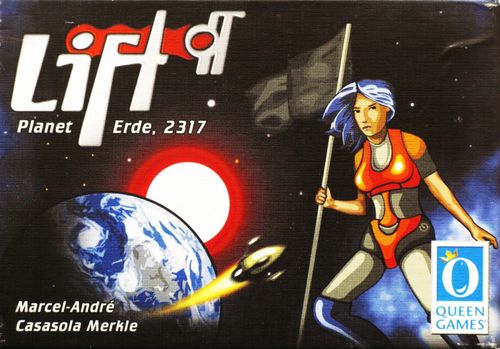
Lift Off (2000)
Lift Off (2000) Rulebook
Table of Contents
Table of Contents
Example of Play
Construction of two missions to the planet Pios Proxima:
Both players have built their mission correctly. Player A (as Stop Player) begins by turning over his first card:
- Player A: Solar Cell
- Player B: Energy Tank
- Player A: Energy Tank
- Player B: Energy Tank
- Player A: Lift off - the mission starts.
- Player B: Settlers
- Player A: Ore Production - the required energy unit is provided by his Solar Cell and the planet still has 2 available ore deposits. Therefore, the Ore Production order is executed successfully. Player A gets a victory point.
- Player B: Lift off - the mission starts.
- Player A: Theft - Player A may steal one of the three blue cards played by Player B (Energy Tanks or Settlers) and put it into play on his side. He chooses the Settlers. Player B cannot fight back since he does not yet have a Security Force card in play at this planet.
- Player B: Terraforming - Player B has two unused Energy Tanks, so he must execute the Terraforming order. The Energy Tanks are now used up and are set aside. After this is complete, the planet is now inhabitable and will score 3 victory points for the player with the most Settlers (in this case, Player A).
Result: Player A: 4 points - Player B: 0 points
Game Components
132 cards in 4 sets, one set for each player.
Each set contains the following cards:
- 15 blue Freight cards; Energy Tanks (x6), Settlers (x6), Security Force (x1), Solar Module (x2).
- 5 Lift Off Cards; for issuing the start command to your spaceships.
- 10 red Order cards; Theft (x2), Terraforming (x3), Ore Production (x5).
Additionally, there are 2 each of 5 Planet cards and 2 Point score summary cards.
Each planet card shows the required input on its left edge (Settlers and Terraforming) and the possible output on its right edge (Victory points, 1 to 5). Additionally, 1-3 brown rock symbols on the lower right edge of the planet card indicate how many ore deposits are available on the planet. A corresponding number of red Ore Production cards may be successfully completed at that planet.
Scoring
Victory points are added up, recorded, and carried forward from round to round. Each successful Ore Production Order yields 1 victory point. Each majority of Settlers on an inhabitable planet yields victory points according to the number marked on the planet. Three rounds are played. After each round, everyone shuffles their complete set of cards again. Whoever has the most victory points after three rounds wins the game.
Terraforming
Requires 2 energy units (on your spaceship as blue cards).
If they are available and not yet used, 1 Terraforming event is produced on the planet.
For planets to be able to support Settlers and, thus, produce victory points, they require either 1 or 2 Terraforming events.
Theft
No resources are required. You may take a blue card from the cards your opponent has turned up at this planet and put it into play in your row. You use it as if it were one of your own cards. If your opponent already has a Security Force card turned up at this planet when you turn up a Theft card, your attempt to steal is repulsed and your opponent may steal a card from you instead.
Stolen cards are returned to their owner and shuffled back into his stack before the next round.
The Planets
There are five different Planet cards. The victory points for that planet (shown by the number at the right edge of the card) are awarded to the player with the most Settlers (at least 1) on the planet. This only applies to inhabitable planets, however. With exception of Beta Minor, all planets must first be made inhabitable. The number of Terraforming symbols (0-2 blue planet symbols) on the left edge of the card indicates how many times Terraforming must successfully occur on the planet for it to support Settlers.
Goal of the Game
By producing ore in mines and settling new planets, players try to gain the most points. They do this by sending their spaceships to each of the five planets. All players load their spaceships simultaneously. However, as soon as any player has played all of his cards, all the other players must stop, as well. The race into the depths of the cosmos has begun...
Set-up
Each player takes a set of cards, shuffles them thoroughly, and lays them face-down in front of himself. The player to his right may cut if he wishes. The Planet cards are laid out between the players. The number of planets used varies depending on the number of players.
With 2 players
5 different planets.
(Hint: The order of the planets should vary with each game!)
With 3 players
9 randomly selected planets.
Because of the uneven selection and distribution of the planets, 3 rounds are always played when playing with 3 players. After each round, each player moves one position to the left.
Hint: Each player will have 6 planets where he can try to send his spaceships. Since players only have 5 Lift Off cards, however, only 5 of those planets can actually be visited.
With 4 players
All planets.
Be sure that the same five planets are adjacent to each player, i.e. exactly one of each type. Players only play cards on the planets lying next to them.
Security Force
Protects against the theft of one card.
Lift Off Card
If a yellow Lift Off card is turned up, it scores no points itself. It must be played first for a mission to be valid, however. After a Lift Off card is turned up, only red cards may be turned up further by that player.
If you turn up a red card, you must check to see if all its requirements are met. You may freely choose which of your available energy sources to use. If all the requirements are met, the printed order must be executed and any used Energy Tanks are removed. Resources are only used for successfully completed orders, however!
Ore Production
Requires 1 Ore deposit (rock symbol on the planet card) and 1 energy unit (on your spaceship as a blue card).
If both are available and not yet used, you score 1 victory point.
Resolving the Planetary Missions
Each planet is resolved separately. The two involved players take their own row of cards into their hand, without changing the sequence of cards, and turn them face-down. Now, both take turns playing the top card from the pile in their hands back to the planet. The player who called "Stop" starts (if that player is not part of this resolution, the player who is closest to the "Stop Player" moving clockwise starts). Blue cards do not have any initial direct effect. They provide necessary energy and Settlers in order to score victory points later. They are explained below:
Energy Tank
Provides 1 energy unit (lightning bolt symbol). After use, the tank is exhausted and is set aside.
Solar Module
Provides 1 energy unit (lightning bolt symbol). The module can be used for multiple orders, however, providing 1 energy unit for each red card used in the mission.
Settlers
Whoever has the majority of Settlers on an inhabitable planet (that is, after it has been terraformed), gets the victory points for the planet.
Overview of the Course of the Game
Each player picks up his face-down stack of cards but does not look at them. The youngest player gives the command "...3 ...2 ...1...Lift Off" and everyone then turns his stack so that all the cards are face-up. Now all players simultaneously play their cards to the planets in a long row, each on his own side of the planet card. These are the missions that lead to the planets. By sharp and quick play of the cards, players try to stay one step ahead of the others.
When playing cards at a planet, you must follow these rules:
- Blue cards may only be played directly adjacent to the planet or following another blue card.
- Yellow Lift Off cards may also only be played directly adjacent to a planet or following a blue card. Each player may only play one Lift Off card per planet!
- Red cards may only be played directly following a Lift Off card or another red card.
Specifics of the Course of the Game
All players play simultaneously. You always have 3 possibilities for playing the top card in your stack:
- Play the card at a planet, or
- Place the card under your stack, or
- Discard the card.
When any player has no more cards in his stack, he calls out "STOP" and the round ends immediately. The other players now set down their card stacks. Scoring takes place.
1. Play a card at a planet
Play your cards on the planet card at the edge closest to you. If you have already played a card on that planet, play additional cards there in a descending row such that the title of each card is always visible. Each planet card may, thus, have at most two rows. Your own cards are on one side and one of your opponent's cards will be on the other side.
2. Place a card under your stack
Simply take the card that you can't or choose not to play at the moment and place it under your stack. Be sure to place it face-up on the bottom of your stack.
3. Discard a card
Set the card aside in a private discard pile. Cards in your discard pile may not be used again in this round! You may discard cards because they're no longer playable, you wish to reduce the size of your stack, or for any reason.
End of the Round
When any player has no more cards in his stack, he calls "STOP" the round ends. All other players set their remaining cards aside. In order to allow easier calculation of victory points, all cards which will not score are also removed from the play area. These cards are:
- a) cards that are illegally placed (see 1. Play a card at a planet),
- b) there is no Lift Off card in that row.