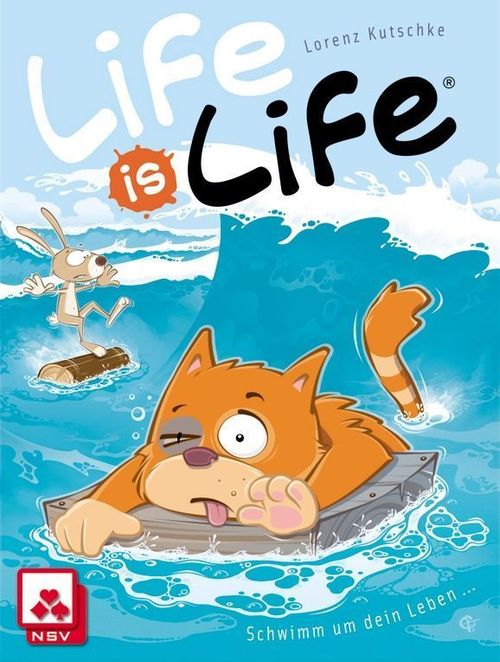
Life Is Life
Life Is Life Rulebook
Table of Contents
Table of Contents
Material
- 60 animal cards:
- 9x giraffe
- 8x bear
- 7x mole
- 7x goat
- 6x sheep
- 6x dog
- 5x rabbit
- 5x pig
- 4x cat
- 3x mouse
- 25 life cards
- 5 info cards
Game setup
Each player receives 5 life cards and lays them next to one another in front of him on the table and 1 info card, which he lays next to them. If there are fewer than 5 players, there will be some info cards and life cards left over. These cards are not needed and can be put back into the box.
Shuffle the 60 animal cards thoroughly and deal them out. Each player receives 10 animal cards that make up his hand and which are held so that the player can see each of his own cards. Also, lay down 10 animal cards face up into four rows in the middle of the table to form a tableau of cards:
- The 1st row is made up of exactly one animal card,
- the 2nd row contains exactly two animal cards,
- the 3rd row has exactly three animal cards and
- the 4th row consists of exactly 4 animal cards.
If there are fewer than 5 players, there will be some animal cards left over. These cards will not be needed in this phase and can be laid face down off to the side.
A game consists of multiple phases.
How to play
Draw to determine who goes first, then take turns in a clockwise direction. On your turn, you have to either A) trade cards or B) knock (which signals the end of the phase).
A) Trade cards
Decide which row (one row only) from the tableau you want to pick up and add to your hand. Before you pick up all the cards in the row, lay down the exact same number of cards from your hand in the middle of the table, then add the row of cards you selected to your hand. Then, take the cards from the middle of the table that you just laid down and use them to form a new row, replacing the missing row in the tableau.
Example: It's Tim's turn: He wants to pick up the 3rd row. First he lays down three cards from his hand and then he picks up all three cards from the 3rd row of cards in the tableau. The three cards that he took out of his hand are then used to form the new 3rd row of the tableau.
Note: It's completely up to you which cards in your hand you want to trade in exchange for a complete row from the tableau. However, you are not allowed to trade in the exact same animal cards that you pick up. The cards that you lay down from your hand must have at least one different animal card from the cards that you pick up from the tableau.
Example: Sarah decides on the second row, which contains one mole and one bear. She is not allowed to trade one mole and one bear, but any other combination (of two animal cards) is possible.
B) Knock
On your turn, you can knock on the table loudly and clearly instead of trading cards, which signals that it's the last round. Once you've knocked, all the other players (but not the player who knocked) have one last turn, in which they can trade cards. Whoever doesn't want to trade any more cards in this last round also knocks. Then count the score for the completed phase.
Note: You can only knock, if you have already traded cards at least once.
End of a phase
In most cases, a phase comes to an end by knocking, after which score is counted normally (see "Normal end of a phase"). A phase can also end abruptly (sudden death) as follows:
Immediate end of a phase (sudden death)
If you have one of the three card combinations in your hand showing on the info card, after trading cards, say so aloud and show your cards. You need all 4 cats or all 5 rabbits or all 5 pigs.
The phase is immediately over. All other players lose 1 life (put one life card back into the game box). Normal scoring does not take place! A new phase is then started.
Note: An immediate end of a phase is also possible if a player has already knocked.
[Diagram caption: Sudden Death, showing 4x cat, 5x rabbit and 5x pig; All other players: -1 life.]
Normal end of a phase
One of the players has knocked and all other players had one last turn. Now it's time to count the score. All players lay down their hands (10 cards) face up in front of them on the table, sorted according to animal type. Now check to see who has the absolute majority of cards for each of the 10 different animal types; that means, the player must have more animal cards in an animal category than each of the other individual players for the same animal category. First compare the giraffes (value 9), then the bears (value 8), then the moles (value 7), etc.
The player with the absolute majority of an animal type receives the same number of points corresponding to the value of this animal type. To indicate the points received, leave these cards face up on the table. Whoever does not have the majority in this animal category turns over his cards of this animal type, for which he receives zero points. The value of an animal type is indicated by the number in the corner of the animal card for each animal type.
Example: Mia has four giraffes, Tim has three giraffes and Sarah has one giraffe. Mia receives 9 points for having the absolute majority of giraffes and leaves her four giraffe cards face up on the table. Tim and Sarah turn over their giraffe cards.
Very important: If more than one player shares the majority of an animal type, no one receives any points for this animal category!
Once all animal types have been compared as described above, each player adds up all the points that he has received in this phase. Now, in the following order:
- The player(s) with the highest point total lose(s) 0 life cards.
- The player(s) with the lowest point total lose(s) 2 life cards.
- All other players (if any at all) lose 1 life card.
Put the lost life cards back into the game box.
Note: If all players share the same number of points, no one loses any life cards.
Example: Tim has a total of 15 points, Mia has 13 points, Linus has 10 points, and Leon and Hanna each have 7 points.
- Tim doesn't lose any life cards.
- Leon and Hanna both lose 2 life cards each.
- Mia and Linus each lose 1 life card.
Very important: As long as there are more than 2 players left in the game, you can have the majority of an animal type with a single card of an animal type, if the other players do not have any animal cards of this animal type.
As soon as there are only two players left in the game, a single animal card does not count as a majority. That means, now, you need at least two cards of an animal type to be able to score any points for this animal category.
Further phases and end of game
The game setup and course of the gam[e] for all further phases stay exactly the same as for the first phase. The player to the left of the player who started the previous phase begins the new phase. If this player has just lost his last life card and therefore is no longer in the game, the next player to the left begins the new phase. Whoever loses his last life card is immediately out of the game. The other players continue as described above. The last player still in the game wins.
Note on the source text: the printed rulebook reads "the gam" here; "[e]" is added to complete the obvious word.
Advanced rules
For advanced players: The rules described above stay the same, but you can only end a phase by sudden death with either all 5 rabbits or all 5 pigs. The player who ends a phase by sudden death receives 1 extra life card. All other players lose 1 life card.