Libra
Libra Rulebook
Table of Contents
Table of Contents
Introduction
LIBRA is a game of asymmetrical goals. Two players (MORE and LESS) share a common pool of stones in two colours. MORE will try to create as many groups of connected stones of the same colour as possible, while LESS will try to avoid that many groups from being created.
Material
LIBRA can be played on a hexagonal grid of any size and shape.
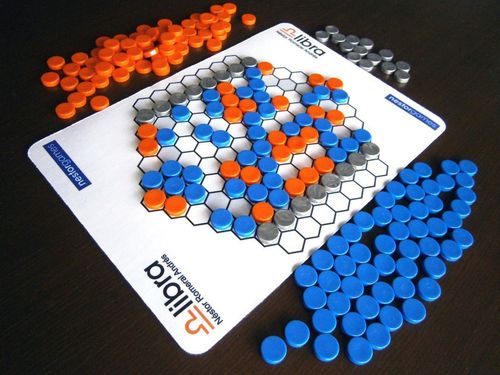
The nestorgames edition includes 200 stones in two colours and a hexagonal board (with 5, 6 or 7 hexes per side depending on skill level). It also includes 36 gray counters in case you wish to try your own shape for the board, by creating a fence with them or even placing isolated stones as obstacles.
Game Preparation
Place the board in the middle of the playing surface. The supply of stones must be easily accessible to both players.
For beginners, playing in a hexagon of 5 cells per side is recommended (inner hexagon of the nestorgames board). It is also recommended that MORE places a bunch of stones by its side to remind players who plays MORE and who plays LESS.
There are 2 types of gameplay:
Duel: The game takes place over two rounds. In the first round, one player plays as 'MORE', the other as 'LESS'. In the second round, the roles reverse. Whoever creates more groups playing the 'MORE' role wins the game.
Bid: Before the game starts players take turns announcing how many groups they think they can create, raising the number each time. The player that passes first plays as 'LESS', and the other player plays as 'MORE' and must create at least as many groups as she bid to win.
How to Play
Starting with 'LESS', players alternate turns placing a stone of any colour on an empty cell of the board. The game ends when all the cells have been occupied (or by mutual consent).
Scoring
Count the number of groups of connected stones for both colours. This is the 'MORE' score. Isolated stones are also considered groups.
Tip: count the groups of one colour first, then the other.
Endgame example: 'MORE' scores 7 groups (3 white and 4 black).
Remember to play twice if you've chosen the 'Duel' type of gameplay. In case of a tie, play again or try a bigger board.
Strategies
Playing MORE
- Try to keep a colour proportion of more than 2 to 1 on the board, as this allows you to create more groups.
- Create 'corridors' with walls of the same colour and then split them into rooms of at least 2 cells. Then your opponent can't stop you making a group on each room.
- Use 'tree' structures for the same colour to split the board into several areas.
Playing LESS
- Try to keep a colour proportion of around 1 to 1 on the board, as this won't allow your opponent to create a large number of groups.
- Spot potential corridors (especially on borders and corners) and fill them with stones of the same colour as the walls.
- Be careful when connecting groups, as you might be splitting others.
Puzzle
What is the maximum number of groups that can be created in a hexagonal board of a given size?