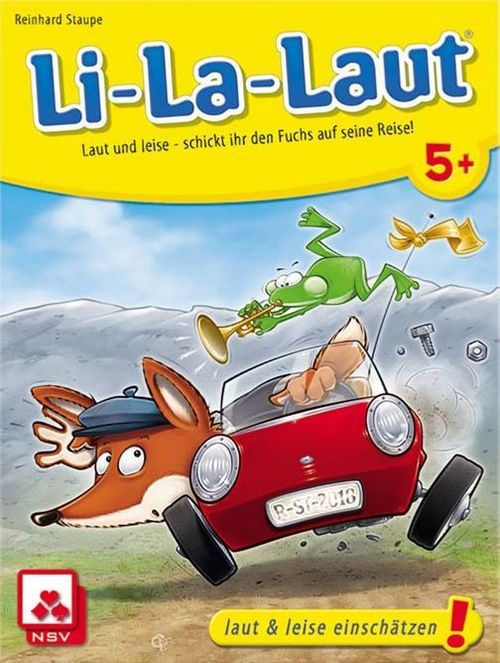
Li-La-Laut
Li-La-Laut Rulebook
Table of Contents
Table of Contents
Game Setup
The 9 target cards are laid out face-up in a circle in any order.
The car is placed on the outside of the circle next to a random target card.
The 36 task cards are shuffled and placed in the centre of the circle in a pile, face-down.
Game Rules (for 3-5 people)
Lots are drawn to determine who will first act as the noise-maker. The noise-maker takes the uppermost card from the pile and looks at it in such a way that the other players cannot see what is on the card.
The noise the noise-maker must make is written at the top of the task card, see "The Noises". Underneath, the player is told which target card the car should travel to in a clockwise direction. Depending on how far the car has to travel, the noise-maker must perform correspondingly loudly or quietly – in careful doses!
Very important: If the noise-maker takes a task card from the deck and then looks for the object that is required among the target cards, they should do so in such a way that the other players cannot recognise the answer from their eye movements. For example, if the task card asks for the banana as the target card, the noise-maker should not obviously look at the banana (preferably, they should look over all the cards).
Example (from the rulebook): It is Tim's turn and he takes the topmost card from the deck. He is to clap his hands. The car is to travel from its current position (umbrella) to the present. As the present is four cards away from the car's current position, Tim should clap a fraction less than moderately loudly.
After the noise-maker has made the required noise, all the other players must guess where the car will probably end up. Loudly and clearly, and beginning with the player to the left of the noise-maker and continuing in a circle, the players declare their guess individually and one after the other. Everyone specifies exactly one random guess.
Example (from the rulebook): Sarah guesses "scissors", Linus guesses "present", Hannah also guesses "scissors" and Ben guesses "banana".
Once everyone has given exactly one guess, the noise-maker announces the answer and moves the car forward accordingly. Sarah says: "The correct answer is 'present'." She moves the car to the present.
→ Every player who guessed correctly receives a task card from the pile as a reward and places it next to them, face-down. If at least one player guesses correctly, the noise-maker also gets a task card as a reward (the one which they have just used).
Example (from the rulebook): Linus guessed correctly. He receives a task card from the pile as a reward. As the noise-maker, Sarah also receives a task card as a reward.
Tip: Instead of distributing cards, you can also write down the points on a piece of paper.
→ Should nobody guess correctly, nobody receives a card as a reward (this includes the noise-maker).
Now, the next player to the left of the last noise-maker becomes the new noise-maker. The game continues to be played as described until there are no more cards left in the pile.
Whoever has the most cards at the end wins. Of course, you can also play in such a way that the first person to reach, for example, 5 cards is the winner.
The Noises
The noise-maker must clap their hands.
The noise-maker must make hissing noises like a snake: "ssss".
The noise-maker must knock on the table (they can also do this with an open palm to protect their knuckles).
The noise-maker must howl like a Native American, i.e. quickly tap the open palm of their hand against their mouth: "ooh-ooh-ooh!"
Using other noises: Principally, all possible noises that the children know and are able to make can be used and incorporated into the game, e.g. stamping with their feet, using a spoon or a coin to beat on the game box, using a xylophone or triangle, whistling, humming, clicking, rattling etc. In this case, the noises depicted on the task cards are then simply ignored. You can play, e.g. one round with humming, then one round using a coin to beat against the game box. The other game rules remain the same.
Playing as a Pair
The complete set of game rules remains the same. However, both players work together as a team. One of the players begins, takes the uppermost card from the pile and looks at it. Then they make the required noise, as has already been described. The other player may now make two guesses. If one of these is correct, the task card is put down face-up by the players as a reward. If both guesses are wrong, the task card is set aside. The players take it in turns to be the noise-maker. The game is played until there are no more cards left in the pile. The more cards won the better. Results over 20 are fantastic.
For true professionals: Only one single guess is given. This is particularly difficult. Should both players achieve more than 20 correct answers through playing in this manner, then they are the noise-making champions!