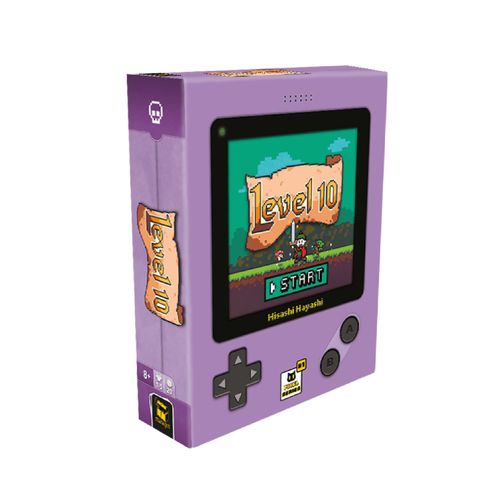
Level 10
Level 10 Rulebook
Table of Contents
Table of Contents
Game Contents
- 40 Level Cards, numbered 1 to 8 (in 5 different worlds: Desert, Forest, Sky, Volcano and Swamp)
- 10 Reset Cards (2 for each world, all numbered 0)
- 3 Pause Cards
Level Card Anatomy
- Level number
- World icon
- An image of Izzy during his adventure! Put the cards in order to discover the full story!
- Note: the Swamp (purple) is represented by a skull. The rest of the worlds are represented by the following icons: Desert, Forest, Volcano, Sky.
Objective
Level 10 is a cooperative card game — that is, you are not competing against each other, but working as a team to help Izzy make his way through the 10 levels of the 5 worlds of the Kingdom of Woz. You will play cards one at a time, placing them in a 5×10 grid until (hopefully) you complete the game. Each of the worlds Izzy visits will be represented by one of the five rows of cards in the grid. To win, you must place all 40 Level Cards and all 10 Reset Cards in that grid. If at any point one of you cannot play a card on your turn, you have all (yes, Izzy too) lost.
Setup
First, lay out the five pairs of Reset Cards to the left of what will become the five world rows, as follows:
- The cards of Sky will be placed in this row during the game.
- The cards of Forest will be placed in this row during the game.
- The cards of Swamp will be placed in this row during the game.
- The cards of Volcano will be placed in this row during the game.
- The cards of Desert will be placed in this row during the game.
Next, decide the difficulty level for the game, which depends on the number of Pause Cards you use. The fewer Pause Cards, the harder the game.
| Difficulty level | Number of Pause Cards in the deck |
|---|---|
| Beginner | 3 |
| Standard | 2 |
| Pro | 1 |
| Master | None! |
Now shuffle the Pause Cards you are going to use together with the Level Cards and place them in a face-down deck. Return any Pause Cards you are not using to the box. Once this is done, deal cards from the deck as shown in the table below. The cards left over after dealing become the common deck you will draw from during the game, so keep them within reach.
| Number of players | Starting hand |
|---|---|
| 1 | 10 cards |
| 2 | 7 cards |
| 3 | 6 cards |
| 4 | 5 cards |
| 5 | 4 cards |
Finally, look at your cards individually and, bearing in mind the communication rules below, decide as a group who should be the starting player. You are now ready to begin!
Communication Rules
When playing a game of Level 10, you may not show your cards to anyone. As a player, you may only share the following information with the rest of the team:
- You may reveal how many cards you have of a given world.
- You may suggest which world you would like to play in on your turn.
- You may say that you would like to play a Reset Card of a specific world.
- You may not give any other kind of information. In particular, you may not say or hint at the numbers of the cards you hold in your hand.
A Round of Play
You play in turns clockwise, starting with the starting player, until (hopefully) you place all 50 Level and Reset Cards in the grid.
Exception: in 5-player games, when the last player of the round plays their card and completes the current column, they immediately take another turn — that is, they play a second card, with which they start the next column. This double turn therefore makes the position of last (and first) player rotate each round.
On your turn, you must carry out one of these two actions:
- A) Play a Level Card or a Pause Card from your hand, or
- B) Place a Reset Card.
If on your turn you cannot do either of these, the game ends immediately and you have all lost!
Let's look at the actions in more detail.
A) Play a Level Card or a Pause Card from your hand
To carry out this action, simply play one of your Level or Pause Cards and place it in the grid, following the card placement rules below. Once you have placed it, draw a new card from the deck and add it to your hand. This is the most common action in the game.
B) Place a Reset Card
To carry out this action, choose a world and move one of the Reset Cards to the left of that row to the far right of it, following the card placement rules below. Once you have done this, if there is at least 1 card in the common deck, choose 0, 1, or 2 cards from your hand and discard them face down, placing them on the bottom of the deck (in whatever order you choose), then draw the same number of cards from the top of the deck.
You may not carry out this action if:
- There are no Reset Cards left in that world, or
- There is already a Reset Card in the current column.
Card Placement Rules
To place a card in the grid, you must follow these rules.
1) All the Level Cards in a row must belong to the same world, and there can only be one row per world.
Example: this card belongs to the world in the first row of the grid, Sky, so you can only place it in this row. In other words, this card cannot go in any of the other rows, since it doesn't match the other worlds.
2) The number on the Level Card you are going to place in the grid must be equal to or higher than the number on the card that will be to its left. If you place a Reset Card, the last number in that row is reset to 0. That is, after a Reset Card, you may play a card of that world with any number.
- Any Sky card with a number higher than 3 may go here.
- Any Forest card with a number higher than 3 may go here.
- Any Swamp card with a number higher than 4 may go here.
- Any Volcano card with a number higher than 6 may go here.
- Any Desert card with a number equal to or higher than 0 may go here.
3) On your turn, you must place the card in the column you are currently playing. You may only start a new column once the previous one is fully complete. For example, you can only place a card in the second column once the first is complete, and so on.
Example: in this example, the next card must be either a Forest card (green) or a Volcano card (red). No one may place a card belonging to any of the other worlds until the current level's column is complete.
4) Each column, always 5 cards, must contain exactly 4 Level or Pause Cards and 1 Reset Card. So by the end of the game, there must be exactly 2 Reset Cards per row.
- There is exactly 1 Reset Card in this column.
- There is more than one Reset Card in this column.
- There is no Reset Card in this column.
5) On your turn, you may play a Pause Card instead of a Level Card. When you place one, that Pause Card's value is the same as the card to its left. For example, if the card to its left is a Reset Card, the Pause Card's value is 0.
- This Pause Card counts as a Sky 2.
- This Pause Card counts as a Swamp 0.
If You Run Out of Cards in the Deck
If your deck runs out of cards, the game continues, except that you can no longer draw cards. If this happens, you gain a special ability that will help you:
When one of you places a Pause Card, you may additionally discard a Level Card belonging to the world of the row in which you placed the Pause Card (if you have one in hand). To do this, place the card you want to discard underneath the Pause Card. You may only discard one Level Card per Pause Card.
If one of you runs out of cards in hand, the game continues, but your turn is skipped for the rest of the game.
Winning or Losing the Game
If you manage to place all 50 Level and Reset Cards in the grid, you have won the game!
However, if any of you cannot carry out any of the possible actions, the game ends immediately and you have all lost.
Example: In this example, the team has lost the game. It is Andrea's turn, and she has only a Forest 6 (green) card in hand. Andrea cannot play this card after the Forest 8 card already in the grid (since it has a lower number). What's more, both Reset Cards for this world have already been played. Therefore, Andrea cannot carry out any action on her turn. Obviously, if the group had chosen a lower difficulty level, they would have had a chance to play a Pause Card. Unfortunately, they only managed to reach level 10 (the tenth column of cards) in three of the five worlds... Do you think you can do better?
Scoring
If you want to keep a running score from game to game, you can count how many Level and Reset Cards you managed to place in the grid by the end of the game. That is your final score, to which you add bonus points for the number of unused Pause Cards: +5 points for one, +20 points for two, and +40 points for three.
If you managed to place ALL of the Level and Reset Cards in the grid, add the following bonus points instead for the number of unused Pause Cards: +10 points for one, +30 points for two, and +50 points for three.
Only the best manage to reach 100 points. Any score above 50 is already very good!
Tips
- When you play each column, it will help a lot to talk about who should place the Reset Card.
- Except for the tenth column, avoid placing a card numbered 8 twice in the same column, because unless you have a Pause Card available, you will lose on the next column.
- Once you have used both Reset Cards of a world, it is essential that you play the rest of that world's cards in the exact order, since you will not be able to reset that row again.