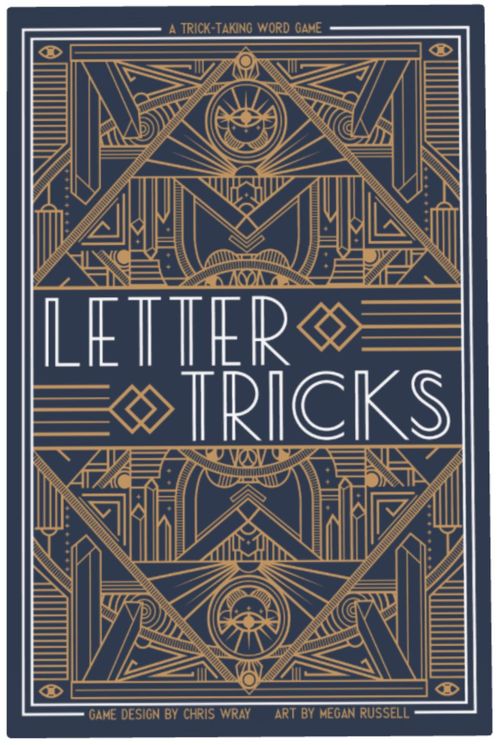
LetterTricks
LetterTricks Rulebook
Table of Contents
Table of Contents
Contents
58 Cards
- 17 Cards in Yellow (A, C, D, E, G, H, I, K, M, O, P, R, S, T, U, W, X)
- 17 Cards in Blue (A, B, C, E, F, G, I, J, L, N, O, P, R, S, U, V, Y)
- 18 Cards in Red (A, B, D, E, F, H, I, L, M, N, O, Qu, S, T, U, W, Y, Z)
- 6 Multicolored Cards (J, K, Qu, V, X, Z) (Only included in some versions of the game.)
5 Player Aids (Only included in some versions of the game.)
This Rules Sheet
LetterTricks is a trick-taking word game that can be played four different ways. Instead of the numbered cards in traditional trick-taking games (like Hearts or Spades), the deck in LetterTricks consists of lettered cards.
The trick-taking and word-forming aspects are the same in all four games, so that is explained first.
Trick-Taking and the "Must Follow" Rule
The start player (traditionally the player to the dealer's left) plays a card from their hand. Players then play into this trick in clockwise order. Each player must play a card of the same color (also called a "suit") as the lead player, if possible. If they don't have that suit, they may play any card from their hand. The highest card of the suit led wins the trick. Z is the highest card in the deck; A is the lowest card. The player with the highest card following suit leads the next trick.
What Constitutes a Word?
In all four games, players are forming words. Plurals are allowed. The dictionary governs what is or is not a word, but there is no need to resort to the dictionary if all players agree that a word is indeed a word.
The "Q" Card
In all four games, when forming words, players may assume that there is virtual a "U" card following the "Q" card. This is optional, and players may instead use an actual "U" card or even create a (rare!) word where "Q" is not followed by "U." The Qu card counts as one letter for purposes of victory in Team LetterTricks.
4- and 5-Player Competitive LetterTricks
Deal the deck of cards evenly among the players. Do not use the multicolored cards in this game. In the 5-player game, two cards are returned to the box, but show them to all players first.
In each trick, the player with the highest card of suit led gets to pick a card from the trick. They can pick any card in the trick. The lowest card (suit does not matter for this purpose) then gets to pick a card after the winner of the trick. In the event of matching letters for the lowest card, the later played card gets the pick. The remaining cards not selected are set aside; they will not be used again this hand. Cards taken are public knowledge.
At the end of the hand, players take the cards they have collected and try to make a single word. Each card used in the word is worth one point, though a few rare letters (J, K, Q, V, X, Z) earn a bonus point each (as indicated by the x2 on those cards). Players do not need to use all the letters they gathered, but letters not in the word do not score points. (Optional Rule: Players get one minute to form their word.) (Advanced Variant: Players lose one point for every second card collected but not used to form the word. The x2 cards do not receive special treatment for this purpose.)
Players write down their scores. Dealer rotates to the left, and players play three hands (though they may agree to more). High score wins. In the event of a tie, the player who had the best individual hand score wins. If there is still a tie, players share the victory.
3-Player Competitive LetterTricks
Put the 15 vowel cards into a face-up display. Shuffle the remaining 43 cards together (including the multicolored cards), then deal them out evenly. Each player should have 14 cards. There will be one card leftover, which is shown to players and returned to the box.
In each trick, the player with the highest card of suit led gets to pick a card from the three cards in the trick. They can pick any card. The player playing the lowest card (suit does not matter for this purpose) then gets to pick one of the two remaining cards from the trick. In the event of matching letters for the lowest card, the later played card gets the pick. Finally, the player playing the middle card (i.e. the card played by the player who has not picked one of the cards previously) gets to pick one of the remaining face-up vowel cards from the display. The unselected card from the trick will be set aside; it is not again needed this hand. Cards taken are public knowledge.
The multicolored cards are all-suited, meaning they can always follow and, thus, be played into any trick. Because they always follow, if they are the highest card in the trick, they win it. If a multicolored card is led, the suit of the trick will be determined by the first non-multicolored card played, if any. A player is never required to play a multicolored card.
At the end of the hand, players take the 14 cards they have collected and try to make up to three words, one for each suit. Each word can only have letters from a single suit or the multicolored cards, and each suit can only be in one word. Each card used in the word is worth one point, though a few rare letters (J, K, Q, V, X, Z) earn a bonus point each (as indicated by the x2 on those cards). Players do not need to use all the letters they gathered, but letters not in the word are each one negative point. (Optional Rule: Players get two minutes to form their words.) High score wins.
This is designed to be a one-hand game, but if players decide in advance to play multiple hands, three hands works well. Players write down their scores between hands, and high score at the end wins. Dealer rotates to the left after each hand. In the event of a tie, the player who had the best individual hand score wins. If there is still a tie, players share the victory.
Team LetterTricks (4 Players)
Deal the deck of cards evenly among the players. If using the multicolored cards (which is recommended), exclude the cards they replace. Each team is trying to make a word of a certain size in all three suits. The first team to do so wins.
In each trick, the player with the highest card of suit led gets to pick a card from the trick. They can pick any card in the trick. The lowest card (suit does not matter for this purpose) then also gets to pick a card, after the winner of the trick. In the event of matching letters for the lowest card, the later played card gets the pick. The remaining cards not selected are set aside for future hands. Cards taken are public knowledge.
After each trick, the winning team has a few seconds to try to arrange or rearrange their winning cards into words. Players do not need to use all the letters they gather. If they successfully form a word of at least four letters in all three suits, they win the game. If using the multicolored cards variant (which is recommended), their goal is to get at least five cards in all three suits (and the multicolored cards can be played in any suit, but only in one suit for purposes of victory).
If used, the multicolored cards are all-suited, meaning they can always follow and, thus, be played into any trick. Because they always follow, if they are the highest card in the trick, they win it. If a multicolored card is led, the suit of the trick will be determined by the first non-multicolored card played, if any. A player is never required to play a multicolored card.
The end game will sometimes take multiple hands of cards. For the second and third hands, shuffle any untaken cards from the previous hand and deal them out evenly. Put any remaining cards (there should be two if the game proceeds to a third round) on the table: they can be taken by the high and low card in the next trick in lieu of one of the cards in the trick, but otherwise they get shuffled aside with that trick's unused cards. Play continues, with the team winning the last trick in the last hand leading the first trick of the new hand.
The following should rarely happen, but if after three hands neither team has formed the winning words, the game ends in a draw. Please email the designer of the game the letters taken by each team so he can puzzle over the dictionary even more!
Cooperative LetterTricks (4- and 5-Players; Best with 4 Players)
Deal the deck of cards evenly among the players. If using the multicolored cards (which is recommended), exclude the cards they replace. During setup, each player passes three cards of their choice to the player to their left. (It is helpful if they remember the cards they passed!) The goal is for players work together to ensure that each trick forms a word. The size of the word will match the number of players. The order in which cards are played into the trick does not matter. (For instance, if the cards A-K-T-E were played in that order, players can rearrange them at the end to form the word T-A-K-E.)
Communication is encouraged, but players cannot say precisely what letters they have. A play may say how many of each suit they have, and how many vowels they have (and "Y" is not a vowel). They can even say how many vowels or consonants they have of each suit, including the multicolored cards. You may agree to conventions in advance if they are in the spirit of the game, though coming up with those is for your group. Such conventions and solid communication are often necessary for the highest scores.
If used, the multicolored cards are all-suited, meaning they can always follow and, thus, be played into any trick. Because they always follow, if they are the highest card in the trick, they win it. If a multicolored card is led, the suit of the trick will be determined by the first non-multicolored card played, if any. A player is never required to play a multicolored card.
When there are two tricks left to play in the hand, the lead player puts both of their cards on the table, opening two tricks. Players can then play into either trick, without needing to follow. Only players who have already played into the trick can recommend where each card goes.
Tricks where words were formed each score one point. A score of 7 is considered a first victory in the 5-player game; 9 is first victory in the 4-player game. Victories occur in future games where the group beats their previous high score.
More About The Multicolored Cards
Using the multicolored cards is required in the 3-player competitive version of LetterTricks, and recommended in the Teams and Cooperative versions of the game. Follow the rules as specified above for each version of the game. Many copies of the First Edition of LetterTricks did not have the multicolored cards.
Frequently Asked Questions
Why not have every letter in every suit? Reducing the cards per suit makes the number of cards in the game manageable. LetterTricks wouldn't be fun with just two suits, so three suits are necessary. If there was one of each card, that would be 78 cards, which is too many to hold, especially in the 3- and 4-player games. Though it can be difficult to remember precisely what is in each suit, not all players want or need to do that, plus the player aids are designed to help with this. There is also a pattern: each suit contains every vowel and two of the six rarest letters (J, K, Q, V, X, Z). The common consonants all appear in two suits.
How did you pick which letters are in each suit? That was the most time-consuming part of designing LetterTricks. I wanted to maximize the number of words that could be made for each. That involves pairing certain consonants that often appear together. For example, "C" and "K" often appear in words together, so I made sure they were in the same suit.
What are the changes from Version 1.0 to 2.0 of LetterTricks? Version 2.0 contains a new teams and 3-player competitive versions of the game. It also includes full-color cards and player aids, and the alphabet is printed on the side of the box bottom.
We are struggling to get high scores in the cooperative version? That's common! To achieve high scores, your team will likely need to emphasize communication and come up with conventions. For example, when my group plays, we try to have a vowel on the table within the first two cards.
Please be sure to check BoardGameGeek for rules updates and additional ways to play!
Rules Version 2.1