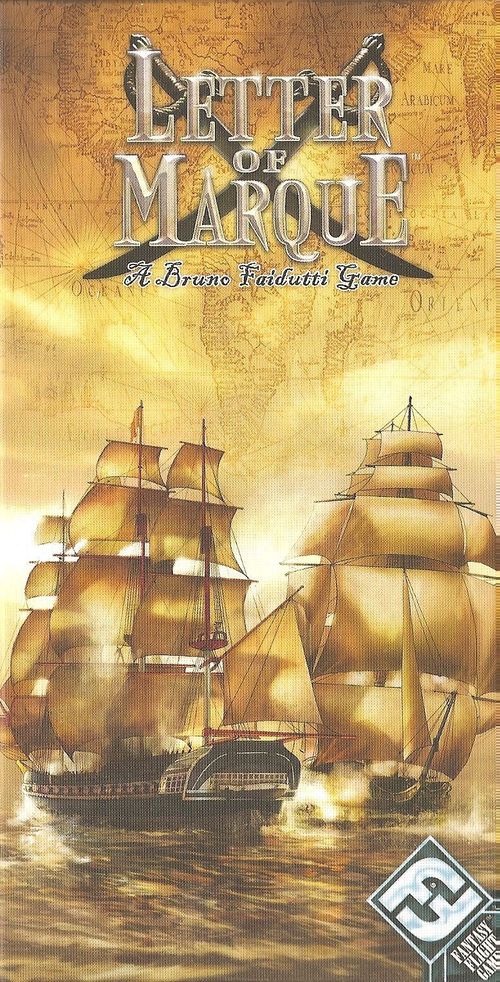
Letter of Marque
Letter of Marque Rulebook
Table of Contents
Table of Contents
Components
- 30 treasure cards, 5 in each player color
- 30 plastic ships, 5 in each player color
- 30 plastic ship bases, 5 in each player color
- 18 cannon cards, 3 in each player color
Overview of the Game
Each player tries to sail his ships across the southern seas without being attacked and captured by his opponents' corsairs, while sending his own corsairs against enemy merchant ships. Players know which ships carry the most wealth, but not which ones are escorted and defended. A corsair will not last long against a heavily defended galleon. The player who scores the most points by stealing his opponent's treasures and successfully defending his own ships wins the game.
Assembly
Each player controls five ships of the same color; along with five ship bases - two with cannon symbols on the bottom, and three without. Each base has two pegs which fit into the two small holes on the bottom of each ship. Before the first game, insert each base into the bottom of a ship that matches the base's color. A base with a cannon symbol indicates that the ship is defended, and a blank base indicates a defenseless ship. Defenses are explained on page 5.
Setting Up the Game
- Each player selects a player color, then takes the five ships, five treasure cards, and three cannon cards in that color.
- Each player then shuffles his five treasure cards and places them facedown in front of him, forming his draw deck.
- Each player then places his three cannon cards and five ships next to his draw deck, making sure to keep the bottoms of the ships hidden from the other players.
Preliminary Turn
Simultaneously, each player draws a card from the top of his treasure deck and places it faceup in the center of the play area. Each player then selects a ship from his reserve pile and places it on top of his faceup treasure card, without letting any other players see the bottom of his ship. The value of the treasure card should be clearly visible. Then the preliminary turn ends.
After the preliminary turn, each player will have a faceup treasure card with a ship on top of it in the center of the play area. A ship with a treasure card placed in the center of the play area is considered at sea. Only the ship's owner knows whether it is armed (marked with the cannon symbol) or defenseless (no symbol).
The player with the lowest value treasure under his ship at sea takes the first regular turn. If two or more players are tied for the lowest treasure value, break ties randomly. Gameplay then proceeds clockwise around the table, with each player taking a turn.
Example
In a four-player game, there are the red, blue, green, and yellow players. At the beginning of the game, every player draws their top treasure card simultaneously. The red player reveals a treasure card with a value of 4, the blue player a 3, the yellow player a 7, and the green player reveals a 5. All players then place their treasure card in the middle of the play area and select a ship to guard their treasure. For example, the yellow player drew a 7 treasure card. Since this is the most valuable card in his treasure deck, yellow secretly chooses an armed ship to place on top of his treasure card. All players then set their selected ship on top of their revealed treasure card. Because the blue player has the lowest treasure value, 3, he has the first turn.
(Diagram caption on the printed page: Ships at sea; labels: Score pile, Cannon cards, Treasure cards, Ship reserves.)
Defenses
A ship base with a cannon symbol indicates the ship is defended, and a blank base indicates a defenseless ship. Each player should keep the bottoms of their ships hidden from the other players. However, players may always look at the bottom of their own ships.
A Player's Turn
During his turn, a player must take one of the following four actions:
- A ship leaves: The player draws the top card from his treasure deck and reveals it. He chooses a ship from his reserve and places it on the treasure card, leaving enough room on the card so that the treasure value is visible to all players. The player then places the new ship and card in the center of the play area. This ship and the attached card are now considered at sea.
- A ship arrives: The player chooses one of his ships at sea. He takes the treasure card from under the ship and places it faceup next to him in his score pile. This treasure card's value will be added to the player's score at the end of the game (See "End of the Game" on page 7). He removes the ship from the game - without revealing whether it is armed or defenseless.
- Attack an opponent's ship: The player uses a cannon card to designate an opponent's ship at sea to attack. The attacked ship is then flipped over and revealed to be armed or defenseless.
- If the ship is armed, the attack fails. The ship is again turned upright and placed back on to its treasure card. The defending player takes the cannon card of the attacking player and places it faceup with his score pile. Opposing players' cannon cards will be added to the defending player's score at the end of the game (See "End of the Game" on page 7).
- If the ship is defenseless, its treasure is captured. The attacking player takes the treasure card, places it in his score pile, and removes his cannon card from the game. The defending ship is removed from the game. A player without cannon cards may not attack another ship.
- Pass: A player who has no more treasure in his deck and no more ships at sea may pass. He is not required to attack an opposing ship.
Example of Play
On the blue player's first turn, he chooses to attack the red player's ship at sea, which is on a 4 treasure card. The blue player designates the ship he is targeting and announces his intention to fire at the red ship with one of his cannon cards. The red player then reveals the bottom of the targeted ship to all players. Red's ship has a cannon symbol on its base - so the ship is armed. The red player then takes the blue player's cannon card and adds it to his own score pile. The red player's ship is placed back on top of its treasure card and remains at sea.
If the red player's ship had been defenseless, the blue player would then have collected the treasure card from below the targeted ship and placed it into his score pile. The red player's ship would then be removed from the game.
End of the Game
The game ends when there are no more ships at sea and no more treasure cards in any players' decks.
Each player adds the value (the listed number) of all treasure cards in his score pile (both his treasures and his opponents' treasures that he captured) to his total number of points. He then adds one point for each opposing player's cannon card in his score pile.
Unused cannon cards are not worth points.
The player with the highest number of points is the winner. If there is a tie, the player with the highest number of cannon cards is the winner. If there is still a tie, players share the win.