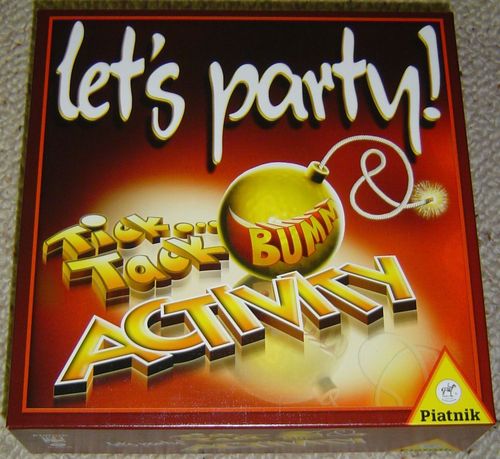
Let's Party!
Let's Party! Rulebook
Table of Contents
Table of Contents
Contents
- 1 game board with 49 spaces, plus a start space and a finish space
- 220 cards, each with 6 Activity terms and 1 Tick Tack Bumm term. Each term is marked with a symbol that shows how it is to be presented. The number in front of a term shows how many spaces a team's game piece may move forward if the task is solved correctly. A term marked in red is an "Open Round".
- 1 electronic timer: the "Bomb". Press the button on its underside to start it. An electronic chip determines the duration at random. The bomb ticks for between 10 and 60 seconds before it ends with an explosion sound, i.e. it "explodes".
- 4 game pieces
- 1 die
- 1 hourglass, running time 1 minute
- 1 rulebook
- Not included, but required: paper and pencil, and 2 AAA batteries, 1.5V (batteries are NOT included)
Game Goal
The goal is to be the first to move your team's game piece to the finish space in the middle of the game board. To do so, teams must solve various Activity or Tick Tack Bumm tasks.
Setup
- Before the first game, insert 2 AAA 1.5V batteries into the bomb. See "Inserting and Replacing the Batteries" at the end of this rulebook.
- Place the game board in the middle of the table.
- Shuffle the cards well and place them as a face-down stack next to the game board.
- Place the die, the hourglass, the bomb, and paper and pencil next to the game board as well.
- The players form several teams of as equal a number of players as possible. Up to 4 teams may take part, and each team must consist of at least 2 players.
- Each team chooses a game piece and places it on the start space of the game board.
- Determine which team begins. That team chooses one player as the first performer. In the following rounds, the players within the team take turns as performer in rotation.
- Decide whether the first or the second term of the same presentation type on the card is to be used.
Gameplay
Play proceeds clockwise. The performer of the first team rolls the die and then draws the top card from the stack, in such a way that the other players cannot read the front of the card. Depending on which symbol the die shows, either an Activity task or a Tick Tack Bumm task must be solved.
Activity Tasks
The performer must convey the term to his team members in the following way:
- Drawing (marked by the drawing symbol, shown on the die and on the card): The term must be drawn with a pencil. The performer may neither speak nor gesture; however, he may signal to his fellow players by nodding that they have correctly guessed part of the term. The drawing may contain neither letters nor numbers.
- Explaining (marked by the explaining symbol, shown on the die and on the card): The term must be described in words. Neither the word itself, nor parts of it, nor derived forms of it may be used.
- Pantomime (marked by the pantomime symbol, shown on the die and on the card): The term must be acted out in pantomime. The performer may neither speak, nor make any sounds, nor use objects in the room or point at them. He may, however, point at his own body parts.
Warning: If a player breaks these rules, his team may not move forward, and the next team takes its turn.
Tip: The terms consist of at least 2 words. As a whole term they are often hard to present. If you present the two parts of the word separately, the task is usually much easier to solve. Example: "Ohrwurm" (earworm) is hard to draw, but "Ohr" (ear) and "Wurm" (worm) can be drawn relatively easily one at a time.
When the performer rolls one of the symbols listed above, he studies the term for about 10 seconds. If the term is not marked in red, and therefore no "Open Round" is being played, he shows the card to the other teams and puts it aside. He then takes the hourglass and turns it over. Each term has a time limit of 1 minute. This is monitored by the players of the opposing teams. They also monitor compliance with the rules. Before the game starts, it should also be agreed how exactly the terms must be guessed, for example whether "Tierfreund" (animal friend) is enough for "Tierliebhaber" (animal lover).
If the team manages to guess the term within the given time, its game piece may move forward as many spaces as the number next to the term indicates. If the term is not guessed, the game piece stays where it is. The next team is then up. The performer determined in that team rolls the die, draws a card, and so on.
Open Round
If the term is marked in red, all players may guess, not just the players of the performer's own team. In this case, the performer may not show the drawn card to anyone. The presentation rules must still be observed! If a player from another team guesses the term, that player's team may move its game piece forward 3 spaces. The performer's team may move forward 2 spaces. If a member of the performer's team guesses the term, that team moves its game piece forward 5 spaces.
Tick Tack Bumm Tasks
If one of the three Tick Tack Bumm symbols is rolled, the task next to the bomb symbol on the card must be solved. There are two different types of Tick Tack Bumm tasks:
1. Letter combinations
If the drawn card shows a letter combination, the meaning of the three different Tick Tack Bumm symbols on the die applies:
- The letter combination must NOT be at the beginning of the word.
- The letter combination may be at any position in the word.
- The letter combination must NOT be at the end of the word.
A word must be named in which the letter combination on the card appears in the way indicated by the die result. Example: ART. Possible words are Karte (card), Artikel (article), Marter (torture), Scharte (notch), Bart (beard), Start (start), etc.
2. Categories
If the card shows no letter combination, but another task such as "in winter", "star sign", "something round", etc., a fitting term for that task must be named. The die result only indicates that a Tick Tack Bumm task must be solved, but specifies nothing further.
Example: The die shows "Tick...", and the card next to the bomb symbol reads "cold drink". Possible answers would be Cola, Fanta, Eistee (iced tea), Mineralwasser (mineral water), Eiskaffee (iced coffee), etc.
A Tick Tack Bumm round proceeds as follows: the player who rolled the die takes the bomb in hand, starts it, and places the card face up on the table where everyone can see it. He must now say a word that fits the task. Immediately after he has said a fitting, valid word, he passes the bomb to a player of the next team clockwise, who in turn must say a new fitting word for the same task before he may pass the bomb on to a player of the next team, and so on.
Note: The next player must take over the ticking bomb immediately as soon as a valid word has been said! Each word may be named only once in the same round. Once a word has been said, it is invalid for the rest of this round. Any player may challenge a word of another player as invalid, for as long as the next player has not yet said a new word. After that, no further challenges are allowed.
The game continues in rotation until the bomb stops ticking and "explodes". Then the Tick Tack Bumm round ends. The team that last named a valid word may move its game piece forward as many spaces as indicated on the card. The team of the player in whose hand the bomb stopped ticking must move its game piece back 2 spaces. Movement backwards may not go beyond the start space. In this case the game piece stays on the start space.
The Last 4 Spaces
As soon as a team's game piece reaches the yellow line, which is the first of the last 4 spaces on the game board, it must be placed there and stay there. From then on, this team may move its game piece only 1 space forward for each task solved, regardless of the number on the card. Even for a Tick Tack Bumm task, the team moves its game piece only 1 space forward.
End of Game
As soon as a team's game piece reaches the finish space, the game ends. That team wins.
Inserting and Replacing the Batteries
The electronic timer works with two 1.5V AAA batteries (not included). Batteries should only be handled by adults and kept out of the reach of children. To replace the batteries, unscrew the screw on the cover of the battery compartment on the underside of the bomb, open the battery compartment, and insert each battery observing the polarity (see diagram). Then place the cover back on the battery compartment and tighten the screw. The safety notes listed here must be observed.
BATTERY SAFETY NOTES:
In exceptional cases, batteries may leak. The leaking fluid can cause burns or destroy the product. To avoid batteries leaking, please observe the following notes:
- Non-rechargeable batteries must not be recharged.
- Removable, rechargeable batteries must always be removed from the product before charging.
- Removable, rechargeable batteries may only be charged under adult supervision.
- Never combine alkaline batteries, standard batteries (zinc-carbon) or rechargeable nickel-cadmium batteries with each other.
- Never insert old and new batteries together (always replace all batteries at the same time).
- Only use batteries of the same or equivalent battery type as recommended.
- Make sure the batteries are inserted in the correct polarity (+/-).
- Always remove old or used batteries from the product.
- The terminals must not be short-circuited.
- Do not throw the product into a fire for disposal. The batteries inside the product may explode or leak.
- Dispose of batteries safely and in accordance with regulations.
- Keep the packaging, as it contains important information!
Warning! Not suitable for children under 36 months. Contains small parts that can be swallowed. Choking hazard. Please keep the address.