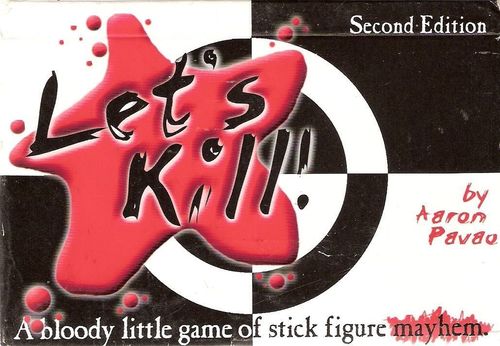
Let's Kill!
Let's Kill! Rulebook
Table of Contents
Table of Contents
Object
The object of the game is to be the first to get to 20 points and then hold that lead while the other players take one last turn. Points are gained by "whacking" the victims represented by the Victim cards by playing Weapon cards on them.
Set Up
This game is designed for three to five players, ages 18 and older, and takes about 30 minutes to play. In addition to this rules sheet, Let's Kill includes two separate decks of 55 cards. Sort them by card back into the Let's Kill deck and the Victims deck. Shuffle both the decks separately and deal five cards from the Let's Kill deck to each player to make their hands. Then deal one Victim card per player from the Victims deck face up into the general play area in the center of the table (if you draw a Location, shuffle it back into the deck), and place both decks face down within reach on the table. A discard pile will also be created during the course of play. Choose a player to go first, using any method on which the players can agree. That player takes a turn, then play progresses to the person on his left.
Game Play
Each player's turn proceeds through three steps: draw and place one Victim card, play one card from your hand, and draw up to five Let's Kill cards.
1. Draw one card from the Victims deck. If the card is a Location, place the card face up in the general play area and draw another Victim card. If the card is a Victim and there is a Location in play where the Victim may be placed, play that Victim face up on the Location; if there is more than one eligible Location in play, you may choose which Location to use. If there are no Locations in play, the Victim is placed by itself face up in the general play area; this represents that the Victim is simply "out on the town."
2. Play one card from your hand. This will be either a Weapon, a Surprise, or an Event card. The specific rules for playing each type of card are given later. Also, instead of playing a card, you may choose to discard your entire hand.
3. Draw cards into your hand from the Let's Kill deck until you have five.
Normally, you'll only need one card, but under some circumstances you may need to draw more than one. This signals the end of your turn, and the player on your left then takes his turn. Continue around the table until you run out of cards or one player declares that he's reached 20 points (see Endgame).
Victim Cards
Victim cards are found in the Victims deck, and have "Victim" written on their face in the bottom left corner. The Victim cards represent each homicidal maniac's potential victims. Each Victim card has a name, an occupation, an illustration, one or more attributes that describe the Victim and interact with other cards in the game (Artsy Fartsy, Tree Hugger, Innocent, Child, Pretentious, Right Wing, Old, Stupid, Student, and Hypocrite), any rules text that applies to the Victim, some color text that has no bearing on the rules of the game, and the number of points the Victim is worth inside a blood splatter icon.
One Victim per turn is drawn from the Victims deck and placed face up on top of a Location in the play area if one is available, or face up by itself in the play area if one is not (see Play, Step 1 for details). Weapons are used to whack victims, at which point the Victim is worth points to the player whose Weapon took it out (see Weapon Cards).
Location Cards
Location cards are also found in the Victims deck, and have "Location" written in the corner as well as being printed sideways. Location cards represent various places around town where murders may happen. Each card has a title, an illustration, any rules text that may apply to that particular Location, and some color text.
Location cards that are drawn from the Victims deck in the process of drawing a Victim card are placed face up in the play area, and Victims are played on top of them. There is no limit to the number of Victims that can be placed on a Location, unless a card specifically says otherwise. When a player whacks one or more Victims at a Location with a Weapon card, that Location becomes part of the Incident (see Weapon Cards); place any surviving Victims that were on that Location into the general play area.
Weapon Cards
Weapon cards are in the Let's Kill deck, and have "Weapon" written in the corner. Each Weapon card represents a tool used by a serial killer in a whacking. Each card has a title, an illustration, one or more attributes that are used to interact with other cards (Gun, Brutal, messy, Explosive, and Sharp & Pointy), some color text, rules text, and a number inside a bomb icon that is called the "body count." The body count of a Weapon card is the maximum number of Victims you may whack when playing the card; you may only whack multiple Victims when they are gathered at a single Location. A Weapon's body count has no bearing on a player's score.
When you play a Weapon card from your hand on your turn, announce which Victims you're whacking. Then take it, along with the Victim cards, any Surprise cards that were underneath those Victims (see Surprise Cards), and the Location if there is one, and place them in a small stack in front of you. This stack is called an Incident, and it is normally worth a number of points equal to the total of the point values of the Victims in it, plus any modifiers from other cards that affect the Incident, including Events (see Event Cards). When resolving an Incident, the effect text of the Victim comes before that of the Location.
Surprise Cards
Surprise cards are also in the Let's Kill deck, and have "Surprise" written in the corner. Surprise cards represent those nifty little things a serial killer finds out about his victim when it's far too late. Surprise cards have a title, an illustration, rules text to follow when the card is revealed, color text, a face icon, and possibly a blood splatter icon that gives a modifier to the Victim on which it's played.
When you play a Surprise card from your hand on your turn, place it face down underneath a Victim in play; it now modifies that Victim. When a player using a Weapon whacks a Victim that has a Surprise card under it, turn the Surprise face up and follow the rules text on the card. Each card has a "happy face" or a "sad face" on it, indicating whether the card has a positive or negative impact on the Incident. Each Victim may only have one Surprise card on it; you may not play a Surprise on a Victim that already has one.
Event Cards
Event cards are found in the Let's Kill deck, and have "Event" written in the corner. Event cards represent happenings that are not covered by other types of cards. Each Event card has a title, an illustration, rules text, color text, perhaps a TV or clock icon, and possibly a blood splatter or bomb icon that gives a modifier to the Incident on which it's played.
When you play an Event card from your hand, simply follow the rules on the card and then add it to the Incident pile (if it affects one) or discard it. In addition to standard Events, which are played on your turn, there are also two Event subtypes: Media Events and Response Events.
An Event card with a TV icon is called a "Media Event," and is played on an Incident (the pile of Victim, Surprise, Location, and Weapon cards in front of a player that's formed after a whacking) during your turn to increase that Incident's score. Each Incident may only have one Media Event played on it.
There are also Event cards with a clock icon, called "Response Events," which you can use during another player's turn in reaction to some action he takes. You may not draw to replace a played Response card until Step 3 of your next turn.
Shootouts
Occasionally, a card in the game will call for a "shootout" against a player. Shootouts represent the long arm of the law closing in on the serial killer. The player affected by the shootout, called the "target," can either win or lose the shootout depending on how many Weapon cards with the Gun attribute he and the other players choose to discard. Follow this procedure:
The target loses the shootout unless he discards at least one Weapon card with the Gun attribute. If he does this, he wins the shootout unless another player or combination of players, in response, discard a number of Guns with a combined body count that's equal to or higher than the target's. The target loses the shootout in this case, unless he can discard another Gun or combination of Guns with a total body count equal to or higher than their total, adding in his previously played Gun(s) to his new total. He can again be countered by another player or combination of players, who add their newly discarded Guns onto their previous total, and so on until no one is willing or able to play another Gun. Cards played in a shootout are not replaced until the end of each player's next turn, and only one shootout can occur per whacking.
Shootout Play Order
Player A: Plays shootout card on Player B.
Player B (target): Discards one or more Guns.
Players A, C, and/or D: Discard Gun(s) equal to or greater than target's Gun(s) total.
Player B (target): Discards one or more Guns, adding these to his previous total to match or beat other players' combined total.
Players A, C, and/or D: Discard Gun(s) that add on to their own old total to match or beat target's new total.
And so on ...
Example of Shootout
Player A: Plays shootout card on Player B.
Player B (target): Discards Nail Gun worth 2, for a total body count of 2.
Players A & C: Discard AK-47 for 3 and .44 Magnum for 2, for a total of 5.
Player B (target): Discards Sawed-Off Shotgun to add 3, for a total of 5.
Players A, C, & D: Unable/unwilling to play more cards.
Player B (target): Wins the shootout!
If a player counters the target by discarding a Gun, he loses that card permanently. If the target wins the shootout, he loses the card(s) he discarded but otherwise play continues as normal. If he loses the shootout, the police have chased the serial killer off, so he must "go into hiding;" the target loses his next turn as well as the card(s) he played. Additionally, any Victims of the attempted whacking that triggered the shootout are returned to their former positions on the play area if the target loses, minus any revealed Surprises.
Endgame
The game can end in three ways: the Let's Kill deck runs out of cards, the Victims deck runs out of cards and there are no Victims in play, or a player declares that he's reached 20 points. In the first case, the game ends when a turn begins and the Let's Kill deck is depleted. In the second case, the game ends when the last Victim leaves play. In either of the first two cases, each player adds up the points in his or her Incidents, and the player with the highest total score wins.
The third case is special. Any player with at least twenty (20) points may, at the end of his turn, declare that he will win at the beginning of his next turn. After this point, each player has one final turn each to try to achieve the highest score. The game ends at the beginning of the declaring player's next turn, and the winner is the player with the highest total points worth of Incidents, even if that's not the player who originally declared a potential victory. If there's a tie, both players win.
Sample Play Area
The printed sheet includes a diagram of a sample play area, labelled: 2 Draw Piles; Discards; Incidents; Permanent; Locations & Victims. It is a layout illustration and is not reproduced here.